
Central Clearing Ccp Waterfall
SEC Exchange Act Rule 15c3-3a Note H: Broker-Dealer Customer U.S. Treasury Margin On-Posting to FICC
Historically, SEC Rule 15c3-3 ("Customer Protection Rule") banned U.S. broker-dealers from posting customer margin onward to FICC—forcing dealers to fund FICC margin out of house cash! Discover how the SEC’s Note H amendment to Rule 15c3-3a unlocked segregated customer Treasury clearing.
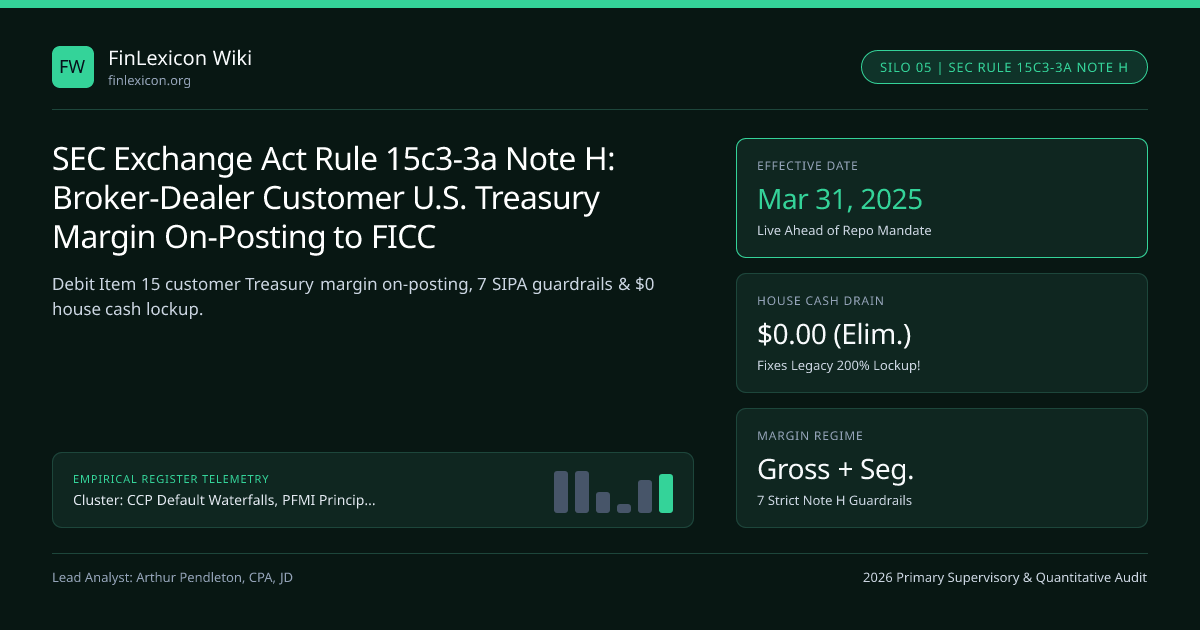
Before March 31, 2025, a bizarre regulatory Catch-22 strangled client U.S. Treasury clearing in America: if Hedge Fund X posted $100 million of margin to its U.S. Broker-Dealer (e.g., BofA Securities) for a cleared Treasury repo, SEC Exchange Act Rule 15c3-3 (`17 CFR § 240.15c3-3`) required the Broker-Dealer to lock that $100M inside its Special Reserve Bank Account (0% rehypothecation to FICC!)—forcing the Broker-Dealer to borrow a SECOND $100M of its OWN house cash to satisfy FICC’s Clearing Fund margin call! The SEC solved that $100B+ liquidity trap by amending Exhibit A (Rule 15c3-3a) to add Note H!
How the Rule 15c3-3a Customer Reserve Formula Worked Before — and Why FICC Was Left Out!#
Under the Securities Investor Protection Act (SIPA) and SEC Rule 15c3-3(e), every carrying U.S. broker-dealer (Bank of America Securities, BNP Paribas Securities Corp, BMO Capital Markets) computes a weekly (or daily, under proposed/final large-BD rules!) Customer Reserve Formula (17 CFR § 240.15c3-3a), anchored in our CCP Default Waterfalls & Central Clearing cornerstone guide:
- Credits (
Items 1–9— What the Broker Owes Customers): Free credit cash balances, cash collateral received from customers, etc. - Debits (
Items 10–14— Permissible Customer-Financing Uses): Margin loans to customers AND margin deposited by the broker-dealer at specific clearing houses (Item 13: OCC for listed options; Item 14: CFTC DCOs / SEC SBS CCPs for futures & security-based swaps!). - Required Lock-Up: If
Total Credits > Total Debits, the broker-dealer must lock100%of the net excess (CashorQualified U.S. Government Securities) inside an untouchable Special Reserve Bank Account for the Exclusive Benefit of Customers!
Spot the Historical Gap: Item 13 and Item 14 listed OCC (options) and CME/ICE (futures/SBS), NEVER DTCC FICC (U.S. Treasuries)! So passing $100M of customer cash/Treasuries to FICC generated a $100M Credit with $0 offsetting Debit—forcing the broker-dealer to fund 200% cash ($100M at FICC + $100M in the Reserve Bank Account)!
Enter Item 15 & Note H (Effective March 31, 2025): The Seven Strict Statutory Conditions#
In SEC Release No. 34-99149, alongside the SEC Rule 17Ad-22(e)(18) Treasury clearing mandate, the SEC created new Debit Item 15 and Note H in Rule 15c3-3a—allowing broker-dealers to include customer cash and U.S. Treasury securities on-posted to FICC (or any qualified Treasury CCA) as a Reserve Formula DEBIT (eliminating the double-funding penalty 100%!) ONLY IF ALL SEVEN strict fiduciary guardrails in Note H are obeyed:
- Customer-Collected Collateral Only: You may only debit margin actually collected from that specific customer for its cleared U.S. Treasury positions (
no using Customer B’s free cash to fund Customer A’s FICC margin—zero cross-customer subsidy!). - Strict Eligible Asset Types: Cash, U.S. Treasury securities, or qualified government securities accepted by FICC.
- Segregated FICC Account (
No House Commingling): Held at FICC in a Segregated Customer Margin Account completely separate from the broker-dealer’s proprietary positions. - Bankruptcy-Remote From FICC Default Mutualization (
0%Default Fund Use!): FICC’s rulebook MUST prohibit using Segregated Customer Margin to mutualize another FICC member’s default or cover the broker-dealer’s proprietary house obligations! - Qualified Custodian / Fedwire Holding: FICC must hold the customer cash/Treasuries at a Federal Reserve Bank (
Section 806(a)) or an eligible Rule 15c3-3 bank (unencumbered by any lien!). - Explicit FICC Per-Customer Gross Margining: FICC calculates customer margin gross per customer (
no netting Customer A’s long against Customer B’s short!). - Written Customer Risk Disclosure & SIPA Protection: ensures that if the broker-dealer enters SIPA liquidation (
supervised by SIPC& Federal Reserve / SEC), customer property returns cleanly!
Why Note H Unlocked Done-Away Treasury Clearing Economics Overnight#
Remember from our FICC Sponsored vs ACM Repo guide why dealers previously refused Done-Away Treasury repo clearing? Without Note H, clearing $20B of hedge-fund Treasury repos required the broker-dealer to drain $450M of its own house liquidity (harming its Basel LCR and NSFR!). With Note H + FICC Segregated Customer Accounts, the hedge fund funds 100% of its own FICC VaR margin (just like futures/swap FCM clearing), reducing broker house liquidity drag to $0.00!
Rule 15c3-3a Reserve Formula Line | Target Clearing House (CCP) | Eligible Asset Class | Permitted Reserve Formula Debit? |
|---|---|---|---|
| Debit Item 13 | Options Clearing Corporation (OCC) | Listed Equity & Index Options | YES (Legacy Rule) |
| Debit Item 14 | CFTC DCOs / SEC SBS CCPs (CME, ICE) | Futures & Security-Based Swaps | YES (Dodd-Frank Rule) |
Legacy FICC (Pre-March 31, 2025) | DTCC FICC (GSD) | U.S. Treasury Cash & Repo | NO (Caused 200% Double-Funding!) |
NEW Debit Item 15 (Note H, Live Mar 2025) | DTCC FICC (& New Treasury CCAs) | Cleared U.S. Treasury Cash & Repo | YES (100% Offset Under 7 Gates!) |
Interplay With Dual-Registered BD / FCM Entities & Daily 15c3-3 Reserve Computations#
In December 2024, the SEC finalized a companion rule requiring large carrying broker-dealers (>=$500M average total credits) to switch their Rule 15c3-3a Reserve Formula calculation from Weekly (Friday) to DAILY—tightening operational treasury precision on Item 15 / Note H debits across the CCP Default Waterfalls & Central Clearing topic hub!
Why Broker-Dealers Still Choose Between Note H Segregation vs Dealer-Funded Margin#
Note H is permissive, NOT mandatory: if an institutional client (such as a 2a-7 MMF or sovereign wealth fund) prefers zero operational margin calls, the broker-dealer can still elect an unsegregated account and fund FICC margin out of house cash (charging +3–8 bps in the all-in repo rate)!
- DebitItem15NoteHFICC = Sum{Clients c} min( MarginCollectedFrom(c) , FICCGrossSegregatedRequirement(c) )
- Broker House Liquidity Saved = DebitItem15NoteHFICC (Eliminates 1-for-1 House HQLA Double-Funding!)
Frequently asked questions
Can a broker-dealer post MORE of Customer A’s free cash to FICC under Note H than FICC actually requires for Customer A?
Strictly NO! Under Note H Condition 1, Item 15 debits are capped for each individual customer at the exact margin required by FICC for that specific customer’s cleared U.S. Treasury positions (preventing a broker from draining Customer B’s excess cash to fund Customer A’s FICC requirement!).
Does FICC pay interest on Customer Cash on-posted into FICC Segregated Customer Margin Accounts under Note H?
Yes! Because FICC deposits qualifying segregated customer cash in its Dodd-Frank Section 806(a) Federal Reserve Bank account (or qualified bank accounts), FICC passes through interest (net of a small administrative fee)—allowing broker-dealers and hedge funds to negotiate transparent margin interest rebates!
Can FICC seize Note H Segregated Customer Margin if ANOTHER clearing bank defaults at FICC?
Never! Note H Condition 4 explicitly prohibits FICC from using Segregated Customer Margin in its mutualized Default Waterfall (or to cover the carrying broker-dealer’s own proprietary FICC obligations), ensuring 0% counterparty exposure RWA under Basel CRE54!
Why did the SEC also mandate DAILY (instead of Weekly) Rule 15c3-3a Reserve calculations for large broker-dealers?
Under the legacy 1972 Friday-only calculation, multi-billion-dollar intraday/mid-week spikes in customer credit balances (especially as trillions of Treasury repos move onto broker ledgers!) could sit un-reserved until the following Tuesday—so in December 2024 (Release 34-101978), the SEC mandated daily Reserve Formula sweeps for carrying broker-dealers above $500M average credits!
Publication record
- Published
- 13 November 2026
- Updated
- 15 November 2026
- Author
- Arthur Pendleton, CPA, JD
- Review
- Review not recorded
- Automated fact check
- Passed in the stored pipeline record
- Source URLs
- 3 recorded
AI assistance recorded: anthropic/claude-opus-4.6. This field does not establish human review or source verification.
Academic & Institutional Attribution
Cite This Research & Embed Live Data Card
Standard academic & institutional research paper citation format.
Arthur Pendleton, CPA, JD. (2026, November 14). SEC Exchange Act Rule 15c3-3a Note H: Broker-Dealer Customer U.S. Treasury Margin On-Posting to FICC. FinLexicon Wiki. https://finlexicon.org/wiki/sec-rule-15c3-3a-note-h-customer-treasury-margin-on-postingRelated Central Clearing Ccp Waterfall & Institutional Briefings
Explore Central Clearing Ccp Waterfall Hub (20) →Central Clearing Ccp Waterfall
CCP Default Waterfalls, CPMI-IOSCO PFMI, VMGH, LSOC Segregation & Treasury Central Clearing GuideCentral Clearing Ccp Waterfall
FICC Capped Contingency Liquidity Facility (CCLF): Cover-1 Repo Liquidity Sizing & Bank LCR ImpactCentral Clearing Ccp Waterfall
CCP Margin Anti-Procyclicality (APC): EMIR RTS Article 28 25% Buffer, 10-Year Stress Weight & Margin FloorsCentral Clearing Ccp Waterfall
CCP Default Management Groups (DMG), Macro Hedging, Auction Juniorization & 2018 Nasdaq LessonsCentral Clearing Ccp Waterfall
Basel III CRE54 Qualifying CCP (QCCP) Capital: 2% vs 4% Client Trade Exposure Risk Weights & K_CCPCentral Clearing Ccp Waterfall
CCP Intraday Variation & Ad-Hoc Margin Calls: Dash-for-Cash Liquidity Spirals & One-Way Pass-ThroughCentral Clearing Ccp Waterfall
Cross-Margining Across Futures & Cleared Fixed Income: CME-FICC Treasury Offsets & Dual BD/FCMsCentral Clearing Ccp Waterfall
CLS Payment-versus-Payment (PvP) FX Settlement: Eliminating Herstatt Risk & 99% Pay-In NettingRegulatory Compliance
Economies are improving, but rule of law is slipping. The buck now stops with Africa’s leaders | Kenneth MohammedPayment Systems
Europe payment market shifts as ECB allows non-bank financial institutions direct settlement -Monetary Policy
Summary of Opinions at the Monetary Policy Meeting on October 29 and 30, 2026Monetary Policy
Bowman, The U.S. Economy and Considerations for Monetary Policy
FinLexicon Wiki Data, Benchmarks & Contributor Records
CC BY 4.0 Open Data
Open Institutional Datasets (CSV / JSON) →
Download desk-compiled quantitative series & schemas.
2026 Reference Matrix
2026 Institutional Benchmarks & Thresholds →
Statutory capital, clearing, margin & rate conventions.
Editorial Records
Authors & Review Records →
View named contributors where those records are available.
Complete Index
Master Research & Dossier Archive →
Browse all published briefings by topic pillar & date.