
Central Clearing Ccp Waterfall
CCP Default Waterfalls, CPMI-IOSCO PFMI, VMGH, LSOC Segregation & Treasury Central Clearing Guide
Post-2008 G20 clearing mandates and SEC Rule 17Ad-22(e)(18) concentrated trillions of interest-rate swaps and U.S. Treasury repos inside systemic Central Counterparties (CCPs)—governed by CPMI-IOSCO PFMI Cover-2 default waterfalls, Skin-in-the-Game, LSOC segregation, and VMGH recovery tools.
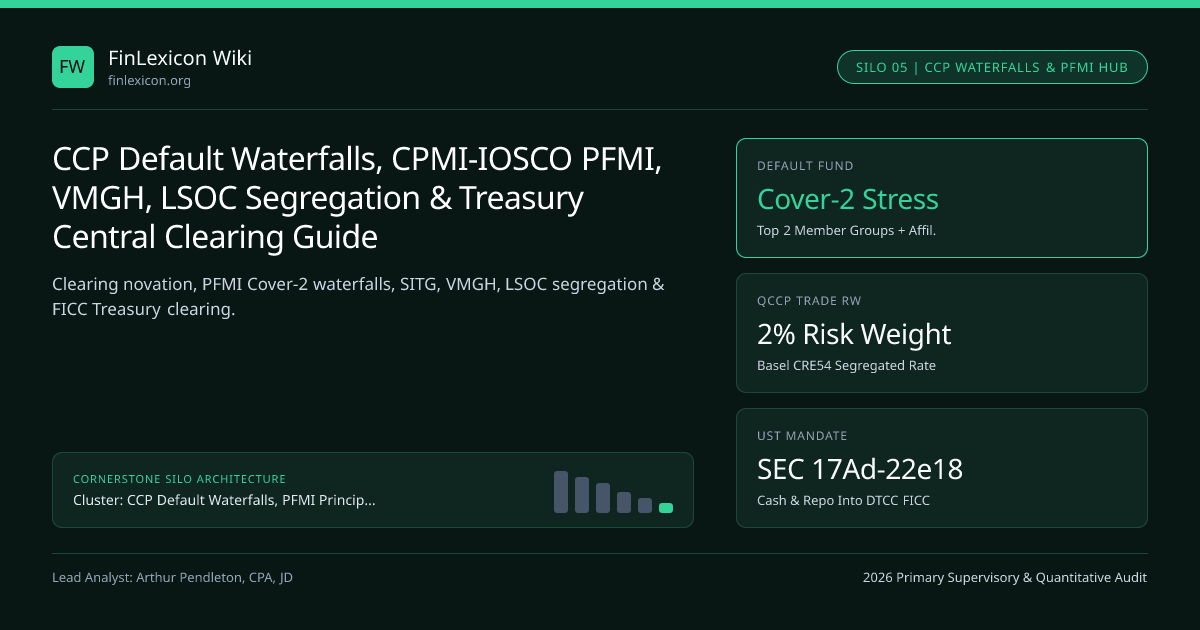
When Lehman Brothers collapsed in September 2008 with over 900,000 derivative contracts, LCH SwapClear neutralized and auctioned Lehman’s $9 trillion notional cleared interest-rate swap portfolio in days using less than 35% of Lehman’s own posted Initial Margin—inflicting $0.00 loss on LCH’s Default Fund or surviving clearing members! Impressed by that resilience, G20 leaders at the 2009 Pittsburgh Summit mandated central clearing for standardized OTC derivatives—and in December 2023, the U.S. SEC extended mandatory central clearing into the $28+ trillion U.S. Treasury cash and repo market (SEC Rule 17Ad-22(e)(18)).
Legal Foundation: Novation vs Open-Offer & Multilateral Compression#
A Central Counterparty (CCP — such as LCH SwapClear, CME Clearing, Eurex Clearing, ICE Clear Credit, or DTCC’s Fixed Income Clearing Corporation [FICC]) interposes itself legally between every buyer and seller via clearing novation or open-offer contract formation plus TriOptima compression. Replacing a tangled web of bilateral exposures among Bank of America, BNP Paribas, Bank of Montreal, and ANZ Bank with a single hub-and-spoke counterparty slashes gross market exposure by 75%–90%—and unlocks Settled-to-Market (`STM`) daily MTM reset plus Basel CRE54 `2%` QCCP trade-exposure risk weights.
Global Supervisory Blueprint: CPMI-IOSCO PFMI Cover-2 Credit & Cover-1/2 Liquidity#
Systemic CCPs supervised by the Bank for International Settlements / BCBS, Federal Reserve, Bank of England, and European Central Bank must satisfy the 2012 CPMI-IOSCO Principles for Financial Market Infrastructures (PFMI). Under PFMI Principles 4 (Credit) and 7 (Liquidity) Cover-2 stress sizing, a systemically important complex CCP sizes its pre-funded Default Fund to survive the simultaneous default of the TWO clearing member groups (plus affiliates) creating the largest combined tail loss above Initial Margin (99.0%–99.7% confidence over a 5-day house / 7-day client MPOR), tempered by EMIR Article 28 anti-procyclicality (`APC`) margin buffers.
Anatomy of the CCP Default Waterfall: Defaulter-Pay, Skin-in-the-Game & Survivor Mutualization#
If a clearing member fails to meet an intraday or end-of-day Variation Margin call, the CCP activates its Default Management Group (`DMG`) hedging and auction juniorization protocol and absorbs losses strictly in the statutory CCP Default Waterfall sequence:
- Defaulter’s Posted Initial Margin (
IM) (Defaulter-Pay Layer 1). - Defaulter’s Default Fund (
DF) Contribution (Defaulter-Pay Layer 2). - CCP First-Loss "Skin-in-the-Game" (
SITG) Equity (calibrated under EMIR 25% minimum capital rules & second-tranche SITG so CCP shareholders hurt before innocent members!). - Surviving Clearing Members’ Pre-Funded Default Fund (
Mutualized Layer). - Capped Unfunded Assessment Cash Calls (1x–2x DF refill limits).
- End-of-Waterfall Recovery & Resolution Tools: Variation Margin Gains Haircutting (`VMGH`), Partial Tear-Up, and statutory resolution powers under EU CCPRRR (2021/23) and Dodd-Frank Title VIII!
Client Clearing Protection: U.S. CFTC Part 22 LSOC vs EU EMIR OSA / ISA#
How is an asset manager’s or pension fund’s posted Initial Margin protected if either a fellow client blows up ("Fellow-Customer Risk") or its Clearing Broker / FCM defaults? Compare U.S. CFTC Part 22 Legally Segregated Operationally Commingled (`LSOC`) against EU EMIR Art. 39 Omnibus (`OSA`) and Individual (`ISA`) segregation—and see how CME-FICC cross-margining programs slash Treasury futures vs cash bond margin.
The U.S. Treasury Central Clearing Revolution: SEC Rule 17Ad-22(e)(18), Sponsored Repo, Note H & CCLF#
Under the SEC Rule 17Ad-22(e)(18) U.S. Treasury Central Clearing Mandate (detailed implementation timeline & exemptions), eligible secondary-market U.S. Treasury cash and repo trades migrate into DTCC FICC Government Securities Division (GSD), powered by three interlocking institutional plumbing pillars:
- FICC Sponsored Member Repo (`Done-With` vs `Done-Away`) (benchmark standard), unlocking
ASC 210-20dealer balance-sheet netting. - SEC Rule 15c3-3a Note H Customer Margin On-Posting (benchmark standard / entity standard), letting broker-dealers rehypothecate customer Treasury margin onward to FICC without locking up house cash.
- FICC Capped Contingency Liquidity Facility (`CCLF`) (entity standard), sizing Cover-1 committed repo liquidity alongside CLS Payment-versus-Payment (`PvP`) FX settlement across the CCP Default Waterfalls & Central Clearing topic hub.
| Systemic Clearing House / FMI | Primary Cleared Asset Classes | Supervisory Lead Regulator(s) | Cover Standard & Key Liquidity / Margin Mechanism |
|---|---|---|---|
LCH Ltd (SwapClear / RepoClear) | Global IRS (>90% cleared OIS), EUR/GBP Repo | Bank of England, CFTC, ESMA Tier 2 | Cover-2 DF; 5d/7d Expected Shortfall + intraday VM |
DTCC FICC (GSD & MBSD) | U.S. Treasury Cash, Sponsored Repo & Agency MBS | U.S. SEC & Federal Reserve (Title VIII SIFMU) | Cover-1 / Cover-2 + mandatory member CCLF repo backstop |
| CME Clearing | SOFR/Treasury Futures, Cleared IRS, FX | U.S. CFTC & Federal Reserve | Cover-2 DF; SPAN 2 / VaR + FICC Cross-Margining |
| Eurex Clearing | EUR IRS, Bund/Bobl/Schatz Futures, Repo | BaFin, Bundesbank, ECB, ESMA | Cover-2 DF; ECB Eurosystem central-bank access + Prisma |
| CLS Bank International | 18-Currency Wholesale FX Settlement (PvP, not CCP) | Federal Reserve & Global Central Bank College | Eliminates Herstatt principal risk w/ ~99% pay-in funding netting |
Systemic Interdependence: Linking CCP Waterfalls to Bank Capital (K_CCP) & Liquidity (LCR)#
Because G-SIBs simultaneously act as Direct Clearing Members, Client Clearing Brokers (FCMs), Custodian Settlement Banks, and Committed Liquidity Providers, CCP margin calls and default fund exposures feed directly into Basel CRE54 capital, G-SIB interconnectedness scores, and 30-day LCR liquidity stress outflows.
- SurvivorLossAllocationk = max( 0 , RealizedCloseOutLoss - IMDef - DFDef - SITGCCP ) * ( DFSurvivork / Sum{m != Def} DFm )
- Basel CRE54 Segregated Client Cleared Trade Exposure RWA:
- RWAClientQCCP = 0.02 (2% Risk Weight) * EAD_SACCR( MPOR = 5 business days ; Alpha = 1.4 ) [vs 20%–100% Bilateral Counterparty RW!]
Frequently asked questions
Has a major clearing house Default Fund ever actually been breached by a member default in modern history?
Rarely, and almost always without hitting end-of-waterfall tear-ups! Lehman Brothers (2008) didn’t even exhaust its own Initial Margin at LCH or CME. However, KRX Korea Exchange (2013 HanMag options bug) and Nasdaq Clearing Commodities (2018 Einar Aas Nordic power spread blowout) *did* pierce defaulter IM + SITG and burn EUR 107M (~68%) of surviving members’ mutualized Default Fund—triggering global DMG reforms!
Why are cleared swaps at a QCCP exempt from Basel III MAR50 Credit Valuation Adjustment (CVA) capital?
Basel MAR50.5 exempts transactions with a Qualifying Central Counterparty (QCCP) from CVA RWA because daily/intraday cash Variation Margin (STM), 99%+ Initial Margin, and Cover-2 Default Funds eliminate bilateral credit-spread MTM drift (replacing CVA RWA with the tiny 2% CRE54 trade exposure + K_CCP DF charge)!
What is the difference between a Qualifying CCP (QCCP) and a Non-Qualifying CCP under Basel CRE54?
A QCCP is licensed and supervised in a jurisdiction that implements CPMI-IOSCO PFMI domestically and publishes quarterly K_CCP hypothetical capital parameters (earning a 2% trade exposure RW). Losing QCCP status triggers a nuclear capital cliff: bilateral Standardized risk weights (20%–100%) on trades PLUS a punitive 1,250% risk weight (100% capital deduction equivalent!) on Default Fund contributions!
Why isn’t CLS Bank considered a Central Counterparty (CCP) even though it settles $6.5+ trillion of FX daily?
Because CLS Bank does NOT novate FX trades or guarantee performance if a member defaults before pay-in! Instead, CLS operates a Payment-versus-Payment (PvP) settlement system: if Bank A fails to pay JPY, CLS simply returns Bank B’s USD principal intact (eliminating Herstatt principal loss, while leaving replacement market-rate MTM risk bilateral).
Publication record
- Published
- 15 November 2026
- Updated
- 15 November 2026
- Author
- Arthur Pendleton, CPA, JD
- Review
- Review not recorded
- Automated fact check
- Passed in the stored pipeline record
- Source URLs
- 4 recorded
AI assistance recorded: anthropic/claude-opus-4.6. This field does not establish human review or source verification.
Academic & Institutional Attribution
Cite This Research & Embed Live Data Card
Standard academic & institutional research paper citation format.
Arthur Pendleton, CPA, JD. (2026, November 14). CCP Default Waterfalls, CPMI-IOSCO PFMI, VMGH, LSOC Segregation & Treasury Central Clearing Guide. FinLexicon Wiki. https://finlexicon.org/wiki/ccp-default-waterfalls-pfmi-vmgh-clearing-novation-guideRelated Central Clearing Ccp Waterfall & Institutional Briefings
Explore Central Clearing Ccp Waterfall Hub (20) →Central Clearing Ccp Waterfall
Clearing Novation vs Open-Offer Mechanics, Multilateral Netting & TriOptima Portfolio CompressionCentral Clearing Ccp Waterfall
CPMI-IOSCO PFMI Principles 4 & 7: Cover-2 Credit Default Fund vs Cover-1 / Cover-2 Liquidity SizingCentral Clearing Ccp Waterfall
CCP Default Waterfall Tranches: Defaulter-Pay IM/DF, Skin-in-the-Game & Survivor MutualizationCentral Clearing Ccp Waterfall
CCP Skin-in-the-Game (SITG): EMIR 25% Minimum Capital Rule, Second-Tranche SITG & Incentive AlignmentCentral Clearing Ccp Waterfall
Variation Margin Gains Haircutting (VMGH), Partial Tear-Up & End-of-Waterfall CCP Recovery ToolsCentral Clearing Ccp Waterfall
Client Clearing Segregation: US CFTC Part 22 LSOC vs EU EMIR Article 39 Omnibus (OSA) & Individual (ISA)Central Clearing Ccp Waterfall
SEC Rule 17Ad-22(e)(18) U.S. Treasury Cash & Repo Central Clearing Mandate: Scope, Deadlines & FICC ImpactCentral Clearing Ccp Waterfall
FICC Sponsored Member Repo: Done-With vs Done-Away Execution, ASC 210-20 Netting & SLR ReliefBasel Iii Endgame Capital Ratios
BCBS d424 72.5% Standardized RWA Output Floor: Phase-In Mechanics & Capital ImpactMarket Insights
Starch Derivatives Market Forecast to 2035, Driven by Clean-Label Demand and Bio-Based Industrial Shift - IndexBoxMarket Insights
Diesel (Derivatives) Analytics: Price Dynamics, Quarterly Returns, and Annual Price Changes in USD - CryptoRankBasel Iii Endgame Capital Ratios
CET1 Regulatory Deductions (CAP30): Goodwill, DTAs, MSRs & the 10%/15% Threshold Rule
FinLexicon Wiki Data, Benchmarks & Contributor Records
CC BY 4.0 Open Data
Open Institutional Datasets (CSV / JSON) →
Download desk-compiled quantitative series & schemas.
2026 Reference Matrix
2026 Institutional Benchmarks & Thresholds →
Statutory capital, clearing, margin & rate conventions.
Editorial Records
Authors & Review Records →
View named contributors where those records are available.
Complete Index
Master Research & Dossier Archive →
Browse all published briefings by topic pillar & date.