
Central Clearing Ccp Waterfall
CPMI-IOSCO PFMI Principles 4 & 7: Cover-2 Credit Default Fund vs Cover-1 / Cover-2 Liquidity Sizing
Solvency ("Credit Cover-2") and same-day cash settlement ("Liquidity Cover-1 / Cover-2") are completely distinct CCP survival constraints under CPMI-IOSCO PFMI Principles 4 and 7—especially when a defaulting G-SIB simultaneously acts as a CCP’s custodian, repo provider, and FX swap line!
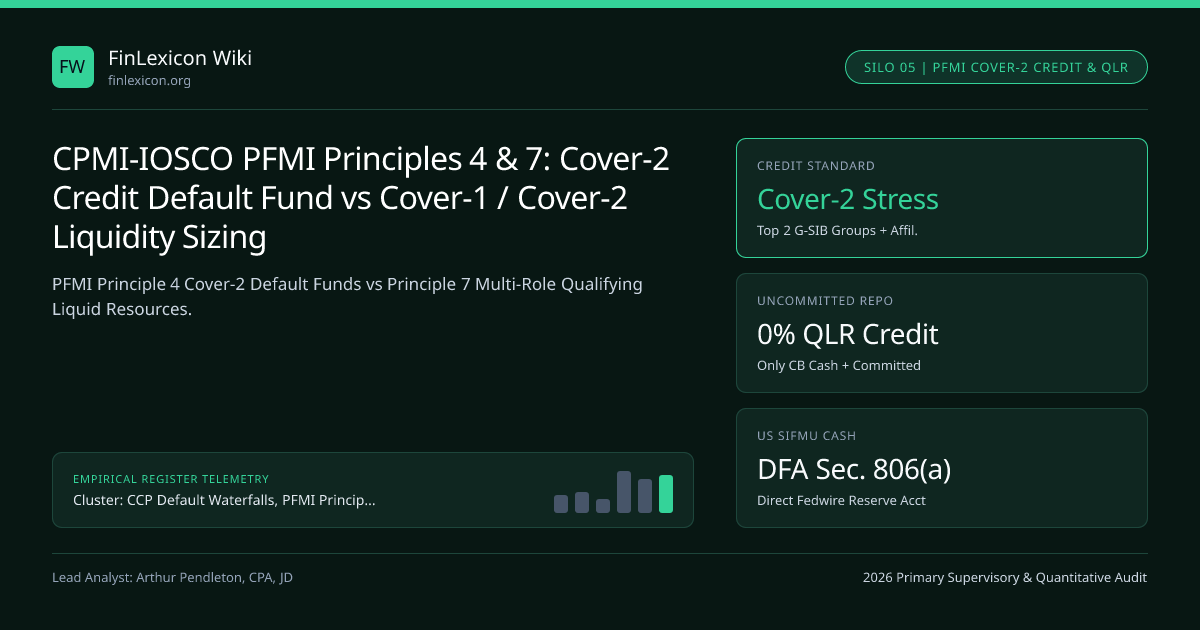
Suppose a clearing house holds $15 billion of 10-year U.S. Treasury bonds posted as Initial Margin and Default Fund contributions when its largest clearing member defaults at 8:30 AM: the CCP may be 100% solvent under Principle 4 (Credit), yet if it owes $9 billion in same-day cash Variation Margin or securities settlement pay-outs by 2:00 PM and cannot convert those Treasury bonds into cash in 4 hours, the CCP itself defaults on Principle 7 (Liquidity)! CPMI-IOSCO’s 2012 Principles for Financial Market Infrastructures (PFMI) draw a razor-sharp boundary between Credit Sizing (Principle 4) and Qualifying Liquid Resources (Principle 7).
PFMI Principle 4 (Credit Risk): When Is Cover-2 Mandatory vs Cover-1?#
Supervised globally by the BIS / BCBS-CPMI, Federal Reserve, Bank of England, and ECB, PFMI Principle 4 requires every CCP to maintain pre-funded financial resources (Initial Margin + Skin-in-the-Game + Mutualized Default Fund) covering tail credit losses under "extreme but plausible" historical and hypothetical stress scenarios, anchored in our CCP Default Waterfalls & Central Clearing cornerstone guide:
Cover-1Minimum Baseline: Default of the single participant (plus all corporate affiliates!) generating the largest aggregate credit exposure above Initial Margin.Cover-2Systemic Mandate: Mandatory for any CCP that is (a) involved in activities with a more-complex risk profile (e.g., CDS with jump-to-default, long-dated swaps, options) OR (b) systemically important in multiple jurisdictions! Under EU EMIR Article 42(3) and CFTC Rule 39.33(a) (Subpart C SIDCOs), virtually ALL major derivatives CCPs (LCH, CME, Eurex, ICE) are strictly locked intoCover-2Credit sizing (simultaneous default of the Top 2 Clearing Member Groups + all affiliates on every single business day!).
PFMI Principle 7 (Liquidity Risk): Multi-Role G-SIB Contagion & Qualifying Liquid Resources (QLR)#
Now watch why PFMI Principle 7 (Liquidity) is often harder to pass than Principle 4 (Credit)! Suppose Bank of America or BNP Paribas is one of the defaulting clearing member groups in the daily stress test. Principle 7 mandates Multi-Role Role-Aggregation ("Wrong-Way Liquidity"):
- In that exact same stress scenario, you MUST assume the defaulting G-SIB simultaneously fails across EVERY operational role it plays for the CCP: (1) Direct Clearing Member, (2) Client Clearing FCM, (3) Committed Liquidity / Repo Line Provider, (4) FX Swap Counterparty, AND (5) Commercial Settlement / Custodian Bank!
- What Counts as "Qualifying Liquid Resources" (
QLR, PFMI Key Consideration 7.5 / CFTC Rule 39.33(c))?
- Cash deposited at the central bank of issue (
gold standard — e.g., Eurex at ECB, LCH Ltd at BoE, CME SIDCO Fedwire account under Dodd-Frank Section 806(a)!). - Cash at creditworthy commercial banks (
subject to strict concentration caps & zero credit for the defaulting G-SIB!). - Pre-arranged, highly reliable committed lines of credit, committed FX swaps, and committed repo facilities (
such asFICC’s Capped Contingency Liquidity Facility (`CCLF`))—NEVER uncommitted market repo assumptions!
Why Physical-Settlement Securities & Repo CCPs (FICC) Face Giant Liquidity Multiples vs Cash-Settled IRS CCPs#
Compare $100 billion of cleared interest-rate swaps at LCH SwapClear against $100 billion of cleared overnight Treasury repos at DTCC FICC:
- On SwapClear, if Member A defaults, LCH only has to pay surviving members the 1-day net Variation Margin change (
e.g., 1.2% = $1.2 billion cash/day) while auctioning the book. - On FICC (
Physical Delivery-versus-Payment), if a huge net Treasury repo borrower defaults, FICC must pay100% of Principal Cash(e.g., $40B–$65B+same-day cash!) to take delivery of the Treasury bonds from surviving sellers—explaining why FICC’s `Cover-1` CCLF exceeds$100+ billion!
| Regulatory Regime | Credit Stress Standard (PFMI P4) | Liquidity Stress Standard (PFMI P7) | Central Bank Cash & Repo Access for CCPs |
|---|---|---|---|
EU EMIR (Art. 42 & Art. 44) | Cover-2 for ALL EU CCPs (even small ones!) | Cover-2 Liquidity (Top 2 members across all roles!) | Full Eurosystem deposit & repo access (Eurex / LCH SA bank licenses) |
U.S. CFTC (Subpart C SIDCOs) | Cover-2 (CME, ICE Clear Credit, LCH) | Cover-1 min (Cover-2 supervisory best practice) | Dodd-Frank Sec. 806(a) Fedwire interest-bearing cash deposit (limited emergency discount) |
U.S. SEC (Covered Clearing — FICC / NSCC / OCC) | Cover-1 (FICC/NSCC) or Cover-2 (complex/multi-jurisd.) | Cover-1 multi-role (backed by $100B+ mandatory CCLF!) | Fedwire cash deposit account (SIFMU); relies on member CCLF for repo monetization |
UK Bank of England (Systemic Tier) | Cover-2 | Cover-2 Liquidity | Direct Bank of England Sterling central-bank reserve & liquidity facilities |
Daily Cover-2 Reverse Stress Testing & Supervisory Multi-CCP Fire Drills#
Under CPMI-IOSCO 2017 Supervisory Stress Testing (SST) frameworks, ESMA, the Bank of England, CFTC, and Federal Reserve run multi-CCP simultaneous Cover-2 fire drills—testing whether liquidating $40B of sovereign collateral simultaneously across LCH, Eurex, and CME breaches market depth across the CCP Default Waterfalls & Central Clearing topic hub!
Allocating Dynamic Cover-2 Default Fund Add-Ons (Stress-Over-IM) to Members#
Each month (or intraday via Cover-2 Margin Breach Add-Ons!), CCPs allocate the 6-tranche CCP Default Waterfall across members proportional to Initial Margin or stressed-tail usage—automatically slapping a bilateral Concentration / Super-Margin Add-On onto any single member whose tail loss starts dominating the mutualized pool!
- PFMIP7LiquidityQLR : CashCentralBank + CommittedRepoSurviving(s) >= PeakCumulativeCashOutflow( DefaultersAll_Roles , s )
- Multi-Role Contagion Strip (When G-SIB Group g is Defaulted in Scenario s):
- AvailableQLR(g , s) = TotalQLR - CommercialDepositsAt(g) - CommittedRepoLineFrom(g) - CommittedFXSwapFrom(g)
Frequently asked questions
Why does EU EMIR mandate Cover-2 for ALL CCPs (both Credit and Liquidity), whereas PFMI allows Cover-1 for simpler domestic CCPs?
When drafting EMIR (Regulation 648/2012, Articles 42 & 44), EU lawmakers eliminated discretionary supervisory carve-outs across the Single Market—imposing a uniform Cover-2 floor on both Credit Default Funds and Liquidity Resources for every EU-authorized CCP regardless of asset class!
What does Dodd-Frank Section 806(a) give U.S. Systemically Important Financial Market Utilities (SIFMUs) like CME and FICC?
Designated under Dodd-Frank Title VIII, U.S. SIFMUs (CME, ICE Clear Credit, OCC, FICC, NSCC, DTC, CLS) hold interest-bearing cash accounts directly at Federal Reserve Banks under Section 806(a)—eliminating commercial custody credit risk! However, Section 806(b) Fed emergency lending applies only in "unusual and exigent circumstances", so U.S. SIFMUs cannot count Fed lending inside routine QLR!
Why do Eurex Clearing and LCH SA hold full European banking licenses when CME and LCH Ltd do not?
Holding a Continental European credit-institution (banking) license (Eurex Clearing AG in Germany; LCH SA in France) grants routine overnight standing access to ECB Eurosystem central-bank refinancing operations against eligible bond collateral—simplifying Principle 7 Cover-2 EUR liquidity enormously!
What is a "Cover-2 Concentration / Stress Add-On" Margin Call?
If one massive clearing member builds an outsized directional position whose stressed tail loss (Stress - IM) starts driving the entire CCP’s Cover-2 Default Fund upward (unfairly forcing 80 other members to post more mutualized DF!), modern CCP rulebooks convert that excess tail exposure into a Defaulter-Pay Stress Initial Margin Add-On billed directly to that single member!
Publication record
- Published
- 13 November 2026
- Updated
- 15 November 2026
- Author
- Arthur Pendleton, CPA, JD
- Review
- Review not recorded
- Automated fact check
- Passed in the stored pipeline record
- Source URLs
- 3 recorded
AI assistance recorded: anthropic/claude-opus-4.6. This field does not establish human review or source verification.
Academic & Institutional Attribution
Cite This Research & Embed Live Data Card
Standard academic & institutional research paper citation format.
Arthur Pendleton, CPA, JD. (2026, November 14). CPMI-IOSCO PFMI Principles 4 & 7: Cover-2 Credit Default Fund vs Cover-1 / Cover-2 Liquidity Sizing. FinLexicon Wiki. https://finlexicon.org/wiki/cpmi-iosco-pfmi-cover-2-credit-cover-1-liquidity-stress-sizingRelated Central Clearing Ccp Waterfall & Institutional Briefings
Explore Central Clearing Ccp Waterfall Hub (20) →Central Clearing Ccp Waterfall
CCP Default Waterfalls, CPMI-IOSCO PFMI, VMGH, LSOC Segregation & Treasury Central Clearing GuideCentral Clearing Ccp Waterfall
CCP Default Waterfall Tranches: Defaulter-Pay IM/DF, Skin-in-the-Game & Survivor MutualizationCentral Clearing Ccp Waterfall
CCP Skin-in-the-Game (SITG): EMIR 25% Minimum Capital Rule, Second-Tranche SITG & Incentive AlignmentCentral Clearing Ccp Waterfall
Variation Margin Gains Haircutting (VMGH), Partial Tear-Up & End-of-Waterfall CCP Recovery ToolsCentral Clearing Ccp Waterfall
Client Clearing Segregation: US CFTC Part 22 LSOC vs EU EMIR Article 39 Omnibus (OSA) & Individual (ISA)Central Clearing Ccp Waterfall
SEC Rule 17Ad-22(e)(18) U.S. Treasury Cash & Repo Central Clearing Mandate: Scope, Deadlines & FICC ImpactCentral Clearing Ccp Waterfall
FICC Sponsored Member Repo: Done-With vs Done-Away Execution, ASC 210-20 Netting & SLR ReliefCentral Clearing Ccp Waterfall
SEC Exchange Act Rule 15c3-3a Note H: Broker-Dealer Customer U.S. Treasury Margin On-Posting to FICCCryptocurrency News
Tether Gold Gets Clean KPMG Audit Confirming $2.2B in Physical Gold BackingRegulatory and Market Glossary
Are Alt-L1s over? Security, costs drive smaller chains to EthereumRegulatory Compliance
Water industry bonus ban to be tightened as Ofwat warns of ‘damage to public trust’Market Insights
Nomura's head of crypto derivatives trading swaps Dubai for a prop trading firm in Singapore - eFinancialCareers
FinLexicon Wiki Data, Benchmarks & Contributor Records
CC BY 4.0 Open Data
Open Institutional Datasets (CSV / JSON) →
Download desk-compiled quantitative series & schemas.
2026 Reference Matrix
2026 Institutional Benchmarks & Thresholds →
Statutory capital, clearing, margin & rate conventions.
Editorial Records
Authors & Review Records →
View named contributors where those records are available.
Complete Index
Master Research & Dossier Archive →
Browse all published briefings by topic pillar & date.