
Central Clearing Ccp Waterfall
CCP Default Waterfall Tranches: Defaulter-Pay IM/DF, Skin-in-the-Game & Survivor Mutualization
Every systemic clearing house encodes a strict statutory waterfall balancing "Defaulter-Pay" collateral against "Survivor-Pay" mutualization—making tranche thickness, siloed asset-class firewalls (IRS vs FX vs CDS), and auction juniorization critical for G-SIB risk managers.
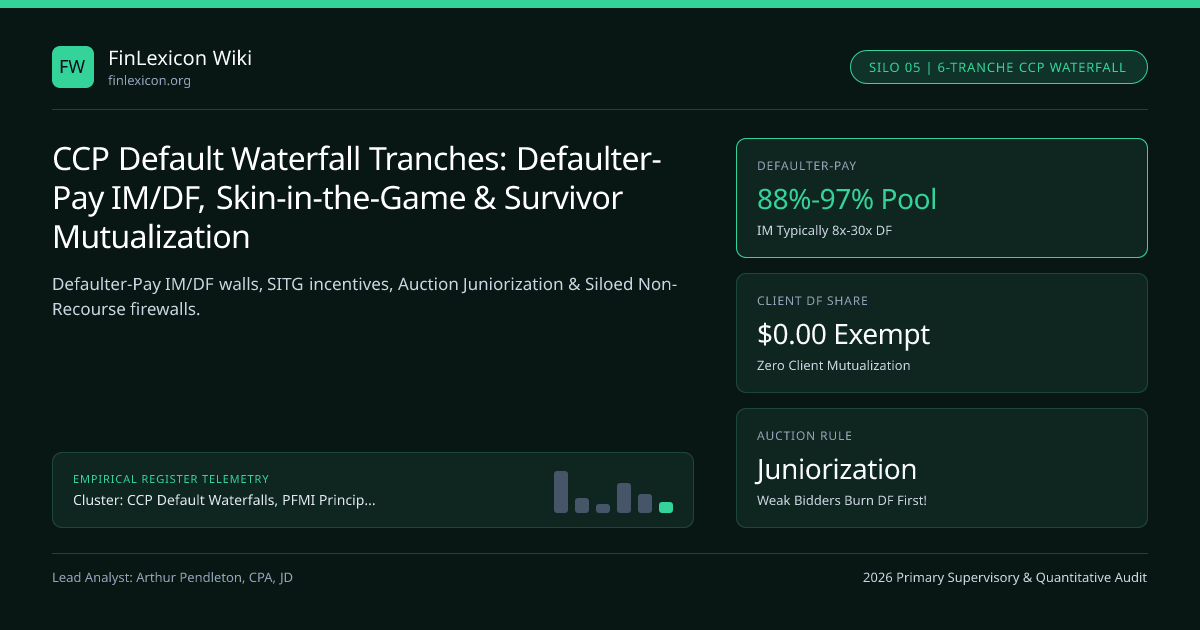
When a clearing bank evaluates joining a Central Counterparty (CCP), its Chief Risk Officer asks two immediate structural questions: "How thick is the Defaulter-Pay wall before my bank’s mutualized Default Fund contribution can be touched—and can a blowup in Nordic power or crypto futures ever raid our Interest-Rate Swap Default Fund?" Answering both requires dissecting the six-tranche CCP Default Waterfall and Compartmentalized (Siloed) vs Combined Default Fund architectures!
Layer-by-Layer Statutory Priority Across the Six Default Waterfall Tranches#
Codified under EU EMIR Article 45, UK PRA/BoE CCP Rules, and U.S. CFTC Rule 39.11 / SEC Rule 17Ad-22(e)(4), losses exceeding a defaulting clearing member’s unpaid Variation Margin are absorbed strictly in sequential order, anchored in our CCP Default Waterfalls & Central Clearing cornerstone guide:
- Tranche 1 — Defaulter’s House Initial Margin (
IM): Sized to99.0%–99.7%confidence (PLUS any concentration, liquidity, and Cover-2 stress add-ons). Crucial firewall: Segregated Client Initial Margin can NEVER be used to cover a House (Proprietary) default (and House IM can optionally flow to help a client shortfall, never the reverse!). - Tranche 2 — Defaulter’s Own Pre-Funded Default Fund (
DF) Contribution: All Default Fund collateral posted by the defaulting member across its house membership. - Tranche 3 — CCP Dedicated First-Loss "Skin-in-the-Game" (
SITG): Shareholder equity committed by the CCP operator (minimum 25% of EMIR regulatory capital, analyzed in depth in our SITG guide)—wiped out BEFORE a single dollar of innocent surviving members’ money is touched! - Tranche 4 — Surviving Clearing Members’ Pre-Funded Default Fund (
Mutualized Pool): Allocated pro-rata (DF_k / Sum DF_survivors)—EXCEPT that any surviving dealer submitting a weak/non-competitive bid in the DMG liquidation auction gets "Juniorized" (losing 100% of its DF slice BEFORE competitive bidders lose a dime!). - Tranche 5 — CCP Second-Tranche SITG (Under EU CCPRRR Art. 9(14)) + Capped Member Assessments: Under EU CCPRRR, CCPs commit a second SITG slice (
10%–25%of risk-based capital) alongside capped unfunded member cash-call assessments (`1x–2x` DF). - Tranche 6 — End-of-Waterfall Recovery (
VMGH& Partial Tear-Up): Variation Margin Gains Haircutting (`VMGH`) on cumulative net winners before statutory resolution.
Siloed (Service-Compartmentalized) Waterfalls vs Combined (Single-Pool) Waterfalls#
Major multi-asset clearing houses (LCH, CME, ICE) face a fundamental design trade-off scrutinized by Bank of America, BNP Paribas, and Bank of Montreal:
- Compartmentalized / Siloed Default Funds (
LCH SwapClearvsForexClearvsRepoClearvsCDSClear;CME BasevsIRS): - Each clearing service maintains its own legally ring-fenced Default Fund, SITG slice, Assessment cap, and Tear-Up boundary! A rates-only bank clearing at
LCH SwapClearhas ZERO mutualized exposure to a sovereign CDS jump-to-default atCDSClear—and ifForexClearhypothetically suffered an unrecoverable catastrophe,SwapClearcannot be dragged down (Limited Recourse / Non-Petitionclauses protect the CCP’s corporate survival!). - Combined / Integrated Default Fund (
Eurex Clearing Integrated DF): - Pools equity derivatives, fixed-income futures, and OTC IRS into a single larger Default Fund (
maximizing cross-product portfolio diversification), while using product-specific liquidation group tranches (auction juniorization by liquidation group) so members active in the defaulted asset class absorb losses ahead of inactive members!
| Waterfall Tranche | Who Funds It? | Economic Incentive Role | Basel CRE54 Capital Treatment for Bank Member |
|---|---|---|---|
| 1. Defaulter House IM | Defaulting Member (99%+ ES) | Primary Defaulter-Pay risk internalization | 0% counterparty RW if bankruptcy-remote |
| 2. Defaulter DF | Defaulting Member | Absorbs member’s own stressed tail | N/A (already defaulted) |
| 3. CCP First-Loss SITG | CCP Shareholders | Prevents CCP under-margining moral hazard | Reduces K_CCP hypothetical capital |
| 4. Survivors’ Pre-Funded DF | Surviving Clearing Members | Cover-2 Mutualization (+ Auction Juniorization) | Risk-weighted via K_CCP formula (2% floor) |
| 5. Unfunded Assessments | Surviving Clearing Members | Replenishes waterfall (capped at 1x–2x DF) | 0% RWA until called (if capped & QCCP) |
| 6. VMGH / Partial Tear-Up | In-the-Money Winners (House + Client) | Prevents disorderly CCP insolvency | Tail recovery risk in resolution playbooks |
Calibrating the Optimal Defaulter-Pay vs Survivor-Pay Ratio (~85:15 to 92:8)#
Across global CCPs supervised by the Bank of England, ECB, and Federal Reserve, total posted Initial Margin (Defaulter-Pay) is typically 8x to 14x larger than the Mutualized Default Fund (Survivor-Pay) (e.g., LCH SwapClear holds ~$230B+ in Initial Margin vs ~$7B–$8B in its SwapClear Default Fund). Why? Because overly cheap IM paired with a bloated Default Fund subsidizes reckless directional traders at the expense of conservative peers (as proved in the 2018 Nasdaq Clearing EUR 107M Default Fund wipeout!).
Why Client Segregated Collateral Never Enters the Mutualized Default Waterfall#
Clients (pension funds, insurers, hedge funds) post Initial Margin, NEVER Default Fund contributions—so client collateral is 100% immune from clearing-member mutualization across the CCP Default Waterfalls & Central Clearing topic hub (though client unrealized gains can face end-of-waterfall VMGH if waterfall tranches 1–5 are 100% exhausted!).
Pillar 3 CCP Quantitative Public Disclosures (CPMI-IOSCO PQD)#
Every quarter, all QCCPs publish standardized CPMI-IOSCO Public Quantitative Disclosures (PQDs — over 200 data fields!), letting bank credit committees track IM-to-DF ratios, K_CCP, Cover-2 breach counts, and 99% backtesting exceptions.
- Three-Tier Auction Juniorization Allocation of ResidualMutualizedLoss (Tranches: NonBidders -> WeakBidders -> WinningBidders):
- 1. LossNonBidders = min( ResidualMutualizedLoss , Sum{k in NonBidders} DF_k )
- 2. LossWeakBidders = min( max(0 , Residual - LossNonBidders) , Sum{k in WeakBidders} DFk )
- 3. LossWinners = min( max(0 , Residual - LossNon - LossWeak) , Sum{k in Winners} DF_k ) [Rewards Aggressive Bids!]
Frequently asked questions
Can a CCP use Excess House Initial Margin to cure a shortfall in that SAME defaulting member’s Client Omnibus Account?
Yes—one-way only! Under both CFTC Part 22 and EMIR, any surplus collateral left over after closing out a defaulting member’s House (Proprietary) account can spill over to help cover a deficit in its Client accounts—NEVER the reverse (Client collateral can never subsidize House losses!)!
What is "Limited Recourse" at the bottom of a Compartmentalized CCP Waterfall?
If losses in a single siloed service (say, CDSClear) hypothetically exhausted all 6 waterfall tranches including VMGH and Partial Tear-Up, Limited Recourse extinguishes any remaining unpaid claims against that service—legally barring creditors from petitioning the CCP corporation into bankruptcy or seizing SwapClear assets!
What did the September 2018 Nasdaq Clearing Einar Aas default change in global CCP waterfall design?
Individual trader Einar Aas held a massive concentrated Nordic-vs-German power spread directly as a clearing member; a 16-sigma rain/carbon price divergence wiped out his EUR 63M collateral, EUR 7M Nasdaq SITG, and EUR 107M (68%) of surviving members’ Default Fund within 48 hours—leading ESMA and global CCPs to tighten membership net-capital minimums, concentration add-ons, and correlation break stress tests!
How fast must surviving members replenish ("refill") their Default Fund after a default burns 68% of it?
Immediately (typically within 1 to 2 business days)! In the 2018 Nasdaq Clearing default, surviving Nordic utility and bank clearing members had to wire EUR 107 million in cash/collateral within 2 business days to restore Cover-2 compliance so the clearing house could stay open!
Publication record
- Published
- 13 November 2026
- Updated
- 15 November 2026
- Author
- Arthur Pendleton, CPA, JD
- Review
- Review not recorded
- Automated fact check
- Passed in the stored pipeline record
- Source URLs
- 3 recorded
AI assistance recorded: anthropic/claude-opus-4.6. This field does not establish human review or source verification.
Academic & Institutional Attribution
Cite This Research & Embed Live Data Card
Standard academic & institutional research paper citation format.
Arthur Pendleton, CPA, JD. (2026, November 14). CCP Default Waterfall Tranches: Defaulter-Pay IM/DF, Skin-in-the-Game & Survivor Mutualization. FinLexicon Wiki. https://finlexicon.org/wiki/ccp-default-waterfall-tranches-defaulter-pay-sitg-mutualizationRelated Central Clearing Ccp Waterfall & Institutional Briefings
Explore Central Clearing Ccp Waterfall Hub (20) →Central Clearing Ccp Waterfall
CCP Default Waterfalls, CPMI-IOSCO PFMI, VMGH, LSOC Segregation & Treasury Central Clearing GuideCentral Clearing Ccp Waterfall
CCP Skin-in-the-Game (SITG): EMIR 25% Minimum Capital Rule, Second-Tranche SITG & Incentive AlignmentCentral Clearing Ccp Waterfall
Variation Margin Gains Haircutting (VMGH), Partial Tear-Up & End-of-Waterfall CCP Recovery ToolsCentral Clearing Ccp Waterfall
Client Clearing Segregation: US CFTC Part 22 LSOC vs EU EMIR Article 39 Omnibus (OSA) & Individual (ISA)Central Clearing Ccp Waterfall
SEC Rule 17Ad-22(e)(18) U.S. Treasury Cash & Repo Central Clearing Mandate: Scope, Deadlines & FICC ImpactCentral Clearing Ccp Waterfall
FICC Sponsored Member Repo: Done-With vs Done-Away Execution, ASC 210-20 Netting & SLR ReliefCentral Clearing Ccp Waterfall
SEC Exchange Act Rule 15c3-3a Note H: Broker-Dealer Customer U.S. Treasury Margin On-Posting to FICCCentral Clearing Ccp Waterfall
FICC Capped Contingency Liquidity Facility (CCLF): Cover-1 Repo Liquidity Sizing & Bank LCR ImpactRegulatory and Market Glossary
Are Alt-L1s over? Security, costs drive smaller chains to EthereumRegulatory Compliance
Water industry bonus ban to be tightened as Ofwat warns of ‘damage to public trust’Market Insights
Nomura's head of crypto derivatives trading swaps Dubai for a prop trading firm in Singapore - eFinancialCareersRegulatory Compliance
Europe Launches Industry Group to Set Tokenized Securities Settlement Rules - CCN.com
FinLexicon Wiki Data, Benchmarks & Contributor Records
CC BY 4.0 Open Data
Open Institutional Datasets (CSV / JSON) →
Download desk-compiled quantitative series & schemas.
2026 Reference Matrix
2026 Institutional Benchmarks & Thresholds →
Statutory capital, clearing, margin & rate conventions.
Editorial Records
Authors & Review Records →
View named contributors where those records are available.
Complete Index
Master Research & Dossier Archive →
Browse all published briefings by topic pillar & date.