
Central Clearing Ccp Waterfall
Variation Margin Gains Haircutting (VMGH), Partial Tear-Up & End-of-Waterfall CCP Recovery Tools
When a catastrophic Cover-3+ shock exhausts 100% of a CCP’s Default Fund and capped assessments, CCP recovery rulebooks deploy Variation Margin Gains Haircutting (VMGH) and Partial Tear-Up while strictly prohibiting Initial Margin Haircutting.
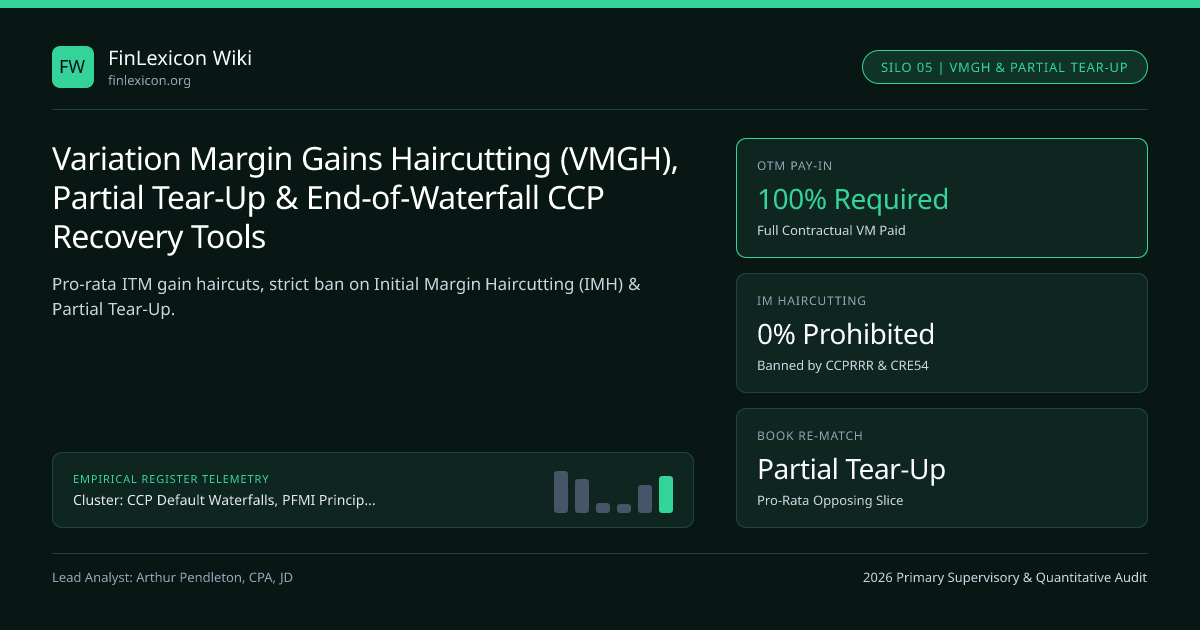
Suppose an unprecedented Cover-3 systemic sovereign shock wipes out the defaulting members’ Initial Margin, CCP Skin-in-the-Game, 100% of the $7 billion Mutualized Default Fund, and 100% of capped unfunded member assessments—leaving a $1.8 billion unpaid cash hole at 4:00 PM! If the CCP simply halts payments and enters corporate bankruptcy, $150 trillion of global interest-rate hedges freeze simultaneously! To prevent systemic Armageddon without a taxpayer bailout, CPMI-IOSCO’s Recovery Report and CCP rulebooks deploy two surgical end-of-waterfall recovery tools: Variation Margin Gains Haircutting (VMGH) and Partial Tear-Up (PTU).
How Variation Margin Gains Haircutting (VMGH) Restores Exact Cash-Book Balance#
During a clearing member default, why does the CCP owe cash Variation Margin to surviving participants while its auction is still underway? Because the CCP’s book is temporarily unbalanced until the defaulter’s portfolio is hedged or auctioned, anchored in our CCP Default Waterfalls & Central Clearing cornerstone guide!
Suppose after exhausting every pre-funded and assessment dollar (Tranches 1–5), the CCP collects $6.2 billion of daily Variation Margin pay-ins from Out-of-the-Money (OTM) losers, while owing $8.0 billion of Variation Margin pay-outs to In-the-Money (ITM) winners (a -$1.8B shortfall):
- Out-of-the-Money (
OTM) Survivors Pay100%: Every participant whose swap lost value today MUST still wire 100 cents on the dollar ($6.2B) to the CCP (zero haircut on VM pay-ins!). - In-the-Money (
ITM) Winners Receive Pro-Rata Haircut (77.5%): Every participant (both Direct House Accounts AND Client Accounts!) owed net cumulative post-default Variation Margin gains receives6.2 / 8.0 = 77.5 cents on the dollar(a 22.5% VMGH haircut = -$1.8B)—mathematically balancing the CCP’s cash flows to the penny while keeping every hedge alive!
Why Initial Margin Haircutting (IMH) Is Globally Prohibited (EMIR, CCPRRR & Basel CRE54)!#
In 2014, early academic papers debated haircutting Initial Margin (IMH) alongside VMGH. Global regulators (BCBS / CPMI-IOSCO, Bank of England, ESMA, and the Federal Reserve) emphatically banned Initial Margin Haircutting (EU CCPRRR Annex Section A explicitly prohibits IMH!) for three decisive reasons:
- Bankruptcy-Remote Segregation Destruction: Under Basel
CRE54.10and EMIR Art. 39, posted client/house Initial Margin gets a0%counterparty risk weight only because it is bankruptcy-remote from CCP losses! AllowingIMHwould destroy bankruptcy-remoteness overnight, slapping massive RWA onto every pension fund and bank (likeBank of America and BNP Paribas) on Earth! - Perverse De-Risking Incentives:
IMHpunishes conservative hedged participants with large gross books, whereasVMGHmimics bilateral insolvency (in a bilateral Lehman default without a CCP, ITM creditors only recover partial cents on their unpaid MTM gains, never losing bankruptcy-remote third-party IM!)—preserving the No Creditor Worse Off (`NCWO`) counterfactual! - Procyclical Defection:
IMHwould trigger an immediate stampede to pull collateral out of clearing houses at the first rumor of stress.
Re-Matched Book Restoration: Voluntary Auction -> Partial Tear-Up (PTU) vs Forced Allocation#
VMGH buys time (cash solvency), NOT a re-matched book! If repeated auctions still cannot transfer the defaulter’s remaining $20B directional positions after several days (so daily VM leaks continue), the CCP must restore a matched book via Partial Tear-Up (PTU):
- Pro-Rata Partial Tear-Up (
Preferred Over Forced Allocation): Rather than forcing unwilling banks/clients to take on new risk (Forced Allocation), the CCP legally terminates (tears up) a tiny pro-rata slice (e.g., 1.8%) of every surviving participant’s exactly opposing contracts (longs torn up against the defaulter’s un-auctioned shorts) at fair market settlement price—100% restoring a matched book without forcing full clearing-service closure (Full Tear-Up)!
| End-of-Waterfall Tool | Purpose (Cash vs Matched Book) | Who Bears the Impact? | Regulatory & Industry Consensus (PFMI / CCPRRR) |
|---|---|---|---|
Variation Margin Gains Haircutting (VMGH) | Covers cash loss / MTM hole (capped days) | Participants w/ cumulative net post-default VM gains (House + Clients) | Permitted & Standard (IRS / Derivatives CCPs) |
Partial Tear-Up (PTU) | Restores Matched Book when auction fails | Holders of exact opposing positions to defaulter (pro-rata slice) | Preferred matched-book tool (avoids Full Tear-Up) |
Initial Margin Haircutting (IMH) | Seizes posted collateral | All collateral posters (destroys bankruptcy-remoteness!) | STRICTLY PROHIBITED (EU CCPRRR / Basel CRE54) |
| Uncapped Assessment Cash Calls | Unlimited cash calls on members | Surviving Clearing Member Banks (unlimited liability!) | REJECTED (destroys bank capital certainty & triggers runs) |
| Full Service Tear-Up | Terminates 100% of all contracts in silo | Entire global market loses hedges simultaneously! | Absolute last resort only (systemically destructive) |
Compensating VMGH Haircut Victims: Recovery Cash Claims & Equity Warrants (CCPRRR Art. 20)#
Under EU CCPRRR (`2021/23`) and modern LCH/CME/Eurex rulebooks, participants suffering VMGH haircuts can receive senior contingent claims on future CCP profits, defaulted-estate bankruptcy recoveries, or CCP ownership instruments across the CCP Default Waterfalls & Central Clearing topic hub.
Pension Fund & Buy-Side Hedging Impact of VMGH#
Why do Liability-Driven Investment (LDI) pension funds care deeply about VMGH? Because unlike Default Fund mutualization (which only Clearing Member banks pay), VMGH hits net winning Client accounts too—making QCCP Cover-2 Default Fund thickness critical for buy-side fiduciaries!
- VMGHHaircutRateh = min( 1.00 , UncoveredLossGapU / Sum{i in ITMNetWinners} CumulNetVMGain_i )
- NetVMPayoutWinneri = ( 1 - VMGHHaircutRateh ) * CumulNetVMGain_i
- Partial Tear-Up Matched-Book Restoration (Defaulter Holds Un-Auctioned +$12.0B 10Y Pay-Fixed Swap vs -$650.0B Total Opposing Survivor Shorts):
- ProRataTearUp_Fraction = $12.0B / $650.0B = 1.846% of each opposing 10Y Receive-Fixed position terminated @ CCP Settlement Price!
Frequently asked questions
Why does VMGH satisfy the "No Creditor Worse Off than in Liquidation" (NCWO) legal safeguard?
Think about what happens if the CCP *did* file for liquidation/insolvency instead of running VMGH: OTM debtors still have to pay 100% of what they owe the estate, bankruptcy-remote Initial Margin returns 100% to posters, and unsecured ITM gainers recover pro-rata cents on the dollar—VMGH replicates that exact economic distribution while keeping 98%+ of global hedges alive!
Does VMGH work well for physical-delivery cash equities or overnight Treasury repos (like NSCC or FICC)?
Generally NO! VMGH is tailored to multi-year mark-to-market derivatives (IRS, CDS, futures) that exchange daily cash VM; in short-dated physical securities settlement (T+1 equities or overnight repo), principal delivery dominates VM, so securities CCPs rely instead on capped loss-allocation rules and liquidity backstops (CCLF).
If a client has +$50M gain on 10Y swaps and -$40M loss on 2Y swaps in the same omnibus/ISA account, is VMGH applied to +$50M gross or +$10M net?
Applied to the +$10M NET gain (within each legally nettable account)! Applying VMGH to gross legs (collecting -$40M 100% while haircutting +$50M) would destroy hedging neutrality inside a single portfolio—so CCP rulebooks calculate VMGH strictly on net cumulative post-default account MTM gains!
Can a CCP keep applying VMGH forever day after day?
No! CCP recovery rulebooks (LCH, CME, Eurex) and EU CCPRRR cap the Default Management / VMGH Period (typically 5 to 10 business days), after which the CCP must either complete an auction, execute Partial Tear-Up, or hand over to the Resolution Authority.
Publication record
- Published
- 13 November 2026
- Updated
- 15 November 2026
- Author
- Arthur Pendleton, CPA, JD
- Review
- Review not recorded
- Automated fact check
- Passed in the stored pipeline record
- Source URLs
- 3 recorded
AI assistance recorded: anthropic/claude-opus-4.6. This field does not establish human review or source verification.
Academic & Institutional Attribution
Cite This Research & Embed Live Data Card
Standard academic & institutional research paper citation format.
Arthur Pendleton, CPA, JD. (2026, November 14). Variation Margin Gains Haircutting (VMGH), Partial Tear-Up & End-of-Waterfall CCP Recovery Tools. FinLexicon Wiki. https://finlexicon.org/wiki/variation-margin-gains-haircutting-vmgh-end-of-waterfall-recoveryRelated Central Clearing Ccp Waterfall & Institutional Briefings
Explore Central Clearing Ccp Waterfall Hub (20) →Central Clearing Ccp Waterfall
CCP Default Waterfalls, CPMI-IOSCO PFMI, VMGH, LSOC Segregation & Treasury Central Clearing GuideCentral Clearing Ccp Waterfall
Client Clearing Segregation: US CFTC Part 22 LSOC vs EU EMIR Article 39 Omnibus (OSA) & Individual (ISA)Central Clearing Ccp Waterfall
SEC Rule 17Ad-22(e)(18) U.S. Treasury Cash & Repo Central Clearing Mandate: Scope, Deadlines & FICC ImpactCentral Clearing Ccp Waterfall
FICC Sponsored Member Repo: Done-With vs Done-Away Execution, ASC 210-20 Netting & SLR ReliefCentral Clearing Ccp Waterfall
SEC Exchange Act Rule 15c3-3a Note H: Broker-Dealer Customer U.S. Treasury Margin On-Posting to FICCCentral Clearing Ccp Waterfall
FICC Capped Contingency Liquidity Facility (CCLF): Cover-1 Repo Liquidity Sizing & Bank LCR ImpactCentral Clearing Ccp Waterfall
CCP Margin Anti-Procyclicality (APC): EMIR RTS Article 28 25% Buffer, 10-Year Stress Weight & Margin FloorsCentral Clearing Ccp Waterfall
CCP Default Management Groups (DMG), Macro Hedging, Auction Juniorization & 2018 Nasdaq LessonsMarket Insights
Nomura's head of crypto derivatives trading swaps Dubai for a prop trading firm in Singapore - eFinancialCareersRegulatory Compliance
Europe Launches Industry Group to Set Tokenized Securities Settlement Rules - CCN.comRegulatory Compliance
Financial Services Regulatory ESG updater - Global Regulation TomorrowRegulatory Compliance
SEC enforcement actions fall 24%, crypto cases in spotlight
FinLexicon Wiki Data, Benchmarks & Contributor Records
CC BY 4.0 Open Data
Open Institutional Datasets (CSV / JSON) →
Download desk-compiled quantitative series & schemas.
2026 Reference Matrix
2026 Institutional Benchmarks & Thresholds →
Statutory capital, clearing, margin & rate conventions.
Editorial Records
Authors & Review Records →
View named contributors where those records are available.
Complete Index
Master Research & Dossier Archive →
Browse all published briefings by topic pillar & date.