
Central Clearing Ccp Waterfall
CCP Assessment Powers & Cooling-Off Periods: Capped Cash Calls vs Uncapped Refills & Bank Capital
Why would an "uncapped" CCP Default Fund assessment obligation render a clearing house unbankable for every G-SIB on Earth? Examine CCP Cooling-Off Periods, 1x–3x multi-default cash-call caps, resignation drop-dead windows, and Basel CRE54 / U.S. National Bank Act limits.
Ask the General Counsel of Bank of America or Bank of Montreal whether a federally chartered U.S. national bank or Canadian bank is legally allowed to join a clearing house with UNLIMITED mutualized Default Fund cash-call ("assessment") liability: the answer is an emphatic NO! Under OCC Interpretive Letters (12 U.S.C. § 24(Seventh)), a U.S. national bank cannot enter an open-ended, uncapped guarantee of third parties’ debts—and under Basel III, uncapped exposure would defy capital quantification! That legal imperative gave birth to Capped CCP Assessment Powers and 30-Day Multi-Default "Cooling-Off Periods".
Distinguishing Two Post-Default Cash Calls: "Loss-Absorption Assessments" vs "Default Fund Refills"#
When a severe member default burns through surviving members’ pre-funded Default Fund, surviving banks (Bank of America, BNP Paribas, ANZ Bank) face two distinct contractual obligations supervised by the OCC, Bank of England, and ECB, anchored in our CCP Default Waterfalls & Central Clearing cornerstone guide:
- *Unfunded Assessment ("Recovery Cash Call") for the Current* Default**:
- If Default #1’s close-out loss exceeds the
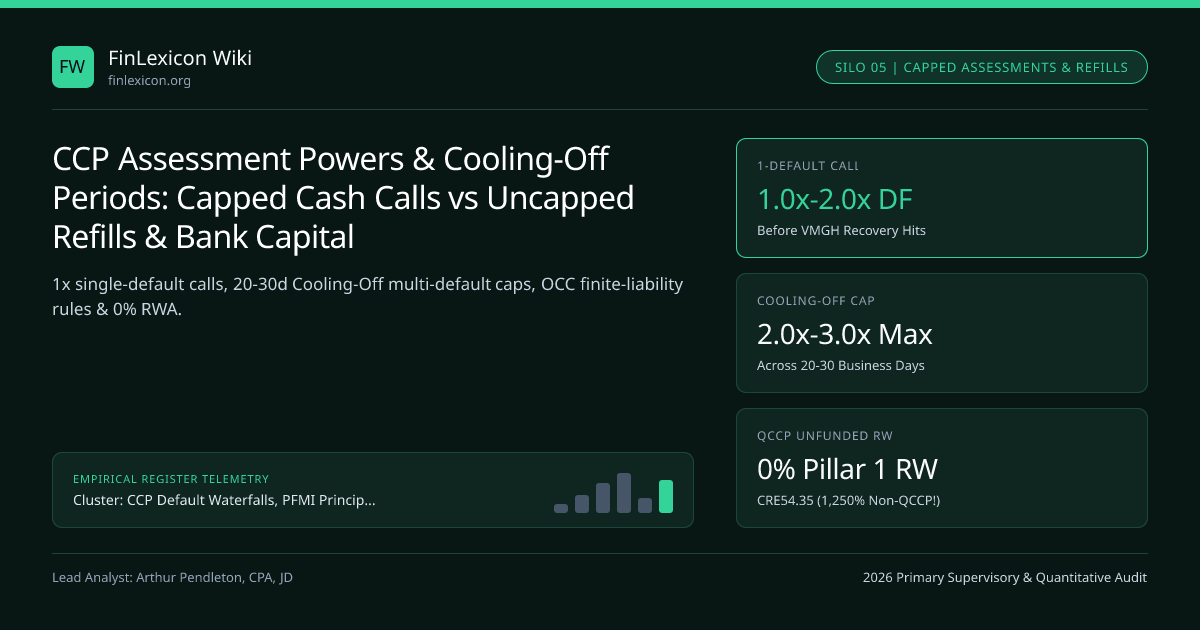
$5.0BPre-Funded Default Fund, the CCP calls surviving members to wire additional cash (typically capped at 1.0x [100%] of each member’s pre-funded DF contribution for a single default!) to finish absorbing Default #1 before triggering VMGH or Partial Tear-Up.
- *Default Fund Replenishment ("Refill") for Future*
Cover-2Operations**:
- Once Default #1 is closed out (
say, burning 70% of the pre-funded DF), the CCP’s surviving Default Fund no longer satisfies PFMI Principle 4 `Cover-2` for tomorrow’s trading! Surviving members who wish to stay in the CCP must replenish ("refill") their Default Fund back toCover-2!
Closing the "Infinite Refill Loop": The 20–30 Business Day Cooling-Off Period Cap (2x–3x Total Liability Cap!)#
Spot the lethal legal loophole if you cap single-default assessments at 1x DF without capping sequential multi-default refills: what if Member A defaults on Monday (1x), Member B defaults on Wednesday (+1x), Member C defaults on Friday (+1x), and Member D defaults next Tuesday (+1x)—creating disguised unlimited liability before a surviving bank can flatten its swaps and resign?!
Every modern QCCP (LCH, CME, ICE, Eurex, DTCC FICC) solves this via a hard Cooling-Off Period (Capped Liability Window, typically 20 to 30 business days starting on Default #1):
- Aggregate Multi-Default Cap Across the Entire Cooling-Off Window: Regardless of whether
1, 3, or 10members default inside that30-dayCooling-Off Period, a surviving member’s maximum cumulative unfunded cash-call + refill liability across ALL defaults in the window is strictly capped (e.g., 1.0x single default / 2.0x–3.0x aggregate across the entire 30-day window!)! - Clean Resignation ("Walk-Away") Exit Ramp: Any surviving member that closes out (
offsets/transfers) 100% of its open positions and submits a formal Resignation Notice BEFORE the 30-day Cooling-Off Period expires is 100% immune from any subsequent post-window assessments or refills (locking in an ironclad maximum worst-case dollar loss for OCC & Basel compliance!)!
The Resignation Stampede Dilemma & FICC Capped Loss Allocation (Rule 4)#
Watch the systemic tightrope highlighted by the Financial Stability Board (FSB): if a member must resign and liquidate $2T of swaps inside 10 days just to cap its liability, the Cooling-Off exit ramp itself could trigger a stampede out of the CCP! Consequently:
- Extended
20–30 Business DayWindows give banks calm breathing room without panic liquidations. - At DTCC FICC (
GSD Rule 4), after SEC-approved loss-allocation reforms, each Netting Member’s loss-allocation cap in an Event Period (10 business days, rolling on subsequent defaults) is clearly bounded alongside a 2-business-day withdrawal notice option (subject to capping at maximum exposure during the Event Period).
| Systemic Clearing House | Single-Default Unfunded Assessment Cap | Multi-Default Cooling-Off Window Cap | Plus Statutory Resolution Authority Call? |
|---|---|---|---|
LCH Ltd (SwapClear) | 1.0x Pre-Funded DF (100%) | 3.0x Unfunded Cap across 30-day Default Period | UK BoE CCP Resolution (up to 2x DF) |
CME Clearing (IRS / Base) | 1.0x – 2.75x (scaled byCover-2/3 tier) | Capped across 5-to-20 business day Cooling-Off Period | U.S. Title II / CFTC recovery rules |
| Eurex Clearing | 2.0x Pre-Funded DF (capped by CCPRRR) | 2.0x – 3.0x across 20–30 day Capped Period | EU CCPRRR Art. 31 (up to 2.0x DF) |
ICE Clear Credit (CDS) | 1.0x Pre-Funded DF per default | 3.0x aggregate cap across 30-day Cooling-Off | U.S. Title VIII / SECCCA framework |
Basel CRE54.35 & LCR Regulatory Treatment of Capped Assessments#
Under Basel `CRE54.35`, capped unfunded assessment commitments to a QCCP carry 0% Credit RWA (until called), whereas in internal liquidity stress testing (ILST / ICAAP / SREP), bank treasuries reserve 100% liquid HQLA cash against at least 1.0x Default Fund assessment calls across the CCP Default Waterfalls & Central Clearing topic hub!
EU CCPRRR Statutory "Resolution Cash Call" (Additional 1.0x–2.0x DF Power!)#
Note one crucial statutory layer in Europe: even after a CCP’s private rulebook contractual assessment (1x–2x DF) is exhausted, EU CCPRRR (`2021/23`) Article 31 empowers the public Resolution Authority to levy a separate Statutory Resolution Cash Call (capped at up to 2.0x pre-funded DF)!
- Walk-Away Resignation Condition (Prior to Day T_CoolOff = 20 or 30 Business Days):
- If OpenNotionalBanki(TCoolOff) == $0 AND NoticeDelivered => FutureAssessmentLiability( t > TCoolOff ) = $0.00!
Frequently asked questions
What happens if a Clearing Member REFUSES to pay a valid 1.0x contractual Assessment Cash Call?
Refusing to pay a mandatory contractual Assessment Call is itself a Clearing Member Event of Default! The non-paying bank is immediately declared in default, its own Initial Margin and remaining collateral are seized to cure its unpaid assessment, and its swap/futures books are liquidated by the DMG!
Can a Clearing Member resign on Day 2 of a crisis to escape paying for Default #1 that ALREADY happened yesterday?
Never! Filing a Resignation Notice NEVER excuses liability for defaults that occurred PRIOR to (or during) the Cooling-Off Period up to the 2x–3x Cooling-Off cap—resignation only shields the departing bank from *new* defaults occurring *after* its positions hit $0 and the Cooling-Off window closes!
Why did CME Clearing once move from uncapped assessments to capped assessments in the early 2010s?
Historically, member-owned futures exchanges had uncapped mutualization; once Dodd-Frank (2010) and Basel III (2012) forced giant U.S. and European bank holding companies to clear trillions of swaps, bank regulators (OCC & BCBS) informed futures CCPs that uncapped assessments were legally impermissible for regulated banks—prompting universal adoption of Cooling-Off caps!
Do Buy-Side Clients ever have to pay CCP Default Fund Assessments or Refills?
$0.00 — Never! Neither contractual Default Fund assessments (1x–3x) nor EU CCPRRR Article 31 Resolution Cash Calls (up to 2x) can be levied on buy-side Clients (those obligations bind Direct Clearing Members exclusively).
Publication record
- Published
- 13 November 2026
- Updated
- 15 November 2026
- Author
- Arthur Pendleton, CPA, JD
- Review
- Review not recorded
- Automated fact check
- Passed in the stored pipeline record
- Source URLs
- 3 recorded
AI assistance recorded: anthropic/claude-opus-4.6. This field does not establish human review or source verification.
Academic & Institutional Attribution
Cite This Research & Embed Live Data Card
Standard academic & institutional research paper citation format.
Arthur Pendleton, CPA, JD. (2026, November 14). CCP Assessment Powers & Cooling-Off Periods: Capped Cash Calls vs Uncapped Refills & Bank Capital. FinLexicon Wiki. https://finlexicon.org/wiki/ccp-assessment-powers-capped-vs-uncapped-default-fund-refillsRelated Central Clearing Ccp Waterfall & Institutional Briefings
Explore Central Clearing Ccp Waterfall Hub (20) →Central Clearing Ccp Waterfall
CCP Default Waterfalls, CPMI-IOSCO PFMI, VMGH, LSOC Segregation & Treasury Central Clearing GuideCentral Clearing Ccp Waterfall
EU CCP Recovery & Resolution Regulation (CCPRRR 2021/23) vs US Dodd-Frank Title II/VIII: NCWO & Bail-InCentral Clearing Ccp Waterfall
CCP Initial Margin Models (Expected Shortfall vs SPAN 2): 5-Day House vs 7-Day Client MPOR & PortingCentral Clearing Ccp Waterfall
Clearing Novation vs Open-Offer Mechanics, Multilateral Netting & TriOptima Portfolio CompressionCentral Clearing Ccp Waterfall
CPMI-IOSCO PFMI Principles 4 & 7: Cover-2 Credit Default Fund vs Cover-1 / Cover-2 Liquidity SizingCentral Clearing Ccp Waterfall
CCP Default Waterfall Tranches: Defaulter-Pay IM/DF, Skin-in-the-Game & Survivor MutualizationCentral Clearing Ccp Waterfall
CCP Skin-in-the-Game (SITG): EMIR 25% Minimum Capital Rule, Second-Tranche SITG & Incentive AlignmentCentral Clearing Ccp Waterfall
Variation Margin Gains Haircutting (VMGH), Partial Tear-Up & End-of-Waterfall CCP Recovery ToolsRegulatory Compliance
Bowman, Modernizing Financial Regulation: Initial Observations from eSLRMarket Insights
Anthropic's IPO is major clearing event for AI trade: Melius' Ben ReitzesRegulatory Benchmarks
Prudential Banking, Clearing & Basel Capital Institutions 2026 Licensing Benchmark: 6D Prudential Scorecard Across 301 Audited EntitiesCompliance Forensics
How to Verify Prudential Banking, Clearing & Basel Capital Institutions Licences & Detect Clone Firms: 2026 Supervisory Lookup Playbook
FinLexicon Wiki Data, Benchmarks & Contributor Records
CC BY 4.0 Open Data
Open Institutional Datasets (CSV / JSON) →
Download desk-compiled quantitative series & schemas.
2026 Reference Matrix
2026 Institutional Benchmarks & Thresholds →
Statutory capital, clearing, margin & rate conventions.
Editorial Records
Authors & Review Records →
View named contributors where those records are available.
Complete Index
Master Research & Dossier Archive →
Browse all published briefings by topic pillar & date.