
Central Clearing Ccp Waterfall
Basel III CRE54 Qualifying CCP (QCCP) Capital: 2% vs 4% Client Trade Exposure Risk Weights & K_CCP
Central clearing earns massive bank capital relief ONLY when the clearing house qualifies as a "QCCP" under Basel III chapter CRE54—unlocking a 2% trade exposure risk weight, 0% bankruptcy-remote IM risk weight, and the SA-CCR-powered K_CCP Default Fund capital formula.
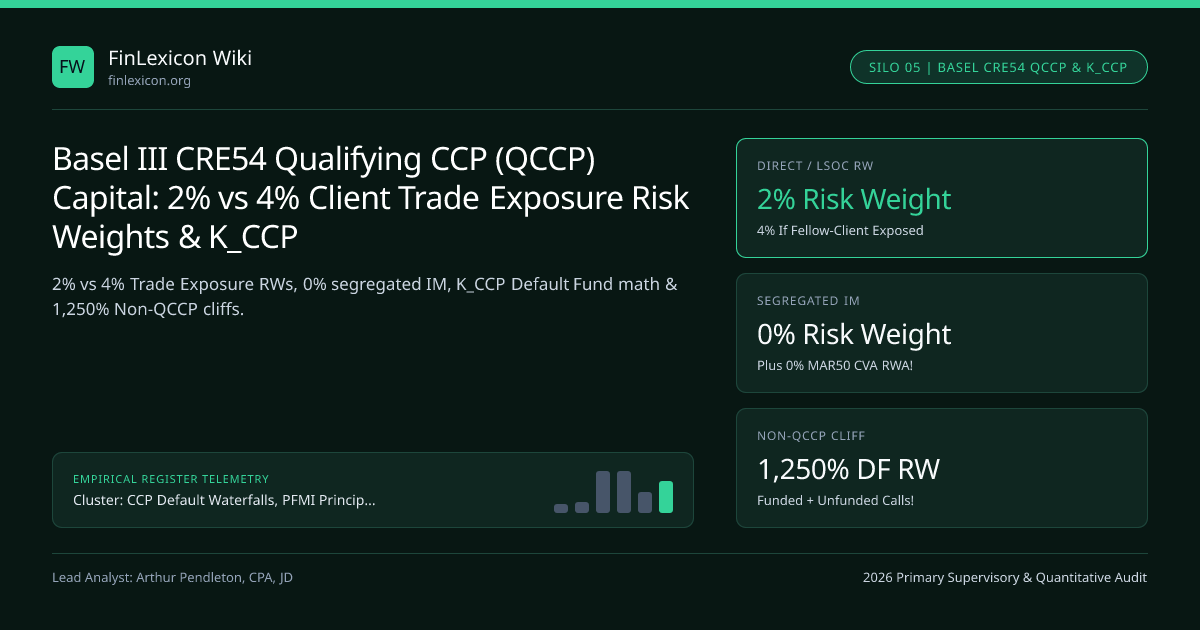
Why did European and UK politicians fight tooth-and-nail over ESMA "Tier 2 CCP Equivalence" for London’s LCH SwapClear after Brexit? Look at the Basel III chapter CRE54 "Non-QCCP Nuclear Cliff": if BNP Paribas clears EUR 10 trillion of swaps at a Qualifying CCP (QCCP), its trade exposure risk weight is 2% (and Default Fund risk weight averages ~18%–35%); if that exact same CCP loses QCCP recognition, trade risk weights jump 10x–25x (to 20%–50%+) and Default Fund contributions get hit with a 1,250% risk weight (100% CET1 capital wipeout!)—increasing capital charges by 30x to 50x overnight!
Pillar 1 of Basel CRE54: Direct & Client Trade Exposure (2% vs 4% vs Bilateral RW)#
Implemented across the Federal Reserve (Reg Q), ECB (CRR III Art. 300–311), UK PRA, and APRA, Basel CRE54 divides a bank’s QCCP exposure into Trade Exposure (EAD via SA-CCR with `MPOR >= 5 business days`) and Default Fund Exposure, anchored in our CCP Default Waterfalls & Central Clearing cornerstone guide:
- Direct Clearing Member Facing a QCCP (
CRE54.7):
- Trade Exposure (
MTM + SA-CCR PFE+ non-segregated IM):2%Risk Weight! - Bankruptcy-Remote Segregated Posted Initial Margin (
CRE54.10):0%Risk Weight! (Custodian counterparty risk applies ONLY if held at a non-bankruptcy-remote third party.)
- *Bank Acting as a Client* Clearing Through a Clearing Broker (
CRE54.8–9—2%vs4%vsBilateral!)**:
2%Risk Weight (Gold Standard — e.g., U.S. LSOC or EU EMIR ISA): Requires three conditions: (a) offsetting CCP leg is explicitly identified as client-segregated, (b) collateral is protected from BOTH Clearing Member default AND fellow-client default (dual-default shield!), and (c) enforceable legal opinions confirm porting to a backup CM upon CM default!4%Risk Weight (Fellow-Customer Exposed — e.g., Net/Gross Omnibus Without Dual-Loss Shield): Applies when porting(a)and(c)hold and the client is protected from Clearing Member default alone, but STILL exposed to joint CM + Fellow-Client losses!- Full Bilateral Clearing-Member Risk Weight (
20%–100%,CRE54.11): Applies if segregation or porting legal opinions fail (e.g., unsegregated bilateral back-to-back trade)!
| Bank CCP Exposure Line | Qualifying CCP (QCCP) Risk Weight | Non-Qualifying CCP Risk Weight | Primary Governing CRE54 Paragraph |
|---|---|---|---|
Direct Member Trade Exposure (EAD) | 2% RW (5-day MPOR) | Standardized Bank/Corp RW (20%–100%) | CRE54.7 / CRE54.40 |
Client Trade Exposure (LSOC / EMIR ISA) | 2% RW (Dual-loss protected + portable) | Bilateral CM RW (20%–100%) | CRE54.8 |
Client Trade Exposure (Fellow-Exposed OSA) | 4% RW (Protected ex-CM only + portable) | Bilateral CM RW (20%–100%) | CRE54.9 |
| Bankruptcy-Remote Posted Initial Margin | 0% RW | 0% if bankruptcy-remote (else Bilateral) | CRE54.10 |
Pre-Funded Default Fund (DF_i) | K_CCP Formula (Min 2% RW, avg 15%–45%) | 1,250% Risk Weight! | CRE54.24–36 / CRE54.41 |
| Unfunded Assessment Commitment | 0% RW | 1,250% Risk Weight! | CRE54.35 / CRE54.41 |
Pillar 2 of Basel CRE54: Bank Guaranteeing a Client (FCM / Sponsoring Bank Side!)#
What about when Bank of America or Bank of Montreal acts as the Clearing Broker / FCM (or FICC Sponsoring Member) guaranteeing Hedge Fund X to the CCP (CRE54.12)?
- The FCM calculates
SA-CCR EADagainst Hedge Fund X (applying Hedge Fund X’s bilateral risk weight, e.g., 50%–100%!), EXCEPT that because clearing settlement is daily and porting/liquidation is rapid, CRE54.12 allows multiplying the client’sMPORscalar down (minimum 5 business days, i.e.,sqrt(5/10) = 0.707xreduction vs 10-day bilateral OTC swaps!).
Pillar 3 of Basel CRE54: The K_CCP Hypothetical Capital Formula for Default Fund Contributions (CRE54.24–39)#
How does Basel risk-weight a bank’s $250 million pre-funded contribution to a QCCP’s Mutualized Default Fund? Via the two-step K_CCP Hypothetical Capital Engine (published every quarter by the QCCP in its CPMI-IOSCO PQD report!):
- Step 1 — QCCP Computes Its Own Hypothetical Capital (
K_CCP):
The QCCP calculates SA-CCR EAD_i against every clearing member i (treating the QCCP as if it were a bank facing all members, using a flat **20% counterparty risk weight** and **8% capital ratio** = 1.6% * Sum EAD_i!).
- *Step 2 — Allocate Capital Requirement `K_CM
Across Pre-Funded Default Fund (CRE54.34–36`)**:
Compare K_CCP against total pre-funded waterfall resources (DF_CCP [SITG] + DF_CM_pref). Each bank’s Default Fund capital charge decays smoothly as DF_pref exceeds K_CCP—subject to an absolute minimum 2% Risk Weight floor (0.16% capital charge) on Default Fund contributions AND an overall cap (CRE54.37) ensuring Trade RWA + DF RWA at a QCCP never exceeds Non-QCCP charges!
Why QCCP Equivalence (ESMA Tier 1 / Tier 2 & CFTC DCO Exemptions) Drives Geopolitics#
Because losing QCCP status imposes a 1,250% risk weight (100% CET1 wipeout) on Default Fund contributions (CRE54.40), cross-border regulatory recognition (EU EMIR 3.0 Active Account compromise vs UK LCH Tier 2 extensions, plus RBI India / JSCC Japan equivalence disputes) sits at the center of global financial diplomacy across the CCP Default Waterfalls & Central Clearing topic hub!
Treatment of Unfunded Assessment Commitments Under CRE54.35 (0% RWA for QCCPs!)#
Crucial relief in finalized Basel CRE54: for a QCCP, unfunded Default Fund assessment commitments carry 0% RWA (until actually called and funded), whereas for a Non-QCCP, unfunded commitments are ALSO hit with 1,250% RWA!
- cCapitalFactor = max( 0.0016 (2% RW Floor) , 0.08 / [ 1 + ( DFCCPSITG + DFCMTotal ) / K_CCP ] ... ) [CRE54.35]
- RWADefaultFundBank = 12.5 * max( KCMAllocated(DFBank) , 0.0016 * DFBank )
- Client Clearing Trade Exposure RWA Summary:
- RWAClient = EADSACCR(MPOR = 5d) * [ 2% if DualLossProtected(LSOC/ISA) ; 4% if FellowClientExposed ; RW_CM if Unportable ]
Frequently asked questions
Why did a dispute between ESMA and the Reserve Bank of India (RBI / CCIL) in 2022–2023 nearly force European banks out of Indian clearing?
When ESMA temporarily withdrew third-country recognition of CCIL (Clearing Corporation of India) over extraterritorial audit-inspection disagreements in late 2022, European banks (BNP Paribas, Deutsche Bank, SocGen, Crédit Agricole) faced the 1,250% Non-QCCP Default Fund cliff on Indian Rupee government bond/FX clearing—forcing intense diplomatic extensions!
What is the EU EMIR 3.0 "Active Account Requirement" (AAR) aimed at LCH SwapClear?
Adopted in December 2024 (Regulation 2024/2987, Art. 7a) to reduce post-Brexit reliance on London’s LCH Ltd (Tier 2 QCCP), large EU financials clearing >EUR 3B in EUR/PLN interest-rate derivatives must maintain an operational "Active Account" at an EU-domiciled CCP (e.g., Eurex) executing a representative minimum number of trades (while preserving LCH’s QCCP 2% status!).
Why does the K_CCP formula use a flat 20% counterparty risk weight for all clearing members?
In Basel CRE54.25, the BCBS assigned a uniform 20% risk weight (the standard investment-grade bank risk weight) inside the CCP’s K_CCP calculation so the CCP does not have to collect confidential internal IRB credit models on every single global member just to publish one public K_CCP number!
Does Settled-to-Market (STM) reduce a QCCP’s K_CCP Default Fund capital charge?
Yes! Because K_CCP sums SA-CCR EAD across all clearing members from the CCP’s perspective, converting swaps from CTM to STM resets unmargined Replacement Cost and lets members compress MPOR to 5 days—shrinking K_CCP and lowering every surviving bank’s Default Fund RWA!
Publication record
- Published
- 13 November 2026
- Updated
- 15 November 2026
- Author
- Arthur Pendleton, CPA, JD
- Review
- Review not recorded
- Automated fact check
- Passed in the stored pipeline record
- Source URLs
- 3 recorded
AI assistance recorded: anthropic/claude-opus-4.6. This field does not establish human review or source verification.
Academic & Institutional Attribution
Cite This Research & Embed Live Data Card
Standard academic & institutional research paper citation format.
Arthur Pendleton, CPA, JD. (2026, November 15). Basel III CRE54 Qualifying CCP (QCCP) Capital: 2% vs 4% Client Trade Exposure Risk Weights & K_CCP. FinLexicon Wiki. https://finlexicon.org/wiki/basel-cre54-qccp-2-percent-vs-4-percent-trade-exposure-kccpRelated Central Clearing Ccp Waterfall & Institutional Briefings
Explore Central Clearing Ccp Waterfall Hub (20) →Central Clearing Ccp Waterfall
CCP Default Waterfalls, CPMI-IOSCO PFMI, VMGH, LSOC Segregation & Treasury Central Clearing GuideCentral Clearing Ccp Waterfall
CCP Intraday Variation & Ad-Hoc Margin Calls: Dash-for-Cash Liquidity Spirals & One-Way Pass-ThroughCentral Clearing Ccp Waterfall
Cross-Margining Across Futures & Cleared Fixed Income: CME-FICC Treasury Offsets & Dual BD/FCMsCentral Clearing Ccp Waterfall
CLS Payment-versus-Payment (PvP) FX Settlement: Eliminating Herstatt Risk & 99% Pay-In NettingCentral Clearing Ccp Waterfall
CCP Assessment Powers & Cooling-Off Periods: Capped Cash Calls vs Uncapped Refills & Bank CapitalCentral Clearing Ccp Waterfall
EU CCP Recovery & Resolution Regulation (CCPRRR 2021/23) vs US Dodd-Frank Title II/VIII: NCWO & Bail-InCentral Clearing Ccp Waterfall
CCP Initial Margin Models (Expected Shortfall vs SPAN 2): 5-Day House vs 7-Day Client MPOR & PortingCentral Clearing Ccp Waterfall
Clearing Novation vs Open-Offer Mechanics, Multilateral Netting & TriOptima Portfolio CompressionRegulatory Compliance
New regulation for heating oil market, but no price controlsMarket Insights
Oil down more than $7 a barrel in post settlement trade as Trump signals restraint on IranMarket Insights
Why the US midterms sparked an AI stock selloffRegulatory and Market Glossary
The Other AI: Remarks at the Open Commission Meeting on Accredited Investor Notices under Rule 501(a)(10) of Regulation D
FinLexicon Wiki Data, Benchmarks & Contributor Records
CC BY 4.0 Open Data
Open Institutional Datasets (CSV / JSON) →
Download desk-compiled quantitative series & schemas.
2026 Reference Matrix
2026 Institutional Benchmarks & Thresholds →
Statutory capital, clearing, margin & rate conventions.
Editorial Records
Authors & Review Records →
View named contributors where those records are available.
Complete Index
Master Research & Dossier Archive →
Browse all published briefings by topic pillar & date.