
Central Clearing Ccp Waterfall
CCP Initial Margin Models (Expected Shortfall vs SPAN 2): 5-Day House vs 7-Day Client MPOR & Porting
Why does clearing the exact same $500M 10-year SOFR swap as a Buy-Side Client require +18% higher Initial Margin than a Dealer House Account at LCH and Eurex—and why did CME retire 35-year-old legacy SPAN in favor of VaR-based SPAN 2?
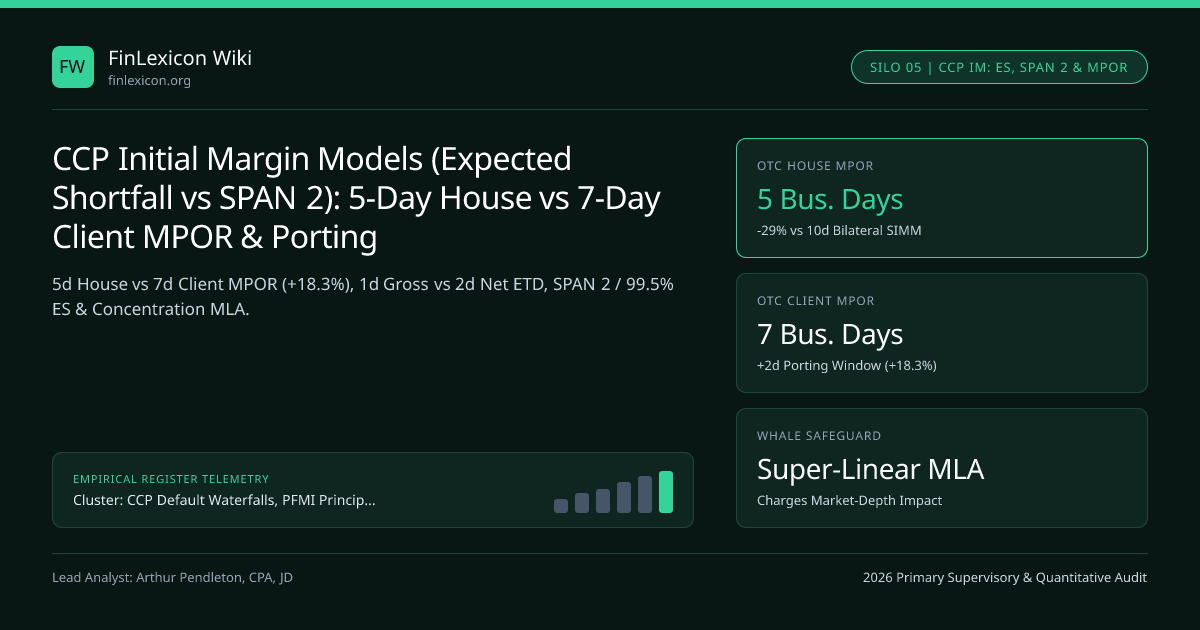
Check the Initial Margin ticket on an identical $500 million 10-year EURIBOR or SOFR swap at LCH SwapClear or Eurex Clearing: a Direct Clearing Dealer’s House Account posts $18.5 million (5-business-day MPOR), whereas a Pension Fund’s Client Account posts $21.9 million (7-business-day MPOR — +18.4% higher via sqrt(7 / 5) = 1.183x!)! Why do buy-side clients pay higher CCP Initial Margin than dealers, how did U.S. CFTC 1-day Gross vs EU EMIR 2-day Net futures rules spark a transatlantic equivalency war, and why did exchanges replace 1988 SPAN with Filtered Historical Expected Shortfall & SPAN 2?
Statutory Minimum MPOR Floors: Why Client MPOR (7-Day OTC) Exceeds House MPOR (5-Day OTC)!#
Under EU/UK EMIR RTS 153/2013 Articles 24–26 (overseen by ESMA, ECB, and Bank of England) and U.S. CFTC Rule 39.13(g)(2) (overseen by CFTC & Federal Reserve), a CCP’s Margin Period of Risk (MPOR / Liquidation Horizon) measures the exact worst-case days from the last successful Variation Margin collection until the DMG finishes hedging and auctioning the book, anchored in our CCP Default Waterfalls & Central Clearing cornerstone guide:
- OTC Derivatives (
IRS, CDS, NDFs):
- House Account (
5 Business Days— Both US CFTC & EU/UK EMIR):Day 1Default detection +Day 2–3DMG macro hedging +Day 4–5auction settlement =5 business days(vs 10 business days foruncleared UMR ISDA SIMM!). - Client Account (
7 Business Daysat LCH/Eurex vs5 Business DaysCFTC Minimum): Why+2 extra days(7dvs5d, addingsqrt(7/5) - 1 = +18.3%Initial Margin)? Because when a Clearing Broker defaults, the CCP cannot liquidate Client positions on Day 1—by law (EMIR Art. 48 / LSOC), the CCP must wait24 to 48 hours(2 days) trying to PORT clients to a backup FCM before the 5-day DMG close-out can even start (2d porting + 5d close-out = 7 days)!
- Exchange-Traded Derivatives (
ETDs — Listed Futures & Options) — The Famous US vs EU Equivalency Battle!:
- U.S. CFTC Rule
39.13(g)(2):1-Dayminimum MPOR, collected STRICTLY GROSS per customer (no netting Client A against Client B!). - EU EMIR RTS Art. 26:
2-Dayminimum MPOR (allowing Net Omnibus), OR1-DayMPOR ("EU EMIR Option"if collected Gross w/ intraday margining—adopted in the historic 2016 CFTC–European Commission Equivalence Pact!)!
| Cleared Product & Account Class | Minimum Statutory MPOR | Minimum Quantile (EMIR / CFTC) | Typical CCP Engine | Sqrt-Time Scaling vs 10d UMR SIMM |
|---|---|---|---|---|
Listed Futures & Options (US CFTC Gross) | 1 Business Day (Gross) | 99.0% VaR / ES | CME SPAN 2 / ICE VaR | sqrt(1/10) = 0.316x (-68%) |
Listed Futures & Options (EU EMIR Net OSA) | 2 Business Days (Net) | 99.0% ES / VaR | Eurex Prisma (2d) | sqrt(2/10) = 0.447x (-55%) |
Cleared U.S. Treasury Cash & Repo (FICC GSD) | 3 Business Days | 99.0% Historical VaR + MLA | FICC GSD Sensitivity VaR | sqrt(3/10) = 0.548x (-45%) |
Cleared OTC Swaps — House (IRS / NDF) | 5 Business Days | 99.5% OTC (EMIR) / 99% (CFTC) | LCH PAIRS ES / Eurex Prisma | sqrt(5/10) = 0.707x (-29%) |
Cleared OTC Swaps — Client (Porting) | 7 Business Days (EU/LCH) / 5d (US) | 99.5%–99.7% ES | LCH (7d) / CME IRS (5d+) | sqrt(7/10) = 0.837x (-16%) |
Confidence Quantiles & Model Evolution: Why SPAN (1988) Gave Way to Expected Shortfall & SPAN 2#
For 35 years (since CME invented it right after the October 1987 Black Monday crash!), Standard Portfolio Analysis of Risk (SPAN) priced global futures margin by scanning 16 fixed price/volatility grid scenarios per contract plus ad-hoc inter-commodity spread credits. Across modern multi-trillion portfolios cleared by Bank of America, BNP Paribas, and Bank of Montreal, legacy 16-grid SPAN hit three mathematical walls:
- Tail Blindness:
99.0% Value-at-Risk (VaR)ignores how catastrophic the worst1%losses are (whereas **99.5% / 99.7% Expected Shortfall [ES / CVaR]** averages all tail losses beyond the quantile!). - Crude Cross-Tenor Curve Offsets: Fixed inter-commodity credits mispriced butterfly/steepener shocks across 40 SOFR/Treasury tenors.
- Modern HVaR / Expected Shortfall Engines:
- LCH SwapClear
PAIRS/ Expected Shortfall & EurexPrisma: Full portfolio Filtered Historical Simulation Expected Shortfall (99.5%–99.7%OTC;99.0%+ETD) blending75%recent +25%permanent stressed scenarios (EMIR Art. 28b APC)! - CME
SPAN 2Framework: Replaced legacy gridSPANacross energy, rates, equities, and metals with full Historical Value-at-Risk (HVaR) + Stressed VaR + Concentration/Liquidity Risk Add-Ons!
Beyond Base ES / VaR: Liquidity, Concentration, Wrong-Way & Basis Margin Add-Ons#
If Hedge Fund Z holds a $40 billion 30-year swap (3.5x normal daily market volume!), 5-day base Expected Shortfall is completely inadequate (because liquidating $40B takes 15 days, not 5!). Every PFMI-compliant CCP stacks four deterministic Margin Add-Ons onto base ES:
- Concentration / Market-Liquidity Add-On (
Liquidation Cost): Scales super-linearly (e.g., (DV01 / MarketDepth)^1.5) whenever net bucket DV01 exceeds normal 2-day market absorption capacity! - Sovereign / Credit Wrong-Way Risk (
WWR) Add-On: Penalizes an Italian bank posting Italian BTPs (or a Canadian bank posting CAD corporate/provincial risk) against correlated rate/FX trades. - Repo / Sovereign Haircut VaR (
FICC GSD): For cleared U.S. Treasury cash & repo, FICC GSD charges a 3-day MPOR99%VaR Charge + Margin Liquidity Adjustment (MLA) + Backtesting Charge!
Daily 99.0% Kupiec & Dynamic Backtesting (CPMI-IOSCO PQD Transparency)#
Risk validation teams run daily out-of-sample portfolio backtests across every single house and client account: if realized 5-day/1-day P&L breaches posted IM more than 2–4 times per year (99% Kupiec Traffic-Light test), the CCP must either recalibrate base ES or levy an automatic Member Backtesting Margin Charge across the CCP Default Waterfalls & Central Clearing topic hub!
Comparing 5d/7d Cleared CCP IM Against 10d Bilateral ISDA SIMM (-30% Collateral Advantage!)#
Even at 7-day Client MPOR, cleared CCP Initial Margin enjoys a ~16%–30% structural collateral advantage over 10-day bilateral ISDA SIMM (sqrt(5/10) = 0.707x for dealers; sqrt(7/10) = 0.837x for clients)—compounded by deep multilateral netting!
- ClientvsHouseBaseRatio = IMBase(MPORClient = 7d) / IMBase(MPORHouse = 5d) ~= sqrt( 7 / 5 ) = 1.1832 (+18.3% Uplift)
- ConcentrationAddOn(DV01k) = BidOfferStressk * DV01k * max( 0 , ( |DV01k| / DailyMarketCapacity_k )^gamma - 1 ) [gamma > 1]
Frequently asked questions
Why does EMIR require a higher confidence level for OTC Derivatives (99.5%) than for Exchange-Traded Futures (99.0%)?
EMIR RTS 153/2013 Article 24(1) sets 99.5% minimum confidence for OTC derivatives vs 99.0% for listed futures/options (ETDs) because bespoke OTC swaps (with 50+ curve/basis tenors and dealer auction close-outs) exhibit fatter jump/liquidity tails than standardized central-limit-order-book futures!
Why can 1-Day Gross Futures Margin actually collect MORE total collateral at the CCP than 2-Day Net Omnibus Margin?
Suppose an FCM has 50 long clients (+$500M 1d IM) and 50 short clients (-$500M 1d IM): under EU 2-Day Net Omnibus, the longs and shorts cancel out so the CCP holds **$0 (0 * sqrt(2) = $0)! Under U.S. 1-Day Gross, the CCP collects $500M + $500M = $1,000M right at the CCP**—proving why CFTC showed 1-Day Gross is often *more* conservative than 2-Day Net!
What is FICC’s "Margin Liquidity Adjustment" (MLA) Charge on U.S. Treasury portfolios?
Introduced by DTCC FICC (SEC-approved), the MLA Charge tests whether a defaulting member’s concentrated net Treasury or MBS bucket exceeds normal daily dealer absorption depth: if closing out $35B of off-the-run 20-year bonds would widen market bid-ask spreads beyond normal 3-day VaR, MLA adds that incremental price-impact cost directly into daily Initial Margin!
How does Expected Shortfall (ES) differ mathematically from Value-at-Risk (VaR) at the 99% level?
On a 2,500-day (10-year) lookback, 99% VaR looks *only* at the 25th worst day (completely ignoring whether Days 1..24 were -2% or -40%!). 99% Expected Shortfall (ES) takes the arithmetic average of ALL 25 worst tail losses (Days 1 through 25)—guaranteeing mathematical sub-additivity (diversification never increases risk) and capturing extreme jump tails!
Publication record
- Published
- 13 November 2026
- Updated
- 15 November 2026
- Author
- Arthur Pendleton, CPA, JD
- Review
- Review not recorded
- Automated fact check
- Passed in the stored pipeline record
- Source URLs
- 4 recorded
AI assistance recorded: anthropic/claude-opus-4.6. This field does not establish human review or source verification.
Academic & Institutional Attribution
Cite This Research & Embed Live Data Card
Standard academic & institutional research paper citation format.
Arthur Pendleton, CPA, JD. (2026, November 14). CCP Initial Margin Models (Expected Shortfall vs SPAN 2): 5-Day House vs 7-Day Client MPOR & Porting. FinLexicon Wiki. https://finlexicon.org/wiki/compressed-mpor-5-day-house-vs-7-day-client-ccp-im-modelsRelated Central Clearing Ccp Waterfall & Institutional Briefings
Explore Central Clearing Ccp Waterfall Hub (20) →Central Clearing Ccp Waterfall
CCP Default Waterfalls, CPMI-IOSCO PFMI, VMGH, LSOC Segregation & Treasury Central Clearing GuideCentral Clearing Ccp Waterfall
Clearing Novation vs Open-Offer Mechanics, Multilateral Netting & TriOptima Portfolio CompressionCentral Clearing Ccp Waterfall
CPMI-IOSCO PFMI Principles 4 & 7: Cover-2 Credit Default Fund vs Cover-1 / Cover-2 Liquidity SizingCentral Clearing Ccp Waterfall
CCP Default Waterfall Tranches: Defaulter-Pay IM/DF, Skin-in-the-Game & Survivor MutualizationCentral Clearing Ccp Waterfall
CCP Skin-in-the-Game (SITG): EMIR 25% Minimum Capital Rule, Second-Tranche SITG & Incentive AlignmentCentral Clearing Ccp Waterfall
Variation Margin Gains Haircutting (VMGH), Partial Tear-Up & End-of-Waterfall CCP Recovery ToolsCentral Clearing Ccp Waterfall
Client Clearing Segregation: US CFTC Part 22 LSOC vs EU EMIR Article 39 Omnibus (OSA) & Individual (ISA)Central Clearing Ccp Waterfall
SEC Rule 17Ad-22(e)(18) U.S. Treasury Cash & Repo Central Clearing Mandate: Scope, Deadlines & FICC ImpactRegulatory Benchmarks
Prudential Banking, Clearing & Basel Capital Institutions 2026 Licensing Benchmark: 6D Prudential Scorecard Across 301 Audited EntitiesCompliance Forensics
How to Verify Prudential Banking, Clearing & Basel Capital Institutions Licences & Detect Clone Firms: 2026 Supervisory Lookup PlaybookSolvency and Protection
Investor Compensation Ceilings, Client-Money Segregation & Counterparty Risk Matrix in Prudential Banking, Clearing & Basel Capital Institutions (2026)Regulatory and Market Glossary
SEC Censures OTC Link LLC for Repeated Compliance Failures Related to Regulation SCI
FinLexicon Wiki Data, Benchmarks & Contributor Records
CC BY 4.0 Open Data
Open Institutional Datasets (CSV / JSON) →
Download desk-compiled quantitative series & schemas.
2026 Reference Matrix
2026 Institutional Benchmarks & Thresholds →
Statutory capital, clearing, margin & rate conventions.
Editorial Records
Authors & Review Records →
View named contributors where those records are available.
Complete Index
Master Research & Dossier Archive →
Browse all published briefings by topic pillar & date.