
Central Clearing Ccp Waterfall
Clearing Novation vs Open-Offer Mechanics, Multilateral Netting & TriOptima Portfolio Compression
Central clearing relies on two distinct legal mechanisms—Novation of bilateral trades vs Open-Offer instantaneous CCP contract creation—paired with multilateral netting and linear-programming portfolio compression that shrinks G-SIB leverage denominators by hundreds of trillions.
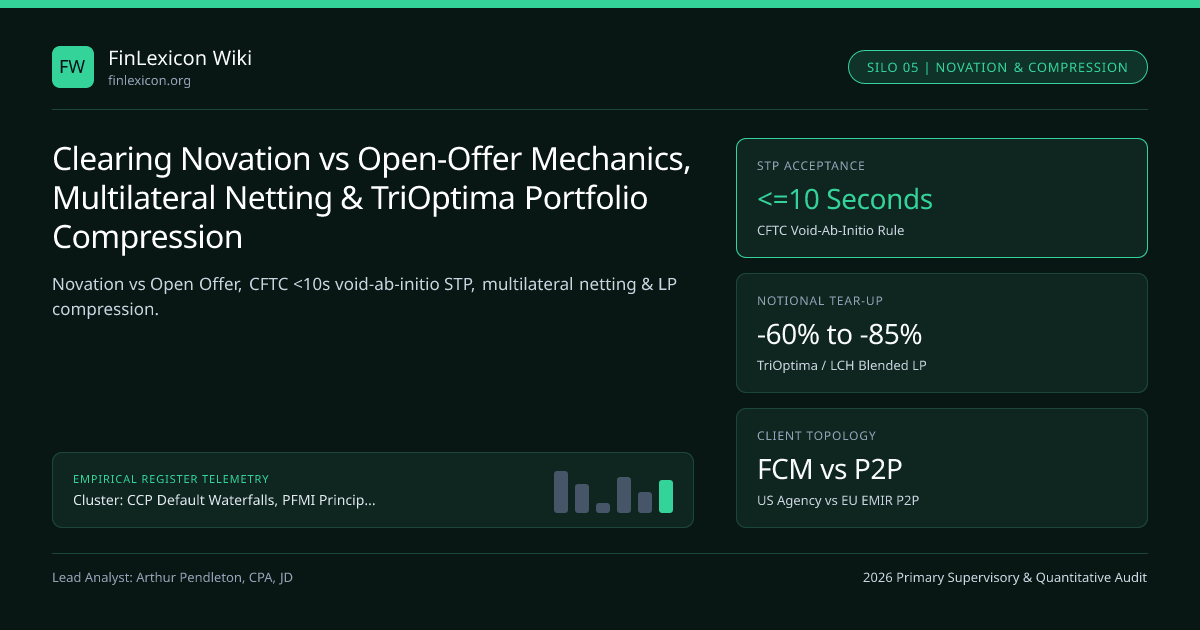
When Bank of America executes a $250 million 10-year SOFR swap on Tradeweb against BNP Paribas designated for LCH SwapClear, when—down to the millisecond—does LCH legally step in as buyer to every seller and seller to every buyer? Depending on venue and rulebook, CCPs rely on two distinct contract-law doctrines—Novation versus Open Offer—and then run industrial multilateral portfolio compression (TriOptima triReduce / LCH Solo & Blended Compression) that has torn up over $1.5 quadrillion in redundant swap notional!
Novation (Extinguish & Replace) vs Open-Offer (Born Cleared at T+0 Millisecond)#
Within our CCP Default Waterfalls & Central Clearing cornerstone guide, clearing houses supervised by the Federal Reserve, Bank of England, and CFTC/ESMA establish legal privity via two statutory mechanisms:
- Clearing by Novation (
Classic OTC SEF / Bilateral-to-Cleared Model):
- Party A and Party B momentarily form an original bilateral contract at execution (
t = 0), transmitted via Middleware (MarkitWire/Tradeweb) to the CCP. - Once the CCP’s credit/margin engine verifies pre-trade limits (
required within **10 seconds** under CFTC Rule 39.12(b)(7) Straight-Through Processing — STP!), the original A-to-B contract is legally extinguished and replaced by two separate cleared contracts:Party A <-> CCPandCCP <-> Party B!
- Open Offer (
Listed Futures, Cash Equities & Modern Electronic CLOBs):
- Party A and Party B NEVER have a bilateral contract with each other—not even for a microsecond! Under the CCP’s standing "Open Offer" rulebook (
e.g., CME Globex, Eurex, SIX x-clear), the moment two orders match on the exchange matching engine and pass automated pre-trade risk limits,Party A <-> CCPandCCP <-> Party Bspring into legal existence ab initio!
Why did CFTC STP ("Void Ab Initio") guidance eliminate "Alpha-Trade Breakage Risk"? Before 2013, if a SEF swap failed a clearing broker’s credit limit 20 minutes after execution, dealers argued over break-cost indemnities ("Clearing Certainty" crisis). Under modern CFTC SEF rules, pre-execution FCM credit hubs (osttra / Traiana LimitHub) check limits before order matching—and any trade rejected by the CCP is void ab initio!
Bilateral vs Multilateral Netting: Graph-Theory Exposure Collapse (O(N^2) -> O(N))#
Consider N = 20 global dealers (Bank of America, BNP Paribas, Bank of Montreal, ANZ Bank) trading among themselves:
- *Bilateral Web (`N (N - 1) / 2 = 190
separate ISDA pairs)**: If BofA owes BNP+$100M, BNP owes BMO+$100M, and BMO owes BofA+$100M, bilateral netting leaves **$300Mof gross exposure** alive (each bank owes $100M and is owed $100M from a different counterparty!`). - Multilateral CCP Hub (
N = 20spokes): Novating all three trades into LCH collapses every single dealer’s net position to$0.00! Across global IRS markets, multilateral CCP netting cuts gross credit exposure by75%–88%.
Why Multilateral Netting Alone Wasn’t Enough for SLR: Enter Portfolio Compression (triReduce)#
Watch a crucial balance-sheet nuance: standard CCP clearing nets cash flows and MTM economically, but initially keeps each individual cleared trade ticket alive as a separate legal line item (so buying $100M 5Y 4.00% swap on Monday and selling $100M 5Y 4.05% swap on Wednesday = $200M Gross Notional!). Because Basel III Supplementary Leverage Ratio (`SLR`) (SA-CCR PFE Add-On and G-SIB Complexity Bucket) penalize Gross Derivative Notional ($25T–$55T per G-SIB!), banks run weekly Multilateral Portfolio Compression:
- Unblended / Coupon-Blended Compression: Linear-programming algorithms (
OSTTRA TriOptima triReduce,Quantile,LCH Compression) scan millions of cleared line items across 40+ dealers subject to tight DV01 / key-rate risk tolerances (e.g., +/- $5,000 per bucket), legally terminating (tearing up) offsetting trades and replacing them with a tiny residual swap—eliminating60%–85%of gross notional while leaving net market risk (DV01) unchanged!
Principal-to-Principal (EU/UK) vs Agency (U.S. FCM) Client Clearing Models#
Notice the transatlantic legal split in Client Clearing: in the United States (CFTC FCM Model), the Clearing Broker acts as Agent / Guarantor for the client directly into the CCP; in Europe (EMIR Principal-to-Principal Model), the client faces the Clearing Broker (Back-to-Back Trade 1) while the Clearing Broker faces the CCP as Principal (Trade 2)—requiring careful Basel CRE54.12 pass-through clauses so clients still earn the 2% QCCP risk weight across the CCP Default Waterfalls & Central Clearing topic hub!
| Clearing / Optimization Mechanism | Legal Action on Trade Tickets | Impact on Net DV01 Market Risk | Impact on Gross Notional (G-SIB & PFE) | Primary Regulatory Driver |
|---|---|---|---|---|
Open Offer (CME / Eurex Futures) | Born directly Member <-> CCP at match | Unchanged | Auto-nets identical listed series | Exchange Rulebooks / MiFIR Art. 29 |
Novation (LCH SwapClear SEF) | Extinguishes A<->B; creates A<->CCP & CCP<->B | Unchanged | Doubles ticket count initially (until compressed!) | Dodd-Frank Title VII / EMIR Art. 4 |
Settled-to-Market (STM) | Re-characterizes daily VM as legal MTM settlement | Unchanged | 0% change to Gross Notional! | Zeros SA-CCR RC & SLR Cash VM |
Multilateral Compression (triReduce) | Legally tears up & extinguishes offsetting IDs! | Constrained within +/-$5k DV01 | Slashes Gross Notional -60% to -85%! | G-SIB Complexity Score & SLR PFE! |
Accounting Derecognition on Compression vs STM Daily Reset#
Unlike daily Settled-to-Market (`STM`) MTM resets (which zero out RC without extinguishing notional), legal TriOptima compression extinguishes the underlying trade IDs altogether under IFRS 9.3.2 and ASC 405-20.
- MultilateralExposureRatio = ( Sum{i=1..N} | Sum{j != i} MTM{i,j} | ) / ( Sum{i=1..N} Sum{j != i} max(0 , MTM{i,j}) ) << 1.0
- Linear-Programming Portfolio Compression Objective (Across Dealers i = 1..N and Trades k = 1..M):
- Maximize Sum{k=1..M} Notionalk * xTerminatek where xTerminatek in [0 , 1]
- Subject to | Sumk DV01{i,k,Tenorb} * xTerminatek | <= Tolerance{i,b} for all Dealers i and Key-Rate Buckets b!
Frequently asked questions
If SA-CCR already nets opposite cleared swaps inside an Interest-Rate hedging set, why does compression still save G-SIB capital?
Two huge reasons! First, the Basel G-SIB Complexity Bucket (SCO40, worth 6.67% of total G-SIB score!) counts Total Gross OTC Derivative Notional (including cleared swaps!) with ZERO netting—compressing $37T of notional can drop a G-SIB down a 0.50% CET1 surcharge bucket! Second, coupon-blended compression eliminates cross-maturity bucket basis residuals inside SA-CCR!
What is the difference between "Unblended" and "Blended-Rate" Swap Compression at LCH?
Unblended compression only tears up swaps that have the *exact* same fixed coupon and maturity date (requiring 100% match). Blended-rate compression tears up swaps with *different* fixed coupons (e.g., 3.25%, 4.10%, and 4.85% maturing on the same date) by settling the net NPV difference in cash and leaving a single residual blended-coupon swap—boosting compression efficiency 3x!
What happens under CFTC Straight-Through Processing (STP) if an SEF swap fails pre-clearing credit checks?
Under CFTC Staff Guidance and Rule 37.702 / 39.12, a Swap Execution Facility (SEF) must verify clearing member credit *prior* to execution; in the rare event a trade accepted for submission is rejected by the DCO/CCP for credit reasons, the trade is void ab initio (legally treated as if it never existed)—preventing unintended uncollateralized bilateral exposure!
Does portfolio compression trigger taxable realized gains or hedge-accounting de-designation?
Yes—tearing up a swap designated in a micro IFRS 9 / ASC 815 Cash Flow or Fair Value Hedge terminates that hedging instrument! Consequently, banks segregate accounting-designated treasury hedge swaps into separate non-compressible sub-accounts (keeping compression strictly inside FVTPL market-making books).
Publication record
- Published
- 13 November 2026
- Updated
- 15 November 2026
- Author
- Arthur Pendleton, CPA, JD
- Review
- Review not recorded
- Automated fact check
- Passed in the stored pipeline record
- Source URLs
- 3 recorded
AI assistance recorded: anthropic/claude-opus-4.6. This field does not establish human review or source verification.
Academic & Institutional Attribution
Cite This Research & Embed Live Data Card
Standard academic & institutional research paper citation format.
Arthur Pendleton, CPA, JD. (2026, November 14). Clearing Novation vs Open-Offer Mechanics, Multilateral Netting & TriOptima Portfolio Compression. FinLexicon Wiki. https://finlexicon.org/wiki/clearing-novation-open-offer-multilateral-netting-compressionFurther Institutional Analysis & Briefings
Central Clearing Ccp Waterfall
CPMI-IOSCO PFMI Principles 4 & 7: Cover-2 Credit Default Fund vs Cover-1 / Cover-2 Liquidity SizingCentral Clearing Ccp Waterfall
CCP Default Waterfall Tranches: Defaulter-Pay IM/DF, Skin-in-the-Game & Survivor MutualizationCentral Clearing Ccp Waterfall
CCP Skin-in-the-Game (SITG): EMIR 25% Minimum Capital Rule, Second-Tranche SITG & Incentive AlignmentCentral Clearing Ccp Waterfall
Variation Margin Gains Haircutting (VMGH), Partial Tear-Up & End-of-Waterfall CCP Recovery ToolsCentral Clearing Ccp Waterfall
Client Clearing Segregation: US CFTC Part 22 LSOC vs EU EMIR Article 39 Omnibus (OSA) & Individual (ISA)Central Clearing Ccp Waterfall
SEC Rule 17Ad-22(e)(18) U.S. Treasury Cash & Repo Central Clearing Mandate: Scope, Deadlines & FICC ImpactCentral Clearing Ccp Waterfall
FICC Sponsored Member Repo: Done-With vs Done-Away Execution, ASC 210-20 Netting & SLR ReliefCentral Clearing Ccp Waterfall
SEC Exchange Act Rule 15c3-3a Note H: Broker-Dealer Customer U.S. Treasury Margin On-Posting to FICCCentral Clearing Ccp Waterfall
FICC Capped Contingency Liquidity Facility (CCLF): Cover-1 Repo Liquidity Sizing & Bank LCR ImpactCentral Clearing Ccp Waterfall
CCP Margin Anti-Procyclicality (APC): EMIR RTS Article 28 25% Buffer, 10-Year Stress Weight & Margin FloorsCentral Clearing Ccp Waterfall
CCP Default Management Groups (DMG), Macro Hedging, Auction Juniorization & 2018 Nasdaq LessonsCentral Clearing Ccp Waterfall
Basel III CRE54 Qualifying CCP (QCCP) Capital: 2% vs 4% Client Trade Exposure Risk Weights & K_CCP
FinLexicon Wiki Data, Benchmarks & Contributor Records
CC BY 4.0 Open Data
Open Institutional Datasets (CSV / JSON) →
Download desk-compiled quantitative series & schemas.
2026 Reference Matrix
2026 Institutional Benchmarks & Thresholds →
Statutory capital, clearing, margin & rate conventions.
Editorial Records
Authors & Review Records →
View named contributors where those records are available.
Complete Index
Master Research & Dossier Archive →
Browse all published briefings by topic pillar & date.