
Liquidity Coverage Nsfr Prudential
Held-to-Maturity (HTM) Unrealized Losses, Uninsured Deposit Runs & the Solvency-Liquidity Doom Loop
Amortized-cost Held-to-Maturity (HTM) accounting shields reported CET1 from bond rate losses only while funding remains sticky; in LCR, HQLA is always marked to fair market value, exposing fragile uninsured deposit franchises.
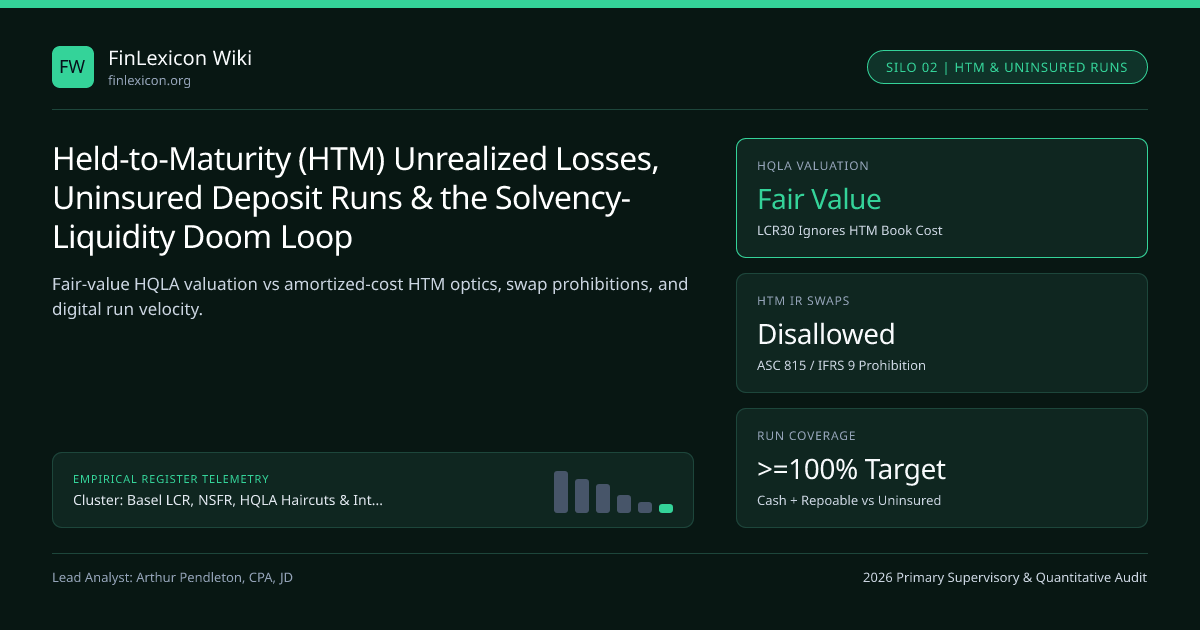
Few balance-sheet interactions in modern prudential banking are more lethal—or more widely misunderstood prior to March 2023—than the divergence between accounting carrying value and liquidity monetization value on Held-to-Maturity (HTM) sovereign and agency mortgage bonds. While ASC 320 / IFRS 9 amortized-cost accounting shields reported earnings and CET1 from rising yield curves, Basel LCR30.32 values every dollar of HQLA strictly at current Fair Market Value—meaning rate hikes silently hollow out a bank’s liquid buffer long before a single cent hits GAAP net income!
Accounting Illusion vs Liquidity Reality: Amortized Cost in CET1 vs Fair Value in HQLA#
Suppose a bank invests $100B of surge uninsured deposits into 1.75%-coupon 10-year Agency MBS classified as Held-to-Maturity (HTM), and policy rates subsequently rise +400 bps, dropping the bonds’ market value to $78.0B (-$22.0B unrecognized economic loss):
- Reported GAAP / CET1 View: On the balance sheet face, the HTM bonds still sit at
$100.0Bamortized cost (with$78.0Bdisclosed only in financial-statement footnotes!). Neither GAAP equity nor CET1 (even without an AOCI filter, because HTM bypasses AOCI too!) deducts the$22.0Bloss. - LCR & Central Bank Liquidity View: Under Basel LCR30 HQLA valuation rules, HQLA must be included at current market value minus Level 2A 15% haircut:
$78.0B * 0.85 = $66.3B! Over one-third (-$33.7B) of the initial$100Bdeposit coverage has already vanished!
Anatomy of the Uninsured Deposit Run & HTM Tainting Doom Loop#
When institutional depositors—corporate treasurers, VC-backed startups, or private-bank clients holding balances far above the $250,000 FDIC (EUR 100,000 EU / GBP 85,000 UK) insurance cap—compute economic tangible common equity (TCE - Unrecognized_HTM_Losses <= 0), game theory flips deposit stickiness into an instant prisoner’s dilemma run:
- Stage 1 (Digital Velocity): Uninsured depositors wire out 25% in a single day (
$42Boutflow in 10 hours at SVB on March 9, 2023, with another$100Bqueued for March 10—6x faster than Washington Mutual’s 16-day 2008 run!). - Stage 2 (AFS Exhaustion & Realized CET1 Hit): Selling Available-for-Sale (AFS) bonds crystallizes AOCI losses into GAAP net income (for Category III/IV banks using the legacy AOCI opt-out filter, selling AFS bonds suddenly slams CET1!).
- Stage 3 (HTM Sale & Tainting Cliff): Once cash, AFS, and same-day repo capacity run dry, selling any HTM bond to pay fleeing depositors taints the entire remaining HTM portfolio, reclassifying all
$22Bof unrealized losses into AFS/AOCI and wiping out CET1 overnight!
Concentrated Uninsured Franchises vs Diversified Granular Retail Banks#
Post-2023 empirical studies by BCBS / BIS (BCBS d555) and the U.S. Federal Reserve contrasted failure-prone banks (>85%–93% uninsured deposits concentrated in networked venture/crypto cohorts) against diversified G-SIBs like Bank of America, BNP Paribas, and Bank of Montreal, where mass-market insured checking, swap-hedged AFS portfolios, and >120% daily LCR prevented run contagion.
| Accounting & Prudential Metric | Available-for-Sale (AFS / FVOCI) | Held-to-Maturity (HTM / Amortized Cost) | Stress Impact During +400 bps Hike & Run |
|---|---|---|---|
| Balance Sheet Carrying Value | Current Fair Market Value ($78B) | Amortized Cost ($100B; $78B in Footnote) | HTM masks -$22B economic loss on balance sheet |
| CET1 Capital Impact (No AOCI Filter) | -$22B deducted immediately via AOCI | $0 deducted while held to maturity! | Sale of 5% HTM taints 100% -> -$22B cliff! |
| Fair-Value Interest-Rate Swap Hedge | Permitted (ASC 815 / IFRS 9) | Strictly Prohibited for IR risk! | HTM locks in unhedged fixed-rate duration |
| Basel LCR HQLA Valuation (LCR30.32) | Fair Market Value minus 0%/15% haircut | Fair Market Value minus 0%/15% haircut! | Identical HQLA shrinkage (-22% pre-haircut) |
| Monetization Without Realized Loss | Repo Only (Outright sale hits P&L) | Repo / Central Bank Facility ONLY! | Outright HTM sale triggers tainting rule |
Why Fair-Value Portfolio Hedge Accounting Cannot Be Applied to HTM Under US GAAP / IFRS 9#
Crucial accounting trap: under both ASC 815 and IFRS 9.6.5, Held-to-Maturity securities CANNOT be designated as hedged items for interest-rate fair-value hedges (because claiming you are indifferent to rate moves via HTM contradicts hedging interest-rate fair value!). Thus, shifting bonds into HTM locks in unhedged economic duration unless offset macroeconomically elsewhere!
Prudential Reforms Under Discussion: Uninsured Run-Off Calibration & HTM Monetization Haircuts#
Global standard-setters across the Basel LCR, NSFR & Prudential Liquidity topic hub are actively reviewing whether LCR40 10% uninsured retail and 25%/40% corporate run-off rates understate networked digital banking speed, and whether HTM HQLA must carry verified repo-encumbrance capacity to count in Pillar 1 LCR.
- HQLAEligibleHTM = FairValueHTM * ( 1 - HaircutLCRLevel ) [ provided RepoPipeCapacity >= FairValueHTM ]
- RunCoverageRatio = ( CashReserves + HQLAAFSFMV + RepoableHTMFMV ) / UninsuredDeposits
- Worked Solvency-Liquidity Stress Audit ($210B Bank: $15B Cash, $25B AFS FMV [-$3B AOCI], $90B HTM Cost / $73B HTM FMV [-$17B Loss]; $155B Uninsured Deposits):
- Reported CET1 = $14.5B | After-Tax Total Unrealized Loss (21% tax on $20B) = -$15.8B => Economic CET1 = -$1.3B (< 0!)
- True Repo-Monetizable Liquidity (Cash $15B + AFS $25B0.95 + HTM $73B0.85 L2A) = $15.0B + $23.75B + $62.05B = $100.8B
- Uninsured Deposit Coverage = $100.8B / $155.0B = 65.0% => Any uninsured run > 65% forces outright HTM liquidation & insolvency!
Frequently asked questions
Does removing the AOCI opt-out filter under U.S. Basel III Endgame (ERBA) put HTM losses into CET1?
No! Removing the AOCI filter brings Available-for-Sale (AFS / FVOCI) unrealized gains and losses into CET1, whereas Held-to-Maturity (HTM) unrealized losses do not flow through AOCI at all under GAAP/IFRS—meaning HTM duration risk must still be policed via IRRBB 15% Tier 1 EVE tests and repo readiness!
Can a bank count Held-to-Maturity Treasury bonds as Level 1 HQLA in the LCR?
Yes—Basel LCR30.17 permits HTM securities to count in HQLA at current fair market value because they can be monetized via repurchase agreements (repo) without violating HTM sale restrictions, provided the treasury desk maintains active legal and operational repo capacity.
Why couldn’t Silicon Valley Bank simply enter pay-fixed interest-rate swaps against its $91B HTM Agency MBS portfolio?
Because ASC 815 forbids fair-value hedge accounting on HTM securities! Entering standalone pay-fixed swaps without hedge accounting would mark swap gains to P&L in hikes—but if rates *fell*, swap losses would hit P&L immediately while HTM bond gains stayed off-income at amortized cost!
What deposit metric do credit analysts now track alongside LCR after March 2023?
Institutional bank analysts track the Uninsured Deposit Coverage Ratio ((Cash + Unencumbered Fair-Value Repoable Securities + Pre-Positioned Discount Window Capacity) / Uninsured Deposits), demanding >= 100% coverage at regional banks.
Publication record
- Published
- 14 November 2026
- Updated
- 15 November 2026
- Author
- Arthur Pendleton, CPA, JD
- Review
- Review not recorded
- Automated fact check
- Passed in the stored pipeline record
- Source URLs
- 3 recorded
AI assistance recorded: anthropic/claude-opus-4.6. This field does not establish human review or source verification.
Academic & Institutional Attribution
Cite This Research & Embed Live Data Card
Standard academic & institutional research paper citation format.
Arthur Pendleton, CPA, JD. (2026, November 15). Held-to-Maturity (HTM) Unrealized Losses, Uninsured Deposit Runs & the Solvency-Liquidity Doom Loop. FinLexicon Wiki. https://finlexicon.org/wiki/htm-held-to-maturity-unrealized-losses-uninsured-deposit-runsRelated Liquidity Coverage Nsfr Prudential & Institutional Briefings
Explore Liquidity Coverage Nsfr Prudential Hub (20) →Liquidity Coverage Nsfr Prudential
Basel III LCR, NSFR, HQLA Haircuts & Intraday Prudential Liquidity ArchitectureLiquidity Coverage Nsfr Prudential
Cross-Currency LCR (LCR30.45), Off-Balance-Sheet FX Swap Funding Gaps & CLS PvP LiquidityLiquidity Coverage Nsfr Prudential
NSFR Interdependent Assets & Liabilities (NSF30.35): 0% Pass-Through, Promotional Loans & CCP IMLiquidity Coverage Nsfr Prudential
Collateral Swaps, Securities Lending & Liquidity Upgrade Trades: LCR30.36 Unwind & LCR40.48 OutflowsLiquidity Coverage Nsfr Prudential
Contingent Funding Plans (CFP), Early Warning Indicators (EWIs) & Liquidity Funds Transfer Pricing (LFTP)Liquidity Coverage Nsfr Prudential
HQLA Level 1, 2A & 2B Haircuts: 40%/15% Composition Caps & Secured Funding Unwind (LCR30)Liquidity Coverage Nsfr Prudential
LCR 30-Day Deposit Run-Off Rates (LCR40): Stable Retail (3%/5%), Operational (25%) & Financial (100%)Liquidity Coverage Nsfr Prudential
LCR 75% Aggregate Cash Inflow Cap: Performing Loan Rollovers, SFTs & the 25% HQLA FloorIsda Csa Derivatives Collateral
ISDA Additional Termination Events (ATEs — Sec. 5(b)(vi)): Hedge Fund NAV Decline & Credit Rating TriggersIsda Csa Derivatives Collateral
Multilateral Portfolio Compression & Margin Optimization (TriOptima / Quantile): SIMM, SA-CCR & eSLR ReliefIsda Csa Derivatives Collateral
Physically Settled FX Forwards & Swaps: U.S. Treasury Exemption, UMR IM Carve-Out, VM Nuances & SA-CCRIsda Csa Derivatives Collateral
2023 ISDA Digital Asset Derivatives Definitions: Fork Events, Oracle Disruptions & Basel SCO60 Capital
FinLexicon Wiki Data, Benchmarks & Contributor Records
CC BY 4.0 Open Data
Open Institutional Datasets (CSV / JSON) →
Download desk-compiled quantitative series & schemas.
2026 Reference Matrix
2026 Institutional Benchmarks & Thresholds →
Statutory capital, clearing, margin & rate conventions.
Editorial Records
Authors & Review Records →
View named contributors where those records are available.
Complete Index
Master Research & Dossier Archive →
Browse all published briefings by topic pillar & date.