
Isda Csa Derivatives Collateral
ISDA Additional Termination Events (ATEs — Sec. 5(b)(vi)): Hedge Fund NAV Decline & Credit Rating Triggers
Added via Part 1(h) of the ISDA Schedule under Section 5(b)(vi), Additional Termination Events (ATEs) protect dealers and end-users via bespoke Rating Downgrade, Hedge Fund NAV Decline, and Key-Person triggers.
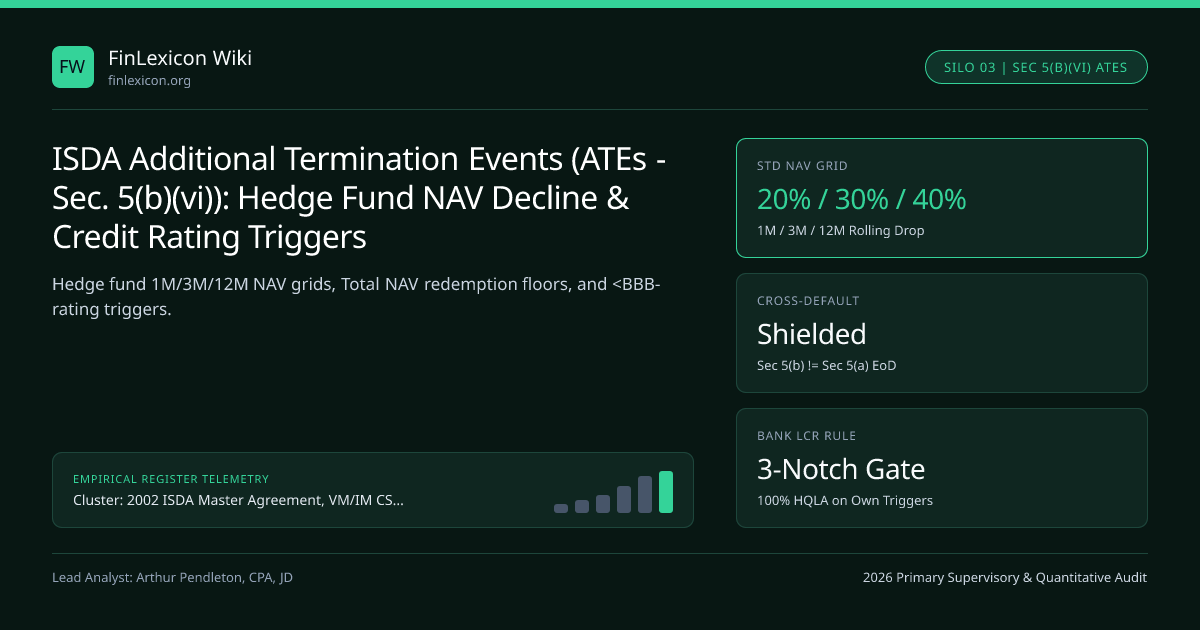
Waiting for a highly leveraged hedge fund or deteriorating counterparty to actually miss a margin wire (Section 5(a)(i)/(iii)) or file for insolvency (Section 5(a)(vii)) often means liquidating swaps after liquidity has evaporated—as prime brokers learned abruptly during the March 2021 Archegos Capital collapse. To create an earlier, no-stigma exit ramp without cross-defaulting third-party bonds, institutional credit officers draft bespoke Additional Termination Events (ATEs) under Section 5(b)(vi) (Part 1(h) of the Schedule) of the 2002 ISDA Master Agreement.
Why Counterparties Prefer an ATE (Section 5(b)(vi)) Over an Event of Default (Section 5(a))#
Why do hedge funds, insurers, and corporates fiercely resist adding financial-ratio or rating triggers inside Section 5(a) Events of Default, yet accept them as Section 5(b)(vi) Additional Termination Events?
- Avoids Cross-Default Contagion: Many syndicated loan agreements, prime-brokerage agreements, and indentures cross-default automatically upon an "Event of Default" under derivatives—whereas a Termination Event (
Section 5(b)) lets a single dealer unwind its swaps cleanly without triggering an instant death-spiral cross-default across every other lender! - Exact Close-Out Parity ("One Affected Party" Pricing): Do NOT think an ATE softens the dealer’s close-out valuation! Because the Schedule designates the downgraded/NAV-breaching fund as the sole "Affected Party", Section 6(e)(ii)(1) prices 100% of terminated transactions using the exact same Non-Affected Party replacement bid/offer Close-Out Amount as an Event of Default!
Anatomy of Hedge Fund NAV Decline Triggers: Total NAV vs NAV-per-Share & Cure Mechanics#
When onboarding macro, credit, or relative-value hedge funds at Bank of America, BNP Paribas, and Bank of Montreal, credit officers negotiate a three-tier Net Asset Value (NAV) Decline Matrix alongside an Absolute NAV Floor:
- Standard Rolling Decline Grid: e.g.,
>= 15%–20%drop over 1 Month,>= 25%–30%drop over 3 Months, and>= 35%–40%drop over 12 Months, PLUS a hard Absolute NAV Floor (e.g.,NAV < max($100M, 50% of Highest Year-End NAV)). - Total Fund NAV vs NAV-per-Share Battle: Dealers demand Total Fund NAV (because investor redemptions shrink the equity cushion absorbing 10-day close-out tail losses even if investment performance is
+2%!). Funds push for NAV per Share (measuring pure trading losses excluding investor redemptions)—often compromising on dual triggers: NAV-per-Share for the 1M/3M performance windows paired with a hard Total Dollar NAV Floor ($150M) to cap redemption drain! - Fish-or-Cut-Bait Sunset Clauses: Without a time limit, a fund dipping
-21%in October 2024 and recovering+35%in 2025 would remain exposed to a surprise ATE termination years later! Funds negotiate a 30-to-60-day Exercise Window once the monthly NAV report is delivered.
Credit Rating Downgrade ATEs & Their Basel LCR40.57 Liquidity Buffer Tax on Banks!#
Mutual Credit Rating Downgrade ATEs—typically triggered if a bank or insurer’s long-term senior unsecured rating falls below Investment Grade (< BBB- S&P/Fitch or < Baa3 Moody’s)—carry a massive prudential liquidity consequence supervised by the Federal Reserve, ECB, and UK PRA:
- Remember AIG Financial Products (2008): a rating downgrade forced AIG to post tens of billions overnight! Consequently, Basel LCR40.56–LCR40.57 requires every bank to hold 100% Level 1/2 HQLA today against all additional collateral or close-out cash outflows triggered by a 3-notch downgrade of the bank’s own credit rating!
- Modern bank treasuries avoid granting rating-linked collateral thresholds (
$0threshold 2016 VM CSA eliminates threshold cliffs!) and cure dealer downgrade ATEs via novation rights to an investment-grade affiliate or posting additional Independent Amount.
| ATE Category (Schedule Part 1(h)) | Typical Quantitative / Legal Trigger | Negotiated Buy-Side Carve-Out / Cure | Designated Affected Party |
|---|---|---|---|
| Rolling NAV Decline (Performance) | >= 20% (1M), >= 30% (3M), >= 40% (12M) | Measured on NAV per Share + 45d exercise sunset | Hedge Fund ONLY |
| Absolute NAV Floor (Size/Redemption) | Total Net Assets < $150M (or < 50% peak) | Equity capital injection cure within 5–10 BD | Hedge Fund ONLY |
| Credit Rating Downgrade (Mutual) | Senior unsecured < BBB- AND < Baa3 ("Both") | Right to novate to IG bank or post top-up IA | Downgraded Party ONLY |
| Investment Manager / Key-Person | Replacement of IM or departure of named CIO | Pre-approved affiliate IM reorganisation carve-out | Fund / Managed Account ONLY |
| ERISA / Regulatory License Loss | Benefit-plan equity >= 25% without QPAM | Immediate mandatory cure / affected unwind | Fund / Unlicensed Party |
Specialized Institutional ATEs: Key-Person, Investment Manager Removal & ERISA Plan Caps#
Buy-side Schedules add Investment Manager Termination / Key-Person Departure ATEs, Delisting / Suspension of Audited NAV, and ERISA 25% "Plan Assets" Threshold Breaches (since crossing 25% benefit-plan investment turns a fund into a statutory ERISA fiduciary prohibited from non-exempt principal dealer swaps!).
Harmonizing ATEs With Margin Lockups Across the Topic Hub#
Prime brokerage and OTC derivative desks synchronize ISDA NAV ATEs with 30-to-90-day Margin Lockup Agreements across the ISDA-2002-CSA 2026 Benchmark Standard and the 2002 ISDA Master Agreement, CSA & SIMM topic hub.
- ATETotalNAVFloorBreached <=> TotalNetAssetsAuditedorAdmin(t) < max( HardFloorUSD , 0.50 * PriorYearEndTotalNAV )
- Worked Dual-Trigger Hedge Fund Credit Audit (Peak Prior Year-End NAV = $600M; Hard Floor = $250M => Dynamic Floor = max($250M, $300M) = $300.0M):
- Month T: Fund returns -8.0% (< 20% 1M NAV/sh trigger), while quarterly investor redemptions withdraw $280.0M:
- Ending Total Net Assets = ($600M * 0.92) - $280M = $552M - $280M = $272.0M!
- Result: $272.0M < $300.0M Dynamic Total NAV Floor -> Triggers Section 5(b)(vi) ATE unless Fund raises +$28.0M equity cure!
Frequently asked questions
What happens if a hedge fund simply stops sending monthly NAV statements to hide a 25% loss?
Every institutional Schedule pairs the NAV Decline ATE with an explicit NAV Reporting Failure Covenant / ATE: failing to deliver an independent third-party fund administrator’s monthly NAV statement within 15–20 calendar days of month-end (after a 2-to-3-day notice cure) is itself an immediate ATE!
In a Rating Downgrade ATE, what is the crucial difference between an "OR" trigger vs an "AND" trigger across S&P and Moody’s?
Under an "OR" trigger (S&P < BBB- OR Moody’s < Baa3), a split rating where *either* agency cuts one notch below IG fires termination; borrowers negotiate "AND" triggers (requiring *both* agencies below IG, plus a trigger if the entity ceases to be rated by at least one agency!).
Can a dealer selectively terminate only its profitable swaps when a Section 5(b)(vi) NAV ATE occurs?
No! Under the ISDA Schedule boilerplate for Credit/NAV/Rating ATEs, all Transactions are defined as *Affected Transactions*, and Section 6(b)(iv) requires terminating all Affected Transactions together (protecting single-agreement netting integrity!).
How did the March 2021 Archegos Capital total-return-swap failure reshape ISDA ATE and Independent Amount terms?
Archegos held massive concentrated single-stock total return swaps across 6+ prime brokers on thin static house IAs with zero cross-dealer position visibility; post-2021, dealers introduced Dynamic Concentration / Gross-Leverage Disclosure Covenants where breaching undisclosed street-wide concentration triggers immediate IA step-ups or ATEs!
Publication record
- Published
- 14 November 2026
- Updated
- 15 November 2026
- Author
- Arthur Pendleton, CPA, JD
- Review
- Review not recorded
- Automated fact check
- Passed in the stored pipeline record
- Source URLs
- 3 recorded
AI assistance recorded: anthropic/claude-opus-4.6. This field does not establish human review or source verification.
Academic & Institutional Attribution
Cite This Research & Embed Live Data Card
Standard academic & institutional research paper citation format.
Arthur Pendleton, CPA, JD. (2026, November 14). ISDA Additional Termination Events (ATEs — Sec. 5(b)(vi)): Hedge Fund NAV Decline & Credit Rating Triggers. FinLexicon Wiki. https://finlexicon.org/wiki/ate-additional-termination-events-nav-decline-rating-triggersRelated Isda Csa Derivatives Collateral & Institutional Briefings
Explore Isda Csa Derivatives Collateral Hub (20) →Isda Csa Derivatives Collateral
2002 ISDA Master Agreement, VM/IM CSA, ISDA SIMM v2.6, SA-CCR & Close-Out Netting ArchitectureIsda Csa Derivatives Collateral
Multilateral Portfolio Compression & Margin Optimization (TriOptima / Quantile): SIMM, SA-CCR & eSLR ReliefIsda Csa Derivatives Collateral
Physically Settled FX Forwards & Swaps: U.S. Treasury Exemption, UMR IM Carve-Out, VM Nuances & SA-CCRIsda Csa Derivatives Collateral
2023 ISDA Digital Asset Derivatives Definitions: Fork Events, Oracle Disruptions & Basel SCO60 CapitalIsda Csa Derivatives Collateral
ISDA Section 2(a)(iii) Condition Precedent: Payment Suspension, Lomas & 2014 Sunset AmendmentIsda Csa Derivatives Collateral
1992 ISDA Market Quotation & Loss vs 2002 Close-Out Amount: Section 6(e) Early Termination ValuationIsda Csa Derivatives Collateral
ISDA Section 5(a) Events of Default vs Section 5(b) Termination Events: Cross-Default & Threshold AmountsIsda Csa Derivatives Collateral
2016 ISDA Variation Margin CSA: New York Security Interest Pledge vs English Law Title TransferIfrs9 Cecl Credit Provisioning
IFRS 7, ASC 326 Vintage Charge-Off Tables & ISA 540 / PCAOB AS 2501 External Audit of Credit Loss EstimatesIfrs9 Cecl Credit Provisioning
Deferred Tax Assets (IAS 12 & ASC 740 Valuation Allowances) vs Basel III CAP30 10% / 17.65% CET1 DeductionsIfrs9 Cecl Credit Provisioning
Held-to-Maturity (HTM) Tainting (ASC 320), IFRS 9.4.4.1 Reclassification & AFS/FVOCI Bond Loss RulesCentral Clearing Ccp Waterfall
Clearing Novation vs Open-Offer Mechanics, Multilateral Netting & TriOptima Portfolio Compression
FinLexicon Wiki Data, Benchmarks & Contributor Records
CC BY 4.0 Open Data
Open Institutional Datasets (CSV / JSON) →
Download desk-compiled quantitative series & schemas.
2026 Reference Matrix
2026 Institutional Benchmarks & Thresholds →
Statutory capital, clearing, margin & rate conventions.
Editorial Records
Authors & Review Records →
View named contributors where those records are available.
Complete Index
Master Research & Dossier Archive →
Browse all published briefings by topic pillar & date.