
Liquidity Coverage Nsfr Prudential
Contingent Funding Plans (CFP), Early Warning Indicators (EWIs) & Liquidity Funds Transfer Pricing (LFTP)
Under BCBS 144 Sound Liquidity Principles, banks unite ex-ante Liquidity Funds Transfer Pricing (LFTP) internal tax curves with ex-post Contingent Funding Plan (CFP) playbooks triggered by real-time Early Warning Indicators.
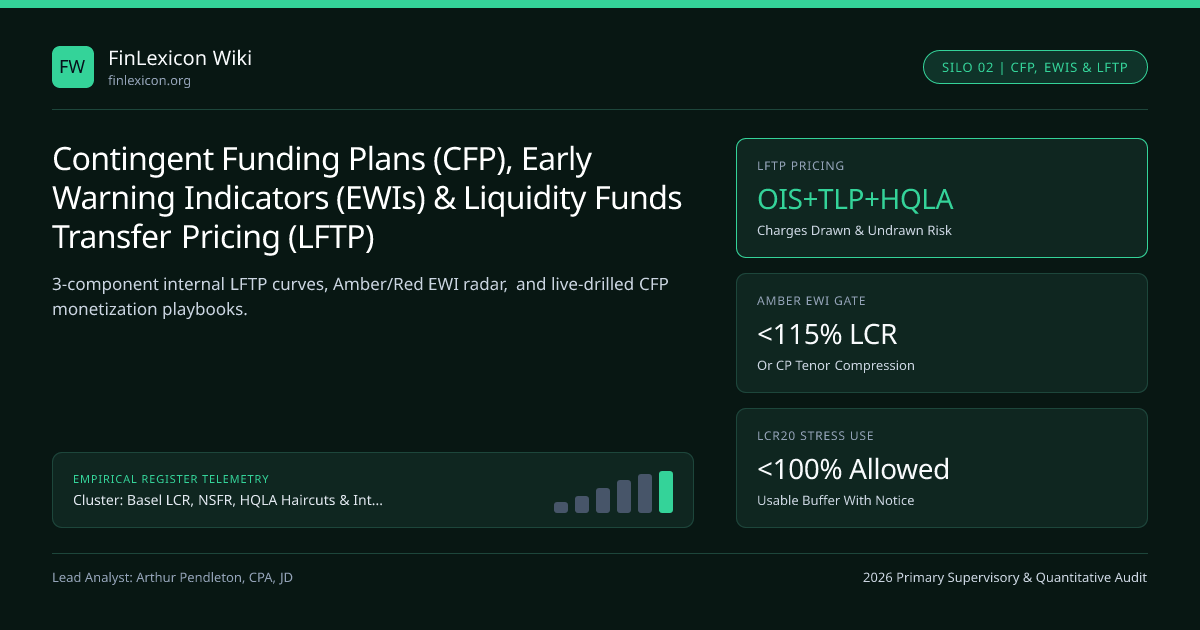
Ratios measure risk; governance and internal pricing prevent and resolve crises. Under the Basel Committee’s foundational Principles for Sound Liquidity Risk Management and Supervision (BCBS 144, codified in Basel SRP50 / Pillar 2), every banking group must pair ex-ante Liquidity Funds Transfer Pricing (LFTP)—charging lending and trading desks the exact basis-point cost of the HQLA and term debt they consume—with an actionable, tabletop-tested Contingent Funding Plan (CFP) wired to quantitative Early Warning Indicators (EWIs).
Liquidity Funds Transfer Pricing (LFTP): Decomposing Base Curve, Term Liquidity, and Contingent HQLA Carry#
Why did investment banking and commercial lending desks over-originate illiquid 100%-outflow liquidity lines and 10-year loans prior to 2008? Because legacy treasuries charged all desks a single flat overnight Libor/Fed Funds rate, treating multi-year term liquidity and contingent HQLA buffers as a "free public good"! Under BCBS 144 Principle 4 and modern ALCO architecture summarized in our Basel LCR, NSFR & HQLA cornerstone guide, internal LFTP decomposes every loan, deposit, and commitment into three explicit pricing legs:
- Risk-Free Base Rate Curve (
SOFR / €STR / SONIA): Matched to the exact repricing tenor (or NMD tractor swap ladder), transferring pure interest-rate risk cleanly to the central ALM hedging desk. - Matched-Maturity Term Liquidity Premium (
TLP): Derived from the bank’s own senior unsecured wholesale issuance spread over OIS (+45 to +115 bpsat 5 years!), charged to 65%/85%-RSF loans and credited to sticky retail/corporate deposit gatherers! - Contingent Liquidity Buffer Charge (
HQLA Carry Cost): Charges off-balance-sheet corporate revolvers (`10%/30%` LCR), prime-brokerage desks, and HLBA derivative desks for the negative carry (Term_Funding_Spread - HQLA_Yield) of holding dedicated Level 1 HQLA on their behalf!

Calibrating Early Warning Indicators (EWIs): Market-Wide vs Idiosyncratic Amber & Red Gates#
Waiting until headline LCR drops below 100% to convene a Crisis Liquidity Committee is fatal—by then, wholesale markets have already shut. Under BCBS 144 Principle 11 and SRP50.14–SRP50.25, treasuries at Bank of America, BNP Paribas, and Bank of Montreal monitor a daily automated dashboard splitting Market-Wide vs Bank-Specific (Idiosyncratic) EWIs across Green / Amber / Red escalation tiers:
- Market / Price Signals: 5-year senior CDS spread widening (
Amber: +30 bps in 5d/Red: +75 bps or >180 bps), intraday equity drop (>8%vs bank index),EUR/USDFX swap basis blowout, and commercial-paper issuance tenor compression (inability to place>30-dayCP!). - Behavioral / Balance-Sheet Signals: Uninsured corporate deposit outflow velocity (
>3%in 48 hours), customers requesting early redemption of fixed-term CDs (forfeiting interest penalties!), unsolicited debt buyback requests from institutional investors, and BCBS 248 intraday incoming-wire deferral.
Contingent Funding Plan (CFP) Escalation Playbook & "Fire-Drill" Monetization Testing#
Once two Amber EWIs or any single Red EWI breach (e.g., Internal 30d Survival Horizon < 40 days or LCR < 110%), the CFP Governance Matrix transfers tactical authority from routine ALCO to an executive Liquidity Crisis Management Team (LCMT) (CEO, CFO, CRO, Treasurer, General Counsel) executing pre-costed monetization tiers:
- Tier 1 (Zero Reputational Signal): Halt uncommitted secondary loan purchases, shift excess central bank cash across non-ring-fenced branches, repo unencumbered Level 1 Treasuries in cleared FICC / central bank standing facilities, and pause share buybacks.
- Tier 2 (Moderate Commercial Friction): Raise digital/corporate deposit pricing betas, slow discretionary non-core loan renewals, execute
>95dcollateral upgrades, and draw pre-positioned Discount Window / ILTR lines. - Tier 3 (Severe Recovery Synchronization): Seamless handoff into the bank’s Recovery Plan (
BRRD / Dodd-Frank 165(d)), executing whole-loan portfolio sales, subsidiary divestitures, or discretionary AT1/dividend conservation ahead of resolution.
| EWI / CFP Governance Tier | Quantitative Market & Behavioral Triggers | Decision Body & Cadence | Authorized Counterbalancing Actions |
|---|---|---|---|
| Green (BAU Steady State) | LCR >= 120%; 90d ILST > $10B; 5Y CDS stable; normal CP tenor | Monthly ALCO / Daily Treasury | Standard LFTP curve updates; quarterly Discount Window / repo pipe tests |
| Amber (Elevated Watch) | LCR 110%–118%; 5Y CDS +35 bps/wk; CP tenor < 21d; >2% 2d deposit drop | Liquidity Watch Group (Daily) | Freeze uncommitted wholesale lending; pre-stage collateral; term out FX swaps |
| Red Stage 1 (CFP Active) | LCR 102%–109%; 30d ILST near buffer floor; CD early redemptions surge | Executive LCMT (Twice Daily) | Execute FICC/SRF repo monetization; draw pre-pledged CB lines; hike deposit rates |
| Red Stage 2 (Recovery Plan) | LCR < 100% (supervisory notice); rating downgrade >=2 notches | Board of Directors + Supervisor | Invoke formal Recovery Plan: asset book sales, capital raise, dividend/buyback halt |
Supervisory Fire-Drills: Testing Live Repo & Central Bank Draws Before Stress Hits#
Supervisors including the Federal Reserve, OCC, FDIC, ECB, and UK PRA reject "paper-only" CFPs: banks must run annual live operational fire-drills—actually settling small live repo trades across every custodian and executing live test draws at the Discount Window / SMF to verify signatory keys, collateral eligibility tapes, and intraday RTGS cutoffs.
Closing the Prudential Liquidity Loop Across All 20 Silo Entries#
When ex-ante LFTP prices liquidity accurately at origination and ex-post CFP playbooks stand operationally pre-wired, Pillar 1 LCR/NSFR and Pillar 2 ILAAP operate as a unified shield across the Basel LCR, NSFR & Prudential Liquidity topic hub.
- LFTPUndrawnLine = OutflowLCRRate * HQLANegativeCarry + RSFOBS5pct * TLPSpread(1Yto_Tenor)
- LFTPDepositCredit = OISTractorCurve + BehavioralStableShare * TLPCreditSpread - LCRRunoffRate * HQLANegativeCarry
- Worked Corporate Relationship Deal LFTP Audit ($500M 5Y Drawn Term Loan [85% RSF] + $500M Undrawn CP Backstop Liquidity Line [30% LCR, 5% RSF]):
- Bank 5Y Senior Unsecured TLP = +90 bps over 5Y SOFR | HQLA Buffer Negative Carry = 45 bps/yr
- 1. Drawn $500M Term Loan LFTP Spread over 5Y SOFR = 0.85 * 90 bps = +76.5 bps ($3.825M/yr internal liquidity charge)
- 2. Undrawn $500M CP Liquidity Line LFTP Cost = (0.30 * 45 bps) + (0.05 * 90 bps) = 13.5 + 4.5 = +18.0 bps ($0.900M/yr charge before RWA!)
Frequently asked questions
Why is "Commercial Paper (CP) issuance tenor shortening" one of the earliest market EWIs of bank funding stress?
Long before money-market funds halt lending altogether or headline LCR dips, institutional cash managers quietly refuse to buy 90-day or 60-day bank CP and roll only 7-day or overnight paper—steadily compressing weighted-average wholesale maturity toward the 30-day LCR cliff!
Why do customers forfeiting interest penalties to break fixed-term CDs early trigger an immediate Red EWI?
In normal markets, retail and SME savers rarely sacrifice accrued interest penalties on locked term deposits; a sudden spike in early-break requests signals acute reputational fear spreading beyond rate-chasing institutional desks into the core branch franchise.
Should a bank’s Treasury LFTP desk operate as a profit center or a zero-sum utility?
Best-practice supervisory guidance (BCBS 144, EBA ILAAP, PRA) specifies that LFTP and execution desks should run as a zero-margin / cost-recovery utility rather than a speculative profit center, so business-line pricing reflects true market marginal funding costs without internal gaming.
When is a bank legally allowed to let its LCR dip below 100% during a Contingent Funding Plan crisis?
Explicitly under Basel LCR20.4–LCR20.5! BCBS designed the HQLA stock specifically to be used during periods of financial stress (LCR < 100%), requiring prompt notification to supervisors alongside a CFP remediation plan rather than destructive asset fire-sales or credit freezes.
Publication record
- Published
- 14 November 2026
- Updated
- 16 November 2026
- Author
- Arthur Pendleton, CPA, JD
- Review
- Review not recorded
- Automated fact check
- Passed in the stored pipeline record
- Source URLs
- 3 recorded
AI assistance recorded: anthropic/claude-opus-4.6. This field does not establish human review or source verification.
Academic & Institutional Attribution
Cite This Research & Embed Live Data Card
Standard academic & institutional research paper citation format.
Arthur Pendleton, CPA, JD. (2026, November 15). Contingent Funding Plans (CFP), Early Warning Indicators (EWIs) & Liquidity Funds Transfer Pricing (LFTP). FinLexicon Wiki. https://finlexicon.org/wiki/contingent-funding-plan-cfp-early-warning-indicators-ftp-pricingRelated Liquidity Coverage Nsfr Prudential & Institutional Briefings
Explore Liquidity Coverage Nsfr Prudential Hub (20) →Liquidity Coverage Nsfr Prudential
Basel III LCR, NSFR, HQLA Haircuts & Intraday Prudential Liquidity ArchitectureLiquidity Coverage Nsfr Prudential
HQLA Level 1, 2A & 2B Haircuts: 40%/15% Composition Caps & Secured Funding Unwind (LCR30)Liquidity Coverage Nsfr Prudential
LCR 30-Day Deposit Run-Off Rates (LCR40): Stable Retail (3%/5%), Operational (25%) & Financial (100%)Liquidity Coverage Nsfr Prudential
LCR 75% Aggregate Cash Inflow Cap: Performing Loan Rollovers, SFTs & the 25% HQLA FloorLiquidity Coverage Nsfr Prudential
LCR Derivatives Collateral Outflows: 24-Month Historical Look-Back Approach (HLBA) & Rating TriggersLiquidity Coverage Nsfr Prudential
Undrawn Credit vs Liquidity Facilities in LCR40: Corporate (10%/30%), Bank (40%) & SPV (100%)Liquidity Coverage Nsfr Prudential
NSFR Available Stable Funding (ASF) Factors (NSF30): Tier 1/2 Capital, Retail & Sub-1Y CliffsLiquidity Coverage Nsfr Prudential
NSFR Required Stable Funding (RSF) Weights (NSF30): Asset Encumbrance, 65% Mortgages & NPLsIfrs9 Cecl Credit Provisioning
IFRS 9 Stage 1, Stage 2 & Stage 3 ECL Migration: 12-Month vs Lifetime PD, Net Interest & Cure RulesIfrs9 Cecl Credit Provisioning
US GAAP ASC 326 (CECL): Day-One Lifetime Loss, R&S Reversion & ASU 2025-08 M&A Double-Count ReformIfrs9 Cecl Credit Provisioning
IFRS 9 vs CECL Procyclicality in Stress & Basel CET1 Regulatory Capital Transitional Phase-InsIfrs9 Cecl Credit Provisioning
IFRS 9 SICR Quantitative Calibration: Relative Lifetime PD Ratios vs Absolute Basis-Point Thresholds
FinLexicon Wiki Data, Benchmarks & Contributor Records
CC BY 4.0 Open Data
Open Institutional Datasets (CSV / JSON) →
Download desk-compiled quantitative series & schemas.
2026 Reference Matrix
2026 Institutional Benchmarks & Thresholds →
Statutory capital, clearing, margin & rate conventions.
Editorial Records
Authors & Review Records →
View named contributors where those records are available.
Complete Index
Master Research & Dossier Archive →
Browse all published briefings by topic pillar & date.