
Isda Csa Derivatives Collateral
Multilateral Portfolio Compression & Margin Optimization (TriOptima / Quantile): SIMM, SA-CCR & eSLR Relief
Modern post-trade optimization runs two complementary engines: multilateral tear-up compression (crushing gross notional for eSLR and G-SIB scores) and synthetic risk rebalancing (cutting ISDA SIMM Initial Margin and SA-CCR EAD by 35%–60%).
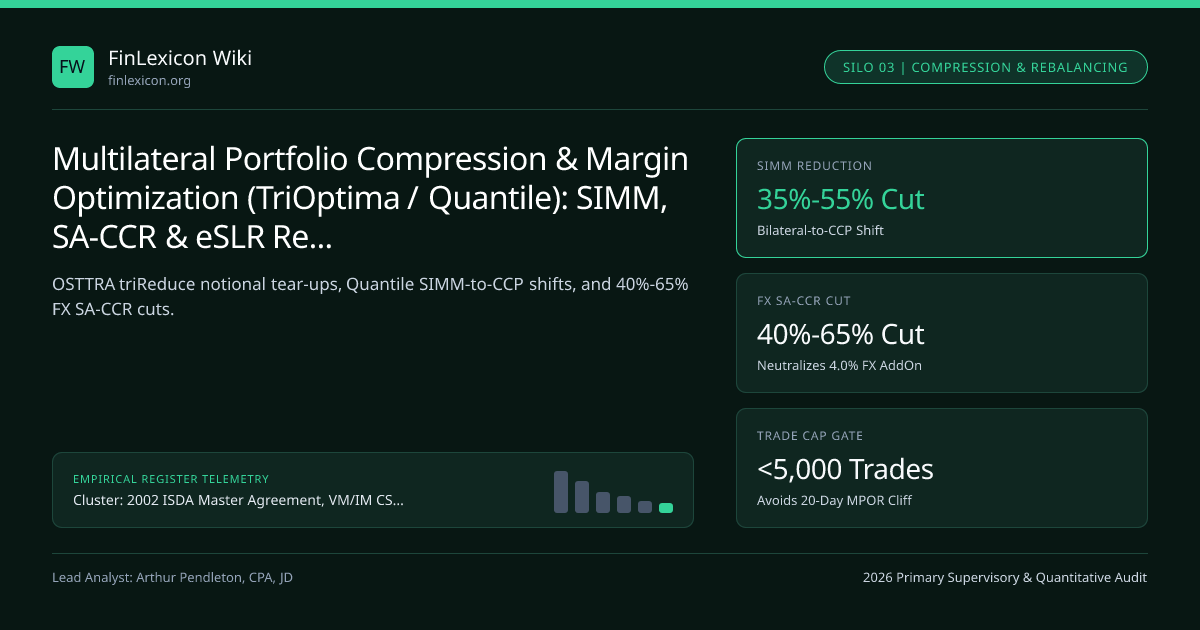
Every time a dealer hedges a 10-year client swap with an offsetting swap rather than legally terminating the original contract, gross notional, trade count, bilateral SIMM margin, and SA-CCR capital accumulate like barnacles on a hull. Across global swap markets, post-trade optimization engines—led by OSTTRA TriOptima (triReduce / triBalance), LSEG Quantile, and Capitolis—execute weekly multilateral cycles that eliminate hundreds of trillions of dollars of redundant notional while slashing bilateral ISDA SIMM Initial Margin and Basel SA-CCR EAD by 35% to 60% without altering market DV01!
Generation 1 ("Notional Tear-Up") vs Generation 2 ("Risk / SIMM / SA-CCR Rebalancing")#
Post-trade portfolio optimization inside the 2002 ISDA, SIMM & SA-CCR ecosystem evolved across two distinct mathematical generations:
- Generation 1 — Multilateral Trade Tear-Up Compression (
triReduce, LCH Blended Rate Compression): Solves a constrained linear program across15–40participating dealers to legally terminate and extinguish loops of offsetting swaps while keeping each dealer’s net market PV and curve DV01 within tiny pre-set tolerances (e.g.,+/- $2,500/bp). Crushes gross notional (lowering BCBS/Fed G-SIB Complexity & Interconnectedness scores), keeps bilateral trade counts safely below the 5,000-trade SA-CCR 20-day MPOR cliff, and satisfies EU EMIR Art. 14 RTS / CFTC23.503semi-annual compression assessment duties! - Generation 2 — Multilateral Margin & Capital Rebalancing (
Quantile,triBalance): Counterintuitively, Generation 2 actually ADDS small new offsetting basis/risk-transfer swaps or FX forwards across bilateral and cleared venues! Why? Suppose Bank A is+$2M/bplong 10Y USD SOFR vs Bank B (uncleared SIMM) and-$2M/bpshort 10Y USD SOFR at LCH SwapClear (zero net market risk, yet paying double Initial Margin at both Bank B and LCH!). Executing a multilateral risk-transfer ring shifts the bilateral DV01 into cleared LCH swaps—leaving net market DV01 unchanged (0) while collapsing bilateral ISDA SIMM and SA-CCR PFE!
FX Forward / Swap SA-CCR & G-SIB Optimization Runs#
Nowhere is Generation 2 optimization more potent than in G10 Foreign Exchange across Bank of America, BNP Paribas, and Bank of Montreal:
- Remember that physically settled FX forwards and swaps carry a steep *4.0% Supervisory Factor in Basel SA-CCR (`4% 1.4 = 5.6%
of notional!)** on every directional currency-pair imbalance (EUR/USD,USD/JPY`). - Weekly multilateral FX rebalancing cycles inject short-dated synthetic FX forwards across participating dealers (and CLS-settled pairs) to flatten bilateral directional
EUR/USDandGBP/USDdeltas toward zero—cutting SA-CCR FX EAD, eSLR leverage denominators, and year-end G-SIB Complexity notionals by 40%–65% in a single Friday evening run!
Legal Mechanics of Atomic Multilateral Unwind: Zero Broken-Ring Execution Risk#
What if 19 banks sign a 20-bank multilateral compression proposal at 15:00 London time and the 20th bank walks away or fails to wire its net cash settlement? Industry rulebooks supervised by the CFTC / Federal Reserve, ECB/ESMA, and UK PRA enforce All-or-Nothing Atomic Execution:
- Every participant pre-sets strict risk/cash/counterparty credit constraints before the solver runs.
- Legal termination of old trades and novation/creation of rebalancing trades take effect simultaneously and indivisibly across all ring participants—eliminating partial-leg "broken ring" market risk!
| Optimization Method | Primary Target Metric | Effect on Gross Notional & Trade Count | Effect on ISDA SIMM & SA-CCR EAD | Regulatory Driver |
|---|---|---|---|---|
| Bilateral Tear-Up / Coupon Blending | Trade count & operational fees | Decreases both notional & trade count | Cuts Grid IM (40% floor!) & <5,000 MPOR cliff | EMIR Art. 14 (>=500 trades twice/yr) & CFTC 23.503 |
Multilateral Cleared Tear-Up (triReduce) | Gross OTC notional & line items | Eliminates $100T+/yr redundant notional | Massive G-SIB Complexity & old CEM relief | BCBS G-SIB OTC Notional Indicator |
SIMM Margin Rebalancing (Quantile/triBalance) | Segregated UMR Initial Margin (MVA) | Slightly adds small overlay basis swaps! | Cuts SIMM IM 35%–55% (85% NSFR RSF saved!) | UMR Phases 1–6 segregated IM cost |
| FX SA-CCR Rebalancing Cycles | Basel CRE52 EAD & eSLR (KVA) | Adds short-dated offsetting FX forwards | Cuts FX SA-CCR AddOn 40%–65%! | 4.0% FX Supervisory Factor & 1.4x Alpha |
Accounting Hedge-Accounting Carve-Out Caution (IFRS 9 / ASC 815)#
Critical operational filter: treasury desks must flag and lock ("ring-fence") swaps designated in formal IFRS 9 / ASC 815 micro fair-value or cash-flow hedge relationships so automated triReduce runs never accidentally terminate a designated accounting hedge and de-designate earnings!
Quantifying MVA & KVA Basis-Point Savings Across the Silo#
Reducing segregated SIMM Initial Margin (85% NSFR RSF + funding spread = MVA) and SA-CCR RWA (KVA) translates directly into tighter client swap quotes across the SA-CCR-EAD 2026 Benchmark Standard and the 2002 ISDA Master Agreement, CSA & SIMM topic hub.
- Subject to : | Sump DV01bucket(Deltaw) | <= ToleranceDV01 [ Zero Net Market Risk Change ]
- Sump Deltaw_p == 0 [ Closed Multilateral Zero-Sum Ring ]
- Worked Bilateral-to-Cleared Rebalancing Economics (Dealer A vs Dealer B Bilateral SIMM = $320M [$50M TH => $270M Posted]; Funding Cost = 65 bps MVA):
- Multilateral Run injects -$1.2M/bp 10Y USD Swap (A vs B) + +$1.2M/bp 10Y Cleared Swap (A vs LCH, netting existing LCH short!):
- 1. Bilateral SIMM drops $320M -> $110M ($60M Posted = -$210M Segregated Bond IM Freed!)
- 2. Net Cleared LCH IM decreases -$45M (offsetting pre-existing cleared exposure!) => Total Margin Freed = -$255.0M ($1.66M/yr MVA saved!)
Frequently asked questions
How can ADDING new FX forward or swap trades in a Quantile/triBalance run REDUCE regulatory capital and initial margin?
Because SA-CCR and ISDA SIMM care about net directional sensitivity per counterparty pair, NOT trade count (as long as count stays <5,000)! If you are long +$1B EUR/USD with Bank X and short -$1B EUR/USD with Bank Y, adding one $1B offsetting forward between X, Y, and you collapses all three bilateral exposures to $0!
Why did year-end G-SIB compression runs draw scrutiny from the Basel Committee and ECB?
Regulators observed banks aggressively compressing or letting FX swaps roll off solely in late December to depress December 31 G-SIB snapshot scores, then re-expanding in January—prompting supervisory moves toward daily/quarterly averaged G-SIB indicators so compression runs continuously year-round!
What is "Coupon Blending" vs "Full Tear-Up" in cleared LCH SwapClear compression?
Previously, two 10-year swaps with identical maturity dates could only be torn up 100% if they had the *exact same fixed coupon* (3.25% vs 4.10% left a residual stub). Blended-Rate Compression merges multiple different-coupon swaps on the same maturity date into one single swap with a weighted-average blended coupon!
Can buy-side hedge funds and pension plans join multilateral SIMM optimization runs alongside dealers?
Yes! Phase 5 and Phase 6 macro hedge funds and LDI pension plans facing SIMM above the $50M threshold increasingly participate as direct or sponsored nodes in multilateral SIMM rebalancing cycles to free segregated Treasury collateral.
Publication record
- Published
- 14 November 2026
- Updated
- 15 November 2026
- Author
- Arthur Pendleton, CPA, JD
- Review
- Review not recorded
- Automated fact check
- Passed in the stored pipeline record
- Source URLs
- 3 recorded
AI assistance recorded: anthropic/claude-opus-4.6. This field does not establish human review or source verification.
Academic & Institutional Attribution
Cite This Research & Embed Live Data Card
Standard academic & institutional research paper citation format.
Arthur Pendleton, CPA, JD. (2026, November 14). Multilateral Portfolio Compression & Margin Optimization (TriOptima / Quantile): SIMM, SA-CCR & eSLR Relief. FinLexicon Wiki. https://finlexicon.org/wiki/multilateral-portfolio-compression-trioptima-simm-sa-ccr-reliefRelated Isda Csa Derivatives Collateral & Institutional Briefings
Explore Isda Csa Derivatives Collateral Hub (20) →Isda Csa Derivatives Collateral
2002 ISDA Master Agreement, VM/IM CSA, ISDA SIMM v2.6, SA-CCR & Close-Out Netting ArchitectureIsda Csa Derivatives Collateral
Physically Settled FX Forwards & Swaps: U.S. Treasury Exemption, UMR IM Carve-Out, VM Nuances & SA-CCRIsda Csa Derivatives Collateral
2023 ISDA Digital Asset Derivatives Definitions: Fork Events, Oracle Disruptions & Basel SCO60 CapitalIsda Csa Derivatives Collateral
ISDA Section 2(a)(iii) Condition Precedent: Payment Suspension, Lomas & 2014 Sunset AmendmentIsda Csa Derivatives Collateral
1992 ISDA Market Quotation & Loss vs 2002 Close-Out Amount: Section 6(e) Early Termination ValuationIsda Csa Derivatives Collateral
ISDA Section 5(a) Events of Default vs Section 5(b) Termination Events: Cross-Default & Threshold AmountsIsda Csa Derivatives Collateral
2016 ISDA Variation Margin CSA: New York Security Interest Pledge vs English Law Title TransferIsda Csa Derivatives Collateral
Uncleared Margin Rules (UMR Phases 1–6): $8B/€8B AANA Calculation & the $50M/€50M IM ThresholdIfrs9 Cecl Credit Provisioning
Deferred Tax Assets (IAS 12 & ASC 740 Valuation Allowances) vs Basel III CAP30 10% / 17.65% CET1 DeductionsIfrs9 Cecl Credit Provisioning
Held-to-Maturity (HTM) Tainting (ASC 320), IFRS 9.4.4.1 Reclassification & AFS/FVOCI Bond Loss RulesCentral Clearing Ccp Waterfall
Clearing Novation vs Open-Offer Mechanics, Multilateral Netting & TriOptima Portfolio CompressionCentral Clearing Ccp Waterfall
CPMI-IOSCO PFMI Principles 4 & 7: Cover-2 Credit Default Fund vs Cover-1 / Cover-2 Liquidity Sizing
FinLexicon Wiki Data, Benchmarks & Contributor Records
CC BY 4.0 Open Data
Open Institutional Datasets (CSV / JSON) →
Download desk-compiled quantitative series & schemas.
2026 Reference Matrix
2026 Institutional Benchmarks & Thresholds →
Statutory capital, clearing, margin & rate conventions.
Editorial Records
Authors & Review Records →
View named contributors where those records are available.
Complete Index
Master Research & Dossier Archive →
Browse all published briefings by topic pillar & date.