
Liquidity Coverage Nsfr Prudential
LCR 75% Aggregate Cash Inflow Cap: Performing Loan Rollovers, SFTs & the 25% HQLA Floor
Basel LCR40 caps aggregate 30-day contractual cash inflows at 75% of total stressed outflows while haircut-rolling 50% of maturing retail and corporate loans, enforcing a hard 25% HQLA floor.
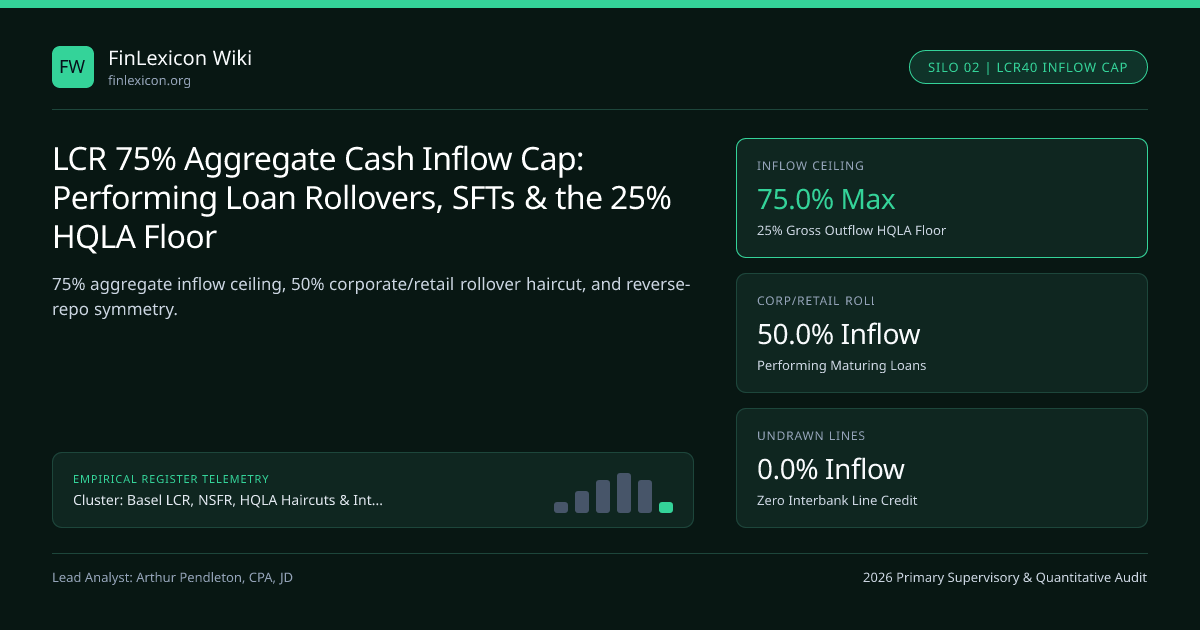
Without a structural ceiling on recognized cash inflows, a short-term trade-finance or matched-book lender could theoretically report an infinite Liquidity Coverage Ratio while holding zero sovereign bonds or central bank reserves. Paragraph LCR40.1 (and LCR40.93) closes that loophole by capping total recognized 30-day contractual cash inflows at 75% of total expected cash outflows, guaranteeing that every bank maintains Liquidity Coverage Ratio HQLA equal to at least 25% of gross stressed outflows.
Strict Eligibility Gates: Fully Performing Contractual Claims Only (Zero Non-Performing or Sight Lines)#
Under LCR40.76, banks may include only contractual cash inflows from exposures that are fully performing and for which the bank has no reason to expect a default within the 30-day horizon. Past-due loans, Stage 3 / non-accrual exposures, contingent dividend projections, and undrawn credit or liquidity lines held by the bank at other commercial banks (0% inflow!) are completely disallowed—preventing circular liquidity illusions where Bank A counts an undrawn line from Bank B as an inflow while Bank B simultaneously suffers stress, as explained in our Basel LCR, NSFR & HQLA cornerstone guide.
The 50% Franchise Rollover Assumption on Retail and Non-Financial Corporate Loans#
Even during an acute liquidity panic, a commercial bank like ANZ Bank, Bank of Ireland, or Bangkok Bank cannot suddenly refuse to roll over 100% of maturing working-capital loans and retail credit lines without destroying its commercial franchise and triggering borrower defaults.
Accordingly, LCR40.88 assumes banks continue rolling over 50% of maturing loans to retail, small-business, and non-financial corporate customers (as well as sovereigns, MDBs, and PSEs—except central banks at 100%): only 50% of contractual principal and interest payments due within 30 days count as cash inflows! Furthermore, revolving lines of credit with no specified maturity date generate 0% principal inflows (only minimum scheduled monthly payments count at 50%). By contrast, maturing unsecured placements due from financial institutions receive a 100% inflow rate (0% for operational deposits held at other banks, since operational cash cannot be pulled!).
Maturing Reverse Repos and Securities Borrowing Inflows (0% Level 1 vs 15%–100% Non-HQLA)#
Reverse repurchase agreements maturing within 30 days mirror the HQLA haircut schedule symmetrically under LCR40.78–LCR40.81:
- Secured by Level 1 HQLA: 0% cash inflow! Why? Because LCR assumes the reverse repo rolls over, OR if it matures in cash, returning the unencumbered Level 1 bond reduces the HQLA stock dollar-for-dollar by the exact cash received (unless the collateral was rehypothecated to cover a short position or >30-day repo, in which case
0%inflow still applies because the bank must buy/borrow the bond back!). - Secured by Level 2A HQLA: 15% cash inflow (reflecting the 15% haircut gap between cash received and the 85%-valued Level 2A collateral surrendered).
- Secured by Level 2B HQLA: 25% RMBS / 50% Corporate-Equity cash inflow.
- Secured by Non-HQLA Collateral (e.g., HY Bonds, Non-Index Equities, Loans): 100% cash inflow (provided collateral was not rehypothecated for >30 days!), because LCR assumes zero rollover of non-HQLA margin lending—except prime-brokerage margin loans lacking a fixed <=30d maturity (
50%or0%depending on contractual call terms).
| Contractual <=30-Day Cash Receivable | Basel LCR40 Inflow Factor | Rehypothecated >30d Impact | Economic Rationale | Matched-Book LCR Effect |
|---|---|---|---|---|
| Maturing Reverse Repo on Level 1 HQLA | 0.0% inflow | 0.0% inflow | Cash inflow offsets Level 1 bond exit 1:1 | Neutral (already inside Level 1) |
| Maturing Reverse Repo on Level 2A HQLA | 15.0% inflow | 0.0% inflow | Captures 15% haircut surplus upon cash return | Matched L2A repo/rev-repo neutral |
| Maturing Reverse Repo on Non-HQLA Stock | 100.0% inflow | 0.0% inflow (locked) | Bank pulls 100% of non-HQLA margin cash | Hits 75% cap if book lacks retail base! |
| Performing Retail, SME & Corporate Loans | 50.0% inflow | N/A | 50% mandatory franchise rollover in crisis | Requires 50% liquidity funding gap |
| Maturing Interbank Placements / Central Bank | 100.0% inflow | N/A | Wholesale money-market placements pulled | 0% if operational clearing nostro |
EU CRR Factoring / Auto-Finance Exemptions From the 75% Inflow Cap#
While the U.S. (Reg WW) and UK enforce the 75% inflow cap universally, EU Commission Delegated Regulation (EU) 2015/61 Article 33 grants narrow supervisory exemptions (up to 90% inflow cap or full pass-through exemption) for specialized mono-line leasing, factoring, and captive auto-finance subsidiaries (such as Ayvens Bank peers overseen inside ECB supervision) that take zero retail deposits and match short-term receivables cleanly.
Why Matched-Book Non-HQLA Dealers Hit the 75% Inflow Cap Hardest#
Consider an equity prime-finance or emerging-market trade-finance subsidiary funding $40B of <=30-day non-HQLA reverse repos (100% inflow = $40B) via $40B of <=30-day non-HQLA repos (100% outflow = $40B). Economically the book is 100% date-matched ($0 net gap), yet the 75% inflow cap limits recognized inflows to $30B, forcing the desk to hold $10B of dead-weight Level 1 HQLA (25% * $40B) across the Basel LCR, NSFR & Prudential Liquidity topic hub!
- InflowsRec = min( InflowsRaw , 0.75 * OutflowsTotal30d )
- NetOutflow = OutflowsTotal30d - InflowsRec = max( OutflowsTotal30d - InflowsRaw , 0.25 * OutflowsTotal_30d )
- Worked Audit ($48.0B Gross Outflows; $20.0B Maturing Corp Loans, $14.0B Maturing Interbank Loans, $18.0B Non-HQLA Equity Reverse Repos [of which $4.0B is rehypothecated into a 60-day short cover]):
- Inflows_Raw = 0.50($20.0B) + 1.00($14.0B) + 1.00*($18.0B - $4.0B) = $10.0B + $14.0B + $14.0B = $38.00B
- 75% Outflow Ceiling = 0.75 * $48.0B = $36.00B (Cap Binds: -$2.00B of Raw Inflows Disallowed!)
- Net Cash Outflows = $48.00B - $36.00B = $12.00B (= 25.0% of $48.00B) => Min Required HQLA = $12.00B
Frequently asked questions
Why does a maturing reverse repo backed by U.S. Treasuries receive a 0% cash inflow in LCR?
While the reverse repo is open, the unencumbered U.S. Treasury received as collateral is already counted at 100% inside the bank’s Level 1 HQLA numerator; if it also counted as a 100% cash inflow in the denominator upon maturity, the exact same liquidity would be double-counted!
What happens if non-HQLA collateral received in a 7-day reverse repo was used to cover a short sale?
Under LCR40.80, if collateral obtained via a <=30-day reverse repo is used to cover a customer or proprietary short position that can remain open beyond 30 days, the inflow rate drops from 100% to 0% because calling back the cash requires buying or re-borrowing the shorted security.
Are derivative receivables recognized gross or net inside 30-day LCR cash inflows?
Under LCR40.89, contractual 30-day derivative cash inflows and outflows are netted across valid ISDA Master Netting Agreements (and net of cash/HQLA variation margin); if the net portfolio sum is positive, it enters inflows at 100%, and if negative, it enters LCR40 outflows at 100%.
Can operational deposits placed by a respondent bank at a clearing correspondent bank count as inflows?
No. LCR40.91 assigns a 0% inflow rate to deposits held at other financial institutions for operational clearing, custody, or cash-management purposes—mirroring the depository bank’s 25% operational outflow assumption.
Publication record
- Published
- 14 November 2026
- Updated
- 15 November 2026
- Author
- Arthur Pendleton, CPA, JD
- Review
- Review not recorded
- Automated fact check
- Passed in the stored pipeline record
- Source URLs
- 3 recorded
AI assistance recorded: anthropic/claude-opus-4.6. This field does not establish human review or source verification.
Academic & Institutional Attribution
Cite This Research & Embed Live Data Card
Standard academic & institutional research paper citation format.
Arthur Pendleton, CPA, JD. (2026, November 14). LCR 75% Aggregate Cash Inflow Cap: Performing Loan Rollovers, SFTs & the 25% HQLA Floor. FinLexicon Wiki. https://finlexicon.org/wiki/lcr-cash-inflow-75-percent-cap-contractual-performing-loansRelated Liquidity Coverage Nsfr Prudential & Institutional Briefings
Explore Liquidity Coverage Nsfr Prudential Hub (20) →Liquidity Coverage Nsfr Prudential
Basel III LCR, NSFR, HQLA Haircuts & Intraday Prudential Liquidity ArchitectureLiquidity Coverage Nsfr Prudential
LCR Derivatives Collateral Outflows: 24-Month Historical Look-Back Approach (HLBA) & Rating TriggersLiquidity Coverage Nsfr Prudential
Undrawn Credit vs Liquidity Facilities in LCR40: Corporate (10%/30%), Bank (40%) & SPV (100%)Liquidity Coverage Nsfr Prudential
NSFR Available Stable Funding (ASF) Factors (NSF30): Tier 1/2 Capital, Retail & Sub-1Y CliffsLiquidity Coverage Nsfr Prudential
NSFR Required Stable Funding (RSF) Weights (NSF30): Asset Encumbrance, 65% Mortgages & NPLsLiquidity Coverage Nsfr Prudential
Asymmetric NSFR Derivatives Treatment (NSF30): Cash VM Offsets & the 20% Gross Liability Add-OnLiquidity Coverage Nsfr Prudential
BCBS 248 Intraday Liquidity Monitoring Tools: RTGS Peak Net Debit & Time-Specific ObligationsLiquidity Coverage Nsfr Prudential
IRRBB Standards (BCBS d368 / SRP31): Six EVE Shock Scenarios, 15% Tier 1 Outlier Test & Delta-NIIIsda Csa Derivatives Collateral
2016 ISDA Variation Margin CSA: New York Security Interest Pledge vs English Law Title TransferIsda Csa Derivatives Collateral
Uncleared Margin Rules (UMR Phases 1–6): $8B/€8B AANA Calculation & the $50M/€50M IM ThresholdIsda Csa Derivatives Collateral
ISDA SIMM v2.6 / v2.7 Methodology: Delta, Vega, Curvature Risk Weights, Concentration Thresholds & Add-OnsIsda Csa Derivatives Collateral
Regulatory Grid Schedule Initial Margin vs ISDA SIMM: Notional Percentages & the 0.4 + 0.6*NGR Formula
FinLexicon Wiki Data, Benchmarks & Contributor Records
CC BY 4.0 Open Data
Open Institutional Datasets (CSV / JSON) →
Download desk-compiled quantitative series & schemas.
2026 Reference Matrix
2026 Institutional Benchmarks & Thresholds →
Statutory capital, clearing, margin & rate conventions.
Editorial Records
Authors & Review Records →
View named contributors where those records are available.
Complete Index
Master Research & Dossier Archive →
Browse all published briefings by topic pillar & date.