
Basel Iii Endgame Capital Ratios
U.S. Expanded Risk-Based Approach (ERBA) & AOCI Unrealized Securities Filter Removal
Under the U.S. Expanded Risk-Based Approach (ERBA) prudential banking reforms, Category I–IV banks above $100B face dual standardized/ERBA RWA stacks and mandatory AOCI CET1 recognition of unrealized AFS bond losses.
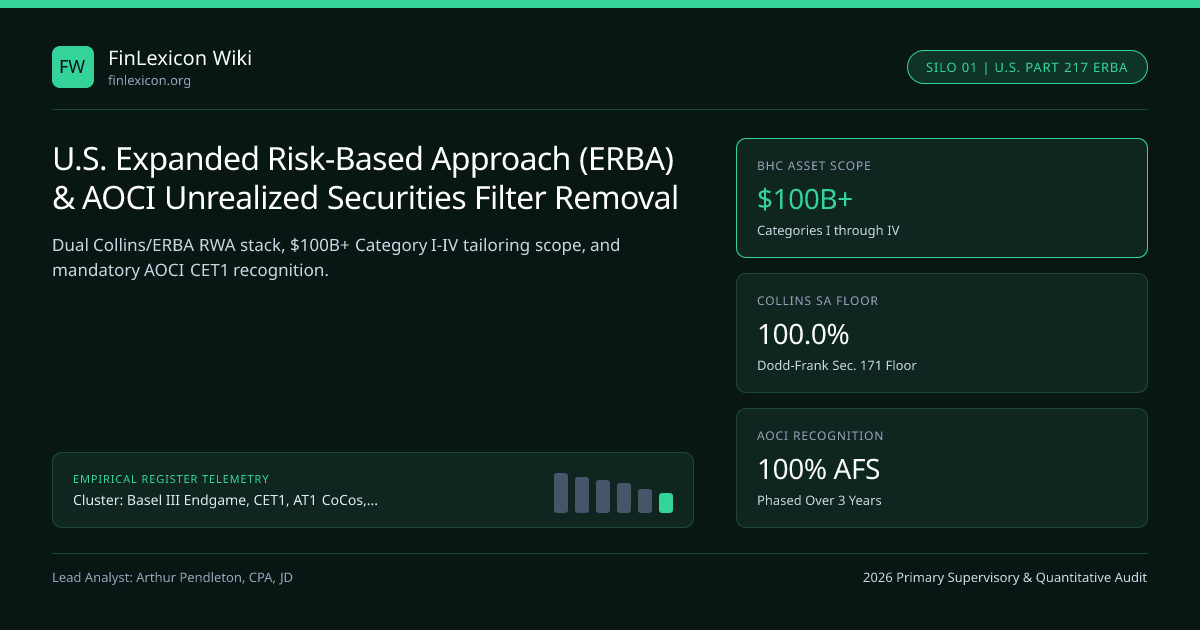
Jointly developed by the U.S. Federal Reserve System, the OCC, and the FDIC to transpose Basel III Endgame into 12 CFR Part 217, the Expanded Risk-Based Approach (ERBA) overhauls capital measurement for U.S. banking organizations with USD 100 billion or more in consolidated assets. Tracked in the ERBA 2026 Benchmark Standard, the framework replaces credit and operational internal models with risk-sensitive standardized schedules while eliminating the Accumulated Other Comprehensive Income (AOCI) capital opt-out that masked unrealized securities losses prior to March 2023.
Elimination of Credit IRB Models and the Dual-Stack U.S. Collins Architecture#
Unlike EU CRR III—which preserves Foundation and Retail IRB subject to the BCBS d424 72.5% RWA output floor—the U.S. ERBA architecture retires Advanced Approaches internal credit risk models altogether in favor of granular standardized risk-weight schedules, FRTB market risk, SA-CCR derivatives exposure, BA-CVA/SA-CVA, and SMA operational risk.
Because Section 171 of the Dodd-Frank Act prohibits risk-based capital requirements from falling below generally applicable U.S. Standardized Approach RWA, covered institutions such as Bank of America, Ally Financial, and American Express must maintain dual reporting engines—calculating capital ratios against both Legacy U.S. Standardized RWA and ERBA RWA, with the lower resulting CET1 ratio governing compliance.
Repeal of the Category III and IV AOCI Filter on Available-for-Sale Debt#
Under the 2019 U.S. Tailoring Rules, Category III and IV regional banks ($100B–$700B in assets) were permitted to make a one-time irrevocable election excluding unrealized gains and losses on Available-for-Sale (AFS) fixed-income portfolios from regulatory CET1. When policy interest rates rose 500+ basis points in 2022–2023, several regional lenders reported 10%–12% regulatory CET1 despite holding unrealized AFS and HTM duration losses exceeding half their tangible common equity.
Requiring AOCI flow-through aligns Category III and IV firms with Category I and II G-SIBs and international CET1 CAP30 deduction rules. Every 100 bps parallel upward shift in Treasury and agency MBS yields directly reduces regulatory CET1 by Duration x Portfolio_MV x (1 - Tax_Rate) unless hedged via pay-fixed interest rate swaps under ASC 815.
Calibration Shifts From the Original 2023 NPR to the Re-Proposed Endgame Consensus#
The initial July 2023 Notice of Proposed Rulemaking estimated a 16%–19% aggregate CET1 requirement increase for Category I and II G-SIBs, driven by gold-plated residential mortgage add-ons (+20 percentage points over BCBS CRE20), punitive tax-equity 400% weights, and fee-heavy SMA operational risk charges on wealth-management and card issuers like American Express.
Subsequent supervisory recalibrations signaled by Federal Reserve leadership trimmed the aggregate Category I/II G-SIB capital increase toward ~9% (~4.8% RWA/CET1 shift for diversified banks) and scaled back Category III/IV coverage primarily to AOCI recognition and targeted trading-book updates—preserving mortgage LTV alignment with international BCBS bands as summarized in our Basel III Endgame & CET1 cornerstone guide.
| U.S. Tailoring Category | Asset / Cross-Border Threshold | Pre-Endgame AOCI Rule | Endgame AOCI & Capital Rule | Representative Cohort |
|---|---|---|---|---|
| Category I (U.S. G-SIBs) | 8 Designated U.S. G-SIBs | Mandatory AOCI in CET1 | Full ERBA + FRTB + CVA + SMA + Method 2 | Bank of America & peers |
| Category II | >=$700B assets or >=$75B cross-border | Mandatory AOCI in CET1 | Full ERBA + FRTB + CVA + SMA stack | Global Custody & Cross-Border BHCs |
| Category III | $250B–$700B assets or >=$75B STWF/WSTF | AOCI Opt-Out Permitted | AOCI Filter Removed + Targeted Trading | American Express & super-regionals |
| Category IV | $100B–$250B consolidated assets | AOCI Opt-Out Permitted | AOCI Filter Removed (Simplified RWA) | Ally Financial & regional BHCs |
Interaction Between ERBA Risk Weights and the Dynamic Stress Capital Buffer (SCB)#
A foundational structural tension in U.S. capital regulation is the risk of double-counting credit, market, and operational shocks across both Pillar 1 ERBA risk weights and the Federal Reserve’s annual CCAR Stress Capital Buffer (SCB) nine-quarter depletion. Under Legacy Standardized RWA, static Pillar 1 lacks an explicit operational risk or trading-book stress component, whereas CCAR’s Global Market Shock and operational loss projections sit inside SCB; migrating to ERBA plus FRTB/SMA necessitates offsetting SCB recalibration so identical fee and trading exposures are not capitalized twice.
Securities Portfolio Duration Management and HTM Reclassification Limits#
Once AOCI flows into CET1, bank ALCO committees cannot freely escape mark-to-market capital volatility simply by shifting AFS bonds into Held-to-Maturity (HTM). Reclassifying underwater AFS bonds to HTM freezes existing unrealized losses in AOCI (amortizing them concurrently with the bond discount over remaining life), while selling even a small slice of HTM securities triggers ASC 320 HTM tainting prohibitions across the Basel III Endgame & Capital Ratios topic hub.
- CET1PostAOCI = ( CET1OptOut + ExistingAOCI + DeltaAOCIAfterTax ) / RWA_Binding
- Worked Category IV Bank Example ($180.0B RWA, $19.62B Opt-Out CET1 = 10.90%, $45.0B AFS Book, Dur = 4.6Y):
- Existing Unrealized Pre-Tax AFS Loss = -$4.145B | Effective Tax Rate = 24.0%
- After-Tax AOCI Deduction = -$4.145B * (1 - 0.24) = -$3.150B
- Fully Loaded Net CET1 = $19.620B - $3.150B = $16.470B => 16.470 / 180.0 = 9.15% (-175 bps)
- Incremental +100 bps (+0.01) Rate Shock: -$45.0B * 4.6 * 0.01 * 0.76 = -$1.573B (-87.4 bps CET1)
Frequently asked questions
Does AOCI filter removal also force Held-to-Maturity (HTM) unrealized losses into CET1?
No. Under U.S. GAAP ASC 320 and 12 CFR Part 217, debt securities classified at origination as Held-to-Maturity remain carried at amortized cost without AOCI marks, unless previously transferred from AFS (where frozen AOCI amortizes over life) or tainted by impermissible sales.
Why did non-interest fee income become controversial in the U.S. ERBA operational risk formula?
Under SMA operational risk, the Services Component takes the maximum of fee income or fee expense and multiplies incremental Business Indicator slices above EUR 30B by 18%, penalizing capital-light custody, asset management, and payment card networks relative to net-interest lenders.
How does the Dodd-Frank Collins Amendment prevent U.S. banks from benefiting from a 72.5% output floor?
Section 171 of the Dodd-Frank Act mandates that generally applicable U.S. Standardized Approach capital ratios serve as a 100% floor for all insured depository institutions and holding companies, overriding any lower 72.5% modeled floor.
Can tax-loss DTAs created by unrealized AOCI bond losses trigger CAP30 threshold deductions?
Because AOCI unrealized losses are presented net of deferred taxes, net temporary-difference DTAs expand when AFS bonds fall below par; if net temporary DTAs surpass the 10%/15% (or 25%) CET1 threshold, excess DTAs suffer an additional CET1 deduction.
Publication record
- Published
- 14 November 2026
- Updated
- 15 November 2026
- Author
- Arthur Pendleton, CPA, JD
- Review
- Review not recorded
- Automated fact check
- Passed in the stored pipeline record
- Source URLs
- 3 recorded
AI assistance recorded: anthropic/claude-opus-4.6. This field does not establish human review or source verification.
Academic & Institutional Attribution
Cite This Research & Embed Live Data Card
Standard academic & institutional research paper citation format.
Arthur Pendleton, CPA, JD. (2026, November 14). U.S. Expanded Risk-Based Approach (ERBA) & AOCI Unrealized Securities Filter Removal. FinLexicon Wiki. https://finlexicon.org/wiki/us-erba-expanded-risk-based-approach-aoci-filter-removalRelated Basel Iii Endgame Capital Ratios & Institutional Briefings
Explore Basel Iii Endgame Capital Ratios Hub (20) →Basel Iii Endgame Capital Ratios
Basel III Endgame (BCBS d424), CET1 Capital Adequacy, 72.5% Output Floor & TLAC ArchitectureBasel Iii Endgame Capital Ratios
Countercyclical Capital Buffer (CCyB): Weighted-Average Reciprocity & Positive Neutral RatesBasel Iii Endgame Capital Ratios
G-SIB Systemic Surcharge: BCBS Method 1 Five-Category Score vs Fed Method 2 STWF ScalarBasel Iii Endgame Capital Ratios
FSB TLAC Term Sheet: 18% RWA / 6.75% Leverage Minimums & Clean Holding Company RulesBasel Iii Endgame Capital Ratios
EU BRRD II MREL Calibration: SPE vs MPE Resolution & Senior Non-Preferred Debt HierarchyBasel Iii Endgame Capital Ratios
Enhanced Supplementary Leverage Ratio (eSLR) & Total Leverage Exposure (LEV20–LEV30)Basel Iii Endgame Capital Ratios
Basel III Standardized Credit Risk (CRE20): LTV Mortgage Buckets & ADC Real Estate WeightsBasel Iii Endgame Capital Ratios
Foundation IRB (F-IRB) Migration & A-IRB PD/LGD Input Floors (CRE30–CRE32)Regulatory Compliance
SEC Proposes Executive and Director Compensation Disclosure ReformsLiquidity Coverage Nsfr Prudential
HQLA Level 1, 2A & 2B Haircuts: 40%/15% Composition Caps & Secured Funding Unwind (LCR30)Liquidity Coverage Nsfr Prudential
LCR 30-Day Deposit Run-Off Rates (LCR40): Stable Retail (3%/5%), Operational (25%) & Financial (100%)Liquidity Coverage Nsfr Prudential
LCR 75% Aggregate Cash Inflow Cap: Performing Loan Rollovers, SFTs & the 25% HQLA Floor
FinLexicon Wiki Data, Benchmarks & Contributor Records
CC BY 4.0 Open Data
Open Institutional Datasets (CSV / JSON) →
Download desk-compiled quantitative series & schemas.
2026 Reference Matrix
2026 Institutional Benchmarks & Thresholds →
Statutory capital, clearing, margin & rate conventions.
Editorial Records
Authors & Review Records →
View named contributors where those records are available.
Complete Index
Master Research & Dossier Archive →
Browse all published briefings by topic pillar & date.