
Liquidity Coverage Nsfr Prudential
NSFR Interdependent Assets & Liabilities (NSF30.35): 0% Pass-Through, Promotional Loans & CCP IM
Basel NSF30.35–NSF30.37 grants national discretion to assign 0% ASF and 0% RSF to strictly matched pass-through items where a liability cannot fall due while the linked asset remains on balance sheet.
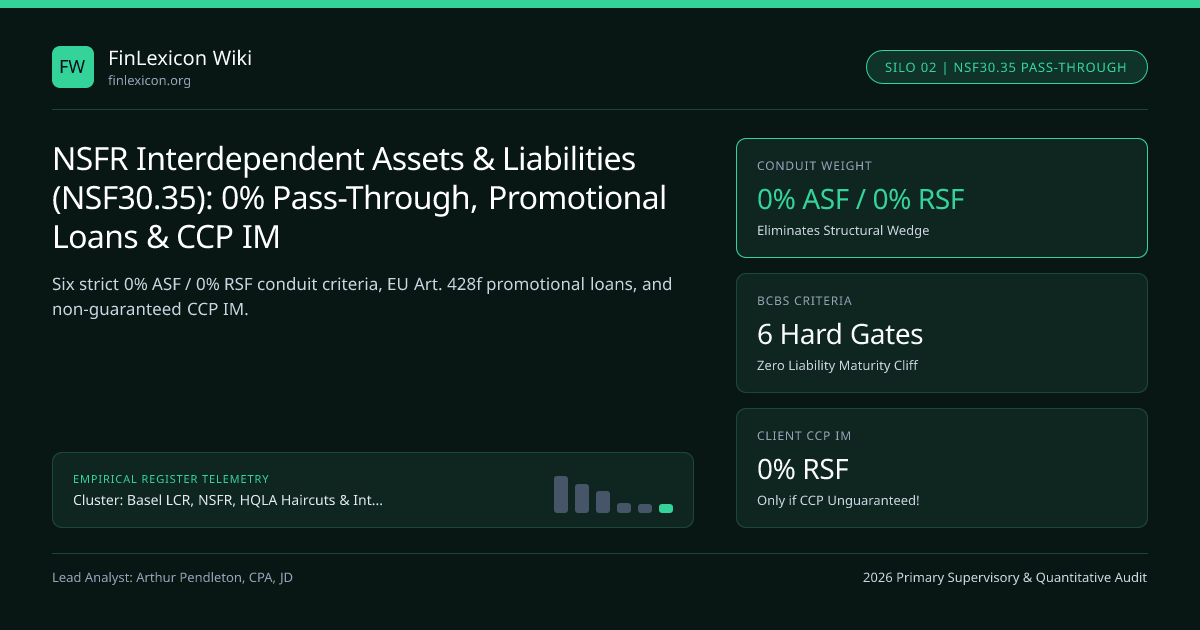
Without an explicit pass-through carve-out, pure agency conduit activities—where a commercial bank channels state promotional development funds to SMEs, issues Danish match-funded mortgage bonds, or passes client initial margin straight through to a central counterparty—suffer punitive asymmetric wedges between NSFR Available Stable Funding (ASF) and Required Stable Funding (RSF). Under Basel Framework paragraphs NSF30.35–NSF30.37, national supervisors may collapse both the asset’s RSF and the liability’s ASF to 0%—provided six airtight non-discretionary pass-through criteria are satisfied!
Six Cumulative Conditions for 0% ASF / 0% RSF Interdependent Treatment (NSF30.35)#
Why is BCBS deeply skeptical of letting banks pair individual assets and liabilities off against each other? Because generalized "matched-book" exemptions would gut the Net Stable Funding Ratio altogether! Therefore, NSF30.35 requires every single one of six conditions to hold simultaneously:
- Individual Identifiability: Each interdependent asset and liability item must be clearly and uniquely identifiable one-for-one (never portfolio-level macro pooling!).
- Identical Maturity & Principal: The maturity and principal amount of both the liability and its paired asset must be identical.
- Pure Pass-Through Conduit Role: The bank acts solely as a pass-through unit to channel funding received into the corresponding interdependent asset.
- Distinct Counterparties: The counterparties for each pair of interdependent liabilities and assets are not the same.
- Asymmetric Zero Maturity Gap: Payment flows from the asset must be used exclusively to repay the liability, AND the liability can NEVER fall due while the asset remains on the balance sheet (even if the asset borrower defaults or extends!).
- Zero Credit-Loss Trap on Liability: Actually, look carefully at how promotional vs guaranteed conduits work: if the asset defaults and the bank still owes the funding provider out of its own pocket, NSF30.35 fails unless statutory carve-outs apply!
Three Real-World Carve-Outs in EU CRR II Article 428f vs U.S. Reg WW Rejection#
Compare how major jurisdictions implemented NSF30.35 across BNP Paribas, Berenberg Bank, and Bank of America:
- European Union (ECB CRR II Article 428f): Explicitly codifies interdependent
0% ASF / 0% RSFstatus for five statutory products: (a) Centralized regulated savings (French Livret A / LDDS swept legally to Caisse des Dépôts et Consignations!), (b) Promotional development loans (e.g., German KfW pass-through SME/green loans), (c) Danish match-funded covered bonds (Balance Principle with zero funding gap), (d) Derivative client clearing initial margin, and (e) Banknote issuance. - United States (Federal Reserve Reg WW
12 CFR 249.108): U.S. agencies declined to adopt any interdependent asset/liability exemption (0approved categories in the 2020 Final Rule!), noting that cleared customer initial margin received and passed straight to a CCP already achieves balance-sheet/RSF neutrality via existing clearing accounting and12 CFR 249.107derivative rules.
Why Derivative Client Clearing Needed Interdependent Relief (0% ASF vs 85% Posted IM RSF!)#
Imagine a clearing member bank receiving $5.0B cash Initial Margin from an institutional client (< 6M financial liability = 0% ASF!) and immediately posting that $5.0B onward to LCH or CME (85% RSF on posted IM under NSF30.30!). Without relief, pure agency client clearing would force the bank to issue $4.25B of >=1-year term debt on zero principal risk! Under NSF30.30 / EU CRR Art. 428f(2)(d) (and U.S. Reg WW 249.107(b)(6) exemption where the clearing member does not guarantee CCP performance to the client!), pass-through client IM receives 0% RSF / 0% ASF, preserving clearing capacity under CCP LSOC & EMIR segregation.
| Conduit / Pass-Through Structure | Unadjusted ASF vs RSF Wedge | Qualifies Under NSF30.35 / EU Art. 428f? | Crucial Legal Prerequisite |
|---|---|---|---|
| French Centralized Savings (Livret A -> CDC) | 95%/90% Retail ASF vs 100% Encumb. CDC RSF | YES (0% ASF / 0% RSF in EU Art. 428f) | Statutory state transfer sweep to CDC |
| Promotional Pass-Through Loans (e.g., KfW) | 0%–100% Refi ASF vs 65%/85% SME Loan RSF | YES (0% ASF / 0% RSF in EU Art. 428f) | No maturity mismatch; pure promotional channel |
| Client Derivative Clearing IM (Non-Guaranteed) | 0% (<6M Client Cash ASF) vs 85% Posted IM RSF! | YES (0% / 0% when CCP performance unguaranteed) | Clearing member does NOT guarantee CCP default! |
| Danish Match-Funded Mortgage Bonds | 100%/50%/0% Bond ASF vs 100% Encumbered Mtg RSF | YES (EU Art. 428f(2)(b) Balance Principle) | Mandatory 1-to-1 pass-through extension triggers |
| Dealer Matched-Book Repo / Reverse Repo | 0% Repo ASF vs 10%/15% (0% US) Rev-Repo RSF | NO — Explicitly Rejected (NSF30.36) | Repo falls due even if reverse-repo counterparty fails! |
Why Repo Matched Books and Covered Bonds Fail General NSF30.35 Criteria#
Dealers routinely lobbied to treat matched-book reverse-repo/repo pairs and standard covered bonds as interdependent. BCBS NSF30.36 explicitly rejects them: in a standard repo matched book, if the reverse-repo borrower fails to return cash on maturity day, the dealer still legally owes cash on its repo leg—violating Condition #5!
Auditing Supervisory Approval Gates Across FinLexicon Benchmarks#
Every interdependent pairing claimed outside EU Article 428f’s automatic list requires prior supervisory sign-off and public Pillar 3 disclosure across the NSFR-FUNDING 2026 Benchmark Standard and the Basel LCR, NSFR & Prudential Liquidity topic hub.
- NSFRInterdependent = ( ASFCore + 0.00 * Lconduit ) / ( RSFCore + 0.00 * A_conduit ) [ iff Conditions 1..6 Hold ]
- TermDebtSaved = max( 0 , wRSF * Aconduit - wASF * Lconduit )
- Worked Client Clearing Agency vs Principal-Guarantee Audit ($24.0B Cash IM received from Hedge Funds & posted to LCH SwapClear):
- Case A (Agency / Non-Guaranteed CCP Performance): Qualifies under NSF30.30 / CRR Art. 428f / 12 CFR 249.107(b)(6)
- Incremental ASF = $0.0B | Incremental RSF = $0.0B => Term Debt Required = $0.00B
- Case B (Clearing Member Contractually Guarantees CCP Default to Client!): Fails non-guarantee gate!
- Incremental ASF (<6M Financial Liability) = $24.0B * 0% = $0.0B | Incremental RSF (Posted IM) = $24.0B * 85% = $20.40B!
Frequently asked questions
Why does guaranteeing a CCP’s performance to a clearing client suddenly trigger an 85% RSF charge on pass-through Initial Margin?
If the CCP failed or haircutted margin and the clearing member contractually promised to make the client whole out of the bank’s own cash, the clearing member is no longer a pure riskless conduit—forcing it to hold 85% structural funding against the posted IM asset!
Why did French banks need an explicit Article 428f carve-out for Livret A regulated savings accounts?
By French statute, ~60% of tax-free *Livret A* and *LDDS* retail deposits must be swept centrally to *Caisse des Dépôts et Consignations (CDC)* to finance social housing. Without 0%/0% interdependent treatment, the swept CDC receivable (100% encumbered RSF) exceeded the 95%/90% retail ASF!
Why did U.S. Regulation WW adopt zero general interdependent asset/liability exemptions under 12 CFR 249.108?
U.S. regulators found no U.S. banking products equivalent to European state-centralized savings or Danish pass-through mortgage bonds that met all six BCBS NSF30.35 criteria, addressing customer clearing margin directly inside 12 CFR 249.107(b)(6) instead.
How does SEC Rule 15c3-3a Note H customer Treasury clearing margin interact with NSFR pass-through rules?
When a broker-dealer collects customer cash/Treasuries and on-posts eligible customer margin to FICC under SEC Rule 15c3-3a Note H without guaranteeing FICC performance, segregated pass-through accounting avoids inflating net RSF.
Publication record
- Published
- 14 November 2026
- Updated
- 15 November 2026
- Author
- Arthur Pendleton, CPA, JD
- Review
- Review not recorded
- Automated fact check
- Passed in the stored pipeline record
- Source URLs
- 3 recorded
AI assistance recorded: anthropic/claude-opus-4.6. This field does not establish human review or source verification.
Academic & Institutional Attribution
Cite This Research & Embed Live Data Card
Standard academic & institutional research paper citation format.
Arthur Pendleton, CPA, JD. (2026, November 14). NSFR Interdependent Assets & Liabilities (NSF30.35): 0% Pass-Through, Promotional Loans & CCP IM. FinLexicon Wiki. https://finlexicon.org/wiki/interdependent-assets-liabilities-nsfr-zero-percent-pass-throughRelated Liquidity Coverage Nsfr Prudential & Institutional Briefings
Explore Liquidity Coverage Nsfr Prudential Hub (20) →Liquidity Coverage Nsfr Prudential
Basel III LCR, NSFR, HQLA Haircuts & Intraday Prudential Liquidity ArchitectureLiquidity Coverage Nsfr Prudential
Collateral Swaps, Securities Lending & Liquidity Upgrade Trades: LCR30.36 Unwind & LCR40.48 OutflowsLiquidity Coverage Nsfr Prudential
Contingent Funding Plans (CFP), Early Warning Indicators (EWIs) & Liquidity Funds Transfer Pricing (LFTP)Liquidity Coverage Nsfr Prudential
HQLA Level 1, 2A & 2B Haircuts: 40%/15% Composition Caps & Secured Funding Unwind (LCR30)Liquidity Coverage Nsfr Prudential
LCR 30-Day Deposit Run-Off Rates (LCR40): Stable Retail (3%/5%), Operational (25%) & Financial (100%)Liquidity Coverage Nsfr Prudential
LCR 75% Aggregate Cash Inflow Cap: Performing Loan Rollovers, SFTs & the 25% HQLA FloorLiquidity Coverage Nsfr Prudential
LCR Derivatives Collateral Outflows: 24-Month Historical Look-Back Approach (HLBA) & Rating TriggersLiquidity Coverage Nsfr Prudential
Undrawn Credit vs Liquidity Facilities in LCR40: Corporate (10%/30%), Bank (40%) & SPV (100%)Isda Csa Derivatives Collateral
Physically Settled FX Forwards & Swaps: U.S. Treasury Exemption, UMR IM Carve-Out, VM Nuances & SA-CCRIsda Csa Derivatives Collateral
2023 ISDA Digital Asset Derivatives Definitions: Fork Events, Oracle Disruptions & Basel SCO60 CapitalIfrs9 Cecl Credit Provisioning
IFRS 9 Stage 1, Stage 2 & Stage 3 ECL Migration: 12-Month vs Lifetime PD, Net Interest & Cure RulesIfrs9 Cecl Credit Provisioning
US GAAP ASC 326 (CECL): Day-One Lifetime Loss, R&S Reversion & ASU 2025-08 M&A Double-Count Reform
FinLexicon Wiki Data, Benchmarks & Contributor Records
CC BY 4.0 Open Data
Open Institutional Datasets (CSV / JSON) →
Download desk-compiled quantitative series & schemas.
2026 Reference Matrix
2026 Institutional Benchmarks & Thresholds →
Statutory capital, clearing, margin & rate conventions.
Editorial Records
Authors & Review Records →
View named contributors where those records are available.
Complete Index
Master Research & Dossier Archive →
Browse all published briefings by topic pillar & date.