
Liquidity Coverage Nsfr Prudential
LCR 30-Day Deposit Run-Off Rates (LCR40): Stable Retail (3%/5%), Operational (25%) & Financial (100%)
Basel LCR40 assigns 30-day stressed outflow run-off rates stepping from 3%–5% on insured transactional retail deposits to 25% on operational clearing balances, 40% corporate, and 100% financial deposits.
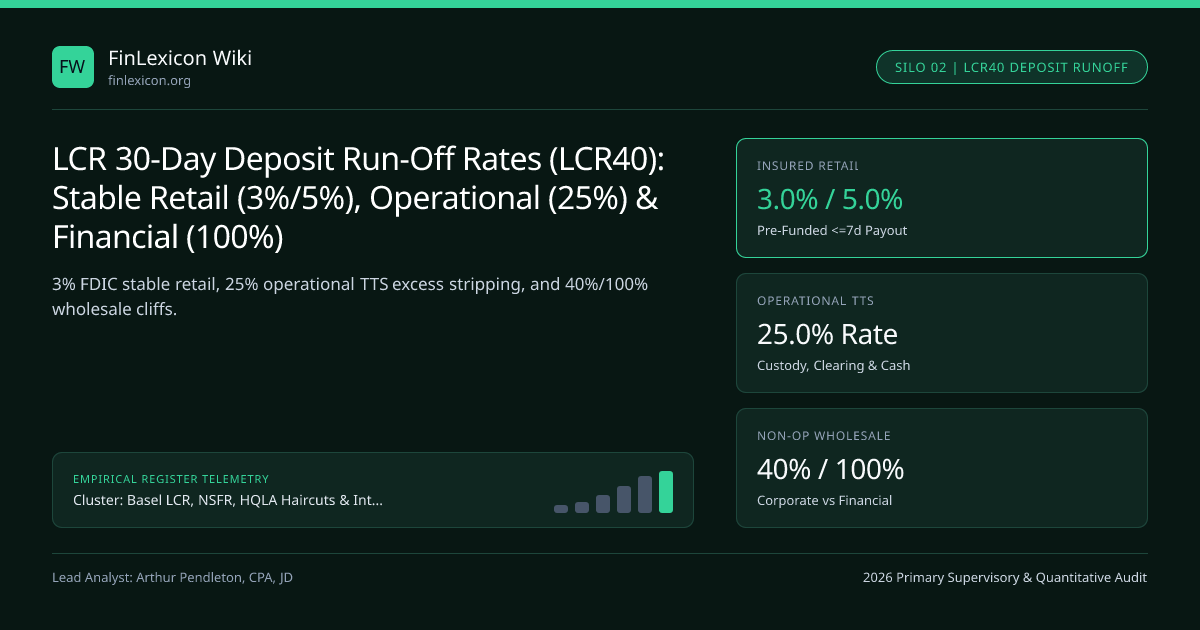
Liability run-off velocity over a 30-day panic varies by more than thirty-fold depending on depositor legal type, deposit-insurance pre-funding, and operational switching friction. Codified in Basel Framework chapter LCR40.1–LCR40.44, regulatory outflow factors price that hierarchy directly—charging just 3% to 5% of Liquidity Coverage Ratio HQLA against insured checking accounts while demanding 100% HQLA backing for non-operational deposits placed by banks, hedge funds, and non-bank financial institutions.
Retail Deposit Segmentation: 3% Pre-Funded Insurance vs 5% Stable and >=10% Less-Stable#
LCR40.5 restricts "retail" treatment to natural persons (plus qualifying small businesses with consolidated aggregate deposits under EUR 1 million / USD 1.5M managed on a pooled retail basis). Within retail, Stable Deposits must be 100% covered by an effective deposit insurance scheme AND either sit in a transactional account (e.g., automatic salary direct deposit) or belong to a customer with an established multi-product relationship.
Normally, Stable Retail deposits carry a 5% 30-day run-off rate. However, under LCR40.10, where the deposit guarantor—such as the U.S. FDIC Deposit Insurance Fund ($250,000 coverage) or Canada Deposit Insurance Corporation—is pre-funded by periodic bank levies, holds explicit sovereign backstop access, and reimburses insured depositors within 7 business days, the run-off rate drops to 3%! Any uninsured slice above $250k / EUR 100k, internet-only rate-chasing accounts, or foreign-currency deposits fall into Less-Stable Retail (>= 10% floor; 10%–20%+ in UK PRA and EU CRR high-balance tiers), as integrated into our Basel LCR, NSFR & HQLA cornerstone guide.
30-Day Term Deposit Penalty Gates: Breaking Early-Withdrawal Optionality#
Retail term CDs with residual maturity exceeding 30 calendar days receive a 0% LCR outflow rate ONLY if the depositor holds no legal right to withdraw within 30 days, OR if early withdrawal triggers a material penalty exceeding lost accrued interest! In jurisdictions where consumer-protection laws allow retail savers to break 1-year CDs by forfeiting merely 30 days of interest, LCR40.17 treats the entire term CD balance as a sight deposit subject to immediate 3%–10%+ 30-day run-off—a critical distinction for digital auto/savings franchises like Ally Financial.
The Coveted 25% Operational Deposit Bucket: Clearing, Custody, and Cash Management#
In wholesale corporate and institutional banking at Bank of America, BNP Paribas, and Bank of Montreal, the single highest-value treasury classification battle centers on Operational Deposits (25% outflow; 5% on the FDIC-insured slice) versus Non-Operational Wholesale Deposits (40% non-financial corporate / 100% financial).
Under LCR40.26–LCR40.36, a wholesale deposit qualifies as Operational solely when maintained as a byproduct of substantive clearing, custody, or cash-management services (payroll disbursement, merchant settlement, securities safekeeping) where the client faces binding legal/operational switching costs, zero economic incentive exists to hold excess cash (interest rates below money-market benchmarks), and the bank deploys a supervisory-approved excess-balance methodology (e.g., rolling minimum/average turnover ratios) to strip excess balances directly back into the 40% corporate or 100% financial non-operational buckets! Prime-brokerage client cash and correspondent-banking interbank placements are explicitly barred from the 25% operational bucket (100% run-off!).
| Deposit Tier (LCR40) | 30-Day Outflow Rate | U.S. Reg WW Rate (12 CFR 249.32) | Paired 1-Year NSFR ASF Weight | Key Qualifying Constraint |
|---|---|---|---|---|
| Stable Insured Retail (Transactional) | 3% (pre-funded) / 5% | 3.0% (FDIC insured) | 95% ASF (90% if 5% LCR) | Full FDIC/DGS cover + salary/relationship |
| Less-Stable Retail & Uninsured Slice | 10% floor (10%–20%+) | 10% general / 20%–40% brokered | 90% ASF (0%–50% <1Y brokered) | Above $250k/EUR 100k or online rate-sensitive |
| Small Business (<EUR 1M / $1.5M) | 5%–10%+ (Retail rules) | 3% / 10% (<= $1.5M aggregated) | 95% / 90% ASF | Managed identically to retail exposures |
| Operational Wholesale (Clearing/Custody) | 25% (5% insured slice) | 25% (5% FDIC insured) | 50% ASF | Strict excess-balance strip; no prime/corresp. |
| Non-Operational Corp vs Financial | 40% Corp / 100% Fin | 40% Non-Fin / 100% Financial | 50% Corp (<1Y) / 0% Fin (<6m) | Financial deposits require 100% HQLA |
Unsecured Wholesale Cliff: 40% Non-Financial Corporate vs 100% Financial & Fiduciary#
Non-operational unsecured deposits maturing or callable within 30 days from non-financial corporates, sovereigns, central banks, MDBs, and PSEs carry a 40% run-off rate (20% only if the entire deposit is 100% covered by deposit insurance and holds zero excess). By contrast, non-operational deposits from banks, insurers, pension funds, hedge funds, money-market funds, SPVs, and fintech sweeps attract a 100% 30-day run-off rate—requiring dollar-for-dollar HQLA Level 1 or Level 2 backing!
Post-2023 Calibration Debate on Social-Media-Amplified Uninsured Corporate Runs#
In March 2023, Silicon Valley Bank lost $42 billion (~25% of total deposits) in a single business day and faced an additional $100 billion queued for Day 2—demonstrating that concentrated venture-backed non-financial corporate deposits can run closer to 75%–100% than Basel’s 40% assumption alongside committed credit and liquidity facility drawdowns, prompting BCBS / BIS reviews of uninsured wholesale concentration overlays across the Basel LCR, NSFR & Prudential Liquidity topic hub.
- OutflowDeposits = 0.03 * RetailStable + 0.10 * RetailLessStable + 0.25 * Sum(OpEligible) + 0.40 * (CorpNonOp + ExcessCorp) + 1.00 * (FinNonOp + ExcessFin)
- Worked Treasury Audit ($80B Insured Checking, $30B High-Net-Worth Uninsured Retail, $50B Corporate TTS Accounts [of which $12B is Excess Cash], $15B Hedge Fund Sight Cash):
- 1. Insured Stable Retail: $80.0B * 3.0% = $2.40B
- 2. Less-Stable Retail: $30.0B * 10.0% = $3.00B
- 3. Operational Corporate: ($50.0B - $12.0B = $38.0B) * 25.0% = $9.50B
- 4. Non-Op + Excess Corp: $12.0B * 40.0% = $4.80B
- 5. Hedge Fund Financial: $15.0B * 100.0% = $15.00B
- Total 30-Day Stressed Deposit Outflow = $34.70B on $175.0B Total Deposits (19.83% Blended Run-Off)
Frequently asked questions
Can a custody bank apply the 25% operational run-off rate to institutional asset-manager custody cash?
Yes, for genuine working cash balances necessary to settle daily securities trades, corporate actions, and FX conversions inside custody accounts—provided the custodian systematically strips excess idle cash above historical settlement needs into the 100% financial non-operational bucket.
How does U.S. Regulation WW penalize third-party reciprocal and sweep brokered retail deposits?
Under 12 CFR 249.32(g), third-party brokered deposits maturing within 30 days carry elevated 25% to 40% run-off rates (10% for reciprocal deposits fully FDIC-insured under EGRRCPA caps) compared to 3% on direct branch checking accounts.
What outflow rate applies to wholesale commercial paper or unsecured bonds maturing on Day 28?
Under LCR40.62, 100% of all unsecured wholesale debt securities (commercial paper, medium-term notes, senior bonds) maturing or investor-puttable within the 30-calendar-day window receive a 100% cash outflow factor.
Why are sovereign and central bank sight deposits given a 40% outflow rate instead of 100%?
LCR40.40 groups sovereigns, central banks, multilateral development banks, and public-sector entities alongside non-financial corporates at 40% (20% if fully insured) rather than private financial institutions because public-sector treasuries do not engage in leveraged interbank runs.
Publication record
- Published
- 14 November 2026
- Updated
- 15 November 2026
- Author
- Arthur Pendleton, CPA, JD
- Review
- Review not recorded
- Automated fact check
- Passed in the stored pipeline record
- Source URLs
- 3 recorded
AI assistance recorded: anthropic/claude-opus-4.6. This field does not establish human review or source verification.
Academic & Institutional Attribution
Cite This Research & Embed Live Data Card
Standard academic & institutional research paper citation format.
Arthur Pendleton, CPA, JD. (2026, November 14). LCR 30-Day Deposit Run-Off Rates (LCR40): Stable Retail (3%/5%), Operational (25%) & Financial (100%). FinLexicon Wiki. https://finlexicon.org/wiki/lcr-30-day-retail-operational-non-operational-deposit-runoffRelated Liquidity Coverage Nsfr Prudential & Institutional Briefings
Explore Liquidity Coverage Nsfr Prudential Hub (20) →Liquidity Coverage Nsfr Prudential
Basel III LCR, NSFR, HQLA Haircuts & Intraday Prudential Liquidity ArchitectureLiquidity Coverage Nsfr Prudential
LCR 75% Aggregate Cash Inflow Cap: Performing Loan Rollovers, SFTs & the 25% HQLA FloorLiquidity Coverage Nsfr Prudential
LCR Derivatives Collateral Outflows: 24-Month Historical Look-Back Approach (HLBA) & Rating TriggersLiquidity Coverage Nsfr Prudential
Undrawn Credit vs Liquidity Facilities in LCR40: Corporate (10%/30%), Bank (40%) & SPV (100%)Liquidity Coverage Nsfr Prudential
NSFR Available Stable Funding (ASF) Factors (NSF30): Tier 1/2 Capital, Retail & Sub-1Y CliffsLiquidity Coverage Nsfr Prudential
NSFR Required Stable Funding (RSF) Weights (NSF30): Asset Encumbrance, 65% Mortgages & NPLsLiquidity Coverage Nsfr Prudential
Asymmetric NSFR Derivatives Treatment (NSF30): Cash VM Offsets & the 20% Gross Liability Add-OnLiquidity Coverage Nsfr Prudential
BCBS 248 Intraday Liquidity Monitoring Tools: RTGS Peak Net Debit & Time-Specific ObligationsIsda Csa Derivatives Collateral
ISDA Section 5(a) Events of Default vs Section 5(b) Termination Events: Cross-Default & Threshold AmountsIsda Csa Derivatives Collateral
2016 ISDA Variation Margin CSA: New York Security Interest Pledge vs English Law Title TransferIsda Csa Derivatives Collateral
Uncleared Margin Rules (UMR Phases 1–6): $8B/€8B AANA Calculation & the $50M/€50M IM ThresholdIsda Csa Derivatives Collateral
ISDA SIMM v2.6 / v2.7 Methodology: Delta, Vega, Curvature Risk Weights, Concentration Thresholds & Add-Ons
FinLexicon Wiki Data, Benchmarks & Contributor Records
CC BY 4.0 Open Data
Open Institutional Datasets (CSV / JSON) →
Download desk-compiled quantitative series & schemas.
2026 Reference Matrix
2026 Institutional Benchmarks & Thresholds →
Statutory capital, clearing, margin & rate conventions.
Editorial Records
Authors & Review Records →
View named contributors where those records are available.
Complete Index
Master Research & Dossier Archive →
Browse all published briefings by topic pillar & date.