
Isda Csa Derivatives Collateral
ISDA Section 5(a) Events of Default vs Section 5(b) Termination Events: Cross-Default & Threshold Amounts
Section 5 of the 2002 ISDA Master Agreement separates fault-based Events of Default (with shortened 1-day payment grace periods and Cross-Default Threshold Amounts) from no-fault Illegality, Force Majeure, and Tax Termination Events.
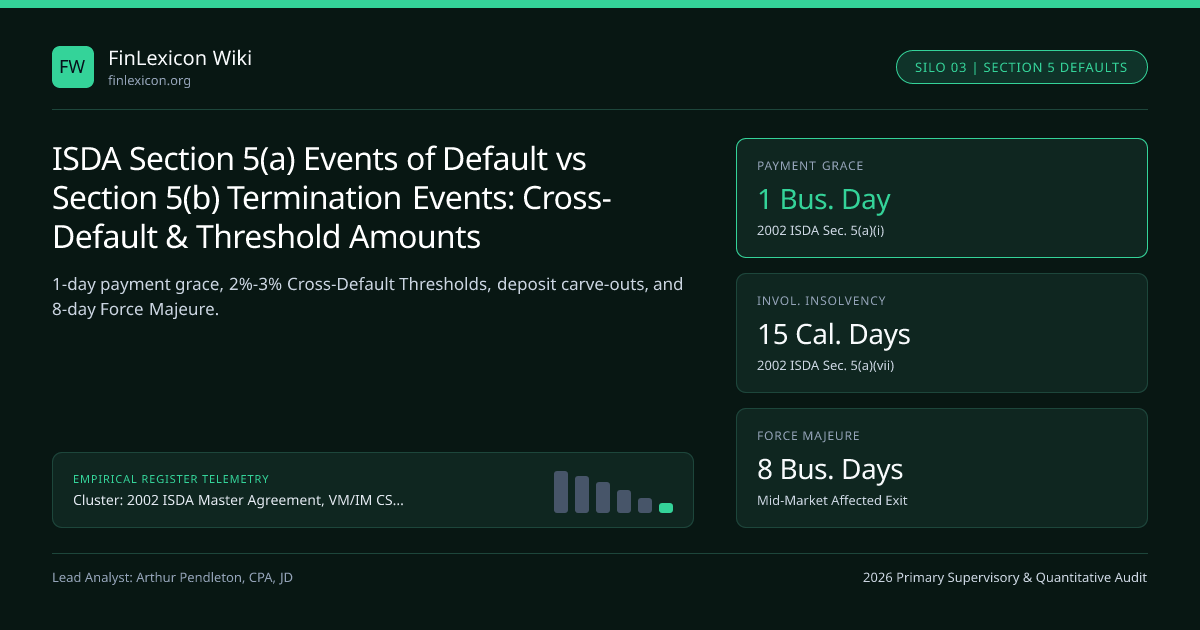
Not every event that ends a derivatives contract carries fault, cross-acceleration contagion, or unilateral portfolio-wide liquidation rights. Section 5 of the 2002 ISDA Master Agreement draws a razor-sharp architectural boundary between eight fault-based Events of Default (Section 5(a))—which entitle the Non-Defaulting Party to terminate 100% of all outstanding transactions at replacement side-of-market—and six no-fault Termination Events (Section 5(b)), which typically terminate only Affected Transactions at mid-market.
Key Upgrades From 1992 to 2002 Across the Eight Section 5(a) Events of Default#
In institutional credit negotiations anchored to our 2002 ISDA Master Agreement cornerstone guide, risk officers focus immediately on how the 2002 ISDA tightened cure windows relative to the 1992 ISDA:
- Failure to Pay or Deliver (
Section 5(a)(i)): Shortened the cure grace period after notice from 3 Local Business Days (1992) down to 1 Local Business Day (2002)—preventing a failing counterparty from free-riding across a long 5-day holiday weekend! - Breach of Agreement / Repudiation (
Section 5(a)(ii)): Retains a 30-day notice cure for non-payment covenant breaches, while making repudiation or disaffirmation an instant (0-day) Event of Default. - Credit Support Default (
Section 5(a)(iii)): Triggered if either party—or its Credit Support Provider (guarantor)—fails to transfer required 2016 Variation Margin or UMR Initial Margin past the CSA’s 1-to-2-day cure gate! - Default Under Specified Transaction (
Section 5(a)(v)): Broadened in 2002 to capture repos, securities lending, forward rate agreements, and physically settled commodity/FX trades between the two parties (and their Specified Entities) with zero dollar threshold! - Bankruptcy (
Section 5(a)(vii)): Shortened the involuntary insolvency-petition dismissal grace period from 30 days (1992) down to 15 calendar days (2002).
Negotiating Section 5(a)(vi) Cross-Default: Specified Indebtedness, Threshold Amount & Operational Carve-Outs#
Why wait for Counterparty B to miss a quarterly swap coupon in November if Counterparty B defaulted on a $250M syndicated bank loan in September? Section 5(a)(vi) ("Cross-Default") acts as an early-warning tripwire on third-party debt ("Specified Indebtedness"—defined as obligations in respect of borrowed money) whenever cumulative defaulted/accelerated debt equals or exceeds the Schedule’s Threshold Amount!
Watch the four high-stakes negotiation levers at Bank of America, BNP Paribas, and Bank of Montreal:
- Cross-Default vs Cross-Acceleration: Buy-side funds and corporates sometimes push to narrow Cross-Default to Cross-Acceleration (triggering only after third-party bondholders actually accelerate principal, rather than when an unaccelerated payment/covenant default occurs).
- Percentage vs Fixed Threshold Amount: Dealers negotiate 2% to 3% of Shareholders’ Equity / Tier 1 Capital for banks (capped or paired with e.g.
$100M–$250M), and 2%–3% of Net Asset Value (NAV) (with a$10M–$25Mfloor) for hedge/credit funds. - Bank Deposit Exclusion Carve-Out: Commercial banks MUST carve out "deposits received in the ordinary course of banking business" from Specified Indebtedness—otherwise a local branch freezing
$150Mof disputed deposits under foreign sanctions or court attachment would accidentally trigger global ISDA Cross-Default! - Administrative / Operational Error Carve-Out: Excludes 1-to-3-day technical wire delays where cash was demonstrably available in the account.
Section 5(b) Termination Events: Force Majeure Waiting Periods & Mid-Market Two-Affected Pricing#
Unlike Section 5(a) defaults, Section 5(b) Termination Events—Illegality (5(b)(i)), the *2002-introduced Force Majeure Event* (5(b)(ii))*, Tax Event* (5(b)(iii)), Tax Event Upon Merger (5(b)(iv)), Credit Event Upon Merger (5(b)(v)), and negotiated Additional Termination Events (ATEs) (5(b)(vi))—handle external shocks:
- Force Majeure Waiting Period (
8 Local Business Daysvs3 LBDIllegality): Under 2002 Section 5(b)(ii), if an act of state, war, or exchange closure makes payment/delivery impossible, obligations pause for an 8-Local-Business-Day Waiting Period before either party may terminate only the Affected Transactions. - Mid-Market Close-Out Valuation (
Section 6(e)(ii)(3)): For Illegality and Force Majeure (where both parties are innocent), 2002 Close-Out Amount is calculated at Mid-Market (excluding dealer bid-offer crossing spreads!).
| Clause & Event | 1992 ISDA Rule | 2002 ISDA Upgrade | Scope of Terminated Trades | Close-Out Valuation Side |
|---|---|---|---|---|
| Sec. 5(a)(i) Failure to Pay | 3 Local Business Days after notice | 1 Local Business Day after notice | 100% of Master Agreement | Non-Defaulting side of Bid/Offer |
| Sec. 5(a)(v) Specified Transaction | Narrow OTC derivative list | Expanded to Repos, SFTs & Physicals ($0 TH) | 100% of Master Agreement | Non-Defaulting side of Bid/Offer |
| Sec. 5(a)(vi) Cross-Default | Borrowed money >= Threshold Amount | Aggregates default + un-paid maturity >= TH | 100% of Master Agreement | Non-Defaulting side of Bid/Offer |
| Sec. 5(a)(vii) Involuntary Bankruptcy | 30 calendar days to dismiss petition | 15 calendar days to dismiss petition | 100% of Master Agreement | Non-Defaulting side of Bid/Offer |
| Sec. 5(b)(i)/(ii) Illegality & Force Majeure | Illegality only (no FM clause!) | 3 LBD Illegality / 8 LBD Force Majeure | Affected Transactions ONLY | Mid-Market (no bid-ask penalty) |
Regulatory Resolution Stays Override Bankruptcy & Cross-Default Triggers#
Critical modern statutory override: if a G-SIB parent holding company enters resolution under FSB TLAC, EU BRRD, or FDIC Orderly Liquidation, statutory QFC Stay Rules temporarily suspend (24–48 hours) and then permanently override Section 5(a)(vi)/(vii) cross-defaults on solvent operating subsidiaries provided guarantees transfer cleanly.
Cross-Checking Credit Triggers Across the ISDA & CSA Silo#
Credit officers align Section 5(a)(vi) Threshold Amounts directly with Section 5(b)(v) Credit Event Upon Merger tests across the ISDA-2002-CSA 2026 Benchmark Standard and the 2002 ISDA Master Agreement, CSA & SIMM topic hub.
- ThresholdAmountDynamic = min( HardDollarCap , alphaEquity * LatestAuditedShareholdersEquityorNAV )
- Worked Corporate Treasury Cross-Default Audit ($4.0B Shareholders Equity; Schedule Election = min($120M, 2.5% of Equity) = $100.0M):
- Event 1: Borrower misses covenant on $65M bilateral equipment loan (lender can accelerate) => $65M < $100M (No ISDA EoD yet)
- Event 2: Borrower fails to repay $45M commercial paper note at maturity (past grace period) => Cumulative = $65M + $45M = $110M!
- Result: $110.0M >= $100.0M Threshold Amount -> Triggers Section 5(a)(vi) Cross-Default across 100% of ISDA swap portfolio!
Frequently asked questions
Why does a hedge fund with zero bank loans still care deeply about Section 5(a)(vi) Cross-Default?
Wait—standard *Specified Indebtedness* covers "obligations in respect of borrowed money," which often excludes prime-brokerage repos and derivatives! That is precisely why dealers ask hedge funds to expand Specified Indebtedness in Part 1(c) of the Schedule to include prime-brokerage margin loans, repos, and third-party derivative close-outs above 2%–3% of NAV!
What is the difference between Section 5(a)(v) Default Under Specified Transaction and Section 5(a)(vi) Cross-Default?
Section 5(a)(v) covers other derivatives, repos, and SFTs directly between Party A and Party B (and their Credit Support Providers/Specified Entities) with zero dollar threshold, whereas Section 5(a)(vi) covers borrowed-money defaults by Party B to unrelated third-party lenders subject to the Threshold Amount.
Why did the 1998 Russian GKO debt moratorium inspire the 2002 Section 5(b)(ii) Force Majeure clause?
In August 1998, currency controls and settlement freezes were not technically "illegal" under every governing law—leaving 1992 ISDA counterparties without an Illegality exit while hitting 3-day Failure to Pay defaults! The 2002 Force Majeure clause provides a clean 8-business-day cooling-off window followed by mid-market close-out.
When does Section 5(b)(v) "Credit Event Upon Merger" fire during a leveraged buyout (LBO)?
If a corporate swap counterparty merges, consolidates, or transfers substantially all assets—or undergoes a 2002 capital reorganization/LBO debt recapitalization—leaving the resulting entity "materially weaker" creditwise, Section 5(b)(v) lets the bank terminate all swaps with that counterparty!
Publication record
- Published
- 14 November 2026
- Updated
- 15 November 2026
- Author
- Arthur Pendleton, CPA, JD
- Review
- Review not recorded
- Automated fact check
- Passed in the stored pipeline record
- Source URLs
- 3 recorded
AI assistance recorded: anthropic/claude-opus-4.6. This field does not establish human review or source verification.
Academic & Institutional Attribution
Cite This Research & Embed Live Data Card
Standard academic & institutional research paper citation format.
Arthur Pendleton, CPA, JD. (2026, November 14). ISDA Section 5(a) Events of Default vs Section 5(b) Termination Events: Cross-Default & Threshold Amounts. FinLexicon Wiki. https://finlexicon.org/wiki/isda-section-5-events-of-default-cross-default-threshold-amountRelated Isda Csa Derivatives Collateral & Institutional Briefings
Explore Isda Csa Derivatives Collateral Hub (20) →Isda Csa Derivatives Collateral
2002 ISDA Master Agreement, VM/IM CSA, ISDA SIMM v2.6, SA-CCR & Close-Out Netting ArchitectureIsda Csa Derivatives Collateral
2016 ISDA Variation Margin CSA: New York Security Interest Pledge vs English Law Title TransferIsda Csa Derivatives Collateral
Uncleared Margin Rules (UMR Phases 1–6): $8B/€8B AANA Calculation & the $50M/€50M IM ThresholdIsda Csa Derivatives Collateral
ISDA SIMM v2.6 / v2.7 Methodology: Delta, Vega, Curvature Risk Weights, Concentration Thresholds & Add-OnsIsda Csa Derivatives Collateral
Regulatory Grid Schedule Initial Margin vs ISDA SIMM: Notional Percentages & the 0.4 + 0.6*NGR FormulaIsda Csa Derivatives Collateral
CSA Minimum Transfer Amounts (MTA <= $500k/€500k), Rounding & Independent Amounts (IA vs Reg IM)Isda Csa Derivatives Collateral
Basel III SA-CCR (CRE52): Alpha = 1.4 Scalar, Margined Replacement Cost & Exponential PFE MultiplierIsda Csa Derivatives Collateral
Multi-Currency CSA Discounting & Cheapest-to-Deliver (CTD) Optionality: SOFR, €STR & ColVA PricingIfrs9 Cecl Credit Provisioning
IFRS 9 SICR Quantitative Calibration: Relative Lifetime PD Ratios vs Absolute Basis-Point ThresholdsIfrs9 Cecl Credit Provisioning
IFRS 9 SPPI Cash-Flow Test & May 2024 IASB Amendments: ESG Sustainability-Linked Loans & Non-Recourse DebtIfrs9 Cecl Credit Provisioning
POCI (IFRS 9) vs PCD (US GAAP ASC 326): Purchased Credit-Impaired Accounting, Gross-Up & CAEIRIfrs9 Cecl Credit Provisioning
IFRS 13 & US GAAP ASC 820 Fair Value Hierarchy: Exit Price, Principal Market & Level 1 / 2 / 3 Transfers
FinLexicon Wiki Data, Benchmarks & Contributor Records
CC BY 4.0 Open Data
Open Institutional Datasets (CSV / JSON) →
Download desk-compiled quantitative series & schemas.
2026 Reference Matrix
2026 Institutional Benchmarks & Thresholds →
Statutory capital, clearing, margin & rate conventions.
Editorial Records
Authors & Review Records →
View named contributors where those records are available.
Complete Index
Master Research & Dossier Archive →
Browse all published briefings by topic pillar & date.