
Liquidity Coverage Nsfr Prudential
Undrawn Credit vs Liquidity Facilities in LCR40: Corporate (10%/30%), Bank (40%) & SPV (100%)
Basel LCR40 sharply distinguishes general-purpose corporate credit revolvers (10% drawdown) from debt-backstop liquidity facilities (30% corporate, 40% bank, and 100% ABCP/SPV drawdown).
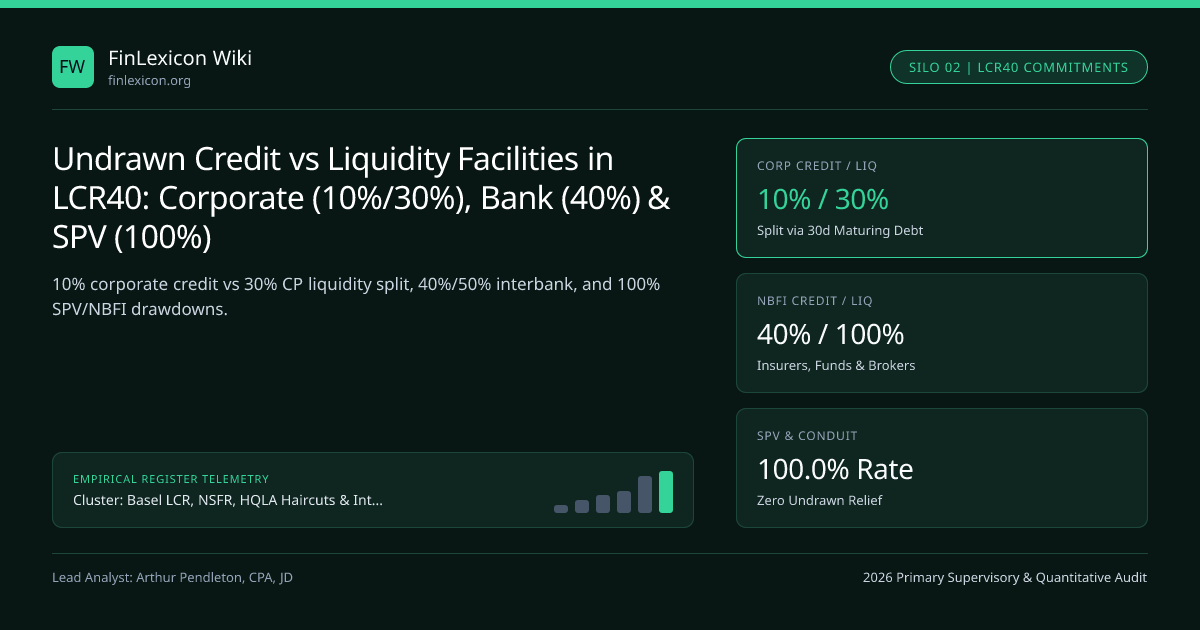
During the March 2020 corporate "dash for cash," Fortune 500 treasurers drew down tens of billions of dollars on syndicated revolving credit lines in a single fortnight to hoard precautionary liquidity. Basel Framework paragraphs LCR40.64–LCR40.73 price off-balance-sheet contingent drawdown risk by splitting irrevocable undrawn commitments into Credit Facilities (5%–40% outflow) and Liquidity Facilities (5%–100% outflow)—with a 3x capital-liquidity jump (10% vs 30%) on corporate commercial paper backstops!
Legal Boundary: When Does a Corporate Revolver Become a 30% Liquidity Facility?#
In everyday loan syndication, borrowers sign a single "Revolving Credit Facility" agreement used both for general corporate working capital and as rating-agency backup for commercial paper (CP) issuance. Under LCR40.65, any committed undrawn facility that would be utilized to refinance the debt obligations of a customer in situations where such a customer is unable to rollover that debt in financial markets MUST be classified as a Liquidity Facility!
Crucially, LCR40.65 introduces a surgical 30-day maturing debt carve-out explained in our Basel LCR, NSFR & HQLA cornerstone guide: for a general working-capital corporate revolver that also backs commercial paper, only the portion covering the borrower’s debt maturing within the 30-day LCR window is treated as a Liquidity Facility (30% outflow), while the excess undrawn commitment capacity above 30-day maturing debt qualifies as a Credit Facility (10% outflow)! (If the bank cannot monitor the client’s 30-day maturing debt schedule, 100% of the revolver is penalized at the 30% Liquidity Facility rate!).
Complete Counterparty Drawdown Matrix (5% Retail to 100% SPV & Hedge Fund)#
Once partitioned between Credit and Liquidity purpose—and reduced net of any unencumbered HQLA collateral already pledged or contractually required to be posted by the customer upon drawing—LCR40.66 applies seven distinct counterparty outflow factors across wholesale lenders like Bank of America, BNP Paribas, and ANZ Bank:
- Retail and Small Business Customers: 5% on both committed credit and liquidity facilities.
- Non-Financial Corporates, Sovereigns, Central Banks, PSEs & MDBs: 10% on Credit Facilities vs 30% on Liquidity Facilities!
- Regulated Deposit-Taking Banks: 40% flat on both Credit and Liquidity Facilities.
- Non-Bank Financial Institutions (Insurers, Securities Firms, Fiduciaries): 40% on Credit Facilities vs 100% on Liquidity Facilities!
- Special Purpose Vehicles (SPVs), ABCP Conduits & Structured Investment Vehicles: 100% on both Credit and Liquidity Facilities (reflecting 2007–2008 SIV conduit collapses!).
Trade Finance Letters of Credit (<= 5% Outflow) vs Unconditionally Cancellable Lines#
Documentary trade finance letters of credit and performance guarantees unrelated to financial-debt refinancing enjoy far lower liquidity usage in crises; LCR40.72 permits national supervisors to assign 0% to 5% outflow rates (e.g., 5% in EU CRR and U.S. Reg WW for trade finance obligations). Similarly, unconditionally cancellable uncommitted lines (such as retail credit cards) carry a 0% baseline Basel LCR outflow (though EU CRR and national ILAAP supervisors monitor behavioral card drawdowns alongside LCR40 deposit run-offs).
| Borrower Counterparty Class | Committed Credit Facility (LCR) | Committed Liquidity Facility (LCR) | 1-Year NSFR RSF Weight | U.S. Reg WW Rate (12 CFR 249.32(e)) |
|---|---|---|---|---|
| Retail & Small Business Customers | 5.0% outflow | 5.0% outflow | 5.0% RSF | 5.0% Credit / 5.0% Liquidity |
| Non-Financial Corporates & PSEs | 10.0% outflow | 30.0% outflow | 5.0% RSF | 10.0% Credit / 30.0% Liquidity |
| Sovereigns, Central Banks & MDBs | 10.0% outflow | 30.0% outflow | 5.0% RSF | 10.0% Credit / 30.0% Liquidity (0% CB) |
| Regulated Banks / Depository Inst. | 40.0% outflow | 40.0% outflow | 5.0% RSF | 50.0% Depository Inst. (U.S. stricter!) |
| Non-Bank Financials (Insurers/Funds) | 40.0% outflow | 100.0% outflow | 5.0% RSF | 40.0% Credit / 100.0% Liquidity |
| ABCP Conduits & Special Purpose Entities | 100.0% outflow | 100.0% outflow | 5.0% RSF | 100.0% SPE / Conduit |
CCP Repo Backstop Commitments: DTCC FICC CCLF Treatment#
In the United States, netting members of DTCC Fixed Income Clearing Corporation must sign legally binding repo liquidity commitments under the Capped Contingency Liquidity Facility (CCLF) to fund a fellow clearing member’s default—requiring explicit liquidity buffer allocation in internal stress tests and liquidity transfer pricing!
Pricing Undrawn Commitment Fees Against HQLA Carry Drag & 5% NSFR RSF#
Every USD 1.0 billion of undrawn 30% corporate CP liquidity backstop forces a bank to fund USD 300 million of Level 1/2A HQLA (plus a 5% NSFR Required Stable Funding weight under NSF30.32). When wholesale term funding spreads sit 45 bps above HQLA yields, the liquidity carry cost alone consumes 0.30 * 45 bps = 13.5 bps per annum—explaining why undrawn commitment fees rose across syndicated loan markets tracked in the Basel LCR, NSFR & Prudential Liquidity topic hub.
- LiqSliceCorp = min( UndrawnNetHQLA , BorrowerDebtMaturing_30d )
- CredSliceCorp = UndrawnNetHQLA - LiqSliceCorp
- OutflowRevolver = 0.30 * LiqSliceCorp + 0.10 * CredSlice_Corp
- Worked Corporate Treasury Syndicate Audit ($1,500M Undrawn Revolver; Borrower has $400M CP maturing in Days 1–30; $100M UST Draw-Condition):
- UndrawnNetHQLA = $1,500M - $100M = $1,400M
- LiqSliceCorp = min($1,400M, $400M) = $400M | CredSliceCorp = $1,400M - $400M = $1,000M
- 30-Day LCR Outflow = 0.30 * $400M + 0.10 * $1,000M = $120M + $100M = $220.0M (vs $450.0M without CP tracking & HQLA offset)
- Minimum Undrawn Commitment Fee to Break Even on 40 bps LFTP HQLA Carry = ($220M / $1,500M) * 40 bps = 5.87 bps (before RWA/eSLR!)
Frequently asked questions
Why did U.S. Regulation WW set a 50% drawdown rate on interbank credit lines instead of Basel’s 40%?
U.S. banking agencies observed during 2008 that troubled regional or correspondent banks facing wholesale runs draw nearly half or more of their committed interbank lines immediately, prompting a 50% outflow factor under 12 CFR 249.32(e)(1)(iii).
Can borrower-pledged corporate loans or commercial real estate reduce undrawn LCR facility outflows?
No. Under LCR40.64, undrawn facility balances may be netted ONLY against unencumbered High-Quality Liquid Assets (Level 1, 2A, or 2B after haircuts) already posted or legally required to be posted upon drawdown—illiquid loans or real estate provide zero LCR offset.
How did the March 2020 corporate revolver drawdown compare against Basel’s 10% Credit Facility rate?
During March 2020, non-investment-grade and BBB-rated corporates drew roughly 20%–35% of available revolving lines within three weeks—exceeding the 10% Credit Facility assumption, though much of the cash remained redeposited at the lending G-SIBs as 40%-outflow corporate deposits!
What NSFR Required Stable Funding weight applies to undrawn committed revolvers?
Under Basel NSF30.32, irrevocably committed off-balance-sheet credit and liquidity facilities carry a baseline 5% RSF factor across counterparty types, ensuring structural 1-year funding alongside the 30-day LCR HQLA buffer.
Publication record
- Published
- 14 November 2026
- Updated
- 15 November 2026
- Author
- Arthur Pendleton, CPA, JD
- Review
- Review not recorded
- Automated fact check
- Passed in the stored pipeline record
- Source URLs
- 3 recorded
AI assistance recorded: anthropic/claude-opus-4.6. This field does not establish human review or source verification.
Academic & Institutional Attribution
Cite This Research & Embed Live Data Card
Standard academic & institutional research paper citation format.
Arthur Pendleton, CPA, JD. (2026, November 14). Undrawn Credit vs Liquidity Facilities in LCR40: Corporate (10%/30%), Bank (40%) & SPV (100%). FinLexicon Wiki. https://finlexicon.org/wiki/committed-credit-vs-liquidity-facilities-lcr-drawdown-factorsRelated Liquidity Coverage Nsfr Prudential & Institutional Briefings
Explore Liquidity Coverage Nsfr Prudential Hub (20) →Liquidity Coverage Nsfr Prudential
Basel III LCR, NSFR, HQLA Haircuts & Intraday Prudential Liquidity ArchitectureLiquidity Coverage Nsfr Prudential
NSFR Available Stable Funding (ASF) Factors (NSF30): Tier 1/2 Capital, Retail & Sub-1Y CliffsLiquidity Coverage Nsfr Prudential
NSFR Required Stable Funding (RSF) Weights (NSF30): Asset Encumbrance, 65% Mortgages & NPLsLiquidity Coverage Nsfr Prudential
Asymmetric NSFR Derivatives Treatment (NSF30): Cash VM Offsets & the 20% Gross Liability Add-OnLiquidity Coverage Nsfr Prudential
BCBS 248 Intraday Liquidity Monitoring Tools: RTGS Peak Net Debit & Time-Specific ObligationsLiquidity Coverage Nsfr Prudential
IRRBB Standards (BCBS d368 / SRP31): Six EVE Shock Scenarios, 15% Tier 1 Outlier Test & Delta-NIILiquidity Coverage Nsfr Prudential
Non-Maturity Deposits (NMD) Behavioral Modeling: Deposit Betas, Core Caps & SRP31 Duration CeilingsLiquidity Coverage Nsfr Prudential
U.S. Regulation WW (12 CFR Part 249): Peak-Day Maturity Mismatch Add-On & Tailoring Categories I–IVIsda Csa Derivatives Collateral
ISDA SIMM v2.6 / v2.7 Methodology: Delta, Vega, Curvature Risk Weights, Concentration Thresholds & Add-OnsIsda Csa Derivatives Collateral
Regulatory Grid Schedule Initial Margin vs ISDA SIMM: Notional Percentages & the 0.4 + 0.6*NGR FormulaIsda Csa Derivatives Collateral
CSA Minimum Transfer Amounts (MTA <= $500k/€500k), Rounding & Independent Amounts (IA vs Reg IM)Isda Csa Derivatives Collateral
Basel III SA-CCR (CRE52): Alpha = 1.4 Scalar, Margined Replacement Cost & Exponential PFE Multiplier
FinLexicon Wiki Data, Benchmarks & Contributor Records
CC BY 4.0 Open Data
Open Institutional Datasets (CSV / JSON) →
Download desk-compiled quantitative series & schemas.
2026 Reference Matrix
2026 Institutional Benchmarks & Thresholds →
Statutory capital, clearing, margin & rate conventions.
Editorial Records
Authors & Review Records →
View named contributors where those records are available.
Complete Index
Master Research & Dossier Archive →
Browse all published briefings by topic pillar & date.