
Isda Csa Derivatives Collateral
ISDA SIMM v2.6 / v2.7 Methodology: Delta, Vega, Curvature Risk Weights, Concentration Thresholds & Add-Ons
Calibrated to a 10-day 99% confidence interval including a 25%+ stress period, ISDA SIMM aggregates analytical Delta, Vega, and Curvature sensitivities across six asset classes without cross-asset correlation offsets.
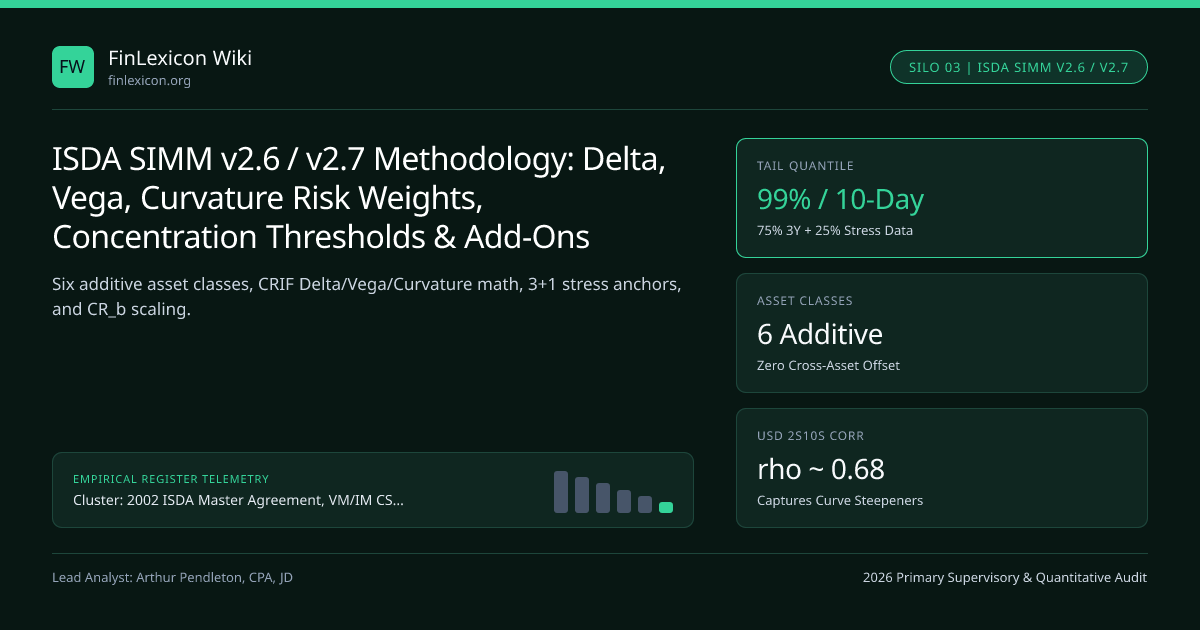
How do two competing derivatives dealers—each running proprietary pricing libraries—agree to the penny every morning at 08:30 on a 10-day 99% confidence Initial Margin figure for 8,000 uncleared swaps? The answer is the ISDA Standard Initial Margin Model (ISDA SIMM), structurally mirrored on Basel’s FRTB Sensitivities-Based Method and governed under the ISDA SIMM Governance Framework (v2.6 / v2.7 annual recalibrations) with supervisory non-objection from the Federal Reserve, CFTC, ECB/EBA, and UK PRA.
Six Siloed Risk Classes With Zero Cross-Asset Diversification#
Per BCBS-IOSCO Margin Requirement Principle 3.1—as embedded in our 2002 ISDA Master Agreement & SIMM cornerstone guide—regulatory Initial Margin models may recognize hedging and diversification within a single asset class, NEVER across distinct asset classes! Accordingly, ISDA SIMM partitions every trade’s risk factors into six strictly additive Risk Classes (plus regulatory notional/multiplicative add-ons where required):
SIMM_Total = SIMM_IR + SIMM_CreditQualifying + SIMM_CreditNonQualifying + SIMM_Equity + SIMM_Commodity + SIMM_FX
Notice how multi-asset hybrids map cleanly: a USD/EUR Cross-Currency Basis Swap generates IR sensitivities in both the USD and EUR interest-rate buckets plus an FX sensitivity on spot principal—entering both SIMM_IR and SIMM_FX!

Four Margin Components Inside Each Risk Class: Delta, Vega, Curvature, and Base Correlation#
Within each Risk Class X, SIMM sums four standardized analytical Greek charges (SIMM_X = DeltaMargin_X + VegaMargin_X + CurvatureMargin_X + BaseCorrMargin_CreditQ):
- Delta Margin (
First-Order Linear Risk): Captures parallel shifts, curve twists across 12 interest-rate tenors (2w, 1m, 3m, 6m, 1y, 2y, 3y, 5y, 10y, 15y, 20y, 30y) and sub-curves (OIS, Libor/Term-RFR, Prime, Municipal, Inflation, XCcy Basis), equity sector buckets (1–12), credit rating/sector buckets, and FX spot. - Vega Margin (
Implied Volatility Risk): Capturessigma * dV/dsigmavolatility-surface shifts on swaptions, caps/floors, FX options, and equity/commodity options. - Curvature Margin (
Second-Order Gamma Convexity): Crucial for short-option and digital/barrier books! SIMM re-approximates 10-day option convexity using a scaled Taylor-style Vega-to-Gamma conversion (CVR_{ik} = Sum_j SF(t_{kj}) * sigma_{kj} * dV/dsigma_{kj}) with an asymmetric loss scaling factorthetaso net short gamma bears full tail-loss margin while net long gamma relief is conservatively capped! - Concentration Risk Factors (
CR_b >= 1.0): Whenever a portfolio’s net DV01 or Vega in a single currency, issuer, or equity ticker exceeds ISDA’s daily market-depth Concentration Threshold (T_b), SIMM scales up that risk weight bysqrt( |Sum WS| / T_b )AND dampens cross-bucket correlations—mirroring longer >10-day liquidation horizons!
Quarterly Backtesting, Annual Recalibration (v2.6 / v2.7), and 3+1 Stress Period Weighting#
To prevent procyclical margin cliffs yet adapt when regime shifts occur (such as the 2022 global sovereign rate volatility surge or the September 2022 UK Gilt LDI shock), ISDA runs quarterly industry backtesting across dealers like Bank of America, BNP Paribas, and Bank of Montreal.
Every SIMM parameter table (Risk Weights, intra-bucket correlations rho, inter-bucket correlations gamma, and concentration thresholds) is calibrated on a "3+1" historical sample: 75% weight on the latest rolling 3 years of market returns plus 25% weight on a fixed high-volatility Stress Period (2008–2009 crisis window), preventing SIMM risk weights from collapsing during calm bull markets!
| ISDA SIMM Risk Class | Sensitivity Definition (s_k) | Bucket Granularity | Illustrative Risk Weight Range | Concentration Threshold (T_b) Basis |
|---|---|---|---|---|
Interest Rate (IR) | PV change for +1 bp (0.0001) curve shift | Per Currency (Reg, Low-Vol JPY, High-Vol) x 12 Tenors | ~48–125 bps (Regular CCY 2y–30y) | ~$210M–$310M/bp USD/EUR vs lower EM |
Credit Qualifying (CreditQ) | PV change for +1 bp issuer CS01 shift | 12 Rating x Sector buckets (IG 1–6, HY/NR 7–12) | ~45–480 bps across IG to HY | Higher for Sovereign/Index vs Single-Name |
Equity (Equity) | PV change for +1% (0.01) spot price jump | 12 Buckets (EM vs Developed x Sector + Indexes) | ~14% (Broad Index) to ~28%–35% (EM/Small) | Market-cap & ADV tier ($M per 1%) |
Commodity (Commodity) | PV change for +1% commodity forward shift | 17 Buckets (Coal, Crude, US Gas, EU Gas, Power, Metals, Ags) | ~16% (Gold) to ~45%–65% (EU Gas/Power!) | Physical futures open-interest liquidity |
Foreign Exchange (FX) | PV change for +1% FX spot vs Calc CCY | High-Liquidity (USD/EUR/JPY/GBP) vs Other CCYs | ~7.2%–8.5% (G10) to ~13%–22% (EM/Volatile) | Daily BIS FX turnover tiers |
Common Sensitivity Unit Reconciliation (CRIF File Format)#
Operationally, counterparties exchange daily Common Risk Interchange Format (CRIF) .tsv files via Acadia (AcadiaSoft) IM Exposure Manager—allowing automated pinpointing of any trade-level DV01 or Vega discrepancy during margin dispute resolution.
Benchmarking SIMM Efficiency Against Schedule Grid & Multilateral Compression#
On balanced client-facing books, ISDA SIMM reduces Initial Margin by 65% to 88% compared to Regulatory Grid Schedule IM, and can be optimized further via TriOptima/Quantile SIMM compression cycles across the 2002 ISDA Master Agreement, CSA & SIMM topic hub.
- WSk = RWk * sk * CRb [ Weighted Sensitivity ]
- Kb = sqrt( Sumk WSk^2 + Sum{k != l} phiij * rhokl * WSk * WSl )
- DeltaMargin = sqrt( Sumb Kb^2 + Sum{b != c} gammabc * gbc * Sb * Sc ) + Kresidual
- Worked 2s10s USD SOFR Curve Steepener SIMM Audit (+$1.50M/bp 2Y DV01 [RW2Y = 61 bps]; -$1.50M/bp 10Y DV01 [RW10Y = 64 bps]; rho_{2Y,10Y} = 0.68):
- Net USD Sum |sk| = |$1.50M - $1.50M| = $0 << $310M/bp USD Tb => CR_USD = 1.00
- WS2Y = 61 * (+$1.50M) = +$91.50M | WS10Y = 64 * (-$1.50M) = -$96.00M
- K_USD = sqrt( 91.50^2 + (-96.00)^2 + 2 * 0.68 * (91.50) * (-96.00) ) = sqrt( 8372.25 + 9216.00 - 11946.24 ) = sqrt( 5642.01 ) = $75.11M!
Frequently asked questions
Can a hedge fund or bank switch freely back and forth between ISDA SIMM and Regulatory Grid Schedule whenever one is lower?
Strictly prohibited ("no cherry-picking") under BCBS-IOSCO Principle 3.2, EMIR, and U.S. UMR rules! Counterparties must commit consistently to SIMM or Grid per asset class unless a fundamental change in business model occurs (subject to regulatory governance/notification).
Why did U.S. Prudential Regulators require prior supervisory model approval for dealers using ISDA SIMM, while EU EMIR Phase 6 funds did not until EMIR 3.0?
Under U.S. Prudential and CFTC rules, all swap dealers needed formal regulatory approval (via NFA / Fed / OCC) to run ISDA SIMM; EU EMIR 3.0 (2024) newly introduced an EBA Centralized Pro-Forma Model Validation regime to harmonize SIMM oversight across European counterparties.
How does ISDA SIMM treat basis risk between SOFR and Term SOFR or Fed Funds within the same USD currency bucket?
Inside the USD IR bucket, SIMM does *not* assume 1.000 correlation between different sub-curves (OIS SOFR vs Fed Funds vs Prime vs Municipal): cross-sub-curve sensitivities multiply by a sub-curve correlation scalar phi_{ij} < 1.0 (e.g., 0.982–0.993), charging explicit basis margin on massive SOFR/FF basis books!
What is a "SIMM Crowding / Multiplicative Add-On" imposed by regulators on bespoke risk factors?
When backtesting shows that a counterparty’s exotic portfolio (e.g., correlation swaps, dividend futures, or weather derivatives) contains material risk uncaptured by SIMM’s standard CRIF buckets, supervisors require trade-level Schedule fallbacks or SIMM Multiplicative / Fixed Add-Ons.
Publication record
- Published
- 14 November 2026
- Updated
- 15 November 2026
- Author
- Arthur Pendleton, CPA, JD
- Review
- Review not recorded
- Automated fact check
- Passed in the stored pipeline record
- Source URLs
- 3 recorded
AI assistance recorded: anthropic/claude-opus-4.6. This field does not establish human review or source verification.
Academic & Institutional Attribution
Cite This Research & Embed Live Data Card
Standard academic & institutional research paper citation format.
Arthur Pendleton, CPA, JD. (2026, November 14). ISDA SIMM v2.6 / v2.7 Methodology: Delta, Vega, Curvature Risk Weights, Concentration Thresholds & Add-Ons. FinLexicon Wiki. https://finlexicon.org/wiki/isda-simm-v2-6-delta-vega-curvature-risk-weights-correlationsRelated Isda Csa Derivatives Collateral & Institutional Briefings
Explore Isda Csa Derivatives Collateral Hub (20) →Isda Csa Derivatives Collateral
2002 ISDA Master Agreement, VM/IM CSA, ISDA SIMM v2.6, SA-CCR & Close-Out Netting ArchitectureIsda Csa Derivatives Collateral
Regulatory Grid Schedule Initial Margin vs ISDA SIMM: Notional Percentages & the 0.4 + 0.6*NGR FormulaIsda Csa Derivatives Collateral
CSA Minimum Transfer Amounts (MTA <= $500k/€500k), Rounding & Independent Amounts (IA vs Reg IM)Isda Csa Derivatives Collateral
Basel III SA-CCR (CRE52): Alpha = 1.4 Scalar, Margined Replacement Cost & Exponential PFE MultiplierIsda Csa Derivatives Collateral
Multi-Currency CSA Discounting & Cheapest-to-Deliver (CTD) Optionality: SOFR, €STR & ColVA PricingIsda Csa Derivatives Collateral
ISDA 2020 IBOR Fallbacks Protocol: Compounded-in-Arrears RFRs & Bloomberg 5-Year Median SpreadsIsda Csa Derivatives Collateral
UMR Eligible Collateral Schedules: Sovereign/Corporate Haircuts, Wrong-Way Risk Bans & the 8% FX Add-OnIsda Csa Derivatives Collateral
Tri-Party & Third-Party Account Control Agreements (ACAs): Segregated UMR IM & Notice of Exclusive ControlIfrs9 Cecl Credit Provisioning
IFRS 13 & US GAAP ASC 820 Fair Value Hierarchy: Exit Price, Principal Market & Level 1 / 2 / 3 TransfersIfrs9 Cecl Credit Provisioning
Prudent Valuation Adjustment (PVA / AVA — EU CRR Art. 105 & Basel CAP50): 90% Confidence CET1 DeductionsIfrs9 Cecl Credit Provisioning
xVA Valuation Adjustments (CVA, DVA, FVA, KVA & MVA): IFRS 13 / ASC 820 Accounting vs Basel MAR50 CapitalIfrs9 Cecl Credit Provisioning
Own-Credit Risk on Fair-Value Option Liabilities (IFRS 9.5.7.7 & ASC 825-10): OCI & Basel CET1 Filters
FinLexicon Wiki Data, Benchmarks & Contributor Records
CC BY 4.0 Open Data
Open Institutional Datasets (CSV / JSON) →
Download desk-compiled quantitative series & schemas.
2026 Reference Matrix
2026 Institutional Benchmarks & Thresholds →
Statutory capital, clearing, margin & rate conventions.
Editorial Records
Authors & Review Records →
View named contributors where those records are available.
Complete Index
Master Research & Dossier Archive →
Browse all published briefings by topic pillar & date.