
Liquidity Coverage Nsfr Prudential
NSFR Available Stable Funding (ASF) Factors (NSF30): Tier 1/2 Capital, Retail & Sub-1Y Cliffs
Basel NSF30 assigns 1-year Available Stable Funding (ASF) weights stepping down from 100% on regulatory capital and >=1-year liabilities to 95%/90% on retail deposits, 50% on <1Y corporate, and 0% on <6M financial funding.
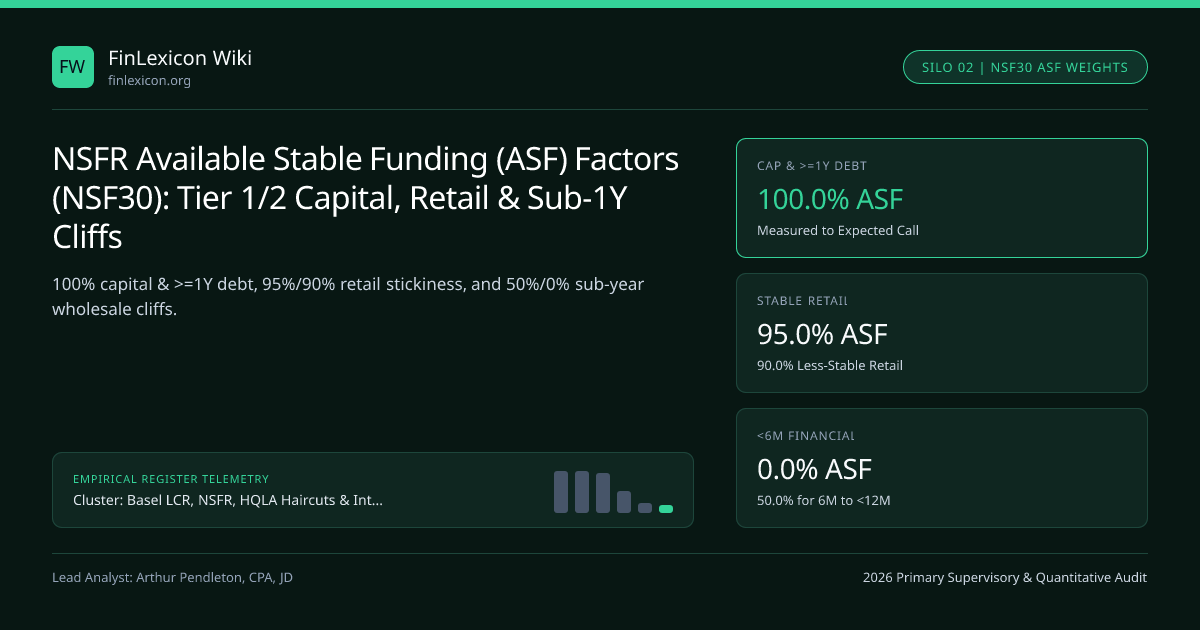
Designed under Basel Framework chapter NSF30.1–NSF30.14 to eradicate the Northern Rock and Lehman Brothers funding model of financing long-term assets with 35-to-180-day wholesale paper, Available Stable Funding (ASF) forms the numerator of the 100% Net Stable Funding Ratio (NSFR) Standard. Tracked across the NSFR-FUNDING 2026 Benchmark Standard, ASF weights every equity and liability tranche by both counterparty stickiness and effective residual maturity across < 6 months, 6 to < 12 months, and >= 1 year cliffs.
Five Statutory ASF Buckets: 100%, 95%, 90%, 50%, and 0% Weights#
NSF30 partitions a bank’s entire right-hand balance sheet into five exact calibration tiers summarized in our Basel LCR, NSFR & HQLA cornerstone guide:
- 100% ASF: Total regulatory capital (CET1, AT1, and Tier 2 before CAP30 deductions, excluding Tier 2 instruments with
< 1 yearresidual maturity!) PLUS any secured or unsecured borrowing/deposit from any counterparty (including hedge funds or banks) with an effective residual maturity >= 1 year (>= 365 days). - 95% ASF: Sight and
< 1 yearStable retail and small-business deposits (matching the 3%/5% LCR40 retail definition). - 90% ASF: Sight and
< 1 yearLess-Stable retail and small-business deposits. - 50% ASF:
< 1 yearfunding (both operational and non-operational!) from non-financial corporates, sovereigns, PSEs, and MDBs; operational deposits across all counterparties; AND wholesale funding from central banks and financial institutions maturing in 6 months to < 1 year! - 0% ASF: All
< 6 monthsnon-operational funding from central banks, banks, and financial institutions (including overnight interbank repo and prime-brokerage cash!), trade-date payables, and net NSFR derivative liabilities.
Conservative Option Exercise Rules on Callable Bonds and Extendible Repos (NSF30.6)#
Can a treasury desk manufacture 100% ASF cheaply by issuing a 2-year floating-rate note with an investor put option at Month 3, or a "366-day evergreen extendible repo"? NSF30.6 blocks option gaming asymmetrically:
- Investor / Counterparty Options: Assumed exercised at the earliest possible date! A 3-year puttable note where the investor can demand redemption at Month 6 has an effective NSFR maturity of 6 months (
50%or0%ASF). - Bank / Issuer Call Options: Whenever market participants expect the bank to exercise a redemption call prior to legal maturity for reputational reasons (for instance,
6NC5TLAC/MREL callable HoldCo notes carrying a par call 12 months before final maturity!), NSF30.6 requires measuring residual maturity to the call date rather than final legal maturity—meaning a6NC5bond drops from100%ASF into the< 1 year(50%/0%) cliff at Year 4.0 (two full years before legal maturity)!
The 6-Month and 12-Month Wholesale Funding Cliffs in Bank Issuance Ladders#
Look closely at how wholesale unsecured CDs, commercial paper, and term repos issued to money-market funds and asset managers step down as time passes at Bank of America, BNP Paribas, and Bank of Montreal:
- Day 366+ remaining: 100% ASF.
- Day 364 down to Day 183 (
6M to < 1Y): Drops immediately by -50 percentage points to 50% ASF! - Day 182 down to Day 0 (
< 6M): Drops to 0% ASF! (Whereas non-financial corporate deposits stay at 50% ASF* all the way to overnight sight accounts!)*
This two-step cliff (100% -> 50% -> 0%) explains why bank treasurers issue 3-to-5-year senior unsecured notes and covered bonds rather than 13-month money-market floaters.
| Liability / Equity Instrument | >= 1 Year Residual | 6 Months to < 1 Year | < 6 Months (Sight / Repo) | U.S. Reg WW NSFR Note (12 CFR 249 Sub. K) |
|---|---|---|---|---|
| CET1, AT1 & Qualifying Tier 2 Capital | 100% ASF | 0% / Debt rule (<1Y T2) | 0% (<6M T2) | Gross of most CAP30 asset deductions |
| Stable Insured Retail Deposits | 100% ASF | 95% ASF | 95% ASF | 95% FDIC-insured transactional |
| Less-Stable / Uninsured Retail Deposits | 100% ASF | 90% ASF | 90% ASF | 50%–0% penalty on short-term brokered! |
| Non-Financial Corporate / Sovereign | 100% ASF | 50% ASF | 50% ASF | 50% across entire <1Y bucket |
| Operational Clearing / Custody Deposits | 100% ASF | 50% ASF | 50% ASF | 50% operational (correspondent = 0% <6M) |
| Financial Institutions & Central Banks | 100% ASF | 50% ASF | 0% ASF | 0% on all <6M repo, CP & Fed Funds |
Central Bank Term Funding Operations (ECB TLTRO / BoE TFSME) Maturity Decay#
Multi-year central bank refinancing operations—such as the European Central Bank TLTRO III or Bank of England TFSME—provided 100% ASF at origination (3–4 year tenors), then rolled mechanically across the < 12M (50% ASF) and < 6M (0% ASF) boundaries, forcing European and UK banks to pre-issue EUR/GBP covered and senior preferred bonds well ahead of central bank repayment dates.
Pairing ASF Numerators With Asset Encumbrance RSF Denominators#
Because ASF supplies the structural funding pool consumed by NSFR Required Stable Funding (RSF) asset weights, ALCO desks run dynamic 4-quarter forward NSFR projections across the Basel LCR, NSFR & Prudential Liquidity topic hub so quarterly wholesale bond maturities never trigger unexpected ratio dips.
- + 0.50 * (Corplt1Y + OpDepositslt1Y + Fin6Mto1Y) + 0.00 * (Finlt6M + NetNSFRDeriv_Liab)
- Worked Balance Sheet ASF Audit ($200.0B Bank):
- Regulatory Capital + >=1Y Senior/TLAC Debt = $34.0B * 100% = $34.00B
- <1Y Stable Retail ($60.0B * 95%) + Less-Stable Retail ($20.0B * 90%) = $57.00B + $18.00B = $75.00B
- <1Y Corporate + Operational Deposits ($46.0B * 50%) + 6M–12M Institutional CDs ($12.0B * 50%) = $23.00B + $6.00B = $29.00B
- <6M Overnight Financial Repo & Money-Market CP ($28.0B * 0%) = $0.00B
- Total Available Stable Funding (ASF) = $34.00B + $75.00B + $29.00B + $0.00B = $138.00B (69.0% Blended ASF Density)
Frequently asked questions
Why does NSF30 use regulatory capital *before* CAP30 goodwill and DTA deductions in the 100% ASF bucket?
Because goodwill, intangibles, and DTAs sit on the asset side of the balance sheet and receive a 100% Required Stable Funding (RSF) weight in the NSFR denominator! Using pre-deduction capital in ASF matches 100% ASF against 100% RSF cleanly without double-penalizing deductions.
Why do operational clearing deposits from financial institutions only get 50% ASF when stable retail gets 95%?
Although operational custody/clearing accounts carry switching costs over a 30-day LCR window (25% outflow), over a 365-day NSFR horizon institutional clients have ample time to migrate custodians or optimize cash sweeps, capping operational ASF at 50%.
How are Deferred Tax Liabilities (DTLs) treated in Available Stable Funding?
Under NSF30.14, Deferred Tax Liabilities and minority interests without an explicit effective maturity date—or where reversal occurs in less than one year—receive 0% ASF (unless contractually settled >= 1 year under specific national rules).
Does issuing 9-month commercial paper to a money-market fund improve NSFR?
Only temporarily and at 50% efficiency: between Month 9 and Month 6 remaining to maturity, financial CP provides 50% ASF, and the instant it crosses below 180 days remaining, its ASF plunges to 0% while remaining on balance sheet.
Publication record
- Published
- 14 November 2026
- Updated
- 15 November 2026
- Author
- Arthur Pendleton, CPA, JD
- Review
- Review not recorded
- Automated fact check
- Passed in the stored pipeline record
- Source URLs
- 3 recorded
AI assistance recorded: anthropic/claude-opus-4.6. This field does not establish human review or source verification.
Academic & Institutional Attribution
Cite This Research & Embed Live Data Card
Standard academic & institutional research paper citation format.
Arthur Pendleton, CPA, JD. (2026, November 14). NSFR Available Stable Funding (ASF) Factors (NSF30): Tier 1/2 Capital, Retail & Sub-1Y Cliffs. FinLexicon Wiki. https://finlexicon.org/wiki/nsfr-asf-available-stable-funding-maturity-bucket-calibrationRelated Liquidity Coverage Nsfr Prudential & Institutional Briefings
Explore Liquidity Coverage Nsfr Prudential Hub (20) →Liquidity Coverage Nsfr Prudential
Basel III LCR, NSFR, HQLA Haircuts & Intraday Prudential Liquidity ArchitectureLiquidity Coverage Nsfr Prudential
NSFR Required Stable Funding (RSF) Weights (NSF30): Asset Encumbrance, 65% Mortgages & NPLsLiquidity Coverage Nsfr Prudential
Asymmetric NSFR Derivatives Treatment (NSF30): Cash VM Offsets & the 20% Gross Liability Add-OnLiquidity Coverage Nsfr Prudential
BCBS 248 Intraday Liquidity Monitoring Tools: RTGS Peak Net Debit & Time-Specific ObligationsLiquidity Coverage Nsfr Prudential
IRRBB Standards (BCBS d368 / SRP31): Six EVE Shock Scenarios, 15% Tier 1 Outlier Test & Delta-NIILiquidity Coverage Nsfr Prudential
Non-Maturity Deposits (NMD) Behavioral Modeling: Deposit Betas, Core Caps & SRP31 Duration CeilingsLiquidity Coverage Nsfr Prudential
U.S. Regulation WW (12 CFR Part 249): Peak-Day Maturity Mismatch Add-On & Tailoring Categories I–IVLiquidity Coverage Nsfr Prudential
Supervisory ILAAP, Internal Liquidity Stress Testing (Reg YY) & Reverse Stress Survival HorizonsIsda Csa Derivatives Collateral
Regulatory Grid Schedule Initial Margin vs ISDA SIMM: Notional Percentages & the 0.4 + 0.6*NGR FormulaIsda Csa Derivatives Collateral
CSA Minimum Transfer Amounts (MTA <= $500k/€500k), Rounding & Independent Amounts (IA vs Reg IM)Isda Csa Derivatives Collateral
Basel III SA-CCR (CRE52): Alpha = 1.4 Scalar, Margined Replacement Cost & Exponential PFE MultiplierIsda Csa Derivatives Collateral
Multi-Currency CSA Discounting & Cheapest-to-Deliver (CTD) Optionality: SOFR, €STR & ColVA Pricing
FinLexicon Wiki Data, Benchmarks & Contributor Records
CC BY 4.0 Open Data
Open Institutional Datasets (CSV / JSON) →
Download desk-compiled quantitative series & schemas.
2026 Reference Matrix
2026 Institutional Benchmarks & Thresholds →
Statutory capital, clearing, margin & rate conventions.
Editorial Records
Authors & Review Records →
View named contributors where those records are available.
Complete Index
Master Research & Dossier Archive →
Browse all published briefings by topic pillar & date.