
Liquidity Coverage Nsfr Prudential
Asymmetric NSFR Derivatives Treatment (NSF30): Cash VM Offsets & the 20% Gross Liability Add-On
Basel NSF30 imposes doubly asymmetric funding charges on OTC derivatives: disallowing bond VM offsets on derivative assets, assigning 0% ASF to net liabilities, and charging a 5%–20% RSF add-on on gross derivative liabilities.
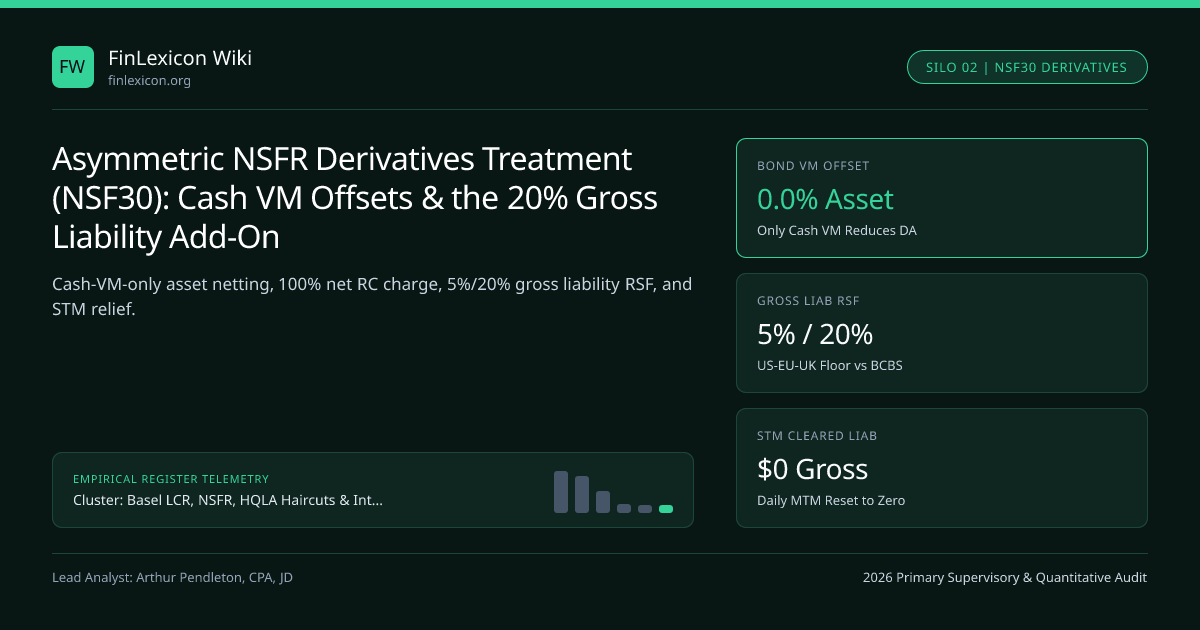
For global swaps dealers, the single most punitive structural funding rule in Basel III sits inside paragraphs NSF30.8–NSF30.9, NSF30.23–NSF30.24, and NSF30.31(3). To pre-fund uncollateralized receivable gaps and contingent collateral calls on out-of-the-money swap books, the Net Stable Funding Ratio (NSFR) enforces three stacked asymmetries across derivative replacement costs, variation margin collateral types, and gross derivative liabilities.
Asymmetry #1: Cash VM Only on Derivative Assets vs All VM Posted on Derivative Liabilities#
In economic reality and bilateral 2016 ISDA Variation Margin CSAs, counterparties routinely post either cash or Sovereign Level 1 bonds to cover mark-to-market swap exposures. Yet NSF30.24 computes NSFR_Derivative_Assets and NSFR_Derivative_Liabilities with deliberate asymmetry, as highlighted in our Basel LCR, NSFR & HQLA cornerstone guide:
- Derivative Assets (
V_i > 0): May be reduced ONLY by Cash Variation Margin received that meets strict Basel LEV30.21 leverage netting conditions (daily calculation, currency-matched to settlement/CSA, not segregated)! Receiving U.S. Treasuries, Gilts, or Bunds as variation margin provides ZERO deduction against NSFR Derivative Assets—leaving the full swap receivable exposed to a 100% RSF charge unless converted to cash! - Derivative Liabilities (
V_j < 0): MUST be reduced by ALL Variation Margin posted by the bank—regardless of whether the bank posted cash, sovereign bonds, or corporate debt! Why is deducting bond VM from derivative liabilities punitive? Because shrinkingNSFR_Derivative_Liabilitiesshrinks the liability offset againstNSFR_Derivative_Assets, inflating net positiveNet_NSFR_Deriv_Assets(100%RSF) while the posted bond simultaneously suffers100%(encumbered) RSF!
Asymmetry #2: 100% RSF on Net Derivative Assets vs 0% ASF on Net Derivative Liabilities#
Once netting-set receivables (NSFR_Deriv_Assets) and payables (NSFR_Deriv_Liabilities) are aggregated across the entire bank:
- If
NSFR_Deriv_Assets > NSFR_Deriv_Liabilities, the net positive difference attracts 100% Required Stable Funding (RSF)—forcing the dealer to fund uncollateralized corporate/sovereign swap receivables (or bond-margined receivables!) dollar-for-dollar with equity or>= 1 yearterm debt ASF. - Conversely, if
NSFR_Deriv_Liabilities > NSFR_Deriv_Assets, the net liability receives 0% Available Stable Funding (ASF) (NSF30.14)—because mark-to-market swap payables are never a stable source of bank funding!
Asymmetry #3: The Controversial 20% (5%–20% Recalibrated) Gross Derivative Liability Add-On#
Above and beyond 100% RSF on net derivative assets and 85% RSF on posted Initial Margin, NSF30.31(3) originally mandated an additional RSF charge equal to 20% of Gross Derivative Liabilities (before deducting ANY variation margin posted!) to serve as a rough proxy for future contingent variation margin outflows.
Industry QIS studies by ISDA and major dealers like BNP Paribas, Bank of America, and Bank of Montreal demonstrated that charging 20% of gross out-of-the-money swap payables—even on matched back-to-back client/CCP books—created massive double-counting alongside LCR 24-month HLBA. In October 2017 (BCBS d421 / NSF30.31 footnote), BCBS / BIS granted national discretion to lower the gross derivative liability add-on down to a 5% floor:
- United States (Federal Reserve Reg WW 12 CFR 249.107) and EU CRR II / UK PRA: Adopted the 5% of Gross Derivative Liabilities add-on (EU CRR II explored SA-CCR PFE alternatives before converging on 5% gross liabilities in CRR II/III alignment!).
| Derivative CSA Profile ($100M MTM) | NSFR Deriv Asset (Post-VM) | NSFR Deriv Liab (Post-VM) | Gross Liab Add-On (5% US/EU | 20% BCBS) | Total Incremental RSF | |
|---|---|---|---|---|---|---|
| In-the-Money Swap (+$100M) Uncollateralized | $100.0M | $0.0M | $0.0M | $0.0M | $100.0M RSF (100% FVA hit!) | |
| In-the-Money (+$100M) w/ $100M Cash VM Rec. | $0.0M (LEV30 Cash) | $0.0M | $0.0M | $0.0M | $0.0M RSF (Clean Cash CSA!) | |
| In-the-Money (+$100M) w/ $100M UST Bond VM! | $100.0M (Bond ignored!) | $0.0M | $0.0M | $0.0M | $100.0M RSF (Severe Bond Penalty!) | |
| Out-of-the-Money (-$100M) w/ $100M Cash VM | $0.0M | $0.0M (Post-VM) | $5.0M | $20.0M (Pre-VM = $100M!) | $5.0M US/EU | $20.0M BCBS RSF |
| Cleared LCH Swap (-$100M Reset via STM) | $0.0M | $0.0M (STM = $0) | $0.0M | $0.0M (STM resets V=0!) | $0.0M + 85% of Posted CCP IM |
How Settled-to-Market (STM) Accounting Collapses Cleared Gross Derivative Liabilities to Zero#
Because central counterparties (LCH SwapClear, CME, Eurex) amended rulebooks to characterize daily variation margin legally as Settled-to-Market (STM) final settlement rather than collateral pledge, STM resets cleared swap fair values to zero every evening! Resetting V_j = 0 legally eliminates cleared swaps from Gross_Derivative_Liabilities, slashing the 5%–20% NSFR add-on on centrally cleared books to near zero!
Pricing Cash-Only CSA Discounts Against Uncollateralized Corporate Swaps#
When a corporate airline or municipality insists on a one-way zero-CSA swap (where the corporate posts zero cash VM when in-the-money to the bank), every $100M mark-to-market gain forces the bank’s xVA desk to fund $100M of 100% RSF (>1Y senior debt spread = Funding Valuation Adjustment [FVA]) across the Basel LCR, NSFR & Prudential Liquidity topic hub!
- DLNSFR = Sum{j: Vj < 0} max( 0 , |Vj| - AllVMPostedCashandSecuritiesj )
- DLGrossPreVM = Sum{j: Vj < 0} |V_j| [Excludes Settled-to-Market STM contracts where legal MTM resets to $0]
- RSFDerivatives = 1.00 * max(0, DANSFR - DLNSFR) + alphaGDL * DLGrossPreVM + 0.85 * (IMPosted + CCPDF)
- Worked Back-to-Back Client Hedge Example ($500M Corporate Swap +$60M MTM [Zero CSA] Hedged w/ Bilateral Dealer -$60M MTM [$60M Cash VM Posted]):
- DANSFR = $60.0M - $0 = $60.0M | DLNSFR = max(0, $60.0M - $60.0M Cash VM) = $0.0M | DLGrossPreVM = $60.0M
- At alphaGDL = 5% (U.S./EU/UK): RSFDerivatives = 1.00($60.0M - $0) + 0.05($60.0M) = $63.0M Term Funding Required!
- If Dealer Hedge is Cleared at LCH under STM (DLGross = $0): RSFDerivatives = $60.0M + 0.85 * IM_Cleared
Frequently asked questions
Why does receiving U.S. Treasury bonds as Variation Margin fail to reduce NSFR Derivative Assets?
Unless a variation margin transfer extinguishes the receivable in cash (pre-settlement payment under LEV30), the derivative asset remains on the balance sheet while rehypothecating received bond collateral creates a separate return obligation; thus xVA desks charge multi-bps CSA discounting spreads against bond-posting counterparties.
Why must a bank deduct posted bonds from Derivative Liabilities if it cannot deduct received bonds from Derivative Assets?
Suppose Bank X has +$50M uncollateralized asset w/ Client A and -$50M liability w/ Dealer B where Bank X posted $50M cash/bonds. If Bank X did NOT deduct the $50M posted VM from Liability B, Liability B (-$50M) would offset Asset A (+$50M) to $0 net RSF—allowing Bank X to avoid funding Client A’s uncollateralized $50M cash drain!
Why did BCBS allow national supervisors to lower the 20% Gross Derivative Liability add-on to 5%?
Empirical data showed that 20% of gross pre-VM swap payables vastly overstated 1-year contingent margin funding risk on hedged dealer portfolios and discouraged end-user interest-rate and FX hedging, prompting the October 2017 BCBS d421 floor of 5%.
Does Initial Margin received from a hedge fund client reduce a dealer’s NSFR RSF?
No. Under NSF30.24, Initial Margin received cannot offset NSFR Derivative Assets (since IM covers potential future close-out losses, not current mark-to-market replacement cost, and regulatory UMR IM is segregated away from bank treasury).
Publication record
- Published
- 14 November 2026
- Updated
- 15 November 2026
- Author
- Arthur Pendleton, CPA, JD
- Review
- Review not recorded
- Automated fact check
- Passed in the stored pipeline record
- Source URLs
- 3 recorded
AI assistance recorded: anthropic/claude-opus-4.6. This field does not establish human review or source verification.
Academic & Institutional Attribution
Cite This Research & Embed Live Data Card
Standard academic & institutional research paper citation format.
Arthur Pendleton, CPA, JD. (2026, November 14). Asymmetric NSFR Derivatives Treatment (NSF30): Cash VM Offsets & the 20% Gross Liability Add-On. FinLexicon Wiki. https://finlexicon.org/wiki/nsfr-derivatives-net-replacement-cost-20-percent-gross-addonRelated Liquidity Coverage Nsfr Prudential & Institutional Briefings
Explore Liquidity Coverage Nsfr Prudential Hub (20) →Liquidity Coverage Nsfr Prudential
Basel III LCR, NSFR, HQLA Haircuts & Intraday Prudential Liquidity ArchitectureLiquidity Coverage Nsfr Prudential
BCBS 248 Intraday Liquidity Monitoring Tools: RTGS Peak Net Debit & Time-Specific ObligationsLiquidity Coverage Nsfr Prudential
IRRBB Standards (BCBS d368 / SRP31): Six EVE Shock Scenarios, 15% Tier 1 Outlier Test & Delta-NIILiquidity Coverage Nsfr Prudential
Non-Maturity Deposits (NMD) Behavioral Modeling: Deposit Betas, Core Caps & SRP31 Duration CeilingsLiquidity Coverage Nsfr Prudential
U.S. Regulation WW (12 CFR Part 249): Peak-Day Maturity Mismatch Add-On & Tailoring Categories I–IVLiquidity Coverage Nsfr Prudential
Supervisory ILAAP, Internal Liquidity Stress Testing (Reg YY) & Reverse Stress Survival HorizonsLiquidity Coverage Nsfr Prudential
Central Bank Liquidity Facilities: Fed Standing Repo (SRF), Discount Window, BoE ILTR & HQLA MonetizationLiquidity Coverage Nsfr Prudential
Held-to-Maturity (HTM) Unrealized Losses, Uninsured Deposit Runs & the Solvency-Liquidity Doom LoopIsda Csa Derivatives Collateral
Basel III SA-CCR (CRE52): Alpha = 1.4 Scalar, Margined Replacement Cost & Exponential PFE MultiplierIsda Csa Derivatives Collateral
Multi-Currency CSA Discounting & Cheapest-to-Deliver (CTD) Optionality: SOFR, €STR & ColVA PricingIsda Csa Derivatives Collateral
ISDA 2020 IBOR Fallbacks Protocol: Compounded-in-Arrears RFRs & Bloomberg 5-Year Median SpreadsIsda Csa Derivatives Collateral
UMR Eligible Collateral Schedules: Sovereign/Corporate Haircuts, Wrong-Way Risk Bans & the 8% FX Add-On
FinLexicon Wiki Data, Benchmarks & Contributor Records
CC BY 4.0 Open Data
Open Institutional Datasets (CSV / JSON) →
Download desk-compiled quantitative series & schemas.
2026 Reference Matrix
2026 Institutional Benchmarks & Thresholds →
Statutory capital, clearing, margin & rate conventions.
Editorial Records
Authors & Review Records →
View named contributors where those records are available.
Complete Index
Master Research & Dossier Archive →
Browse all published briefings by topic pillar & date.