
Liquidity Coverage Nsfr Prudential
BCBS 248 Intraday Liquidity Monitoring Tools: RTGS Peak Net Debit & Time-Specific Obligations
Published in BCBS 248, Basel intraday liquidity monitoring tracks minute-by-minute RTGS cumulative peak net debit usage, time-specific CLS and CCP payment deadlines, and intraday payment throughput.
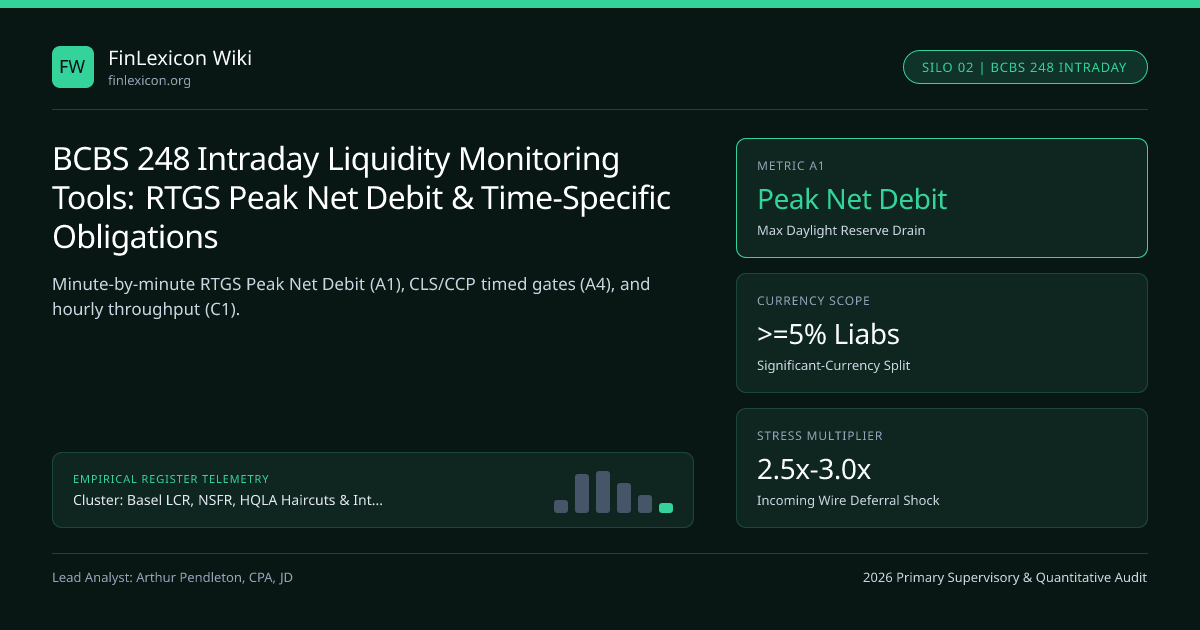
Both the 30-day Liquidity Coverage Ratio and 1-year Net Stable Funding Ratio measure balance sheets exclusively at end-of-day close (17:00–18:30)—leaving a blind spot across the $15+ trillion of gross wires settled intra-hour on Fedwire Funds, TARGET2 (T2), CHAPS, and BOJ-NET. Issued by BCBS / BIS in April 2013 in consultation with CPMI, *BCBS 248 (Monitoring Tools for Intraday Liquidity Management)* establishes seven quantitative intraday telemetry metrics and four severe intraday stress scenarios.
Why End-of-Day LCR Misses Intraday Payment Gridlock: The Peak Net Debit Gap#
Suppose a clearing bank starts the morning at 08:00 with $12.0B of reserve balances at the U.S. Federal Reserve System, sends $45.0B of outgoing client, CCP margin, and Treasury repo wires between 08:30 and 11:30 while receiving only $22.0B of incoming wires, and later collects $24.0B of incoming wires between 14:00 and 16:30 to finish at 17:00 with $13.0B of reserves.
End-of-day LCR records a placid +$1.0B reserve gain! Yet at 11:30 a.m., the bank suffered a Daily Maximum Intraday Liquidity Usage (Peak Cumulative Net Debit Position) of -$23.0B—exhausting its entire $12.0B opening reserve balance and requiring $11.0B of collateralized daylight overdraft credit! If counterparties hoard incoming payments during a rumor-driven panic (as happened to Lehman Brothers in September 2008 when clearing banks demanded full intraday cash pre-funding), the bank defaults on time-critical wires hours before close, as integrated into our Basel LCR, NSFR & HQLA cornerstone guide.
The Seven Quantitative BCBS 248 Reporting Metrics (Direct Participants vs Correspondent Users)#
BCBS 248 mandates monthly supervisory reporting (with daily internal timestamped ledger capture) across three universal metrics (A1–A3), two correspondent-banking metrics (B1–B2), and two direct RTGS participant metrics (C1–C2) implemented across ECB, Bank of England CHAPS, HKMA, and Federal Reserve FR 2052a Complex Institution Liquidity Monitoring Reports:
- A1 — Daily Maximum Intraday Liquidity Usage: The largest negative net cumulative payment position (
Min_t [Cumulative_Receipts_t - Cumulative_Payments_t]) on each business day (reporting the top 3 largest daily peaks + monthly average). - A2 — Available Intraday Liquidity at Start of Business Day: Opening central bank reserves, unencumbered Level 1 HQLA pre-positioned in central bank collateral pools, and committed intraday credit lines.
- A3 — Total Payments: Gross daily outgoing and incoming wire volumes.
- A4 (Time-Specific & Critical Obligations): Exact value and settlement-timestamp compliance for hard-deadline obligations where missing a cutoff triggers systemic failure or reputational default: CLS Payment-versus-Payment (PvP)
07:00–12:00 CETpay-in schedules, intraday CCP variation margin calls, and ancillary retail batch settlements! - B1 & B2 (Correspondent Banking Providers): Value of payments executed on behalf of financial-institution customers (
B1) and uncommitted intraday credit lines extended to respondent banks (B2) by clearing leaders like Bank of America and BNP Paribas. - C1 & C2 (Direct RTGS Participants): Intraday Throughput (
C1)—percentage of total daily outgoing payments settled by08:00, 09:00, 10:00 ... 17:00(detecting payment-throttling / hoarding!)—and Gross Intraday Central Bank Credit Usage (C2).
Four Mandatory BCBS 248 Intraday Stress Scenarios for ILAAP Buffer Sizing#
While BCBS 248 intentionally refrained from creating a rigid Pillar 1 "Intraday LCR" percentage—recognizing that rigid intraday minimums could perversely incentivize banks to delay outgoing wires and cause RTGS gridlock!—paragraphs 41–45 require sizing internal ILAAP survival buffers across four acute intraday shocks: (1) Own Financial Stress (counterparties defer incoming wires until late afternoon and cut intraday credit lines), (2) Counterparty Stress (a major clearing counterparty fails to send scheduled incoming wires all day), (3) Customer Bank Stress (respondent banks draw maximum intraday overdrafts at a correspondent), and (4) Market-Wide Credit/FX Shock (haircuts jump on pledged central bank collateral while currency swap lines freeze).
| BCBS 248 Code & Metric Name | Reporting Institution Scope | Measurement Cadence | Primary Vulnerability Detected | FR 2052a / Supervisory Link |
|---|---|---|---|---|
| A1: Daily Max Intraday Usage | All Reporting Banks | Top 3 daily peaks + monthly avg | Daylight insolvency before 17:00 close | FR 2052a SI-1 Peak Net Debit |
| A2: Opening Available Liquidity | All Reporting Banks | Lowest 3 opening days + avg | Insufficient pre-positioned CB collateral | FR 2052a Reserves + Window Pool |
| A4: Time-Specific Obligations | All Reporting Banks | Total & missed timed wires | CLS 08:00–12:00 CET / CCP T+0 breach | Immediate supervisory escalation |
| B1 / B2: Correspondent Credit | Clearing Correspondent Banks | Max intraday customer lines | Respondent bank overdraft contagion | Wholesale clearing tiering review |
| C1: Intraday Throughput (%) | Direct RTGS Participants | Hourly buckets (08:00 to 17:00) | Defensive wire hoarding / RTGS gridlock | CHAPS / T2 throughput rules |
Liquidity-Saving Mechanisms (LSMs) and Throughput Guidelines in CHAPS & T2#
Modern RTGS engines—such as Eurosystem T2 and Bank of England CHAPS—pair pure real-time settlement with Liquidity-Saving Mechanisms (LSMs) that match bilateral and multilateral offsetting payment queues every few seconds, cutting peak net debit liquidity needs by 25%–40% while enforcing supervisory throughput benchmarks (e.g., >=50% of daily value settled by 12:00–13:00).
Double-Duty Overlap: Counting Pre-Positioned RTGS Reserves in Both BCBS 248 and 30-Day LCR#
Crucially, central bank reserves used intraday to absorb a 11:00 a.m. peak net debit return to the reserve account by 17:00 close in normal operations; however, under severe stress (Scenario 1/2), if delayed incoming wires remain unpaid overnight, intraday liquidity drains convert permanently into Day-1 LCR outflows—requiring an explicit intraday buffer tranche inside Liquidity Funds Transfer Pricing across the Basel LCR, NSFR & Prudential Liquidity topic hub!
- MaxIntradayUsage = | min{t} ( 0 , NetCum_Pos(t) ) | [BCBS 248 Metric A1]
- StressedA1Scenario = | min{t} ( 0 , (1 - alphadefer(t)) * CumReceipts(t) - CumUrgent_Payments(t) ) |
- IntradayBufferReq = max( 0 , StressedA1Scenario - UnencumberedOpeningReservesandRTGS_Credit )
- Worked Intraday Stress Audit (Opening Reserves = $18.0B, Pre-Positioned Fedwire Collateral = $12.0B => A2 = $30.0B):
- By 11:30 a.m. normal day: Cumulative Outgoing = $42.0B (incl. $16.0B mandatory CLS/CCP A4) | Cumulative Incoming = $29.0B
- Normal A1 Peak Net Debit = |$29.0B - $42.0B| = $13.0B (43.3% of A2 capacity)
- Under Own-Stress Scenario (50% of morning incoming wires deferred past 15:00; mandatory + franchise outgoing = $39.0B):
- Stressed 11:30 a.m. Net Pos = (0.50 * $29.0B) - $39.0B = -$24.50B => Consumes 100% of $18B Cash + $6.50B Daylight Credit!
Frequently asked questions
Why did BCBS make BCBS 248 a Pillar 2 monitoring toolkit rather than a Pillar 1 minimum ratio?
If banks faced a binding public intraday ratio breach penalty at 11:00 a.m., every treasury would delay sending non-timed outgoing payments until receiving incoming wires first—creating a Prisoner’s Dilemma payment freeze across Fedwire, TARGET2, and CHAPS!
How must internationally active banks report BCBS 248 across multiple foreign currencies?
Under BCBS 248 paragraph 15, intraday metrics are reported separately for each significant currency (any currency where aggregate liabilities equal or exceed 5% of the bank’s total liabilities), because intraday USD Fedwire deficits cannot be settled instantly with unswapped JPY or EUR reserves.
How did FedNow and 24/7/365 instant payment rails change intraday liquidity management?
Weekend and holiday retail/corporate runs can now settle continuously outside traditional Monday–Friday 09:00–18:00 central bank window hours, prompting banks to maintain larger pre-funded master-account reserve cushions and automated weekend discount-window collateral pledges.
What is "payment throttling" and when is it permissible vs prohibited by supervisors?
Payment throttling queues non-urgent outgoing wires inside an internal Liquidity-Saving scheduler to smooth minute-by-minute peaks; while prudent smoothing is standard, systematically missing C1 hourly throughput bands or delaying client settlements during mild volatility draws immediate supervisory intervention.
Publication record
- Published
- 14 November 2026
- Updated
- 15 November 2026
- Author
- Arthur Pendleton, CPA, JD
- Review
- Review not recorded
- Automated fact check
- Passed in the stored pipeline record
- Source URLs
- 3 recorded
AI assistance recorded: anthropic/claude-opus-4.6. This field does not establish human review or source verification.
Academic & Institutional Attribution
Cite This Research & Embed Live Data Card
Standard academic & institutional research paper citation format.
Arthur Pendleton, CPA, JD. (2026, November 14). BCBS 248 Intraday Liquidity Monitoring Tools: RTGS Peak Net Debit & Time-Specific Obligations. FinLexicon Wiki. https://finlexicon.org/wiki/bcbs-248-intraday-liquidity-monitoring-rtgs-peak-net-debitRelated Liquidity Coverage Nsfr Prudential & Institutional Briefings
Explore Liquidity Coverage Nsfr Prudential Hub (20) →Liquidity Coverage Nsfr Prudential
Basel III LCR, NSFR, HQLA Haircuts & Intraday Prudential Liquidity ArchitectureLiquidity Coverage Nsfr Prudential
IRRBB Standards (BCBS d368 / SRP31): Six EVE Shock Scenarios, 15% Tier 1 Outlier Test & Delta-NIILiquidity Coverage Nsfr Prudential
Non-Maturity Deposits (NMD) Behavioral Modeling: Deposit Betas, Core Caps & SRP31 Duration CeilingsLiquidity Coverage Nsfr Prudential
U.S. Regulation WW (12 CFR Part 249): Peak-Day Maturity Mismatch Add-On & Tailoring Categories I–IVLiquidity Coverage Nsfr Prudential
Supervisory ILAAP, Internal Liquidity Stress Testing (Reg YY) & Reverse Stress Survival HorizonsLiquidity Coverage Nsfr Prudential
Central Bank Liquidity Facilities: Fed Standing Repo (SRF), Discount Window, BoE ILTR & HQLA MonetizationLiquidity Coverage Nsfr Prudential
Held-to-Maturity (HTM) Unrealized Losses, Uninsured Deposit Runs & the Solvency-Liquidity Doom LoopLiquidity Coverage Nsfr Prudential
Cross-Currency LCR (LCR30.45), Off-Balance-Sheet FX Swap Funding Gaps & CLS PvP LiquidityIsda Csa Derivatives Collateral
Multi-Currency CSA Discounting & Cheapest-to-Deliver (CTD) Optionality: SOFR, €STR & ColVA PricingIsda Csa Derivatives Collateral
ISDA 2020 IBOR Fallbacks Protocol: Compounded-in-Arrears RFRs & Bloomberg 5-Year Median SpreadsIsda Csa Derivatives Collateral
UMR Eligible Collateral Schedules: Sovereign/Corporate Haircuts, Wrong-Way Risk Bans & the 8% FX Add-OnIsda Csa Derivatives Collateral
Tri-Party & Third-Party Account Control Agreements (ACAs): Segregated UMR IM & Notice of Exclusive Control
FinLexicon Wiki Data, Benchmarks & Contributor Records
CC BY 4.0 Open Data
Open Institutional Datasets (CSV / JSON) →
Download desk-compiled quantitative series & schemas.
2026 Reference Matrix
2026 Institutional Benchmarks & Thresholds →
Statutory capital, clearing, margin & rate conventions.
Editorial Records
Authors & Review Records →
View named contributors where those records are available.
Complete Index
Master Research & Dossier Archive →
Browse all published briefings by topic pillar & date.