
Isda Csa Derivatives Collateral
1992 ISDA Market Quotation & Loss vs 2002 Close-Out Amount: Section 6(e) Early Termination Valuation
Following the 1998 LTCM and 2008 Lehman crises where 4-dealer Market Quotation polls broke down, the 2002 ISDA Master Agreement introduced Close-Out Amount—blending executable third-party quotes, mid-market curves, and internal models.
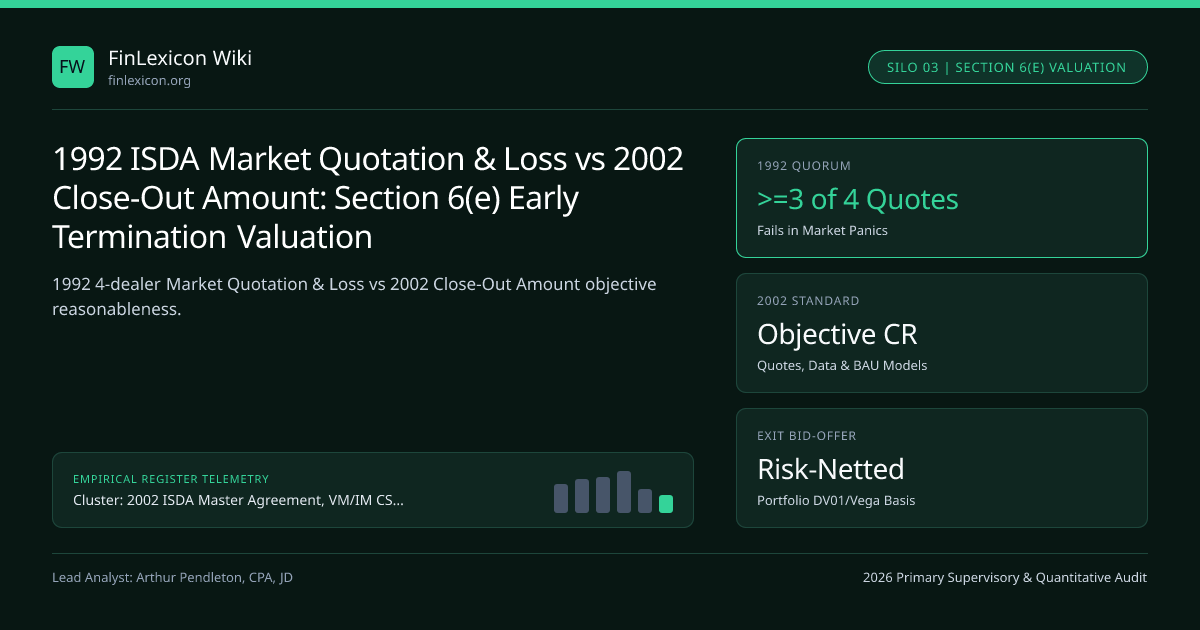
Valuing 15,000 bespoke cross-currency swaps, swaptions, and exotic credit derivatives at 09:00 on the morning a global investment bank collapses is the ultimate stress test of financial contract law. Between the 1992 ISDA Master Agreement and the 2002 ISDA Master Agreement, Section 6(e) underwent a fundamental philosophical shift—retiring rigid four-dealer "Market Quotation" and subjective "Loss" in favor of the unified, commercially reasonable "Close-Out Amount" standard.
Why 1992 ISDA "Market Quotation" Failed During the 1998 LTCM and 2008 Lehman Panics#
Under the 1992 ISDA Master Agreement, parties typically elected Market Quotation (paired with Second Method two-way payment) as their primary close-out valuation yardstick within the ISDA single-agreement netting architecture. Mechanically, Market Quotation required the Non-Defaulting Party to:
- Solicit firm replacement quotes from four leading Reference Market-makers for the exact economic equivalent of each terminated transaction (or portfolio group).
- If all 4 quotes arrived, discard the highest and lowest and average the middle 2 quotes; if exactly 3 quotes arrived, select the middle quote.
- If fewer than 3 Reference Market-makers provided firm quotes—which happened on virtually every illiquid or large swap book during September 1998 (LTCM/Russia) and September 2008 (Lehman)—Market Quotation collapsed automatically into the fallback "Loss" definition!
Worse still, switching abruptly from rigid third-party bid/offer quotes (Market Quotation) to broad indemnity-style valuation (Loss) sparked years of billion-dollar courtroom battles over whether internal hedge unwinds, funding spreads, and own/counterparty credit spreads (CVA/DVA) could be priced into the claim!
Architecture of the 2002 ISDA "Close-Out Amount": Good Faith & Commercial Reasonableness#
Drafted directly from the lessons of 1998 Asian/Russian/LTCM defaults, the 2002 ISDA Master Agreement fused Market Quotation and Loss into a single, flexible, objectively policed metric: Close-Out Amount (Section 14).
Under Close-Out Amount, the Determining Party calculates the gains or losses it would incur in replacing—or providing the economic equivalent of—the material terms of the terminated transactions, acting in good faith and using commercially reasonable procedures in order to produce a commercially reasonable result!
Crucially, Section 14 explicitly authorizes a three-source data hierarchy without requiring 4 failed dealer phone calls first:
- Firm or Indicative Third-Party Quotations (weighted by market liquidity and size).
- Relevant External Market Data (observable broker screens, futures, OIS curves, vol surfaces).
- Internal Pricing Models & Rate Curves—explicitly permitted whenever used by the Determining Party in the regular course of its business for valuing similar transactions with third parties!
Creditworthiness & Funding Spreads on Close-Out: Can Determining Parties Charge Bid-Ask & CVA?#
Look closely at two decisive valuation rules enforced by New York and English courts across dealers such as Bank of America, BNP Paribas, and Bank of Montreal:
- Exclusion of Defaulting Party’s Credit Spread (
Credit-Risk-Free Replacement): Both Market Quotation and 2002 Close-Out Amount price replacement swaps assuming satisfaction of all conditions precedent (Section 2(a)(iii)) with a creditworthy replacement dealer (including existing 2016 VM CSA collateral terms!)—you cannot discount what you owe an insolvent counterparty by its 4,000 bps distressed CDS spread! (However, the Determining Party’s own creditworthiness* MAY be considered under 2002 Close-Out Amount when third-party dealers quote replacement levels to a weakened Determining Party!)* - Executable Bid-Offer Crossing Cost (Concentration / Liquidity Add-On): Exiting a
$15BDV01 swap book costs real dealer bid-ask crossing spread; courts uphold commercially reasonable portfolio-level bid-ask adjustments (netting offsetting risk buckets first rather than charging gross trade-by-trade bid-ask on 10,000 offsetting swaps!).
| Valuation Feature | 1992 Market Quotation | 1992 Loss (Fallback / Primary) | 2002 Close-Out Amount (Standard) |
|---|---|---|---|
| Primary Valuation Mechanism | 4 Reference Market-maker firm quotes (trim high/low) | Broad good-faith total loss/gain determination | Replacement economic equivalent via quotes, data, or models |
| Standard of Judicial Review | Procedural compliance with 4-dealer poll | Subjective good faith (Wednesbury rationality in UK) | Objective "commercially reasonable procedures & result"! |
| Use of Internal Pricing Models | Not permitted unless <3 quotes trigger Loss | Permitted as fallback evidence of Loss | Explicitly permitted where used in BAU business |
| Consideration of Credit Support (CSA) | Silent/ambiguous in 1992 pre-printed text | Considered economically | Explicitly includes existing Credit Support Documents! |
| Determining Party’s Own Credit | Excluded (assumes prime dealer) | Debated in Lehman litigation | May be included where affecting replacement quotes |
The 2009 ISDA Close-Out Amount Protocol: Upgrading Legacy 1992 Master Agreements#
Rather than repapering tens of thousands of legacy 1992 Schedules from scratch, institutional counterparties adhered to the 2009 ISDA Close-Out Amount Protocol, surgically replacing 1992 Market Quotation/Loss with the 2002 Close-Out Amount definition while preserving bespoke Schedule elections like Section 5 Cross-Default thresholds.
Auditability of Close-Out Calculations Under Section 6(d)(i)#
Under Section 6(d)(i), the Determining Party must deliver a detailed written Close-Out Statement showing quotations, market data, and model inputs in reasonable detail—a key audit focus across the ISDA-2002-CSA 2026 Benchmark Standard and the 2002 ISDA Master Agreement, CSA & SIMM topic hub.
- CloseOutAmountPortfolio = PVMidCSA(NettingSet) + CrossingCost( NetBucketSensitivitiesDeltaVega )
- [ Subject to Objective Standard: |CloseOutAmount - ExecutablePortfolioReplacement| <= MarketDispersion_Band ]
- Worked Section 6(e) Settlement Statement (Defaulting Counterparty B; Determining Party A; USD Termination Currency):
- 1. Mid-Market CSA-Discounted PV of 450 Terminated Swaps (in favor of Party A) = +$180.00M
- 2. Portfolio-Netted Dealer Bid-Offer Replacement Charge (3.5 bps * $4.0M/bp Net DV01) = +$14.00M => Close-Out Amount = +$194.00M
- 3. Unpaid Past-Due Coupons Owed to A (+$3.20M) minus Title-Transfer Cash VM Held by A (-$175.00M Unpaid Amount)
- Net Section 6(e) Early Termination Payable by Defaulting Party B = $194.00M + $3.20M - $175.00M = +$22.20M!
Frequently asked questions
How did English courts distinguish the legal standard of 1992 "Loss" vs 2002 "Close-Out Amount"?
In *Fondazione Enasarco v Lehman Brothers Finance SA* [2015] EWHC 1307, the High Court explained that 1992 Loss requires only good faith and *Wednesbury* rationality (not perverse), whereas 2002 Close-Out Amount requires objective commercial reasonableness in both methodology and numerical outcome!
If the Non-Defaulting Party actually executes a replacement swap in the market, is the Determining Party bound to that exact trade price?
Under 2002 Close-Out Amount, an arm’s-length replacement hedge or auction executed promptly in the market is powerful—often decisive—evidence of replacement value, provided the auction/execution itself followed commercially reasonable procedures (not a sweetheart affiliate print!).
How does Variation Margin already held enter the Section 6(e) Early Termination formula?
Under an English Law Title Transfer CSA, posted VM forms a Conditional Return "Transaction" whose value enters Unpaid Amounts directly inside Section 6(e); under a New York Law Security Interest CSA, Section 6(e) computes the gross swap Close-Out Amount first, and Paragraph 8 of the NY CSA sets off pledged collateral immediately against it!
Can a Determining Party include Hedge Accounting break costs or regulatory capital (KVA) in Close-Out Amount?
Hedging losses/gains directly incurred in unwinding hedges of the terminated transactions may be considered as evidence of replacement cost, whereas internal regulatory capital charges (KVA) that a third-party market maker would not charge in an executable replacement swap price are generally disallowed.
Publication record
- Published
- 14 November 2026
- Updated
- 15 November 2026
- Author
- Arthur Pendleton, CPA, JD
- Review
- Review not recorded
- Automated fact check
- Passed in the stored pipeline record
- Source URLs
- 3 recorded
AI assistance recorded: anthropic/claude-opus-4.6. This field does not establish human review or source verification.
Academic & Institutional Attribution
Cite This Research & Embed Live Data Card
Standard academic & institutional research paper citation format.
Arthur Pendleton, CPA, JD. (2026, November 15). 1992 ISDA Market Quotation & Loss vs 2002 Close-Out Amount: Section 6(e) Early Termination Valuation. FinLexicon Wiki. https://finlexicon.org/wiki/isda-1992-market-quotation-loss-vs-2002-close-out-amountRelated Isda Csa Derivatives Collateral & Institutional Briefings
Explore Isda Csa Derivatives Collateral Hub (20) →Isda Csa Derivatives Collateral
2002 ISDA Master Agreement, VM/IM CSA, ISDA SIMM v2.6, SA-CCR & Close-Out Netting ArchitectureIsda Csa Derivatives Collateral
ISDA Section 5(a) Events of Default vs Section 5(b) Termination Events: Cross-Default & Threshold AmountsIsda Csa Derivatives Collateral
2016 ISDA Variation Margin CSA: New York Security Interest Pledge vs English Law Title TransferIsda Csa Derivatives Collateral
Uncleared Margin Rules (UMR Phases 1–6): $8B/€8B AANA Calculation & the $50M/€50M IM ThresholdIsda Csa Derivatives Collateral
ISDA SIMM v2.6 / v2.7 Methodology: Delta, Vega, Curvature Risk Weights, Concentration Thresholds & Add-OnsIsda Csa Derivatives Collateral
Regulatory Grid Schedule Initial Margin vs ISDA SIMM: Notional Percentages & the 0.4 + 0.6*NGR FormulaIsda Csa Derivatives Collateral
CSA Minimum Transfer Amounts (MTA <= $500k/€500k), Rounding & Independent Amounts (IA vs Reg IM)Isda Csa Derivatives Collateral
Basel III SA-CCR (CRE52): Alpha = 1.4 Scalar, Margined Replacement Cost & Exponential PFE MultiplierIfrs9 Cecl Credit Provisioning
IFRS 9 vs CECL Procyclicality in Stress & Basel CET1 Regulatory Capital Transitional Phase-InsIfrs9 Cecl Credit Provisioning
IFRS 9 SICR Quantitative Calibration: Relative Lifetime PD Ratios vs Absolute Basis-Point ThresholdsIfrs9 Cecl Credit Provisioning
IFRS 9 SPPI Cash-Flow Test & May 2024 IASB Amendments: ESG Sustainability-Linked Loans & Non-Recourse DebtIfrs9 Cecl Credit Provisioning
POCI (IFRS 9) vs PCD (US GAAP ASC 326): Purchased Credit-Impaired Accounting, Gross-Up & CAEIR
FinLexicon Wiki Data, Benchmarks & Contributor Records
CC BY 4.0 Open Data
Open Institutional Datasets (CSV / JSON) →
Download desk-compiled quantitative series & schemas.
2026 Reference Matrix
2026 Institutional Benchmarks & Thresholds →
Statutory capital, clearing, margin & rate conventions.
Editorial Records
Authors & Review Records →
View named contributors where those records are available.
Complete Index
Master Research & Dossier Archive →
Browse all published briefings by topic pillar & date.