
Isda Csa Derivatives Collateral
Regulatory Grid Schedule Initial Margin vs ISDA SIMM: Notional Percentages & the 0.4 + 0.6*NGR Formula
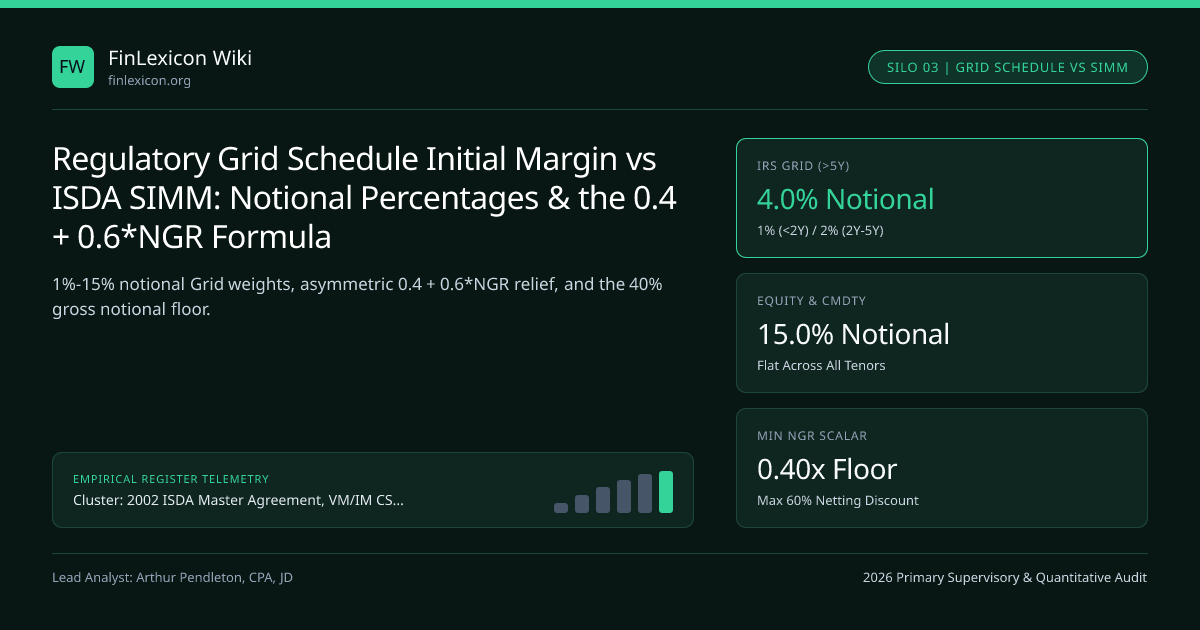
For Phase 6 end-users seeking to avoid CRIF sensitivity infrastructure—or holding one-way directional hedges—the BCBS-IOSCO Standardized Grid Schedule computes Initial Margin using 1%–15% notional weights scaled by 0.4 + 0.6*NGR.
Running ISDA SIMM requires daily option-surface pricing engines, CRIF sensitivity generation, quarterly backtesting, and model governance fees. For smaller UMR Phase 6 insurers, endowments, and corporate pension funds—and surprisingly even for purely directional one-way duration hedges—BCBS-IOSCO Annex A provides a zero-Greek regulatory alternative: the Standardized Regulatory Grid ("Schedule") Initial Margin coupled with the *Net-to-Gross Ratio (`0.4 + 0.6 NGR`)** netting formula!
The Official BCBS-IOSCO Standardized Grid Table (1% to 15% of Gross Notional)#
Codified identically across U.S. Prudential (12 CFR Part 237 Appendix A), CFTC (17 CFR 23.154(c)), EU EMIR RTS Annex IV, and UK PRA rulebooks within our 2002 ISDA Master Agreement & UMR cornerstone guide, the Regulatory Grid multiplies each trade’s gross notional principal by a fixed statutory percentage:
- Interest Rate Swaps, Swaptions & Inflation: 1.0% (
< 2 yearsresidual maturity), 2.0% (2 to 5 years), 4.0% (> 5 years—notice a 6-year swap and a 50-year swap both get 4.0%!). - Credit Derivatives (CDS): 2.0% (
< 2 years), 5.0% (2 to 5 years), 10.0% (> 5 years). - Foreign Exchange (Non-Exempt FX Options / NDFs): 6.0% across all maturities (physically settled FX forwards/swaps are 0% exempt* from UMR IM!)*.
- Equities & Commodities: 15.0% across all maturities!
- Other / Bespoke Exotics: 15.0% across all maturities.

How the 0.4 + 0.6 * NGR Formula Grants Up to 60% Portfolio Netting Relief#
Summing Gross_Initial_Margin = Sum_i (Grid_%_i * Notional_i) blindly across a portfolio of offsetting swaps would charge double margin whenever a fund unwound an existing swap by entering an equal-and-opposite offsetting trade! To recognize bilateral close-out netting without computing sensitivities, BCBS-IOSCO borrowed the classic Basel II CEM Net-to-Gross Ratio (NGR) scalar:
- Compute Net Replacement Cost (
Net_RC = max(0, Sum_i MTM_i)) across all UMR-covered trades in the netting set. - Compute Gross Replacement Cost (
Gross_RC = Sum_i max(0, MTM_i))—the sum of strictly positive mark-to-market trades. - Set
NGR = Net_RC / Gross_RC(NGR in [0, 1]; setNGR = 1.0ifGross_RC == 0on Day 0 when all swaps are freshly struck at par!). - Compute *`NetStandardizedIM = ( 0.40 + 0.60 NGR ) * GrossInitialMargin`**!
Two Astonishing Mathematical Quirks of 0.4 + 0.6 * NGR Every Quant Must Know#
Examine the NGR formula closely across institutional portfolios facing Bank of America, BNP Paribas, and Bank of Montreal—it hides two counterintuitive behaviors:
- Quirk #1 (Day-0 Par Trap vs Out-of-the-Money Drop!): Suppose a pension fund enters a brand-new
$1.0B30-year SOFR receiver swap at par (MTM = $0). At Day 0 (Gross_RC = 0),NGR = 1.0, soGrid_IM = 4.0% * $1.0B = $40.0M. Tomorrow, rates rise+5 bpsso the swap moves -$10M out-of-the-money to the fund (MTM = -$10M)! NowNet_RC = max(0, -$10M) = $0, while for the dealerNet_RC = +$10M(NGR_dealer = 1.0,NGR_fund = 0.0if another tiny+$1ktrade exists)! Suddenly *one side’s Grid IM drops 60% (`0.4 $40M = $16M) while the other side stays at$40M`—making Grid IM asymmetric** between Party A and Party B (unlike symmetric ISDA SIMM!)! - Quirk #2 (30-Year Duration Arbitrage vs SIMM): On a 30-year zero-coupon or par receiver swap, true DV01 is
~21 bps/$, so ISDA SIMM charges ~13.4% of notional (21 * 64 bps), whereas Grid caps >5Y IRS flat at 4.0% of notional! However, remember the strict no-cherry-picking rule (BCBS d499/ ECB EMIR): you cannot flip between Grid and SIMM Opportunistically!
| Asset Class & Residual Maturity | Regulatory Grid % of Notional | Typical ISDA SIMM Equivalent | Symmetry Between Party A & B | Best Institutional Use Case |
|---|---|---|---|---|
Interest Rate (< 2Y / 2–5Y / > 5Y) | 1.0% / 2.0% / 4.0% | ~0.6% (1Y) to ~13.5% (30Y!) | Grid Asymmetric (NGR); SIMM Symmetric | Small sub-$50M TH funds or ultra-long 30Y |
Credit Derivatives (< 2Y / 2–5Y / > 5Y) | 2.0% / 5.0% / 10.0% | ~1.2% (IG Index) to ~18% (HY) | Grid penalizes IG CDX/iTraxx hedges heavily | Rarely optimal for active CDS desks |
| FX Options & Non-Deliverable Forwards | 6.0% (All maturities) | ~3.5%–8.5% (net Delta + Vega) | Grid ignores Delta-hedged FX option offsets | Low-notional NDF hedgers (<$800M) |
| Equity Swaps & Options (EU/UK UMR) | 15.0% (All maturities) | ~14%–28% (net long/short beta) | Grid charges 15% on BOTH long & short legs! | Minor single-trade sleeve carve-out |
| Commodities (Swaps, Forwards & Options) | 15.0% (All maturities) | ~16% (Gold) to ~55% (Gas/Power) | Grid ignores calendar-spread offsets | Non-core commodity sleeve on IR bank |
Hybrid Election: Using SIMM on Rates/FX While Using Grid on Minor Commodity/Equity Sleeves#
Both U.S. UMR and EU/UK EMIR permit Risk-Class-Level Election: an insurer running 99% interest-rate and FX hedges on SIMM with three small legacy commodity swaps may elect Grid (15%) solely for the Commodity class rather than building a full commodity CRIF engine!
Operational Adoption of Grid for Sub-$50M Phase 6 Threshold Monitoring#
Many newly in-scope $9B AANA funds use Grid (<= $15M total IM) to prove effortlessly to dealers that their portfolio sits far below the $50M group IM threshold, documented across the ISDA-2002-CSA 2026 Benchmark Standard and the 2002 ISDA Master Agreement, CSA & SIMM topic hub.
- NGRPartyX = max( 0 , Sumi MTM{X,i} ) / Sumi max( 0 , MTM{X,i} ) [ defined = 1.0 if Denominator == 0 ]
- NetScheduleIM = ( 0.40 + 0.60 * NGRPartyX ) * GrossGridIM
- Worked Asymmetric NGR Audit (Party A vs Party B on 2 Swaps: Swap 1 = $500M 7Y IRS [MTM to A = +$15M]; Swap 2 = $500M 7Y IRS [MTM to A = -$25M]):
- GrossGridIM (Both Parties) = 4.0% * $500M + 4.0% * $500M = $20.0M + $20.0M = $40.00M
- From Party A View (Collecting IM): NetRCA = max(0, +$15M - $25M) = $0 | GrossRCA = +$15M => NGR_A = $0 / $15M = 0.00!
- IM Collected by Party A = (0.40 + 0.60 * 0.00) * $40.0M = $16.00M
- From Party B View (Collecting IM): NetRCB = max(0, -$15M + $25M) = +$10M | GrossRCB = +$25M => NGR_B = $10M / $25M = 0.40!
- IM Collected by Party B = (0.40 + 0.60 * 0.40) * $40.0M = 0.64 * $40.0M = $25.60M! (Asymmetric two-way Grid IM!)
Frequently asked questions
Why does an unwound swap pair still carry a 40% Gross Grid IM floor instead of dropping to zero?
Because Net_Schedule_IM = (0.40 + 0.60 * NGR) * Gross_IM floors the multiplier at 0.40 even when NGR = 0! Only legally tearing up and terminating the two offsetting trades (bilateral tear-up or multilateral compression) eliminates their gross notional!
Can Party A calculate IM using ISDA SIMM while its counterparty Party B calculates IM on the exact same CSA using the Grid Schedule?
Yes! Because UMR requires two-way IM collection (Party A as Secured Party collects IM calculated under Party A’s approved model, while Party B as Secured Party collects IM under Party B’s compliant method), a G-SIB dealer may collect SIMM from a small insurer while the insurer collects Grid from the dealer (or delegates SIMM calculation to the dealer!).
Why did Basel replace CEM’s 0.4 + 0.6 * NGR in bank capital (with SA-CCR) yet retain 0.4 + 0.6 * NGR inside the UMR Grid Schedule?
BCBS-IOSCO intentionally kept the fallback UMR Grid Schedule ultra-simple so small financial end-users swept into UMR would never be forced by law to license complex Greeks or SA-CCR software just to compute fallback initial margin.
How are amortizing swaps and forward-starting swaps treated in the Grid notional and maturity lookup?
Grid uses current effective notional principal (stepping down as an amortizing swap pays down principal) and final legal maturity (end date minus today)—meaning a 1-year swap starting in 5 years (1y5y forward swap) lands in the > 5 years (4.0%) Grid bucket!
Publication record
- Published
- 14 November 2026
- Updated
- 15 November 2026
- Author
- Arthur Pendleton, CPA, JD
- Review
- Review not recorded
- Automated fact check
- Passed in the stored pipeline record
- Source URLs
- 3 recorded
AI assistance recorded: anthropic/claude-opus-4.6. This field does not establish human review or source verification.
Academic & Institutional Attribution
Cite This Research & Embed Live Data Card
Standard academic & institutional research paper citation format.
Arthur Pendleton, CPA, JD. (2026, November 15). Regulatory Grid Schedule Initial Margin vs ISDA SIMM: Notional Percentages & the 0.4 + 0.6*NGR Formula. FinLexicon Wiki. https://finlexicon.org/wiki/regulatory-grid-schedule-im-vs-isda-simm-ngr-netting-offsetRelated Isda Csa Derivatives Collateral & Institutional Briefings
Explore Isda Csa Derivatives Collateral Hub (20) →Isda Csa Derivatives Collateral
2002 ISDA Master Agreement, VM/IM CSA, ISDA SIMM v2.6, SA-CCR & Close-Out Netting ArchitectureIsda Csa Derivatives Collateral
CSA Minimum Transfer Amounts (MTA <= $500k/€500k), Rounding & Independent Amounts (IA vs Reg IM)Isda Csa Derivatives Collateral
Basel III SA-CCR (CRE52): Alpha = 1.4 Scalar, Margined Replacement Cost & Exponential PFE MultiplierIsda Csa Derivatives Collateral
Multi-Currency CSA Discounting & Cheapest-to-Deliver (CTD) Optionality: SOFR, €STR & ColVA PricingIsda Csa Derivatives Collateral
ISDA 2020 IBOR Fallbacks Protocol: Compounded-in-Arrears RFRs & Bloomberg 5-Year Median SpreadsIsda Csa Derivatives Collateral
UMR Eligible Collateral Schedules: Sovereign/Corporate Haircuts, Wrong-Way Risk Bans & the 8% FX Add-OnIsda Csa Derivatives Collateral
Tri-Party & Third-Party Account Control Agreements (ACAs): Segregated UMR IM & Notice of Exclusive ControlIsda Csa Derivatives Collateral
ISDA Close-Out Netting Legal Opinions & Resolution Stay Protocols: EU BRRD, U.S. QFC & 48-Hour Bail-In StaysIfrs9 Cecl Credit Provisioning
Prudent Valuation Adjustment (PVA / AVA — EU CRR Art. 105 & Basel CAP50): 90% Confidence CET1 DeductionsIfrs9 Cecl Credit Provisioning
xVA Valuation Adjustments (CVA, DVA, FVA, KVA & MVA): IFRS 13 / ASC 820 Accounting vs Basel MAR50 CapitalIfrs9 Cecl Credit Provisioning
Own-Credit Risk on Fair-Value Option Liabilities (IFRS 9.5.7.7 & ASC 825-10): OCI & Basel CET1 FiltersIfrs9 Cecl Credit Provisioning
IFRS 9 General Hedge Accounting vs US GAAP ASC 815: Rebalancing, Cost of Hedging OCI & Effectiveness Rules
FinLexicon Wiki Data, Benchmarks & Contributor Records
CC BY 4.0 Open Data
Open Institutional Datasets (CSV / JSON) →
Download desk-compiled quantitative series & schemas.
2026 Reference Matrix
2026 Institutional Benchmarks & Thresholds →
Statutory capital, clearing, margin & rate conventions.
Editorial Records
Authors & Review Records →
View named contributors where those records are available.
Complete Index
Master Research & Dossier Archive →
Browse all published briefings by topic pillar & date.