
Ifrs9 Cecl Credit Provisioning
IFRS 9 vs CECL Procyclicality in Stress & Basel CET1 Regulatory Capital Transitional Phase-Ins
Empirical COVID-19 and CCAR/EBA stress tests reveal an inverse trade-off: US GAAP CECL hits CET1 harder on Day-1 loan growth, whereas IFRS 9 triggers steeper Stage 2 cliff volatility at the onset of sudden macro recessions.
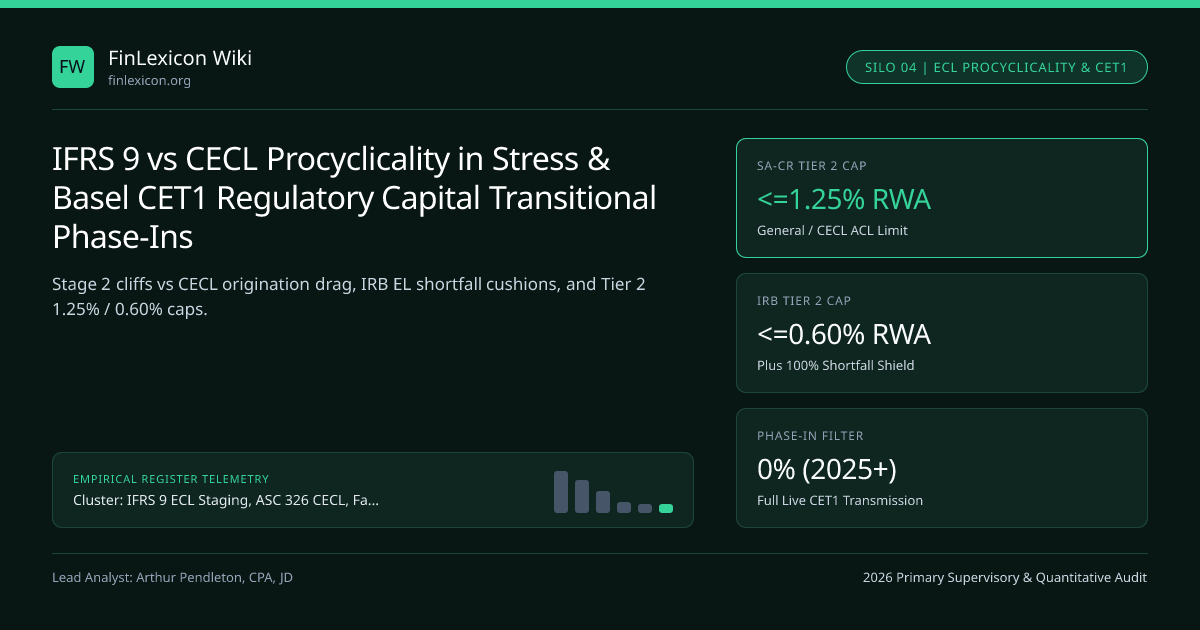
Which expected credit loss standard—IFRS 9 or US GAAP ASC 326 (CECL)—is more procyclical during a systemic recession, and how do prudential capital filters prevent sudden provision spikes from choking bank lending? Empirical evidence from Q1–Q2 2020 COVID-19 bank filings, Federal Reserve CCAR tests, and ECB/EBA stress tests uncovered a fascinating structural trade-off governed by BCBS d401 / CAP90 regulatory CET1 transitional add-backs.
Two Different Flavors of Procyclicality: CECL’s "Origination Tax" vs IFRS 9’s "Stage 2 Cliff"#
Compare the cycle dynamics of Bank of America (CECL) against BNP Paribas and Bank of Montreal (IFRS 9) across the four phases of a macro cycle, building on our IFRS 9 & ASC 326 CECL cornerstone guide:
- Late-Expansion / Recovery Loan Growth (
CECL More Restrictive): Every new$1B10-year loan originated during a recovery forces a US GAAP CECL bank to book full 10-year lifetime losses upfront (-150 bps) before earning a dime of interest, whereas an IFRS 9 bank books only 12-month Stage 1 ECL (-35 bps)—making CECL an heavier capital brake on new credit supply coming out of recessions! - Onset of a Sudden Shock (
IFRS 9 Steeper Percentage Jump): When unemployment forecasts spike in a single quarter (e.g., Q1 2020), CECL banks already held lifetime reserves on 100% of their book (so reserves scale byDelta_Lifetime_PD), whereas IFRS 9 banks experience a double multiplier: rising PDs push15%–25%of the loan book across SICR Stage 2 thresholds, jumping those loans from 12-month to Lifetime ECL simultaneously! - Perfect Foresight vs Realistic Imperfect Foresight (
BIS Working Paper Findings): Academic BIS simulations prove that if economists possessed perfect foresight 2 years ahead of recessions, provisions would build smoothly in booms; in real life, forecast surprises arrive abruptly at Quarter 1 of the recession, causing both IFRS 9 and CECL to front-load CET1 hits at the trough unless buffered by capital filters!
Standardized (SA-CR) vs Internal Ratings-Based (IRB) Accounting-to-Capital Transmission#
Never assume $1.00 of new IFRS 9 or CECL provision reduces Basel III CET1 capital identically across banks! Basel CAP10 / CRE35 splits transmission cleanly by credit RWA approach:
- Standardized Approach (
SA-CR) Banks (Including ALL U.S. Banks on Risk-Based Collins Floor!): Specific/Stage 3 allowances reduce risk-weighted exposure net of provisions, while General Allowances (ASC 326 ACLin U.S. / General provisions) hit Retained Earnings (-100%CET1 after tax) and may only be added back into Tier 2 Capital up to1.25%of Standardized Credit RWA! (Crucially, in the United States, ALL ASC 326 CECL Allowances for Credit Losses (ACL) count as Tier 2 general allowances up to the1.25%RWA cap!) - Internal Ratings-Based (
IRB) Banks (European / UK / Canadian G-SIBs): Compare Total Eligible Provisions against *1-Year Regulatory Expected Loss (`ELIRB = PDTTC LGD_Downturn * EAD`)**: - If
Provisions < EL_IRB(Shortfall):100%of the shortfall was already deducted from CET1—so raising IFRS 9 provisions up toEL_IRBis CET1-NEUTRAL (+$1shortfall relief offsets-$1retained earnings)! - If
Provisions > EL_IRB(Excess): Excess hits CET1 (-$1after tax) and enters Tier 2 Capital up to0.60%of IRB Credit RWA!
Dynamic CET1 Transitional Phase-Ins: U.S. "25% CECL Scaling" vs EU CRR "Quick Fix" Art. 473a#
In March 2020, both transatlantic regulators enacted emergency 5-Year Dynamic CET1 Add-Back Filters (BCBS d498):
- United States (
12 CFR 217.301— 2020 Interim Final Rule): Allowed banks to defer 100% of Day-1 CECL adoption impact PLUS 25% of the post-Day-1 increase in ACL during Years 1–2 (2020–2021) (calibrated because25%approximated the excess of lifetime CECL build over 12-month Stage 1!), followed by a 3-year linear phase-out (75%in 2022,50%in 2023,25%in 2024,0%fully phased-in from January 1, 2025!). - European Union (
CRR Quick FixRegulation 2020/873 Art. 473a) & UK PRA: Reset dynamic Stage 1 + Stage 2 non-credit-impaired ECL add-backs to 100% in 2020–2021, stepping down75%(2022),50%(2023),25%(2024), to0%fully phased-in from January 1, 2025!
| Stress & Capital Dimension | IFRS 9 (EU / UK / Canada / APAC) | US GAAP ASC 326 CECL (United States) | Post-2025 Prudential Reality |
|---|---|---|---|
| Steady-State Reserve Level | Lower (~0.5%–0.9% performing) | Higher (~1.3%–2.1% performing) | U.S. banks carry thicker baseline ACL |
| New Loan Origination Capital Drag | Mild (12-month Stage 1 ECL) | Heavy (100% Lifetime Day-1 tax) | Penalizes rapid post-crisis loan growth |
Recession Onset Shock (Q1 Crisis) | Sharp Stage 2 SICR Cliff (3x–8x jump) | High dollar build on R&S macro revision | Both front-load losses at recession start |
IRB Expected Loss (EL) Buffer | Yes — IRB EL shortfall absorbs hit! | Collins Floor (SA-CR) prevents IRB offset! | European IRB banks enjoy initial CET1 shield |
| Transitional CET1 Add-Back (2025+) | Expired (0% add-back from Jan 1, 2025) | Expired (0% add-back from Jan 1, 2025) | 100% live CET1 volatility globally |
Why Federal Reserve CCAR Stress Tests Still Delayed Full CECL Incorporation#
Recognizing that embedding forward-looking CECL inside a 9-quarter severely adverse CCAR Stress Capital Buffer (`/wiki/stress-capital-buffer-scb-ccar-nine-quarter-cet1-depletion`) simulation risks double-penalizing Quarters 8–9 terminal reserves alongside Quarter-1 shocks, the Federal Reserve maintained specialized supervisory stress loss modeling rules.
Permanent Post-2025 Equilibrium Without Transitional Shields#
With both U.S. and EU 5-year COVID transitional filters expired at 0% in 2025, every dollar of Stage 2 migration or CECL R&S forecast revision flows straight into post-tax CET1 across the IFRS 9, CECL & Fair Value Accounting topic hub.
- DeltaCET1IRB = -( 1 - TaxRate ) * DeltaECLTotal + min( PreShockELShortfall , DeltaECL_Total )
- Tier2AddBackEligible = min( ExcessGeneralACL , 0.0125 * RWACreditSA ) + min( ExcessIRBProv , 0.0060 * RWACreditIRB )
- Worked IRB Shortfall Offset Proof ($100B IRB Credit RWA Bank; Pre-Shock IRB EL = $1,800M vs Pre-Shock IFRS 9 ECL = $1,100M => $700M CET1 Deduction):
- Recession triggers +$1,200M IFRS 9 Stage 2 ECL surge (25% Tax Rate => Retained Earnings falls -$900M):
- New IFRS 9 ECL = $2,300M > $1,800M IRB EL => Pre-existing $700M IRB Shortfall CET1 Deduction drops to $0 (+$700M CET1 relief!)
- Net CET1 Change = -$900M (Retained Earnings) + $700M (Eliminated IRB Shortfall) = -$200M (-20 bps vs -90 bps without IRB offset!)
Frequently asked questions
Why did the 2020 U.S. regulatory rule add back exactly 25% of CECL reserve builds into CET1?
Federal Reserve, OCC, and FDIC empirical calibration estimated that during a sudden crisis, roughly 75% of a bank’s CECL reserve surge reflects near-term 12-month credit losses (comparable to legacy/IFRS 9 Stage 1–3), while 25% reflects the incremental multi-year lifetime tail unique to CECL!
What happens if a massive recession ECL charge creates Deferred Tax Assets (DTAs) that breach the 10% CET1 threshold?
Double CET1 amplifier! Provision expenses create temporary-difference DTAs (Tax_Rate * Delta_ECL); if cumulative timing DTAs exceed Basel CAP30’s 10%/15% CET1 threshold basket (or require a GAAP/IFRS valuation allowance due to operating losses!), the tax shield itself gets deducted 100% from CET1!
Does the BCBS d424 72.5% Output Floor erode the IRB Expected Loss cushion for European banks?
Watch how CRE99 / EU CRR III computes the 72.5% Output Floor: **total capital ratios compare CET1 (after IRB shortfall deductions) against max(RWA_modeled, 0.725 * RWA_SA)**—requiring careful tracking of general vs specific credit risk adjustments inside the Standardized output-floor denominator!
Can supervisors reactivate dynamic IFRS 9 / CECL CET1 phase-in filters in a future crisis?
Not automatically without legislation or rulemaking! Both 12 CFR 217.301 and EU CRR Art. 473a contained fixed statutory sunset dates ending December 31, 2024; re-introducing dynamic filters in a future shock would require fresh agency/parliamentary action (unlike automatic CCyB buffer releases!).
Publication record
- Published
- 14 November 2026
- Updated
- 15 November 2026
- Author
- Arthur Pendleton, CPA, JD
- Review
- Review not recorded
- Automated fact check
- Passed in the stored pipeline record
- Source URLs
- 4 recorded
AI assistance recorded: anthropic/claude-opus-4.6. This field does not establish human review or source verification.
Academic & Institutional Attribution
Cite This Research & Embed Live Data Card
Standard academic & institutional research paper citation format.
Arthur Pendleton, CPA, JD. (2026, November 14). IFRS 9 vs CECL Procyclicality in Stress & Basel CET1 Regulatory Capital Transitional Phase-Ins. FinLexicon Wiki. https://finlexicon.org/wiki/ifrs-9-vs-cecl-procyclicality-cet1-regulatory-capital-phase-inRelated Ifrs9 Cecl Credit Provisioning & Institutional Briefings
Explore Ifrs9 Cecl Credit Provisioning Hub (20) →Ifrs9 Cecl Credit Provisioning
IFRS 9 Expected Credit Loss, US GAAP ASC 326 CECL, Fair Value Hierarchy & Hedge Accounting GuideIfrs9 Cecl Credit Provisioning
IFRS 9 SICR Quantitative Calibration: Relative Lifetime PD Ratios vs Absolute Basis-Point ThresholdsIfrs9 Cecl Credit Provisioning
IFRS 9 SPPI Cash-Flow Test & May 2024 IASB Amendments: ESG Sustainability-Linked Loans & Non-Recourse DebtIfrs9 Cecl Credit Provisioning
POCI (IFRS 9) vs PCD (US GAAP ASC 326): Purchased Credit-Impaired Accounting, Gross-Up & CAEIRIfrs9 Cecl Credit Provisioning
IFRS 13 & US GAAP ASC 820 Fair Value Hierarchy: Exit Price, Principal Market & Level 1 / 2 / 3 TransfersIfrs9 Cecl Credit Provisioning
Prudent Valuation Adjustment (PVA / AVA — EU CRR Art. 105 & Basel CAP50): 90% Confidence CET1 DeductionsIfrs9 Cecl Credit Provisioning
xVA Valuation Adjustments (CVA, DVA, FVA, KVA & MVA): IFRS 13 / ASC 820 Accounting vs Basel MAR50 CapitalIfrs9 Cecl Credit Provisioning
Own-Credit Risk on Fair-Value Option Liabilities (IFRS 9.5.7.7 & ASC 825-10): OCI & Basel CET1 FiltersCentral Clearing Ccp Waterfall
CCP Skin-in-the-Game (SITG): EMIR 25% Minimum Capital Rule, Second-Tranche SITG & Incentive AlignmentCentral Clearing Ccp Waterfall
Variation Margin Gains Haircutting (VMGH), Partial Tear-Up & End-of-Waterfall CCP Recovery ToolsCentral Clearing Ccp Waterfall
Client Clearing Segregation: US CFTC Part 22 LSOC vs EU EMIR Article 39 Omnibus (OSA) & Individual (ISA)Central Clearing Ccp Waterfall
SEC Rule 17Ad-22(e)(18) U.S. Treasury Cash & Repo Central Clearing Mandate: Scope, Deadlines & FICC Impact
FinLexicon Wiki Data, Benchmarks & Contributor Records
CC BY 4.0 Open Data
Open Institutional Datasets (CSV / JSON) →
Download desk-compiled quantitative series & schemas.
2026 Reference Matrix
2026 Institutional Benchmarks & Thresholds →
Statutory capital, clearing, margin & rate conventions.
Editorial Records
Authors & Review Records →
View named contributors where those records are available.
Complete Index
Master Research & Dossier Archive →
Browse all published briefings by topic pillar & date.