
Ifrs9 Cecl Credit Provisioning
POCI (IFRS 9) vs PCD (US GAAP ASC 326): Purchased Credit-Impaired Accounting, Gross-Up & CAEIR
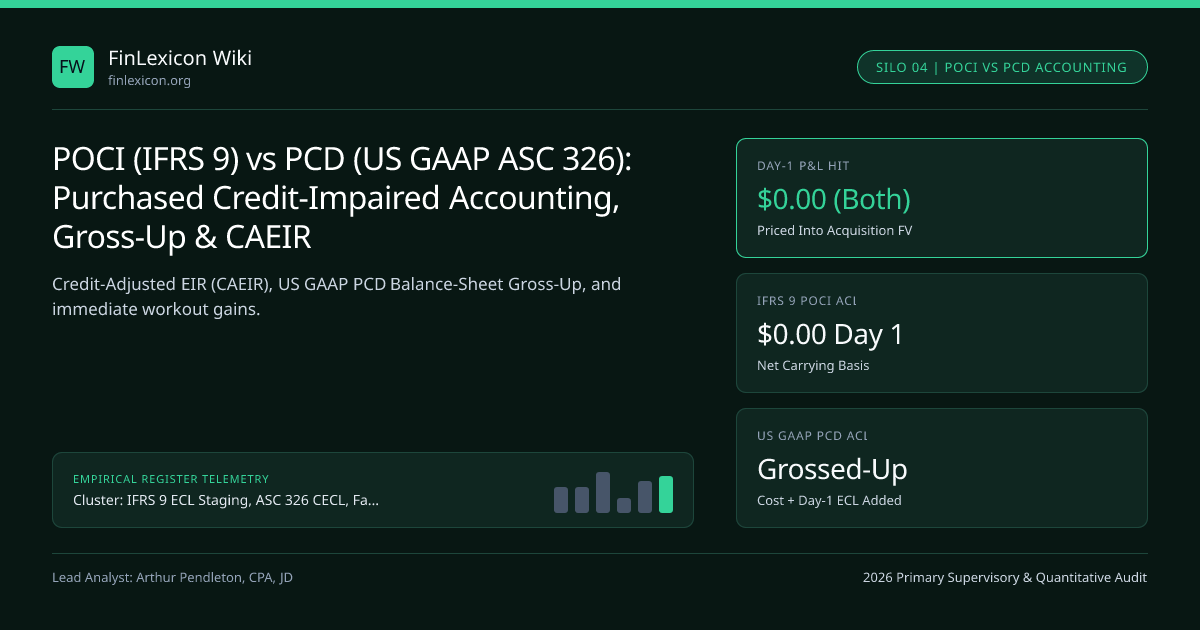
When banks acquire distressed loans at deep discounts, IFRS 9 (POCI) embeds expected losses into a net Credit-Adjusted Effective Interest Rate, whereas US GAAP ASC 326 (PCD) grosses up both Amortized Cost and the Allowance on Day 1.
Suppose a healthy bank acquires a distressed $100 million par commercial loan portfolio for $58 million cash (42% discount reflecting $35 million of expected credit defaults and $7 million of time-value interest discount). How should Day-1 carrying value, Day-1 credit allowance, and post-acquisition Workout recoveries be booked? Compare IFRS 9’s Purchased or Originated Credit-Impaired (POCI) model against US GAAP ASC 326’s Purchased Credit Deteriorated (PCD) Gross-Up architecture!
Scope Threshold: IFRS 9 "Credit-Impaired" (POCI) vs US GAAP "More-Than-Insignificant" (PCD)#
First, notice that PCD under US GAAP casts a wider net than POCI under IFRS 9 inside our IFRS 9 & ASC 326 CECL cornerstone guide:
- IFRS 9
POCI(Appendix A&5.5.13): Applies strictly to assets that are already Stage 3 Credit-Impaired (>=90 DPD, borrower bankruptcy, or distressed restructuring) at purchase OR at origination (e.g., when a bank originates a deeply distressed rescue loan derecognizing an old defaulted loan under modification rules!). - US GAAP
PCD(ASC 326-20-30-13): Applies to acquired assets that have experienced a "more-than-insignificant deterioration in credit quality since origination"—capturing both defaulted Stage-3-style loans AND deteriorated Stage-2-style watchlist loans! (And under FASB’s Seasoned Purchased Financial Assets update, Gross-Up expands across seasoned acquired loans broadly!)
Day-1 Balance-Sheet Presentation: Net Carrying (IFRS 9 POCI) vs Gross-Up (US GAAP PCD)#
Look at the Day-1 balance-sheet entries on our $100M par loan bought for $58M ($35M expected credit loss) across BNP Paribas (IFRS 9) versus Bank of America (US GAAP):
- Both Regimes Recognize
$0Day-1 Income Statement Provision Expense! Neither POCI nor PCD hits Day-1 profit or CET1 because the$58Mcash price already reflects Day-1 expected losses! - IFRS 9
POCI(Net Entry —$0Day-1 Allowance!): Books the asset at $58.0M Gross Carrying Amount with $0.0M Loss Allowance! Instead, IFRS 9 solves for a Credit-Adjusted Effective Interest Rate (CAEIR) that equates the present value of expected credit-adjusted cash flows ($65Mcollectible, NOT$100Mcontractual!) to the$58Mpurchase price! - US GAAP
PCD("Gross-Up" Entry —$35.0MDay-1 Allowance!): Grosses up the Day-1 Amortized Cost Basis toPurchase Price ($58M) + Day-1 Expected Credit Loss ($35M) =$93.0M, offset immediately on the balance sheet by a $35.0M Allowance for Credit Losses (ACL) (Net Carrying Value = $93M - $35M = $58.0M!), accruing interest on the$58Mnet basis using the remaining$7.0Mnon-credit discount!
Subsequent Favorable Workouts: When Borrower Recoveries Beat Day-1 Expectations!#
What happens in Year 2 if commercial real estate prices rebound so expected cash collections jump by +$12.0M above Day-1 expectations (say from $65M up to $77M)? Both standards give an immediate symmetric Day-1 P&L windfall:
- Under IFRS 9
POCI(IFRS 9.5.5.14): Even though the Day-1 allowance started at$0, favorable changes in lifetime expected cash flows (discounted at originalCAEIR) are recognized immediately in Profit or Loss as an Impairment Gain (+$12MPV) (creating a "negative ECL allowance" / upward gross-carrying adjustment on the balance sheet rather than waiting years to accrete via yield, unlike old IAS 39 / US SOP 03-3!)! - Under US GAAP
PCD: Simply releases$12.0Mout of the$35.0MACL (ACL -> $23.0M), booking an immediate+$12.0Mnegative provision benefit in P&L!
| Accounting Feature ($100M Par @ $58M FV) | IFRS 9 POCI | US GAAP ASC 326 PCD | Legacy US GAAP SOP 03-3 (Retired) |
|---|---|---|---|
| Qualification Scope | Stage 3 Credit-Impaired (Purchase or Orig.) | Purchased w/ >insignificant credit deterioration | Purchased credit-impaired |
| Day-1 Gross / Amortized Cost | $58.0M (Purchase Fair Value) | $93.0M ($58M FV + $35M Credit Loss) | $58.0M |
Day-1 Loss Allowance (ACL) | $0.0M | $35.0M (Net Carrying = $58.0M) | $0.0M |
| Day-1 Income Statement Hit | $0.0M | $0.0M | $0.0M |
Subsequent +$12M Recovery Improvement | Immediate +$12M P&L Impairment Gain! | Immediate +$12M P&L ACL Release! | Slowly raised prospective yield (no Day-1 gain!) |
Permanent POCI Lock-In Rule vs FDIC Assisted Failed-Bank Acquisitions#
Under IFRS 9, once POCI, ALWAYS POCI: even if a restructured POCI borrower cures completely for 10 years, the asset never migrates into Stage 1 or reverts to unadjusted contractual EIR! In U.S. FDIC-assisted failed-bank acquisitions (like First Citizens / SVB or NYCB / Signature in 2023), PCD Gross-Up accounting proved pivotal to transparent Day-1 balance-sheet reporting without distorting acquirer CET1.
Reconciling POCI & PCD Ratios for Bank Analysts Across the Silo#
Equity and credit analysts comparing transatlantic bank Allowance / NPL Coverage Ratios must adjust for IFRS 9’s net POCI presentation ($0 Day-1 allowance) vs US GAAP’s grossed-up $35M PCD allowance, indexed in the IFRS 9, CECL & Fair Value Accounting topic hub.
- PCDAmortizedCost = PurchaseFairValue + ECLLifetimeatAcquisition( discountedat_CAEIR )
- DeltaECLPOCI(t) = PV{CAEIR}( ExpectedCFPrior ) - PV{CAEIR}( ExpectedCFCurrent_t )
- Worked 2-Year Bullet Distressed Loan Acquisition ($100.0M Par 0%-Coupon Defaulted Loan Bought for $58.00M; Expected Workout @ t=2 is $66.38M):
- 1. Solve Credit-Adjusted EIR (
CAEIR): $58.00M * (1 + CAEIR)^2 = $66.38M => CAEIR = sqrt(66.38 / 58.00) - 1 = 7.00%! - 2. Under US GAAP PCD (DCF Method): PV of $33.62M Contractual Shortfall ($100M - $66.38M) @ 7.00% CAEIR = $29.37M Day-1 ACL
- PCD Day-1 Amortized Cost = $58.00M + $29.37M = $87.37M (minus $29.37M ACL = $58.00M Net; remaining $12.63M is non-credit rate discount!)
- 3. Year-1 Interest Income (Identical under BOTH IFRS 9 POCI & US GAAP PCD!) = 7.00% * $58.00M = $4.060M!
Frequently asked questions
How can a loan be "Originated" Credit-Impaired (the "O" in POCI) — why would a bank ever originate a defaulted loan?
Think of a distressed corporate restructuring / rescue refinancing! When a Stage 3 borrower’s old loan is modified so substantially (>10% PV change or equity-for-debt swap) that the old loan is derecognized and a brand-new restructured loan is recognized while the borrower remains distressed, that new loan enters the balance sheet as Originated Credit-Impaired (POCI)!
Why did FASB choose the PCD "Gross-Up" presentation instead of IFRS 9’s $0-allowance POCI presentation?
U.S. bank investors and regulators (FDIC / OCC) disliked seeing a bank buy $5B of non-performing loans and report $0 Allowance for Credit Losses on the balance sheet! Grossing up both Amortized Cost and ACL keeps headline Allowance-to-Loans ratios comparable between organic and acquisitive banks.
Under US GAAP PCD, must a bank use Discounted Cash Flows (CAEIR) or can it use a non-DCF loss-rate method?
ASC 326-20-30-14 permits non-DCF methods on PCD pools as well: if a bank estimates a 25% undiscounted loss rate on unpaid principal balance ($100M * 25% = $25M), it grosses up $58M + $25M = $83M Amortized Cost ($25M ACL), ensuring only the remaining $17M non-credit discount accretes into interest income!
How do Basel IRB and Standardized RWA rules treat the unbooked purchase discount on an IFRS 9 POCI loan?
Crucial Basel III rule (CRE20.105 / EU CRR Art. 159 / EBA RTS on Non-Refundable Purchase Price Discounts [NRPPD]): refundable vs non-refundable purchase price discounts on defaulted exposures can be treated analogously to specific credit risk adjustments when testing the 20% vs 50% Stage 3 NPL risk-weight threshold!
Publication record
- Published
- 13 November 2026
- Updated
- 15 November 2026
- Author
- Arthur Pendleton, CPA, JD
- Review
- Review not recorded
- Automated fact check
- Passed in the stored pipeline record
- Source URLs
- 3 recorded
AI assistance recorded: anthropic/claude-opus-4.6. This field does not establish human review or source verification.
Academic & Institutional Attribution
Cite This Research & Embed Live Data Card
Standard academic & institutional research paper citation format.
Arthur Pendleton, CPA, JD. (2026, November 14). POCI (IFRS 9) vs PCD (US GAAP ASC 326): Purchased Credit-Impaired Accounting, Gross-Up & CAEIR. FinLexicon Wiki. https://finlexicon.org/wiki/poci-vs-pcd-purchased-credit-impaired-credit-adjusted-eirRelated Ifrs9 Cecl Credit Provisioning & Institutional Briefings
Explore Ifrs9 Cecl Credit Provisioning Hub (20) →Ifrs9 Cecl Credit Provisioning
IFRS 9 Expected Credit Loss, US GAAP ASC 326 CECL, Fair Value Hierarchy & Hedge Accounting GuideIfrs9 Cecl Credit Provisioning
IFRS 13 & US GAAP ASC 820 Fair Value Hierarchy: Exit Price, Principal Market & Level 1 / 2 / 3 TransfersIfrs9 Cecl Credit Provisioning
Prudent Valuation Adjustment (PVA / AVA — EU CRR Art. 105 & Basel CAP50): 90% Confidence CET1 DeductionsIfrs9 Cecl Credit Provisioning
xVA Valuation Adjustments (CVA, DVA, FVA, KVA & MVA): IFRS 13 / ASC 820 Accounting vs Basel MAR50 CapitalIfrs9 Cecl Credit Provisioning
Own-Credit Risk on Fair-Value Option Liabilities (IFRS 9.5.7.7 & ASC 825-10): OCI & Basel CET1 FiltersIfrs9 Cecl Credit Provisioning
IFRS 9 General Hedge Accounting vs US GAAP ASC 815: Rebalancing, Cost of Hedging OCI & Effectiveness RulesIfrs9 Cecl Credit Provisioning
Portfolio Macro Fair-Value Hedge Accounting: EU IAS 39 Carve-Out, US GAAP Portfolio Layer Method & IASB DRMIfrs9 Cecl Credit Provisioning
Off-Balance-Sheet Loan Commitments & Guarantees: IFRS 9 Behavioral CCF vs ASC 326 Cancellable RulesCentral Clearing Ccp Waterfall
SEC Rule 17Ad-22(e)(18) U.S. Treasury Cash & Repo Central Clearing Mandate: Scope, Deadlines & FICC ImpactCentral Clearing Ccp Waterfall
FICC Sponsored Member Repo: Done-With vs Done-Away Execution, ASC 210-20 Netting & SLR ReliefCentral Clearing Ccp Waterfall
SEC Exchange Act Rule 15c3-3a Note H: Broker-Dealer Customer U.S. Treasury Margin On-Posting to FICCCentral Clearing Ccp Waterfall
FICC Capped Contingency Liquidity Facility (CCLF): Cover-1 Repo Liquidity Sizing & Bank LCR Impact
FinLexicon Wiki Data, Benchmarks & Contributor Records
CC BY 4.0 Open Data
Open Institutional Datasets (CSV / JSON) →
Download desk-compiled quantitative series & schemas.
2026 Reference Matrix
2026 Institutional Benchmarks & Thresholds →
Statutory capital, clearing, margin & rate conventions.
Editorial Records
Authors & Review Records →
View named contributors where those records are available.
Complete Index
Master Research & Dossier Archive →
Browse all published briefings by topic pillar & date.