
Liquidity Coverage Nsfr Prudential
U.S. Regulation WW (12 CFR Part 249): Peak-Day Maturity Mismatch Add-On & Tailoring Categories I–IV
U.S. Regulation WW (12 CFR Part 249) gold-plates international Basel LCR via the 12 CFR 249.30 Peak-Day Maturity Mismatch Add-On while scaling LCR/NSFR stringency from 100% down to 85%, 70%, or 0% across Tailoring Categories I–IV.
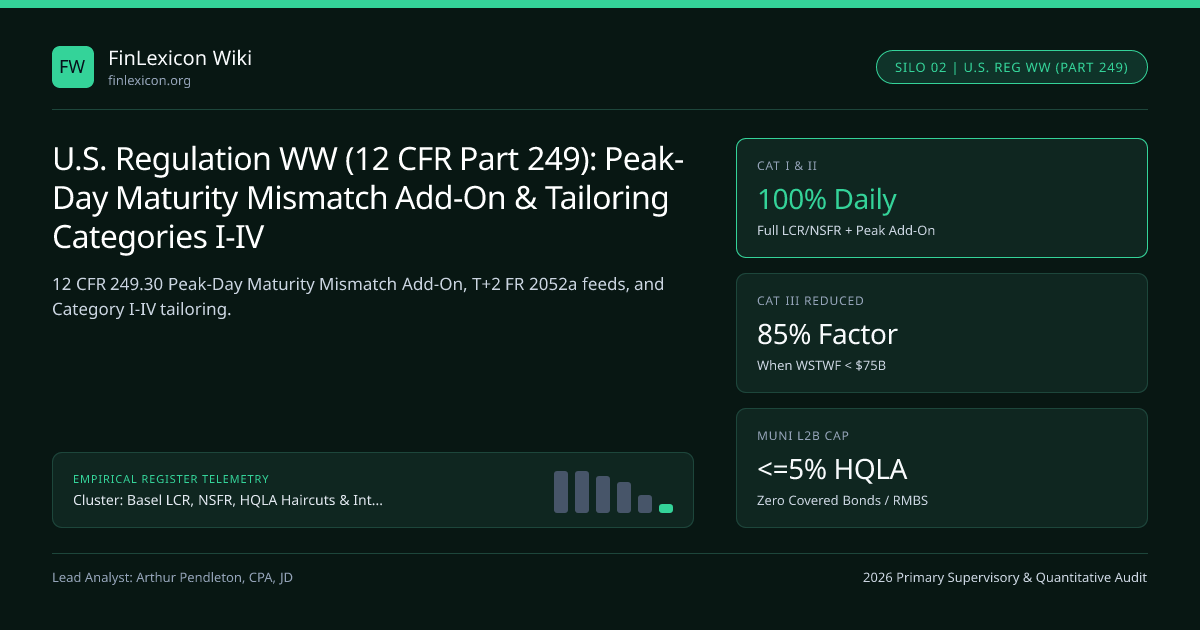
Jointly promulgated by the U.S. Federal Reserve System, the Office of the Comptroller of the Currency, and the Federal Deposit Insurance Corporation at 12 CFR Part 249 (Regulation WW), the United States liquidity framework diverges structurally from international Basel III in two opposite directions: super-equivalent gold-plating for U.S. G-SIBs via the Peak-Day Maturity Mismatch Add-On, and 2019 EGRRCPA tailoring (85%, 70%, or 0% LCR/NSFR) for regional banks between $100B and $700B in assets.
12 CFR 249.30: How the U.S. Peak-Day Maturity Mismatch Add-On Stops "Day-28 Inflow Cliff" Gaming#
Consider a fatal loophole in standard international Basel LCR: suppose a bank owes $40B of maturing wholesale commercial paper on Day 2, offset by $30B of contractual reverse-repo inflows arriving on Day 28. Under cumulative 30-day Basel LCR math, net outflows appear to be just $40B - $30B = $10B—yet on Day 2, the bank runs $40B short of cash 26 days before its inflows arrive!
To eliminate intra-window timing cliffs, 12 CFR 249.30(b) computes a Maturity Mismatch Add-On on maturity-dated wholesale cash flows:
- Track cumulative maturity-dated inflows minus outflows across every individual day
d in {1..30}to find the Peak Cumulative Net Outflow Day (Max_{d=1..30} Net_Dated_Outflow(d)). - Compare that Peak Day against Day 30 Cumulative Net Dated Outflow (
Net_Dated_Outflow(30)). - Add
max( 0 , Peak_Dated_Outflow - Day_30_Dated_Outflow )directly on top of the standard 30-day net cash outflow denominator!
The 2019 Tailoring Rule: Categories I, II, III, and IV Across FR 2052a Reporting#
In October 2019 (implementing S.2155 / EGRRCPA), U.S. agencies partitioned banking organizations above $100B into four prudential tiers tied to Complex Institution Liquidity Monitoring Report (FR 2052a) cadence:
- Category I (U.S. G-SIBs, e.g., Bank of America): 100% Full LCR & 100% NSFR, computed every business day, with daily (
T+2) FR 2052a granular cash-flow reporting. - Category II (
>= $700Bassets OR>= $75Bcross-jurisdictional activity): 100% Full LCR & 100% NSFR, daily calculation & daily FR 2052a. - Category III (
>= $250Bassets OR>= $75BWSTWF / NBFI / off-balance-sheet): - If Weighted Short-Term Wholesale Funding (
WSTWF)>= $75B: 100% Full LCR & 100% NSFR (daily FR 2052a). - If
WSTWF < $75B(e.g., Ally Financial / American Express peer tier): Reduced 85% LCR & 85% NSFR (monthly FR 2052a). - Category IV (
$100B to $250Bassets): Exempt (0%LCR/NSFR) unlessWSTWF >= $50B(Reduced 70% LCR & 70% NSFR, monthly calculation)! (SVB sat in Category IV below$50BWSTWF—exempt from Reg WW LCR right up to its collapse!)
Additional U.S. Reg WW Divergences vs EU CRR and International Basel LCR#
Beyond the Peak-Day Maturity Mismatch Add-On and Category tailoring, treasurers managing transatlantic subsidiaries at BNP Paribas or Bank of Montreal navigate four extra Reg WW rules:
- Zero Covered Bonds & Zero RMBS in U.S. HQLA: Unlike Basel LCR30 Level 2A/2B rules, Reg WW excludes all covered bonds and private-label RMBS, while admitting limited investment-grade municipal general obligation bonds (
<= 5%of total HQLA) as Level 2B. - 50% Interbank Commitment Rate: Charges
50%(vs40%Basel) on undrawn lines to depository institutions. - Daily Rolling Average Public Disclosure: U.S. LCR disclosures report the quarterly average of ~63 daily observations, preventing month-end window-dressing.
- Strict Operational Excess Split: Automated isolation of excess corporate cash at
40%non-operational outflow.
| U.S. Prudential Category | Asset / Risk Threshold | Reg WW LCR Multiplier | Reg WW NSFR Multiplier | FR 2052a Liquidity Reporting |
|---|---|---|---|---|
| Category I (U.S. G-SIBs) | 8 Designated U.S. G-SIBs | 100% Full Daily LCR | 100% Full NSFR | Daily (T+2 submission) |
| Category II | >=$700B Assets OR >=$75B Cross-Jur. | 100% Full Daily LCR | 100% Full NSFR | Daily (T+2 submission) |
| Category III (High WSTWF) | >=$250B Assets & WSTWF >= $75B | 100% Full Daily LCR | 100% Full NSFR | Daily (T+2 submission) |
| Category III (Low WSTWF) | >=$250B Assets & WSTWF < $75B | 85% Reduced Daily LCR | 85% Reduced NSFR | Monthly (T+10 submission) |
| Category IV (High WSTWF) | $100B–$250B Assets & WSTWF >= $50B | 70% Reduced Monthly LCR | 70% Reduced NSFR | Monthly (T+10 submission) |
| Category IV (Low WSTWF) | $100B–$250B Assets & WSTWF < $50B | Exempt (Reg YY internal stress) | Exempt (0%) | Monthly FR 2052a |
Post-2023 Regional Bank Reform Proposals: Re-Extending Full LCR to >=$100B Banks#
Following the 2023 failures of SVB ($209B), Signature Bank ($110B), and First Republic ($229B), Federal Reserve, FDIC, and OCC examiners spotlighted how the $50B WSTWF threshold blinded Category IV tailoring to uninsured sight deposit runs and HTM bond losses, driving supervisory pushes toward daily FR 2052a readiness and standardized LCR coverage above $100B.
Benchmarking U.S. Reg WW Against Global LCR Standards#
Cross-jurisdictional spreads between U.S. Reg WW (with Maturity Mismatch Add-On) and BCBS LCR typically widen U.S. G-SIB denominators by 5%–14%, as tracked in the LCR-HQLA 2026 Benchmark Standard and the Basel LCR, NSFR & Prudential Liquidity topic hub.
- PeakDatedOutflow = max{d in 1..30} NetDated_Outflow(d)
- MaturityMismatchAddOn = max( 0 , PeakDatedOutflow - NetDatedOutflow(30) )
- OutflowDenominatorUS = OutflowFactorCat * ( NonDatedNetOutflows + NetDatedOutflow(30) + MaturityMismatch_AddOn )
- Worked Category III Reduced-LCR vs Category I Audit ($95.0B HQLA; $50B Non-Dated Outflows; $35B Day-5 Out; $25B Day-26 In):
- PeakDatedOutflow (at d = 5) = $35.0B | NetDatedOutflow(30) = $35.0B - $25.0B = $10.0B
- MaturityMismatchAddOn = $35.0B - $10.0B = $25.0B => Unscaled Reg WW Denominator = $50B + $10B + $25B = $85.0B
- Cat I G-SIB (100% factor): LCR = $95.0B / $85.0B = 111.76% | Cat III <$75B WSTWF (85% factor): LCR = $95.0B / (0.85 * $85.0B) = 131.49%
Frequently asked questions
Why are sight retail and operational deposits excluded from the 12 CFR 249.30 Maturity Mismatch Add-On?
Sight deposits lack a fixed contractual maturity day within the 30-day window (assuming 100% of 30-day retail outflows occur at 8:00 a.m. on Day 1 would make Day 1 artificially higher than late inflows on every bank). Only instruments with contractual maturity dates (CP, term deposits, repos, maturing debt) enter the Peak-Day test.
How does an "85% Reduced LCR" mathematically work for a Category III bank?
Rather than lowering the headline minimum pass mark from 100% to 85%, 12 CFR 249.30(c) multiplies total net cash outflows in the denominator by 0.85 (HQLA / (0.85 * Net_Outflows) >= 100%), which is algebraically equivalent to requiring HQLA equal to 85% of full-LCR outflows.
What is Weighted Short-Term Wholesale Funding (WSTWF) and why did Silicon Valley Bank fall below $50B?
WSTWF weights <1 year wholesale funding (like brokered deposits, short FHLB advances, and repo) by counterparty risk—assigning relatively low weights to uninsured operational/corporate sight deposits from venture-backed startups, allowing SVB to grow past $200B while showing minimal WSTWF!
What is the FR 2052a report and why is T+2 daily automation a major regtech engineering challenge?
FR 2052a is the Federal Reserve’s ultra-granular XML liquidity schema requiring Category I–III banks to reconcile millions of loan, deposit, repo, collateral-swap, and derivative cash flows across every legal entity and currency within two business days (T+2) of trade date.
Publication record
- Published
- 14 November 2026
- Updated
- 15 November 2026
- Author
- Arthur Pendleton, CPA, JD
- Review
- Review not recorded
- Automated fact check
- Passed in the stored pipeline record
- Source URLs
- 3 recorded
AI assistance recorded: anthropic/claude-opus-4.6. This field does not establish human review or source verification.
Academic & Institutional Attribution
Cite This Research & Embed Live Data Card
Standard academic & institutional research paper citation format.
Arthur Pendleton, CPA, JD. (2026, November 14). U.S. Regulation WW (12 CFR Part 249): Peak-Day Maturity Mismatch Add-On & Tailoring Categories I–IV. FinLexicon Wiki. https://finlexicon.org/wiki/us-reg-ww-modified-lcr-daily-calculation-maturity-mismatchRelated Liquidity Coverage Nsfr Prudential & Institutional Briefings
Explore Liquidity Coverage Nsfr Prudential Hub (20) →Liquidity Coverage Nsfr Prudential
Basel III LCR, NSFR, HQLA Haircuts & Intraday Prudential Liquidity ArchitectureLiquidity Coverage Nsfr Prudential
Supervisory ILAAP, Internal Liquidity Stress Testing (Reg YY) & Reverse Stress Survival HorizonsLiquidity Coverage Nsfr Prudential
Central Bank Liquidity Facilities: Fed Standing Repo (SRF), Discount Window, BoE ILTR & HQLA MonetizationLiquidity Coverage Nsfr Prudential
Held-to-Maturity (HTM) Unrealized Losses, Uninsured Deposit Runs & the Solvency-Liquidity Doom LoopLiquidity Coverage Nsfr Prudential
Cross-Currency LCR (LCR30.45), Off-Balance-Sheet FX Swap Funding Gaps & CLS PvP LiquidityLiquidity Coverage Nsfr Prudential
NSFR Interdependent Assets & Liabilities (NSF30.35): 0% Pass-Through, Promotional Loans & CCP IMLiquidity Coverage Nsfr Prudential
Collateral Swaps, Securities Lending & Liquidity Upgrade Trades: LCR30.36 Unwind & LCR40.48 OutflowsLiquidity Coverage Nsfr Prudential
Contingent Funding Plans (CFP), Early Warning Indicators (EWIs) & Liquidity Funds Transfer Pricing (LFTP)Isda Csa Derivatives Collateral
Tri-Party & Third-Party Account Control Agreements (ACAs): Segregated UMR IM & Notice of Exclusive ControlIsda Csa Derivatives Collateral
ISDA Close-Out Netting Legal Opinions & Resolution Stay Protocols: EU BRRD, U.S. QFC & 48-Hour Bail-In StaysIsda Csa Derivatives Collateral
OTC Portfolio Reconciliation & Margin Dispute Aging: EMIR Art. 11, CFTC 23.502 & the EUR 15M / 5-Day ReportIsda Csa Derivatives Collateral
ISDA Additional Termination Events (ATEs — Sec. 5(b)(vi)): Hedge Fund NAV Decline & Credit Rating Triggers
FinLexicon Wiki Data, Benchmarks & Contributor Records
CC BY 4.0 Open Data
Open Institutional Datasets (CSV / JSON) →
Download desk-compiled quantitative series & schemas.
2026 Reference Matrix
2026 Institutional Benchmarks & Thresholds →
Statutory capital, clearing, margin & rate conventions.
Editorial Records
Authors & Review Records →
View named contributors where those records are available.
Complete Index
Master Research & Dossier Archive →
Browse all published briefings by topic pillar & date.