
Isda Csa Derivatives Collateral
Tri-Party & Third-Party Account Control Agreements (ACAs): Segregated UMR IM & Notice of Exclusive Control
Mandatory UMR segregation requires tri-party or third-party Account Control Agreements (ACAs) perfecting UCC Article 8/9 control, separating Pledgor Access Notices from Secured Party Notices of Exclusive Control.
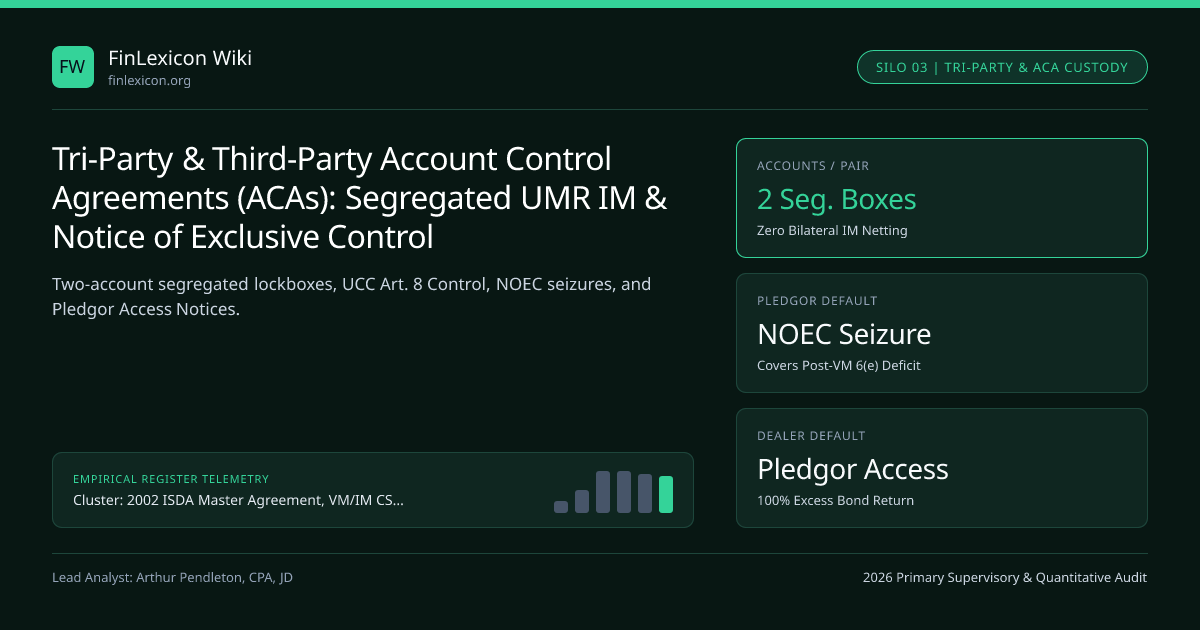
Why did institutional buy-side counterparties lose billions of excess Initial Margin/Independent Amounts trapped inside commingled Lehman Brothers accounts in September 2008? Because posting collateral directly onto a swap dealer’s own balance sheet turns your safety margin into an unsecured claim if the dealer fails! Under BCBS-IOSCO Principle 5, 100% of Regulatory Initial Margin must sit inside bankruptcy-remote segregated accounts governed by a three-way Account Control Agreement (ACA) between the Pledgor (Chargor), the Secured Party, and an Independent Custodian.
Two Segregation Architectures: Automated Tri-Party Agents vs Third-Party Relationship Custodians#
When onboarding UMR Phase 1–6 Initial Margin under the 2018 ISDA Credit Support Annex for Initial Margin (NY Law) or 2018 ISDA Credit Support Deed (English Law) inside our 2002 ISDA Master Agreement cornerstone guide, counterparties choose between two custodial operating models:
- Tri-Party Collateral Management (
BNY Mellon,Euroclear,Clearstream,J.P. Morgan Tri-Party): Counterparties send a single dollar RQV ("Required Value") wire figure via Acadia/SWIFT (e.g., $42.5M). The Tri-Party Agent’s automated optimization engine selects eligible bonds from the Pledgor’s long-box inventory, applies exact UMR maturity and 8% FX haircuts, marks bonds to market daily, and executes automated substitutions with zero manual CUSIP tickets! - Third-Party Relationship Custody (
State Street,Northern Trust,Citi,BBH): Favored by asset managers and pension plans whose assets already sit at a single master global custodian (avoiding moving bonds out to an ICSD). Here, the Pledgor’s middle office must manually select specific ISINs/CUSIPs, calculate haircuts, and instruct bilateral SWIFTMT540/MT542free-of-payment transfers into the pledged sub-account!
Perfecting UCC Article 8/9 "Control" & Competing Default Notices: NOEC vs Pledgor Access Notice#
Under New York UCC §§ 8-106 and 9-104/9-106, a Secured Party’s first-priority security interest over a securities entitlement is perfected by "Control"—established the moment the Custodian signs the ACA agreeing to comply with entitlement orders originated by the Secured Party without further consent by the Pledgor!
Look at how the ACA protects both sides symmetrically if either party defaults across relationships with Bank of America, BNP Paribas, and Bank of Montreal:
- If the Pledgor (Poster) Defaults (
Notice of Exclusive Control — NOEC): Upon an ISDA Section 5 Event of Default with respect to the Pledgor, the Secured Party delivers a formal Notice of Exclusive Control (NOEC) to the Custodian—freezing Pledgor substitutions and transferring 100% of segregated bonds immediately to the Secured Party to satisfy unpaid Section 6(e) Close-Out Amounts! - If the Secured Party (Dealer!) Defaults (
Pledgor Access Notice): Suppose Dealer B goes bankrupt while holding$80Mof Pension Fund A’s segregated Initial Margin (and VM already covers MTM)! Under the 2018 ISDA IM CSA and ACA, Pension Fund A delivers a Pledgor Access Notice (Chargor Access Notice) to BNY Mellon/State Street—reclaiming 100% of its$80Mbonds intact outside Dealer B’s bankruptcy estate!
Negotiating Custodian Liability Caps, Lien Waivers, and "Dispute / Cooling-Off" Windows#
Why did ACA negotiations historically take 4 to 9 months before ISDA Create standardized digital templates? Three fierce three-way legal flashpoints supervised by the Federal Reserve, ECB, and UK PRA:
- Waiver of Custodian’s Own Lien: UMR rules strictly require the Custodian to subordinate or waive any general banker’s lien / set-off over the segregated IM account (save narrow unpaid custody account fees!).
- Zero Custodian Investigation Duty: Custodians refuse to act as courtroom judges! If a Secured Party sends a validly signed NOEC, the Custodian acts ministerially without verifying whether an ISDA Event of Default truly occurred (leaving wrongful-NOEC damages strictly between Pledgor and Secured Party under the CSA!).
- 2-Day vs 0-Day Stay / Notice Window: Buy-side Pledgors sometimes lobby for a 1-to-2-business-day notice delay on Pledgor Access Notices/NOECs—which dealers reject if any delay threatens clean regulatory immediate enforcement legal opinions!
| Custody Feature | Tri-Party Agent (BNY, Euroclear, Clearstream) | Third-Party Custodian (State St, Northern Trust) | Commingled Bilateral VM (Contrast) |
|---|---|---|---|
| Daily Instruction Sent by Parties | Single $ / EUR Required Value (RQV) amount | Specific bond ISIN / CUSIP + par lot instructions | Direct bilateral wire / DVP transfer |
| Haircut & Eligibility Screening | Automated by Tri-Party Agent ICAD engine | Calculated by counterparties / middle office | Calculated bilaterally by Valuation Agent |
| Automated Bond Substitution | Yes — instant long-box optimization | Manual consent / matching workflow | Paragraph 4(d) bilateral substitution |
| Onboarding Setup Complexity | Requires Pledgor long-box account at Tri-Party | Uses Pledgor’s existing master custodian! | Zero third-party ACA needed |
| Dealer Insolvency Protection | 100% Ring-fenced (Pledgor Access Notice) | 100% Ring-fenced (Pledgor Access Notice) | Exposed on excess Independent Amounts! |
Protection Against Custodian Insolvency Itself: Securities Entitlement Property Law#
What if the Custodian Bank itself became insolvent? Because non-cash securities (Treasuries, Bunds, Gilts) sit in segregated client custody accounts under UCC Article 8 / English custody trust law / EU CSDR, securities never enter a custodian’s own balance sheet—which is precisely why non-cash bonds beat un-invested cash deposits for UMR IM!
Digital ACA Onboarding via ISDA Create Across the Silo#
Standardized bilateral and tri-party ACA riders (Euroclear Single Collateral Management Rulebook, BNY Mellon Rider) integrate directly with the ISDA-2002-CSA 2026 Benchmark Standard and the 2002 ISDA Master Agreement, CSA & SIMM topic hub.
- SecuredPartyNOECDraw = min( SegregatedIMMarketValue , max( 0 , NetSection6eCloseOutOwedbyPledgor ) )
- ExcessIMReturnedtoEstate = max( 0 , SegregatedIMMarketValue - NetSection6eCloseOutOwedby_Pledgor )
- Worked Pledgor Default Waterfall Audit (Hedge Fund X Defaults; Dealer A holds $45M Cash VM + $30M Segregated UST IM at BNY Mellon):
- 1. Final 10-Day Auction Replacement Cost of Terminated Swaps (Section 6(e) Close-Out Amount) = +$63.0M Owed to Dealer A
- 2. Apply $45.0M Cash VM Held = +$18.0M Unpaid Deficit Remaining
- 3. Dealer A serves NOEC to BNY Mellon -> Liquidates $18.0M of Segregated UST IM ($0 Credit Loss to Dealer A!); returns $12.0M Surplus IM to Fund X Estate!
Frequently asked questions
Why does a single bilateral UMR relationship require TWO segregated accounts instead of netting IM?
Suppose Dealer A’s SIMM = $80M ($30M above $50M TH) and Client B’s SIMM = $80M ($30M above $50M TH). If you netted $30M - $30M = $0, neither party would hold any protection if the other defaulted tomorrow! Both $30M pools must sit simultaneously in two separate locked pledge boxes.
Can Party A use BNY Mellon Tri-Party while its counterparty Party B uses State Street Third-Party Custody on the same relationship?
Yes, 100% common! Each party chooses the custodian for the IM it posts (subject to the Secured Party’s reasonable credit/legal onboarding of that custodian): Dealer A posts its $30M IM via BNY Mellon Tri-Party, while Pension Fund B posts its $30M IM inside State Street Third-Party Custody!
What happens if a Secured Party wrongfully sends a Notice of Exclusive Control (NOEC) when no Event of Default occurred?
Because the Custodian acts purely ministerially without investigating the underlying ISDA Master Agreement, the Custodian obeys the NOEC—but sending a wrongful NOEC constitutes an immediate breach of the 2018 ISDA IM CSA ("Control Covenant"), exposing the wrongful sender to full damages and default!
Why do English Law UMR Initial Margin documents use a "Credit Support Deed" (2018 CSD) or "Security Agreement" instead of an Annex?
Unlike the English Law VM CSA (which transfers outright title as a Confirmation), English Law Initial Margin creates a formal English security charge over custodial assets, executed as a Deed (2018 ISDA Credit Support Deed / 2019 Bank Custodian Security Agreement) paired with UK Financial Collateral Regulations perfection.
Publication record
- Published
- 14 November 2026
- Updated
- 15 November 2026
- Author
- Arthur Pendleton, CPA, JD
- Review
- Review not recorded
- Automated fact check
- Passed in the stored pipeline record
- Source URLs
- 3 recorded
AI assistance recorded: anthropic/claude-opus-4.6. This field does not establish human review or source verification.
Academic & Institutional Attribution
Cite This Research & Embed Live Data Card
Standard academic & institutional research paper citation format.
Arthur Pendleton, CPA, JD. (2026, November 14). Tri-Party & Third-Party Account Control Agreements (ACAs): Segregated UMR IM & Notice of Exclusive Control. FinLexicon Wiki. https://finlexicon.org/wiki/tri-party-aca-account-control-agreement-im-custodian-insolvencyRelated Isda Csa Derivatives Collateral & Institutional Briefings
Explore Isda Csa Derivatives Collateral Hub (20) →Isda Csa Derivatives Collateral
2002 ISDA Master Agreement, VM/IM CSA, ISDA SIMM v2.6, SA-CCR & Close-Out Netting ArchitectureIsda Csa Derivatives Collateral
ISDA Close-Out Netting Legal Opinions & Resolution Stay Protocols: EU BRRD, U.S. QFC & 48-Hour Bail-In StaysIsda Csa Derivatives Collateral
OTC Portfolio Reconciliation & Margin Dispute Aging: EMIR Art. 11, CFTC 23.502 & the EUR 15M / 5-Day ReportIsda Csa Derivatives Collateral
ISDA Additional Termination Events (ATEs — Sec. 5(b)(vi)): Hedge Fund NAV Decline & Credit Rating TriggersIsda Csa Derivatives Collateral
Multilateral Portfolio Compression & Margin Optimization (TriOptima / Quantile): SIMM, SA-CCR & eSLR ReliefIsda Csa Derivatives Collateral
Physically Settled FX Forwards & Swaps: U.S. Treasury Exemption, UMR IM Carve-Out, VM Nuances & SA-CCRIsda Csa Derivatives Collateral
2023 ISDA Digital Asset Derivatives Definitions: Fork Events, Oracle Disruptions & Basel SCO60 CapitalIsda Csa Derivatives Collateral
ISDA Section 2(a)(iii) Condition Precedent: Payment Suspension, Lomas & 2014 Sunset AmendmentIfrs9 Cecl Credit Provisioning
Loan Modifications, Forbearance & 10% Derecognition Test (IFRS 9.5.4.3 vs US GAAP ASU 2022-02 TDR Repeal)Ifrs9 Cecl Credit Provisioning
Day-1 P&L Deferral (IFRS 9.B5.1.2A vs US GAAP ASC 820): Level 3 Calibration Reserves & Release RulesIfrs9 Cecl Credit Provisioning
Multi-Scenario Macroeconomic Weighting & Post-Model Adjustments (PMAs / Overlays) in IFRS 9 & CECLIfrs9 Cecl Credit Provisioning
IFRS 7, ASC 326 Vintage Charge-Off Tables & ISA 540 / PCAOB AS 2501 External Audit of Credit Loss Estimates
FinLexicon Wiki Data, Benchmarks & Contributor Records
CC BY 4.0 Open Data
Open Institutional Datasets (CSV / JSON) →
Download desk-compiled quantitative series & schemas.
2026 Reference Matrix
2026 Institutional Benchmarks & Thresholds →
Statutory capital, clearing, margin & rate conventions.
Editorial Records
Authors & Review Records →
View named contributors where those records are available.
Complete Index
Master Research & Dossier Archive →
Browse all published briefings by topic pillar & date.