
Isda Csa Derivatives Collateral
ISDA Close-Out Netting Legal Opinions & Resolution Stay Protocols: EU BRRD, U.S. QFC & 48-Hour Bail-In Stays
Enforceable ISDA close-out netting rests on annually refreshed external counsel opinions across 80+ jurisdictions—balanced post-2014 by 24-to-48-hour statutory resolution stays under U.S. QFC Rules and EU BRRD.
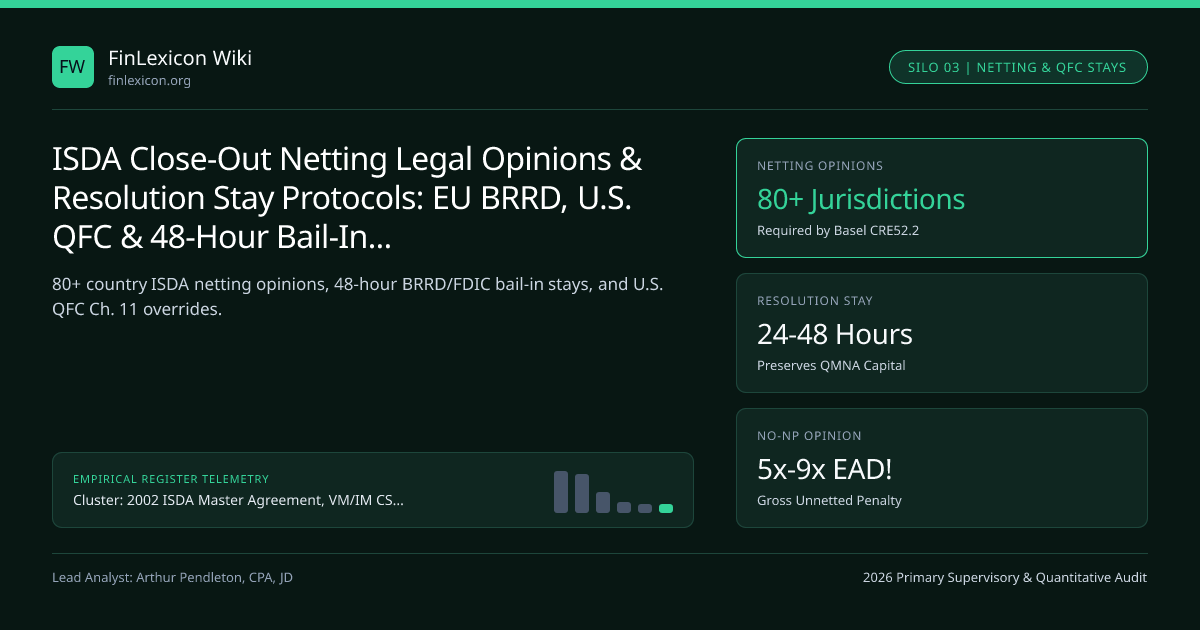
Two legal pillars prevent a G-SIB derivative portfolio from either blowing up bank capital in peacetime or triggering a Lehman-style disorderly liquidation in a crisis: ISDA Jurisdictional Close-Out Netting Legal Opinions (required under Basel CRE52.2 to compress gross swap exposure by ~90%) and ISDA Resolution Stay Protocols / U.S. QFC Rules (required under FSB TLAC & Resolution Standards to freeze Section 5 termination rights for 24 to 48 hours over a bail-in resolution weekend!).
Basel CRE52.2 Requirements for Clean Close-Out Netting Legal Opinions (80+ Jurisdictions)#
Never assume Section 1(c) and Section 6(e) of the 2002 ISDA Master Agreement automatically bind a foreign bankruptcy court! Under Basel Framework CRE52.2–CRE52.9 (and EU CRR Art. 296 / U.S. 12 CFR 217.3 "Qualifying Master Netting Agreement" [QMNA] rules), a bank may net positive and negative derivative values in SA-CCR EAD ONLY if it maintains written, reasoned legal opinions across:
- The Law of the Counterparty’s Incorporation / Charter (plus every foreign branch location traded!).
- The Governing Law of the ISDA Master Agreement (
New YorkorEnglishlaw). - The Law Governing Individual Transactions.
ISDA commissions and updates annual external-counsel Netting, Collateral, and Cleared Derivatives Opinions across 80+ jurisdictions (including landmark post-2022 China Futures and Derivatives Law statutory close-out netting recognition!). If an emerging-market entity type (e.g., certain sovereign ministries, public municipalities, or statutory trusts) carries a "Non-Netting / Qualified" opinion, banks MUST calculate capital gross (RC = Sum max(0, V_i) and NGR / PFE unnetted)!
Why G20 Resolution Authorities Needed 24–48 Hour Contractual Stays Over Foreign-Law ISDAs#
Consider the cross-border bail-in dilemma faced by the U.S. FDIC, Federal Reserve, European Central Bank/SRB, and Bank of England after 2008:
- Suppose German or UK Bank X enters EU BRRD / UK Banking Act weekend bail-in resolution on Friday at 18:00: regulators write down HoldCo TLAC/MREL bonds to recapitalize Operating Bank X so it opens solvent on Monday at 08:00.
- Domestic Law Limit: EU BRRD Article 71 (and FDIC Title II Dodd-Frank § 210(c)(10)—a 1-business-day / 5:00 p.m. next-day stay) legally suspends early termination rights under domestic law—but what if Bank X signed a New York Law ISDA with a U.S. hedge fund, and a New York court ignored EU BRRD’s foreign administrative stay?
- Mass Friday-evening swap close-outs in New York or Tokyo would drain
$50Bof margin and destroy the recapitalized bank before Monday morning!
ISDA 2015 Universal Stay Protocol, 2018 U.S. Stay Protocol & U.S. QFC Stay Rules#
To solve extraterritorial recognition contractually across every dealer (Bank of America, BNP Paribas, Bank of Montreal) and buy-side counterparty, regulators mandated Qualified Financial Contract (QFC) Stay Rules (12 CFR Part 252 Subpart I [Fed], 12 CFR Part 47 [OCC], 12 CFR Part 382 [FDIC], EU BRRD II Art. 71a, UK PRA Stay Rules):
- Direct Special Resolution Regime (
SRR) Opt-In: Counterparties trading under foreign-law ISDAs contractually opt in to abide by the temporary 1-to-2-business-day (24–48 hour) administrative stay and bail-in transfer powers of the G-SIB’s home resolution authority! - U.S. Bankruptcy Code Cross-Default Override (
U.S. QFC Rule Clean-Holding-Company): Uniquely under U.S. QFC rules (implemented via the ISDA 2018 U.S. Resolution Stay Protocol), if a U.S. G-SIB Parent HoldCo files for ordinary Chapter 11 Bankruptcy while its swap-dealer subsidiary stays solvent and transfers parent guarantees to a Bridge Holding Company within 48 hours, counterparties permanently waive ISDA Section 5(a)(vi)/(vii) parent affiliate cross-defaults!
| Resolution Stay Regime | Statutory Authority | Maximum Stay Window | Covers Ordinary HoldCo Bankruptcy? | Adherence Mechanism |
|---|---|---|---|---|
| U.S. Dodd-Frank Title II (OLA) | FDIC (12 U.S.C. § 5390) | 5:00 p.m. next business day (~24–48h) | Title II receivership only | ISDA 2015 / 2018 Stay Protocols |
| U.S. QFC Stay Rules (12 CFR 252 Sub. I) | Federal Reserve / OCC / FDIC | 48 hours (1 bus. day) on parent Ch. 11 | YES! Overrides affiliate Ch. 11 cross-default | ISDA 2018 U.S. Stay Protocol |
| EU BRRD II (Art. 33a, 69–71a) | ECB / Single Resolution Board | Midnight end of next business day (~48h) | Resolution & pre-resolution moratorium | EU BRRD II Stay Clause / Modular Protocol |
| UK Banking Act 2009 / PRA Rules | Bank of England & UK PRA | Midnight next business day (~48h) | UK Special Resolution Regime | ISDA UK (PRA Rule) Jurisdictional Module |
| China Futures & Derivatives Law (2022) | NFRA / PBOC / CSRC (PRC) | Statutory banking resolution stay | Recognized statutory close-out netting (Art. 35)! | 2022+ Clean ISDA PRC Netting Opinion |
Creditor Safeguards: Why a 48-Hour Resolution Stay Does NOT Destroy Basel Netting Status#
Crucial safeguard: Basel CRE52.5 explicitly confirms that temporary 24–48 hour statutory resolution stays do NOT disqualify a master agreement as a Qualifying Master Netting Agreement—because if the resolution authority fails to transfer 100% of the netting set intact (strict no-cherry-picking rule!) or defaults on ongoing VM payments after the 48-hour stay expires, full ISDA Section 6 close-out netting springs back immediately!
Mapping Netting & QFC Compliance Across FinLexicon Benchmarks#
Legal-opinion matrices and QFC omnibus adherence lists anchor counterparty capital onboarding across the ISDA-2002-CSA 2026 Benchmark Standard and the 2002 ISDA Master Agreement, CSA & SIMM topic hub.
- RCNoNettingOpinion = Sum{i=1..N} max( 0 , Vi ) [ Zero offset from negative Vj < 0 trades, 0 VM net! ]
- EADPenaltyNoQMNA = 1.4 * ( Sumi max(0, Vi) + Sumi AddOnStandalonei ) - EADCleanQMNA
- Worked Corporate Emerging-Market Counterparty Capital Audit (40 Offsetting Swaps: Sum max(0, Vi) = +$180M; Sum Vi = +$15M; Unmargined):
- 1. Jurisdiction Lacks Clean Netting Opinion: RC = +$180.0M | Sum Standalone AddOns = $95.0M => EAD = 1.4 * ($180M + $95M) = $385.0M!
- 2. Jurisdiction Enacts Statutory Close-Out Netting (Clean ISDA Opinion): RC = +$15.0M | Netted Hedging-Set AddOn = $28.0M
- Clean QMNA EAD = 1.4 * ($15.0M + $28.0M) = $60.2M => 84.4% Immediate Counterparty RWA & CVA Reduction!
Frequently asked questions
Why was China’s August 2022 Futures and Derivatives Law (FDL) a historic watershed for global ISDA markets?
For decades prior to August 2022, PRC Enterprise Bankruptcy Law gave administrators discretion that prevented clean unqualified ISDA netting opinions for Chinese banks and corporates; Articles 35 and 37 of the 2022 FDL enshrined statutory Single Agreement and Close-Out Netting protection, unlocking clean ISDA PRC netting opinions and UMR compliance!
During a 48-hour BRRD or FDIC resolution stay, can the troubled bank stop paying daily Variation Margin?
Absolutely NOT! Both EU BRRD Article 71(5) and U.S. QFC/FDIC Title II statutory safeguards require the institution in resolution to continue performing all ongoing payment, delivery, and Variation Margin obligations during the stay; missing a live payment triggers an independent direct Failure to Pay outside the stay!
Can a resolution authority transfer a G-SIB’s profitable in-the-money swaps to a Bridge Bank while leaving out-of-the-money swaps behind?
Strictly prohibited by statute ("No-Cherry-Picking Safeguard" — BRRD Art. 76 / 12 U.S.C. § 5390(c)(9))! A resolution authority must either transfer 100% of all QFCs and CSAs under a Master Agreement together to the solvent transferee, or leave 100% behind in the receivership!
Why do buy-side asset managers sign the ISDA 2018 U.S. Resolution Stay Protocol instead of bilateral QFC Bilateral Amendments?
Adhering once via the ISDA 2018 U.S. Resolution Stay Protocol automatically updates QFCs across all U.S. G-SIB counterparties AND earns slightly broader creditor-protection conditions under 12 CFR 252.84 than negotiating bespoke bilateral QFC clauses!
Publication record
- Published
- 14 November 2026
- Updated
- 15 November 2026
- Author
- Arthur Pendleton, CPA, JD
- Review
- Review not recorded
- Automated fact check
- Passed in the stored pipeline record
- Source URLs
- 4 recorded
AI assistance recorded: anthropic/claude-opus-4.6. This field does not establish human review or source verification.
Academic & Institutional Attribution
Cite This Research & Embed Live Data Card
Standard academic & institutional research paper citation format.
Arthur Pendleton, CPA, JD. (2026, November 14). ISDA Close-Out Netting Legal Opinions & Resolution Stay Protocols: EU BRRD, U.S. QFC & 48-Hour Bail-In Stays. FinLexicon Wiki. https://finlexicon.org/wiki/close-out-netting-legal-opinions-stay-protocols-brrd-us-qfcRelated Isda Csa Derivatives Collateral & Institutional Briefings
Explore Isda Csa Derivatives Collateral Hub (20) →Isda Csa Derivatives Collateral
2002 ISDA Master Agreement, VM/IM CSA, ISDA SIMM v2.6, SA-CCR & Close-Out Netting ArchitectureIsda Csa Derivatives Collateral
OTC Portfolio Reconciliation & Margin Dispute Aging: EMIR Art. 11, CFTC 23.502 & the EUR 15M / 5-Day ReportIsda Csa Derivatives Collateral
ISDA Additional Termination Events (ATEs — Sec. 5(b)(vi)): Hedge Fund NAV Decline & Credit Rating TriggersIsda Csa Derivatives Collateral
Multilateral Portfolio Compression & Margin Optimization (TriOptima / Quantile): SIMM, SA-CCR & eSLR ReliefIsda Csa Derivatives Collateral
Physically Settled FX Forwards & Swaps: U.S. Treasury Exemption, UMR IM Carve-Out, VM Nuances & SA-CCRIsda Csa Derivatives Collateral
2023 ISDA Digital Asset Derivatives Definitions: Fork Events, Oracle Disruptions & Basel SCO60 CapitalIsda Csa Derivatives Collateral
ISDA Section 2(a)(iii) Condition Precedent: Payment Suspension, Lomas & 2014 Sunset AmendmentIsda Csa Derivatives Collateral
1992 ISDA Market Quotation & Loss vs 2002 Close-Out Amount: Section 6(e) Early Termination ValuationIfrs9 Cecl Credit Provisioning
Day-1 P&L Deferral (IFRS 9.B5.1.2A vs US GAAP ASC 820): Level 3 Calibration Reserves & Release RulesIfrs9 Cecl Credit Provisioning
Multi-Scenario Macroeconomic Weighting & Post-Model Adjustments (PMAs / Overlays) in IFRS 9 & CECLIfrs9 Cecl Credit Provisioning
IFRS 7, ASC 326 Vintage Charge-Off Tables & ISA 540 / PCAOB AS 2501 External Audit of Credit Loss EstimatesIfrs9 Cecl Credit Provisioning
Deferred Tax Assets (IAS 12 & ASC 740 Valuation Allowances) vs Basel III CAP30 10% / 17.65% CET1 Deductions
FinLexicon Wiki Data, Benchmarks & Contributor Records
CC BY 4.0 Open Data
Open Institutional Datasets (CSV / JSON) →
Download desk-compiled quantitative series & schemas.
2026 Reference Matrix
2026 Institutional Benchmarks & Thresholds →
Statutory capital, clearing, margin & rate conventions.
Editorial Records
Authors & Review Records →
View named contributors where those records are available.
Complete Index
Master Research & Dossier Archive →
Browse all published briefings by topic pillar & date.