
Liquidity Coverage Nsfr Prudential
Supervisory ILAAP, Internal Liquidity Stress Testing (Reg YY) & Reverse Stress Survival Horizons
Beyond standardized Pillar 1 LCR/NSFR formulas, ECB/PRA ILAAP and U.S. Regulation YY (12 CFR 252.35) mandate bespoke Internal Liquidity Stress Testing across overnight, 30-day, and 90-to-365-day survival horizons.
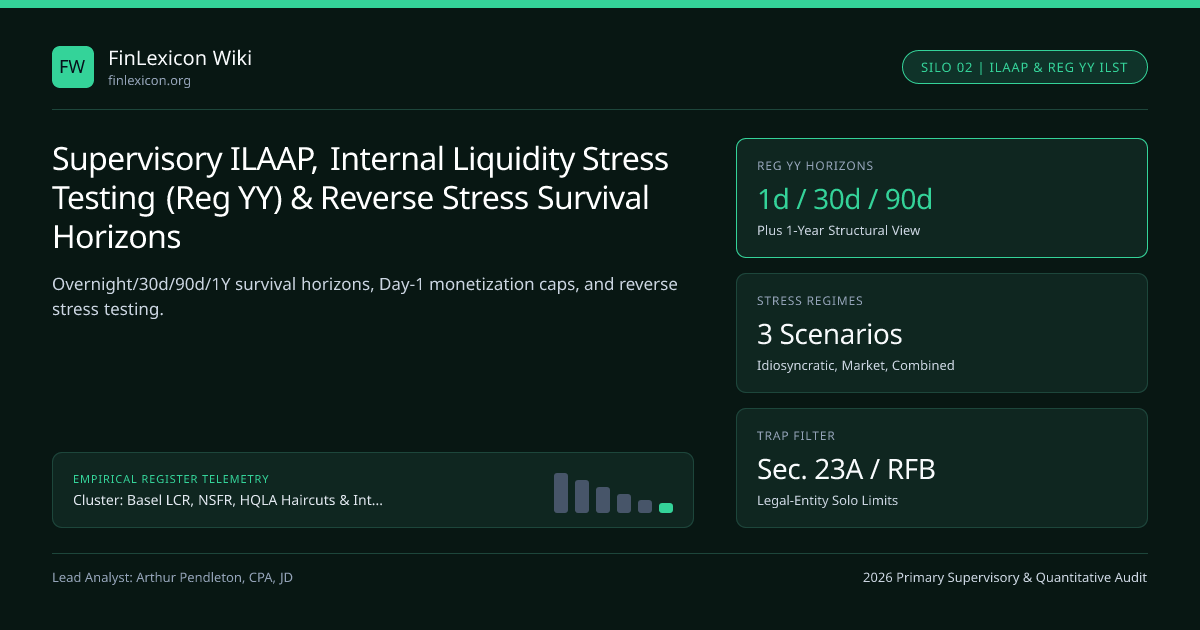
Passing a 100% Pillar 1 Liquidity Coverage Ratio never guarantees survival during a fast-moving bank run: standardized LCR ignores Days 1–5 intraday/overnight cliffs, Days 31–90 funding walls, reputational debt buybacks, and non-contractual franchise support. Consequently, Pillar 2 supervisory regimes—the Internal Liquidity Adequacy Assessment Process (ILAAP) under ECB SSM and UK PRA SREP, alongside U.S. Regulation YY (12 CFR 252.35) Internal Liquidity Stress Testing (ILST) under the Federal Reserve—require banks to hold bespoke liquidity buffers calibrated to multi-horizon Survival Periods.
Why Pillar 1 LCR Is Insufficient: Five Structural Blind Spots Captured by ILAAP / ILST#
In horizontal liquidity examinations linked to our Basel LCR, NSFR & HQLA cornerstone guide, supervisors verify that a bank’s internal stress model explicitly prices five risks omitted or under-weighted by Pillar 1 LCR:
- Ultra-Short Acute Horizon (Overnight & Days 1–5): In digital social-media runs, 20%–35% of uninsured deposits can exit in 48 hours—long before T+2 bond sales settle unless central bank repo/discount-window pipes are pre-positioned!
- Day 31–90 & Day 91–365 Cliff Horizons: Prevents treasurers from parking wholesale commercial paper maturities at Day 32 just outside the LCR window.
- Legal-Entity Trapped Liquidity: Cash surpluses at a ring-fenced UK retail bank or regulated U.S. broker-dealer cannot flow upstream to a parent HoldCo above statutory inter-affiliate lending caps (e.g., Federal Reserve Section 23A/23B limits!).
- Intraday RTGS & CCP Spikes: Incorporates BCBS 248 stressed intraday net debit peaks directly into Day-1 buffer consumption.
- Franchise / Reputational Outflows: Buying back structured notes, supporting sponsored money-market funds, or rolling core client credit lines to avoid signaling distress.
Three Mandatory Stress Scenarios & Multi-Horizon Monetization Rules (12 CFR 252.35)#
Under U.S. Regulation YY (12 CFR 252.35)—and parallel ECB ILAAP Guides—large banks (>= $100B) must execute comprehensive Internal Liquidity Stress Tests at least monthly (daily/weekly tactical runs at G-SIBs like Bank of America, BNP Paribas, and Bank of Montreal) across three scenarios (Idiosyncratic Adverse, Market-Wide Systemic, and Combined Severe) and four mandatory planning horizons: Overnight (1-Day), 30-Day, 90-Day, and 1-Year.
Crucially, Reg YY enforces horizon-specific monetization constraints: on the Overnight (Day-1) horizon, only cash on deposit at the central bank and overnight-monetizable Treasury repo/standing-facility collateral count—corporate Level 2B bonds cannot be liquidated in 4 hours without crushing market depth!
Reverse Stress Testing and Survival Horizon Governance#
Whereas forward ILST asks "How much net liquidity surplus remains at Day 30 and Day 90?", Liquidity Reverse Stress Testing inverts the equation: "What exact combination of rating downgrades, uninsured deposit velocity, FX swap freeze, and intraday wire delay exhausts our usable counterbalancing capacity to $0 inside 30 days?"
Reverse stress testing exposes hidden non-linear cliff correlations—for instance, a 2-notch credit downgrade that simultaneously triggers ISDA Additional Termination Events, locks the bank out of bilateral FX swap markets, and freezes tri-party Level 2 repo lines on the exact same Tuesday morning.
| Dimension | Pillar 1 Standardized LCR | U.S. Reg YY ILST (12 CFR 252.35) | ECB SSM ILAAP (SREP) | UK PRA Pillar 2 Liquidity (PS2/18) |
|---|---|---|---|---|
| Time Horizons Tested | Single cumulative 30-day point | Overnight, 30-Day, 90-Day & 1-Year | Intraday, 5d, 30d, 90d & >=1-Year | Intraday, Days 1–30 glidepath & 90d |
| Intraday RTGS Integration | Excluded from Pillar 1 LCR | Explicit Day-1 daylight reserve holdback | Mandatory normative & economic ILAAP | Explicit Pillar 2 intraday add-on! |
| Day 31–90 Cliff Risk | Blind to Day-31+ maturities | Captured in 90-Day & 1-Year buckets | Survival period >= 3–6 months target | survival curve & debt-buyback add-on |
| Inter-Entity Trapping | Consolidated cap up to subsidiary outflow | Legal-entity Section 23A/broker limits | Solo vs consolidated wafer scrutiny | Ring-fenced bank (RFB) solo buffers |
| Supervisory Consequence | Public breach <100% + remediation | Buffer increase + Reg YY enforcement | SREP Score 1–4 + Quantitative Liquidity Req | Explicit Pillar 2 HQLA £/$ add-on |
SREP Liquidity Scores and UK PRA Pillar 2 Liquidity Add-Ons#
In the UK and Eurozone, weak ILAAP governance or uncaptured intraday/franchise outflows translate directly into binding Pillar 2 Liquidity Guidance / Add-Ons—raising a bank’s binding supervisory HQLA requirement well above 100% Pillar 1 LCR (e.g., 115%–130% effective HQLA coverage)!
Wiring ILAAP Limits Directly Into Contingent Funding Plans (CFPs)#
Every board-approved survival horizon (typically >= 30 days pure private-market monetization and >= 90 days including central bank facilities under Combined Severe stress) sets hard green/amber/red triggers inside Contingent Funding Plans & Early Warning Indicators across the Basel LCR, NSFR & Prudential Liquidity topic hub.
- NetLiqPos(h) = CBCUsable(h) - CumContractualOut(h) - CumBehavioralFranchiseOut(h) - IntradayHoldback(h) + CumCapped_In(h)
- SurvivalHorizonDays = min { h >= 1 : NetLiqPos(h) < 0 } - 1
- Worked Day-1 vs Day-30 Reg YY Monetization Audit ($65.0B Total HQLA: $25B Fed Reserves, $30B USTs, $10B Level 2A/2B):
- At Horizon h = 1 Day: Fed Reserves ($25B) + Same-Day Repo/SRF USTs ($30B * 98% = $29.4B) + L2 Bonds ($0B Day-1 cap) - $4.4B Sub Trap = $50.0B CBC(1d)
- Day-1 Outflows: $18.0B Stressed Intraday Peak Holdback + $12.0B Day-1 Uninsured Wire Run = $30.0B => Day-1 Surplus = +$20.0B
- At Horizon h = 30 Days: Full CBC = $60.2B | 30d ILST Outflows (incl. $6B Franchise Note Buybacks) = $47.5B => Day-30 Surplus = +$12.7B
Frequently asked questions
What is the difference between ECB ILAAP "Normative" and "Economic" perspectives?
mirroring ICAAP for capital, the Normative perspective projects whether the bank continuously meets all regulatory ratios (LCR >= 100%, NSFR >= 100%) over a multi-year baseline and adverse horizon, while the Economic perspective tests all internal material liquidity risks (intraday, Day-5 digital run, franchise support) regardless of regulatory formulas.
Why must Internal Liquidity Stress Tests model non-contractual "franchise" outflows if the bank has no legal obligation to pay them?
In real stress, refusing to make markets in the bank’s own structured notes, calling every maturing SME working-capital loan at 100% inflow, or refusing intraday client overdrafts broadcasts panic to wholesale markets—triggering a far larger institutional deposit run!
How does U.S. Regulation YY restrict reliance on the Federal Reserve Discount Window inside the 30-day ILST buffer?
Under 12 CFR 252.35(a)(7), a covered company’s 30-day liquidity buffer must be monetizable via private repo and outright secondary markets (plus cash reserves) during the initial 30-day stress window, reserving central bank lender-of-last-resort borrowing primarily for contingency planning and extended horizons.
How do Section 23A and ring-fencing trap liquidity inside a consolidated banking group?
If a bank’s broker-dealer faces a $5B prime-brokerage outflow while its FDIC-insured bank subsidiary holds $20B excess Fed reserves, Federal Reserve Act Section 23A caps covered credit extensions from the insured bank to its affiliate at 10% of bank capital (with 100%–130% collateral)—trapping excess bank cash unless pre-funded at the HoldCo!
Publication record
- Published
- 14 November 2026
- Updated
- 17 November 2026
- Author
- Arthur Pendleton, CPA, JD
- Review
- Review not recorded
- Automated fact check
- Passed in the stored pipeline record
- Source URLs
- 3 recorded
AI assistance recorded: anthropic/claude-opus-4.6. This field does not establish human review or source verification.
Academic & Institutional Attribution
Cite This Research & Embed Live Data Card
Standard academic & institutional research paper citation format.
Arthur Pendleton, CPA, JD. (2026, November 17). Supervisory ILAAP, Internal Liquidity Stress Testing (Reg YY) & Reverse Stress Survival Horizons. FinLexicon Wiki. https://finlexicon.org/wiki/ilaap-internal-liquidity-adequacy-survival-horizon-reverse-stressRelated Liquidity Coverage Nsfr Prudential & Institutional Briefings
Explore Liquidity Coverage Nsfr Prudential Hub (20) →Liquidity Coverage Nsfr Prudential
Basel III LCR, NSFR, HQLA Haircuts & Intraday Prudential Liquidity ArchitectureLiquidity Coverage Nsfr Prudential
Central Bank Liquidity Facilities: Fed Standing Repo (SRF), Discount Window, BoE ILTR & HQLA MonetizationLiquidity Coverage Nsfr Prudential
Held-to-Maturity (HTM) Unrealized Losses, Uninsured Deposit Runs & the Solvency-Liquidity Doom LoopLiquidity Coverage Nsfr Prudential
Cross-Currency LCR (LCR30.45), Off-Balance-Sheet FX Swap Funding Gaps & CLS PvP LiquidityLiquidity Coverage Nsfr Prudential
NSFR Interdependent Assets & Liabilities (NSF30.35): 0% Pass-Through, Promotional Loans & CCP IMLiquidity Coverage Nsfr Prudential
Collateral Swaps, Securities Lending & Liquidity Upgrade Trades: LCR30.36 Unwind & LCR40.48 OutflowsLiquidity Coverage Nsfr Prudential
Contingent Funding Plans (CFP), Early Warning Indicators (EWIs) & Liquidity Funds Transfer Pricing (LFTP)Liquidity Coverage Nsfr Prudential
HQLA Level 1, 2A & 2B Haircuts: 40%/15% Composition Caps & Secured Funding Unwind (LCR30)Isda Csa Derivatives Collateral
ISDA Close-Out Netting Legal Opinions & Resolution Stay Protocols: EU BRRD, U.S. QFC & 48-Hour Bail-In StaysIsda Csa Derivatives Collateral
OTC Portfolio Reconciliation & Margin Dispute Aging: EMIR Art. 11, CFTC 23.502 & the EUR 15M / 5-Day ReportIsda Csa Derivatives Collateral
ISDA Additional Termination Events (ATEs — Sec. 5(b)(vi)): Hedge Fund NAV Decline & Credit Rating TriggersIsda Csa Derivatives Collateral
Multilateral Portfolio Compression & Margin Optimization (TriOptima / Quantile): SIMM, SA-CCR & eSLR Relief
FinLexicon Wiki Data, Benchmarks & Contributor Records
CC BY 4.0 Open Data
Open Institutional Datasets (CSV / JSON) →
Download desk-compiled quantitative series & schemas.
2026 Reference Matrix
2026 Institutional Benchmarks & Thresholds →
Statutory capital, clearing, margin & rate conventions.
Editorial Records
Authors & Review Records →
View named contributors where those records are available.
Complete Index
Master Research & Dossier Archive →
Browse all published briefings by topic pillar & date.