
Liquidity Coverage Nsfr Prudential
NSFR Required Stable Funding (RSF) Weights (NSF30): Asset Encumbrance, 65% Mortgages & NPLs
Basel NSF30 calibrates 1-year Required Stable Funding (RSF) weights from 0%–5% on unencumbered Level 1 HQLA and 10%/15% on financial reverse repos up to 65% on prime mortgages, 85% corporate loans, and 100% on encumbered or NPL assets.
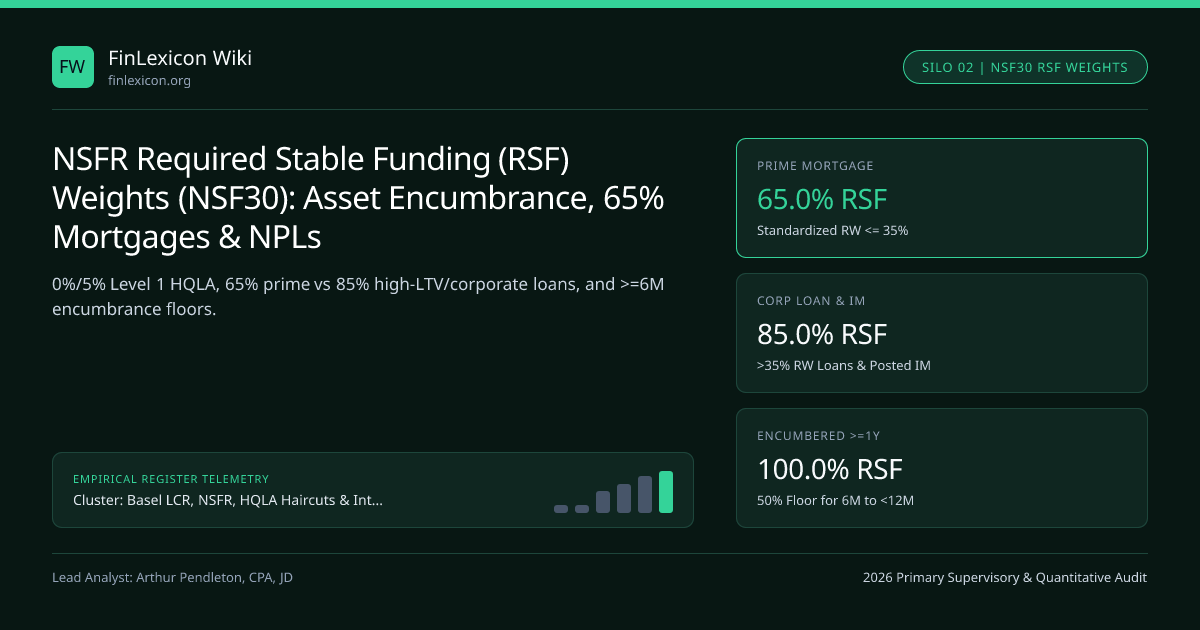
As the denominator of the Net Stable Funding Ratio (NSFR), Required Stable Funding (RSF) under Basel Framework paragraphs NSF30.15–NSF30.34 measures the structural illiquidity of every on-balance-sheet asset and off-balance-sheet commitment over a 365-day horizon. Even a sovereign Treasury bond carries a 50% to 100% RSF charge if pledged out in term repo or margin encumbrance for six months or longer!
Unencumbered Asset Hierarchy: From 0% Reserves and 5% Sovereigns to 85% Corporate Loans#
For unencumbered performing assets (or assets encumbered for < 6 months), NSF30 assigns eight progressive RSF tiers detailed in our Basel LCR, NSFR & HQLA cornerstone guide:
- 0% RSF: Coins, banknotes, all central bank reserves (both required and excess!), claims on central banks
< 6 months, and trade-date receivables. - 5% RSF: Unencumbered Level 1 HQLA securities (0%-RW sovereigns like U.S. Treasuries, Bunds, Gilts). (Crucial note: U.S. Reg WW 12 CFR 249.106 sets Level 1 HQLA securities at 0% RSF, eliminating the 5% Basel tax on cash Treasury market-making in the United States, whereas EU CRR II initially set 0% on sovereigns!)
- 10% / 15% Short-Term Interbank & SFTs:
< 6 monthsloans to financial institutions secured by Level 1 HQLA (10%RSF under BCBS;0%in U.S. Reg WW and0%–5%in EU CRR II!), vs unsecured or non-Level-1< 6 monthsloans to financials AND unencumbered Level 2A HQLA (15%RSF). - 50% RSF: Unencumbered Level 2B HQLA, all loans to financial institutions & central banks maturing in 6 to < 12 months, operational deposits held at other banks, and all
< 1 yearperforming loans to non-financial corporates, retail, SMEs, sovereigns, and PSEs! - 65% RSF: Unencumbered
>= 1 yearresidential mortgages AND>= 1 yearnon-financial loans qualifying for a<= 35%Basel II/III Standardized credit risk weight. - 85% RSF: Unencumbered
>= 1 yearperforming retail, SME, and >35%-RW corporate loans, unencumbered non-HQLA securities< 1Yor exchange-traded equities, physical traded commodities (gold!), and initial margin posted for derivatives / CCP default fund contributions! - 100% RSF: All non-performing / >90-day past-due loans, goodwill/DTAs/fixed assets, net NSFR derivative assets, and unencumbered non-HQLA debt securities
>= 1Y.
The Asset Encumbrance Override Rule (< 6M, 6M to < 12M, >= 1 Year)#
Whenever an asset on the balance sheet is encumbered—pledged to secure a repo, covered bond pool, FHLB advance, or central bank facility—NSF30.20 overrides its unencumbered RSF factor based strictly on the remaining period of encumbrance:
- Encumbered
< 6 Months: Retains its normal unencumbered RSF weight (e.g.,5%or0%on a Treasury bond repoed overnight). - Encumbered
6 Months to < 1 Year: Assignedmax( 50% , Unencumbered_RSF )! Pledging a 5%-RSF German Bund into an 8-month term repo spikes its RSF tenfold to 50% (matching the 50% ASF of the 8-month financial repo)! - Encumbered
>= 1 Year: Assigned 100% RSF! Thus, residential mortgages pledged into a 5-year covered bond pool at BNP Paribas, Bank of Montreal, or ANZ Bank jump from65%RSF to 100% RSF (matched against the100%ASF of the 5-year covered bond!).
Why Basel’s Asymmetric 10%/15% Reverse Repo vs 0% Repo Taxed Dealer Matched Books#
Under pure BCBS NSF30, borrowing cash overnight via a financial repo provides 0% ASF, whereas lending that cash out overnight via a financial reverse repo charges 10% RSF (Level 1 collateral) or 15% RSF (non-Level-1 collateral)! Consequently, a pure matched-book repo dealer at Bank of America or European dealers regulated by the ECB and UK PRA faced a structural 10%–15% term-debt tax per dollar of matched repo—prompting U.S. Reg WW to slash Level 1 reverse-repo RSF to 0% and EU CRR II/III to cut Level 1/non-L1 SFT RSF to 0%/5%–10% to protect sovereign bond liquidity!
| On/Off-Balance-Sheet Asset Category | BCBS NSF30 Unencumbered RSF | U.S. Reg WW RSF (12 CFR 249.106) | Encumbered 6M to <1Y | Encumbered >= 1 Year |
|---|---|---|---|---|
| Central Bank Reserves & Cash | 0.0% RSF | 0.0% RSF | 50.0% RSF | 100.0% RSF |
| Level 1 HQLA Sovereign Securities | 5.0% RSF | 0.0% RSF (Zero tax!) | 50.0% RSF | 100.0% RSF |
| <6M Financial Reverse Repo (Level 1) | 10.0% RSF | 0.0% RSF (Zero tax!) | 50.0% RSF | 100.0% RSF |
| Level 2A HQLA & <6M Non-L1 Fin SFT | 15.0% RSF | 15.0% RSF | 50.0% RSF | 100.0% RSF |
| >=1Y Mortgages & Loans (<=35% RW) | 65.0% RSF | 65.0% RSF | 65.0% RSF | 100.0% RSF |
| >=1Y Corporate Loans (>35% RW) & IM | 85.0% RSF | 85.0% RSF | 85.0% RSF | 100.0% RSF |
| Non-Performing Loans (NPLs) & Fixed | 100.0% RSF | 100.0% RSF | 100.0% RSF | 100.0% RSF |
85% RSF on Posted Derivative Initial Margin and CCP Default Fund Contributions#
Cash or bonds posted as mandatory Initial Margin under UMR Phase 1–6 SIMM or contributed to a CCP default fund cannot be monetized by the posting bank without closing out the underlying hedge book; NSF30.30 assigns max(85%, Underlying_Asset_RSF) to posted IM and CCP default funds!
Linking Credit Deterioration Directly Into Liquidity: The 100% NPL Cliff#
The moment a 65%-RSF mortgage or 85%-RSF corporate loan crosses 90 days past due (non-performing), its RSF jumps to 100% (net of specific provisions), tightening structural funding ratios against NSFR Available Stable Funding (ASF) buckets and asymmetric NSFR derivative charges across the Basel LCR, NSFR & Prudential Liquidity topic hub.
- = max( 0.50 , RSFUnencj ) * Asset_j (if Encumbered 6M to < 1Y)
- = RSFUnencj * Asset_j (if Unencumbered OR Encumbered < 6M)
- RSFTotal = Sumj RSFAssetj + 0.85 * (PostedIM + CCPDF) + 1.00 * NetNSFRDerivAsset + 0.20 * GrossDerivLiab + 0.05 * OBSCommitments
- Worked Mortgage & Dealer Bank RSF Audit ($200.0B Assets + $40.0B Undrawn Corporate Revolvers):
- $25B Reserves (0%) + $30B Unencumb. Level 1 USTs (5% BCBS = $1.50B) + $20B Level 2A MBS (15% = $3.00B)
- $60B Unencumb. Prime Mortgages <=35% RW (65% = $39.00B) + $20B Mortgages Pledged in 3Y Covered Bonds (100% = $20.00B)
- $35B >=1Y Unrated Corporate Loans (85% = $29.75B) + $6B Posted SIMM IM (85% = $5.10B) + $4B NPLs/Goodwill (100% = $4.00B)
- Off-Balance-Sheet Revolvers: $40.0B * 5% = $2.00B => Total RSF = $104.35B (With $122.0B ASF => NSFR = 116.91%)
Frequently asked questions
How does Basel III CRE20 LTV mortgage risk weighting interact with the 65% vs 85% NSFR mortgage split?
Under NSF30.29, a >=1 year residential mortgage qualifies for 65% RSF only if it earns a <=35% risk weight under Standardized Credit Risk; under CRE20 Whole-Loan rules, owner-occupied mortgages above 80% LTV (40%–70% RW) and buy-to-let mortgages above 60% LTV (45%–105% RW) breach 35% RW and jump to 85% RSF!
Does pledging mortgages to a Federal Home Loan Bank (FHLB) under a blanket lien trigger 100% RSF on the whole pool?
No—only the specific collateral dollar slice legally encumbered to secure drawn FHLB advances (including required overcollateralization haircuts) takes the encumbrance horizon of the FHLB advance; excess unencumbered borrowing-base loans remain at 65%/85% RSF.
Why did the U.S. Federal Reserve cut Level 1 Treasury and Level 1 Reverse-Repo RSF to 0%?
Applying 5% RSF to cash Treasuries and 10% RSF to overnight Treasury reverse repos against 0% ASF on overnight Treasury repos would have forced primary dealers to issue billions in expensive >1-year unsecured debt purely to intermediate risk-free overnight Treasury repo markets.
If a bank posts 5%-RSF U.S. Treasury bonds as UMR SIMM Initial Margin, why is RSF 85% instead of 5%?
Because Initial Margin sits locked in a segregated third-party custodian account securing a portfolio of multi-year swaps and cannot be liquidated by treasury to meet funding outflows; NSF30.30 overrides the bond’s 5% RSF to 85%.
Publication record
- Published
- 14 November 2026
- Updated
- 15 November 2026
- Author
- Arthur Pendleton, CPA, JD
- Review
- Review not recorded
- Automated fact check
- Passed in the stored pipeline record
- Source URLs
- 3 recorded
AI assistance recorded: anthropic/claude-opus-4.6. This field does not establish human review or source verification.
Academic & Institutional Attribution
Cite This Research & Embed Live Data Card
Standard academic & institutional research paper citation format.
Arthur Pendleton, CPA, JD. (2026, November 14). NSFR Required Stable Funding (RSF) Weights (NSF30): Asset Encumbrance, 65% Mortgages & NPLs. FinLexicon Wiki. https://finlexicon.org/wiki/nsfr-rsf-required-stable-funding-encumbered-assets-mortgagesRelated Liquidity Coverage Nsfr Prudential & Institutional Briefings
Explore Liquidity Coverage Nsfr Prudential Hub (20) →Liquidity Coverage Nsfr Prudential
Basel III LCR, NSFR, HQLA Haircuts & Intraday Prudential Liquidity ArchitectureLiquidity Coverage Nsfr Prudential
Asymmetric NSFR Derivatives Treatment (NSF30): Cash VM Offsets & the 20% Gross Liability Add-OnLiquidity Coverage Nsfr Prudential
BCBS 248 Intraday Liquidity Monitoring Tools: RTGS Peak Net Debit & Time-Specific ObligationsLiquidity Coverage Nsfr Prudential
IRRBB Standards (BCBS d368 / SRP31): Six EVE Shock Scenarios, 15% Tier 1 Outlier Test & Delta-NIILiquidity Coverage Nsfr Prudential
Non-Maturity Deposits (NMD) Behavioral Modeling: Deposit Betas, Core Caps & SRP31 Duration CeilingsLiquidity Coverage Nsfr Prudential
U.S. Regulation WW (12 CFR Part 249): Peak-Day Maturity Mismatch Add-On & Tailoring Categories I–IVLiquidity Coverage Nsfr Prudential
Supervisory ILAAP, Internal Liquidity Stress Testing (Reg YY) & Reverse Stress Survival HorizonsLiquidity Coverage Nsfr Prudential
Central Bank Liquidity Facilities: Fed Standing Repo (SRF), Discount Window, BoE ILTR & HQLA MonetizationIsda Csa Derivatives Collateral
CSA Minimum Transfer Amounts (MTA <= $500k/€500k), Rounding & Independent Amounts (IA vs Reg IM)Isda Csa Derivatives Collateral
Basel III SA-CCR (CRE52): Alpha = 1.4 Scalar, Margined Replacement Cost & Exponential PFE MultiplierIsda Csa Derivatives Collateral
Multi-Currency CSA Discounting & Cheapest-to-Deliver (CTD) Optionality: SOFR, €STR & ColVA PricingIsda Csa Derivatives Collateral
ISDA 2020 IBOR Fallbacks Protocol: Compounded-in-Arrears RFRs & Bloomberg 5-Year Median Spreads
FinLexicon Wiki Data, Benchmarks & Contributor Records
CC BY 4.0 Open Data
Open Institutional Datasets (CSV / JSON) →
Download desk-compiled quantitative series & schemas.
2026 Reference Matrix
2026 Institutional Benchmarks & Thresholds →
Statutory capital, clearing, margin & rate conventions.
Editorial Records
Authors & Review Records →
View named contributors where those records are available.
Complete Index
Master Research & Dossier Archive →
Browse all published briefings by topic pillar & date.