
Liquidity Coverage Nsfr Prudential
IRRBB Standards (BCBS d368 / SRP31): Six EVE Shock Scenarios, 15% Tier 1 Outlier Test & Delta-NII
Under Basel SRP31 (BCBS d368), prudential banking supervisors evaluate Interest Rate Risk in the Banking Book across six yield-curve shocks, flagging outliers whenever Economic Value of Equity depletion exceeds 15% of Tier 1 capital.
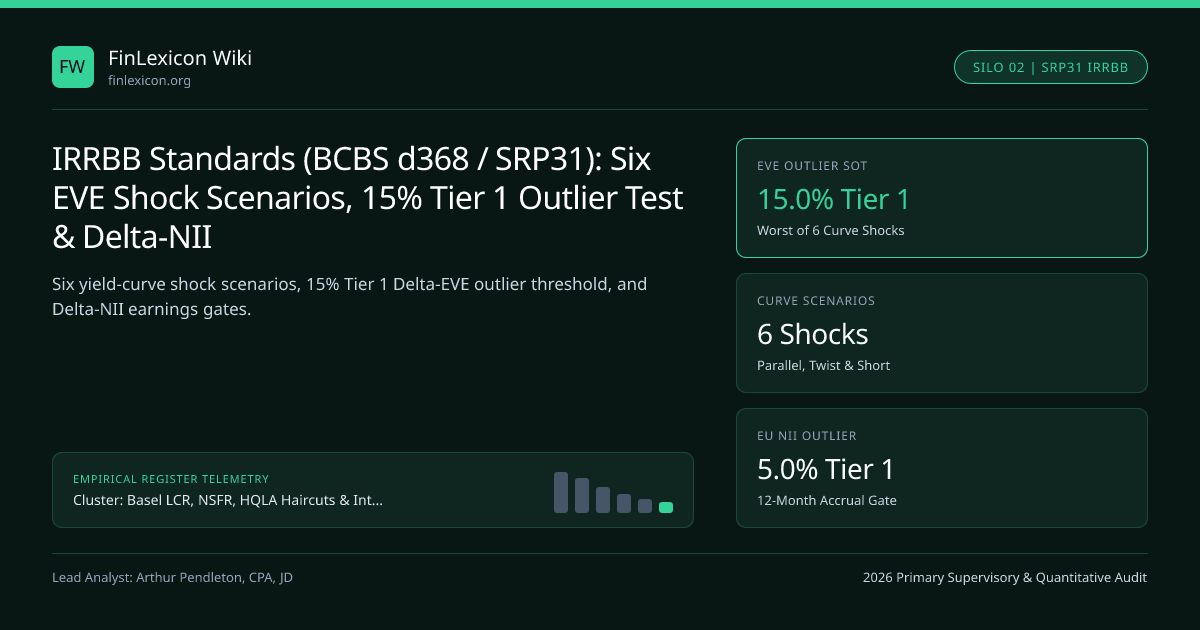
Published in April 2016 as BCBS d368 and codified in Basel Framework chapter SRP31, the Interest Rate Risk in the Banking Book (IRRBB) standard replaces the simplistic +/-200 bps parallel rate shock of Basel II with six granular yield-curve scenarios and a tighter 15% of Tier 1 capital Supervisory Outlier Test (SOT). Whereas Pillar 1 market risk (FRTB) governs fair-valued trading desks, SRP31 sits inside Pillar 2 to capture structural repricing, basis, yield-curve twist, and behavioral option risks across loans, bond portfolios, and deposits.
Dual Measurement Lens: Economic Value of Equity (Delta-EVE) vs Net Interest Income (Delta-NII)#
No single metric captures banking book rate exposure across both short-term earnings and long-term solvency. As framed in our Basel LCR, NSFR & HQLA cornerstone guide, SRP31 mandates dual measurement:
- Economic Value of Equity (
Delta-EVE): Discounts run-off cash flows of all existing on- and off-balance-sheet banking book items (excluding CET1 equity itself!) back to present value across baseline vs shocked risk-free or commercial-margin curves.Delta-EVEreveals hidden multi-decade duration mismatches—such as 30-year fixed-rate mortgages or held-to-maturity sovereign bond books—long before accounting accruals register losses. - Net Interest Income (
Delta-NII): Simulates rolling 12-month (up to 36-month) accrual net interest earnings under a constant or dynamic balance sheet assumption, where maturing assets and liabilities roll into new instruments priced at shocked market rates plus commercial spreads.
The Six Standardized Yield-Curve Shock Scenarios and Currency Calibrations#
Under SRP31.90, banks must compute Delta-EVE across six prescribed interest rate shock scenarios independently for every material currency (accounting for >= 5% of banking book assets or liabilities), aggregating only losses (max(0, Loss_ccy)) across currencies without full positive gain offsets (or 50% EU EBA gain recognition):
- Parallel Shock Up (
+200 bpsUSD/EUR/GBP/CAD;+400 bpsZAR;+100 bpsJPY baseline calibration). - Parallel Shock Down (
-200 bpsUSD/EUR, subject to a dynamic post-shock rate floor starting at-100 bpsovernight rising by5 bps/yearto0%at 20 years). - Steepener Shock (short rates down, long rates up via exponential decay/growth scalars around a 4-year pivot).
- Flattener Shock (short rates up, long rates down—devastating for classic maturity-transforming banks funding long fixed-rate bonds with short-rate deposits!).
- Short Rates Shock Up (
+/-250 bpsUSD /+/-250 bpsEUR /+/-300 bpsGBP decaying exponentiallye^(-t / 4)). - Short Rates Shock Down.
The 15% of Tier 1 Capital Supervisory Outlier Test (vs Legacy 20% Total Capital)#
BCBS d368 tightened the global outlier threshold in two ways simultaneously: lowering the percentage cap from 20% down to 15%, and narrowing the capital denominator from Total Capital (Tier 1 + Tier 2) to Tier 1 Capital (CET1 + AT1)! In the European Union, the European Central Bank and EBA added a second statutory SOT on Delta-NII (flagging any bank whose 1-year NII drops by more than 5.0% of Tier 1 capital under parallel up/down shocks), while the UK PRA, APRA (which uniquely imposes a Pillar 1 IRRBB RWA capital charge under APS 117!), and the U.S. Federal Reserve scrutinize outlier breaches for Pillar 2 capital add-ons or balance-sheet hedging orders.
| Jurisdiction & Supervisor | Regulatory Rulebook | Pillar Classification | Delta-EVE Outlier Gate | Delta-NII Outlier Gate |
|---|---|---|---|---|
| INTL (BCBS / BIS) | Basel SRP31 (BCBS d368, 2016/2024) | Pillar 2 Supervisory Review | > 15.0% of Tier 1 Capital (6 shocks) | Pillar 2 monitoring (Parallel +/-) |
| European Union (ECB / EBA) | CRD V Art. 98(5) & EBA/RTS/2022/10 | Pillar 2 (SREP P2R / P2G input) | > 15.0% of Tier 1 Capital (6 shocks) | > 5.0% of Tier 1 Capital (Parallel +/-) |
| United Kingdom (UK PRA) | ICAA Rulebook & SS31/15 Pillar 2A | Pillar 2A deterministic add-on | > 15.0% of Tier 1 Capital (6 shocks) | Supervisory earnings review |
| Australia (APRA) | Prudential Standard APS 117 (2025) | Hard Pillar 1 RWA Charge (IRB ADIs)! | Direct CET1 RWA Charge + 15% review | Embedded repricing & basis charge |
| United States (Federal Reserve / OCC) | SR 10-1 Interagency IRR Guidance | Pillar 2 CAMELS "S" (Sensitivity) | Board risk limits + supervisory review | 12M & 24M earnings-at-risk bands |
Automatic and Behavioral Embedded Optionality: Prepayments and Deposit Betas#
Fixed-rate mortgages carry negative convexity: when yields fall -200 bps, households refinance early (shortening asset duration), whereas when yields surge +200 bps, prepayments freeze ("extension risk") just as non-maturity deposit (NMD) pass-through betas accelerate! Institutions such as Bank of America, BNP Paribas, and ANZ Bank model shock-dependent CPR (Conditional Prepayment Rate) multipliers (0.8x in up-shocks, 1.2x–1.4x in down-shocks) under SRP31 standardized behavioral tables.
Coupling IRRBB Duration Losses With Liquidity Stress Under ILAAP#
Silicon Valley Bank’s March 2023 failure proved that IRRBB and liquidity risk are inseparable: once Delta-EVE losses erode economic solvency, uninsured depositors flee, forcing bond liquidation inside internal liquidity adequacy (ILAAP) survival horizons tracked across the Basel LCR, NSFR & Prudential Liquidity topic hub.
- DeltaEVEs = EVE0 - EVEs [Positive value = Economic Loss]
- OutlierTest : max{s in 1..6} ( Sum{ccy} max(0, DeltaEVE{s,ccy}) ) > 0.15 * Tier1_Capital
- Worked Multi-Currency SOT Audit (Tier 1 Capital = $10.0B -> 15% Threshold = $1.50B):
- Scenario 1 (Parallel Up): USD Banking Book Loss = +$1.35B | EUR Banking Book Gain = -$0.40B (gain ignored or weighted 50% EBA)
- Strict BCBS Loss-Only Aggregation = max(0, $1.35B) + max(0, -$0.40B) = $1.35B (13.5% of Tier 1 -> Passes; 11.5% under EBA 50% offset)
- If Mortgage Extension Adds +$0.25B USD Loss => Total Loss = $1.60B (16.0% of Tier 1 -> Breaches 15% SOT!)
Frequently asked questions
Why must CET1 equity be excluded from liability cash flows when calculating Economic Value of Equity?
Because EVE is defined as the residual present value of assets minus non-equity liabilities (PV(Assets) - PV(Liabilities)). Including artificial fixed-duration cash flows for perpetual common equity would manufacture phantom duration hedges that mask real economic asset-liability mismatches (SRP31.50).
Can a bank show positive Delta-NII in a +200 bps hike while simultaneously failing the -15% Delta-EVE test?
Yes! That exact paradox occurred in 2022–2023: floating-rate loans and central bank reserves boosted 12-month NII initially while sticky checking deposits stayed near 0%, even as 10-to-30-year fixed-rate MBS books suffered massive present-value EVE depletion.
Should banks include commercial credit margins in cash flows and discount rates for Delta-EVE?
Under SRP31.53, banks must choose consistently: either exclude commercial margins from cash flows and discount using a pure risk-free curve (OIS/SOFR), OR include contractual commercial margins in cash flows and discount using a risk-free curve plus the origination margin spread.
Why did BCBS recalibrate currency rate shock sizes in 2024?
Following the post-2021 global inflation and rate cycle, BCBS updated its SRP31 shock calibration methodology (July 2024) using rolling 2000–2022 interest-rate time series and percentile bounds so currencies exiting zero-rate regimes reflect realistic volatility.
Publication record
- Published
- 14 November 2026
- Updated
- 15 November 2026
- Author
- Arthur Pendleton, CPA, JD
- Review
- Review not recorded
- Automated fact check
- Passed in the stored pipeline record
- Source URLs
- 4 recorded
AI assistance recorded: anthropic/claude-opus-4.6. This field does not establish human review or source verification.
Academic & Institutional Attribution
Cite This Research & Embed Live Data Card
Standard academic & institutional research paper citation format.
Arthur Pendleton, CPA, JD. (2026, November 14). IRRBB Standards (BCBS d368 / SRP31): Six EVE Shock Scenarios, 15% Tier 1 Outlier Test & Delta-NII. FinLexicon Wiki. https://finlexicon.org/wiki/irrbb-bcbs-d368-eve-six-shock-scenarios-vs-nii-sensitivityRelated Liquidity Coverage Nsfr Prudential & Institutional Briefings
Explore Liquidity Coverage Nsfr Prudential Hub (20) →Liquidity Coverage Nsfr Prudential
Basel III LCR, NSFR, HQLA Haircuts & Intraday Prudential Liquidity ArchitectureLiquidity Coverage Nsfr Prudential
Non-Maturity Deposits (NMD) Behavioral Modeling: Deposit Betas, Core Caps & SRP31 Duration CeilingsLiquidity Coverage Nsfr Prudential
U.S. Regulation WW (12 CFR Part 249): Peak-Day Maturity Mismatch Add-On & Tailoring Categories I–IVLiquidity Coverage Nsfr Prudential
Supervisory ILAAP, Internal Liquidity Stress Testing (Reg YY) & Reverse Stress Survival HorizonsLiquidity Coverage Nsfr Prudential
Central Bank Liquidity Facilities: Fed Standing Repo (SRF), Discount Window, BoE ILTR & HQLA MonetizationLiquidity Coverage Nsfr Prudential
Held-to-Maturity (HTM) Unrealized Losses, Uninsured Deposit Runs & the Solvency-Liquidity Doom LoopLiquidity Coverage Nsfr Prudential
Cross-Currency LCR (LCR30.45), Off-Balance-Sheet FX Swap Funding Gaps & CLS PvP LiquidityLiquidity Coverage Nsfr Prudential
NSFR Interdependent Assets & Liabilities (NSF30.35): 0% Pass-Through, Promotional Loans & CCP IMIsda Csa Derivatives Collateral
ISDA 2020 IBOR Fallbacks Protocol: Compounded-in-Arrears RFRs & Bloomberg 5-Year Median SpreadsIsda Csa Derivatives Collateral
UMR Eligible Collateral Schedules: Sovereign/Corporate Haircuts, Wrong-Way Risk Bans & the 8% FX Add-OnIsda Csa Derivatives Collateral
Tri-Party & Third-Party Account Control Agreements (ACAs): Segregated UMR IM & Notice of Exclusive ControlIsda Csa Derivatives Collateral
ISDA Close-Out Netting Legal Opinions & Resolution Stay Protocols: EU BRRD, U.S. QFC & 48-Hour Bail-In Stays
FinLexicon Wiki Data, Benchmarks & Contributor Records
CC BY 4.0 Open Data
Open Institutional Datasets (CSV / JSON) →
Download desk-compiled quantitative series & schemas.
2026 Reference Matrix
2026 Institutional Benchmarks & Thresholds →
Statutory capital, clearing, margin & rate conventions.
Editorial Records
Authors & Review Records →
View named contributors where those records are available.
Complete Index
Master Research & Dossier Archive →
Browse all published briefings by topic pillar & date.