
Liquidity Coverage Nsfr Prudential
Non-Maturity Deposits (NMD) Behavioral Modeling: Deposit Betas, Core Caps & SRP31 Duration Ceilings
Contractually withdrawable at par overnight yet behaviorally sticky across rate cycles, Non-Maturity Deposits (NMDs) are governed under Basel SRP31 by strict core proportion ceilings (50%–90%) and average maturity caps of 4 to 5 years.
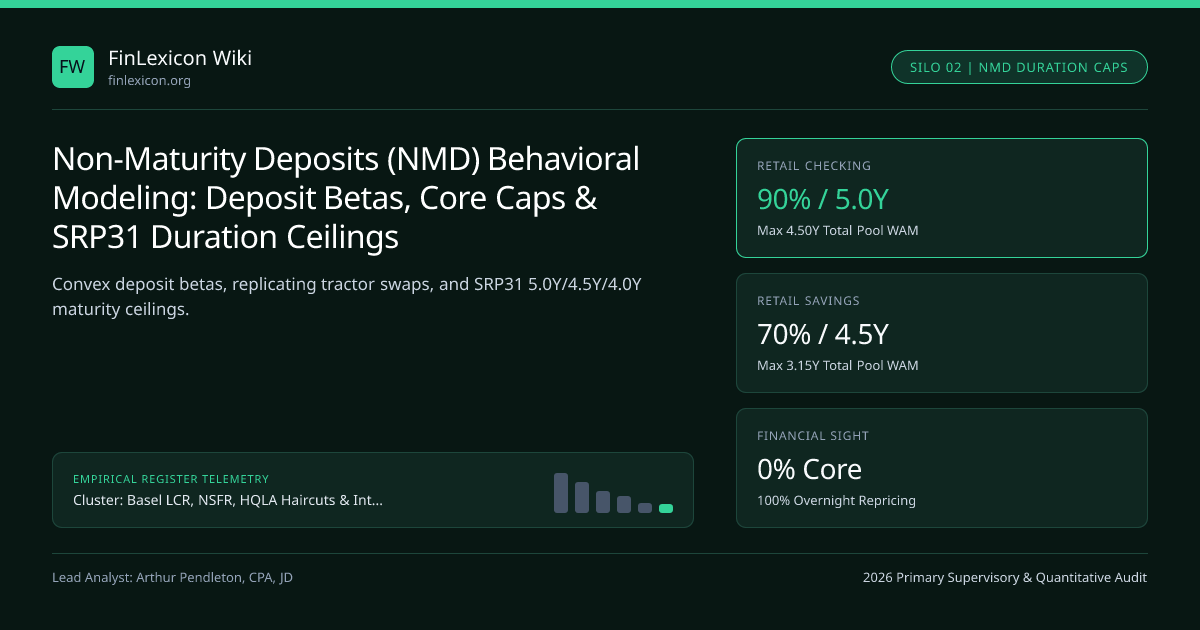
Checking accounts, NOW accounts, corporate cash-management balances, and instant-access savings accounts—collectively termed Non-Maturity Deposits (NMDs)—carry a contractual repricing maturity of zero days (overnight). Yet because millions of retail payroll and operational accounts exhibit low rate sensitivity ("deposit beta"), treasury ALCO desks hedge NMDs with multi-year receiver swaps or fixed-rate bonds. To prevent banks from overstating deposit duration and hiding IRRBB EVE duration mismatches, Basel Framework paragraphs SRP31.73–SRP31.82 impose hard statutory caps on both core NMD proportions and behavioral average maturities.
Decomposing NMDs Into Overnight Non-Core and Replicating-Portfolio Core Slices#
Every NMD category must first be segmented into homogeneous depositor pools—Retail Transactional, Retail Non-Transactional (savings/MMDA), and Wholesale Non-Financial Corporate (financial-institution sight deposits can NEVER be treated as core NMDs and must be slotted 100% overnight!). Within each eligible pool, as connected to our Basel LCR, NSFR & HQLA cornerstone guide, ALCO models separate balances into:
- Non-Core NMDs (Rate-Sensitive / Volatile): Slotted into the overnight (
<= 1 day) repricing time bucket. This includes both rate-chasing balances expected to reprice immediately (Deposit Beta) and balances expected to migrate into high-yielding time deposits or money-market funds when policy rates surge. - Core NMDs (Stable & Rate-Insensitive): Stable balances unlikely to reprice even under significant interest-rate shocks, which treasury hedges via a replicating portfolio of staggered 1-to-10-year fixed-rate tranches (provided the weighted-average maturity stays within SRP31 caps!).
Basel SRP31 Table 2 Statutory Ceilings: 90%/70%/50% Core & 5.0Y/4.5Y/4.0Y Maturity Caps#
Under the Basel SRP31 standardized framework (Table 2, SRP31.81)—and mirrored as supervisory backstops by the European Central Bank, EBA (5-year retail/non-financial average cap), and UK PRA—banks cannot exceed strict two-dimensional caps:
- Retail Transactional NMDs: Maximum 90% Core proportion; Maximum 5.0 years average maturity of core (
=> Max 4.50 yearsportfolio-wide weighted average maturity!). - Retail Non-Transactional NMDs (Savings): Maximum 70% Core proportion; Maximum 4.5 years average maturity of core (
=> Max 3.15 yearsportfolio-wide WAM!). - Wholesale Non-Financial Corporate NMDs: Maximum 50% Core proportion; Maximum 4.0 years average maturity of core (
=> Max 2.00 yearsportfolio-wide WAM!). - Wholesale Financial Institution NMDs: 0% Core (
100% Overnight,0.0 yearsWAM!).
Non-Linear Deposit Betas and Convex Regime Shifts After Zero-Rate Decades#
Why did econometric NMD models calibrated on 2009–2021 data fail across regional and universal banks in 2022–2023? Because deposit pass-through betas (beta = Delta_r_deposit / Delta_r_policy) are convex and state-dependent!
- For the first
+100 bpshike off zero, bank deposit betas often sit near0.15–0.25. Once central bank policy rates cross3.50%–5.00%and mobile banking apps advertise5.0%Treasury money-market funds in two taps, cumulative betas jump toward0.55–0.75while non-interest-bearing checking accounts cannibalize into high-yield CDs! Institutions like Bank of America, BNP Paribas, and Ally Financial stress-test regime-switching S-curve betas rather than linear regressions.
| NMD Depositor Segment | SRP31 Max Core Share | SRP31 Max Core Avg Maturity | Max Total Pool WAM | Corresponding LCR / NSFR Weight |
|---|---|---|---|---|
| Retail Transactional (Checking/Payroll) | 90.0% | 5.0 Years | 4.50 Years | 3%–5% LCR Outflow / 95% ASF |
| Retail Non-Transactional (Savings/MMDA) | 70.0% | 4.5 Years | 3.15 Years | 10%+ LCR Outflow / 90% ASF |
| Wholesale Non-Financial Corporate | 50.0% | 4.0 Years | 2.00 Years | 25% Op / 40% Non-Op / 50% ASF |
| Wholesale Financial Institutions / NBFI | 0.0% (Forbidden!) | 0.0 Years (Overnight) | 0.00 Years | 25% Op / 100% Non-Op / 0% ASF |
| EU EBA RTS 2022/10 Aggregate Rule | Model-validated | 5.0 Years Hard Ceiling | <= 5.00 Years | Excludes financial & high-value deposits |
Reconciling LCR 30-Day Run-Off, NSFR 95%/90% ASF, and IRRBB NMD Duration#
Supervisors cross-audit a bank’s behavioral assumptions across liquidity and interest-rate silos: claiming a high-yield online savings account is "70% core with 4.5-year duration" for IRRBB while simultaneously classifying it as a higher-outflow digital/less-stable deposit in 30-day LCR run-off tables triggers immediate SREP/horizontal exam challenges!
Structural Tractor Replicating Portfolios in Funds Transfer Pricing (FTP)#
To stabilize net interest margins, treasury desks credit retail branches via a rolling 60-month "tractor" swap strip (e.g., 1/60th rolling into a new 5-year receiver swap each month) calibrated inside Contingent Funding & FTP governance across the Basel LCR, NSFR & Prudential Liquidity topic hub.
- WAMCoreEff = min( CapMatSRP31 , ModeledCoreWAM )
- WAMTotalPool = CoreShareEff * WAMCoreEff + (1 - CoreShareEff) * (1 / 365)
- Worked Retail Savings NMD Calibration ($40.0B Digital + Branch Savings Pool under +200 bps Up-Shock):
- 10-Year Historical Decay in Stress = 15% | Up-Shock Deposit Beta (including migration to Term CDs) = 0.40
- Modeled Core_Share = (1 - 0.15) * (1 - 0.40) = 0.85 * 0.60 = 51.0% (Below 70.0% SRP31 Ceiling -> 51.0% binds)
- Modeled Core Ladder = Equal 1Y-to-8Y Tractor (Avg = 4.50Y, exactly at 4.50Y SRP31 Retail Non-Transactional Cap)
- Effective Pool WAM = 0.51 * 4.50Y = 2.295 Years ($20.4B Core Hedged Across 1–8Y; $19.6B Slotted Overnight)
Frequently asked questions
What exactly is a "60-month tractor" replicating portfolio for Non-Maturity Deposits?
A 60-month (5-year) tractor invests 1/60th of the Core NMD balance each month into a new 5-year fixed-rate asset or receive-fixed swap. At steady state, maturities are evenly spaced from 1 month to 60 months, giving a smooth 2.5-year average duration that dampens NII volatility.
Why does deposit cannibalization (migration from 0% checking into 4.5% CDs at the same bank) hurt IRRBB even if total cash stays at the bank?
Even though liquidity (LCR/NSFR) appears unchanged when a customer shifts $100,000 from 0% checking into a 6-month 4.8% CD at the same bank, economically a 4.5-year zero-cost liability vanished overnight and repriced to market rates—destroying both NII and the EVE duration hedge!
Are banks allowed to apply the 90%/5.0Y SRP31 caps mechanically without behavioral modeling?
Only institutions using the simplified Standardized IRRBB Framework apply Table 2 baselines subject to historical caps; internal-model IMS banks must prove empirically via multi-cycle econometric decay and beta models that their core share and maturity are justified below those ceilings.
How does EBA RTS 2022/10 treat high-net-worth retail deposits above EUR 100,000 in NMD modeling?
Mirroring LCR40 retail rules, EBA IRRBB guidelines require banks to segment high-value/private-banking balances separately from mass-market payroll checking because affluent clients exhibit wholesale-like deposit betas (0.60–0.85) during tightening cycles.
Publication record
- Published
- 14 November 2026
- Updated
- 15 November 2026
- Author
- Arthur Pendleton, CPA, JD
- Review
- Review not recorded
- Automated fact check
- Passed in the stored pipeline record
- Source URLs
- 3 recorded
AI assistance recorded: anthropic/claude-opus-4.6. This field does not establish human review or source verification.
Academic & Institutional Attribution
Cite This Research & Embed Live Data Card
Standard academic & institutional research paper citation format.
Arthur Pendleton, CPA, JD. (2026, November 14). Non-Maturity Deposits (NMD) Behavioral Modeling: Deposit Betas, Core Caps & SRP31 Duration Ceilings. FinLexicon Wiki. https://finlexicon.org/wiki/non-maturity-deposits-nmd-core-pass-through-behavioral-capsRelated Liquidity Coverage Nsfr Prudential & Institutional Briefings
Explore Liquidity Coverage Nsfr Prudential Hub (20) →Liquidity Coverage Nsfr Prudential
Basel III LCR, NSFR, HQLA Haircuts & Intraday Prudential Liquidity ArchitectureLiquidity Coverage Nsfr Prudential
U.S. Regulation WW (12 CFR Part 249): Peak-Day Maturity Mismatch Add-On & Tailoring Categories I–IVLiquidity Coverage Nsfr Prudential
Supervisory ILAAP, Internal Liquidity Stress Testing (Reg YY) & Reverse Stress Survival HorizonsLiquidity Coverage Nsfr Prudential
Central Bank Liquidity Facilities: Fed Standing Repo (SRF), Discount Window, BoE ILTR & HQLA MonetizationLiquidity Coverage Nsfr Prudential
Held-to-Maturity (HTM) Unrealized Losses, Uninsured Deposit Runs & the Solvency-Liquidity Doom LoopLiquidity Coverage Nsfr Prudential
Cross-Currency LCR (LCR30.45), Off-Balance-Sheet FX Swap Funding Gaps & CLS PvP LiquidityLiquidity Coverage Nsfr Prudential
NSFR Interdependent Assets & Liabilities (NSF30.35): 0% Pass-Through, Promotional Loans & CCP IMLiquidity Coverage Nsfr Prudential
Collateral Swaps, Securities Lending & Liquidity Upgrade Trades: LCR30.36 Unwind & LCR40.48 OutflowsIsda Csa Derivatives Collateral
UMR Eligible Collateral Schedules: Sovereign/Corporate Haircuts, Wrong-Way Risk Bans & the 8% FX Add-OnIsda Csa Derivatives Collateral
Tri-Party & Third-Party Account Control Agreements (ACAs): Segregated UMR IM & Notice of Exclusive ControlIsda Csa Derivatives Collateral
ISDA Close-Out Netting Legal Opinions & Resolution Stay Protocols: EU BRRD, U.S. QFC & 48-Hour Bail-In StaysIsda Csa Derivatives Collateral
OTC Portfolio Reconciliation & Margin Dispute Aging: EMIR Art. 11, CFTC 23.502 & the EUR 15M / 5-Day Report
FinLexicon Wiki Data, Benchmarks & Contributor Records
CC BY 4.0 Open Data
Open Institutional Datasets (CSV / JSON) →
Download desk-compiled quantitative series & schemas.
2026 Reference Matrix
2026 Institutional Benchmarks & Thresholds →
Statutory capital, clearing, margin & rate conventions.
Editorial Records
Authors & Review Records →
View named contributors where those records are available.
Complete Index
Master Research & Dossier Archive →
Browse all published briefings by topic pillar & date.