
Ifrs9 Cecl Credit Provisioning
US GAAP ASC 326 (CECL): Day-One Lifetime Loss, R&S Reversion & ASU 2025-08 M&A Double-Count Reform
Codified in FASB ASC 326, Current Expected Credit Losses (CECL) mandates Day-1 lifetime allowances combining Reasonable and Supportable forecasts with historical loss reversion—while FASB’s Purchased Financial Assets update eliminates the M&A Non-PCD "Double Count" penalty.
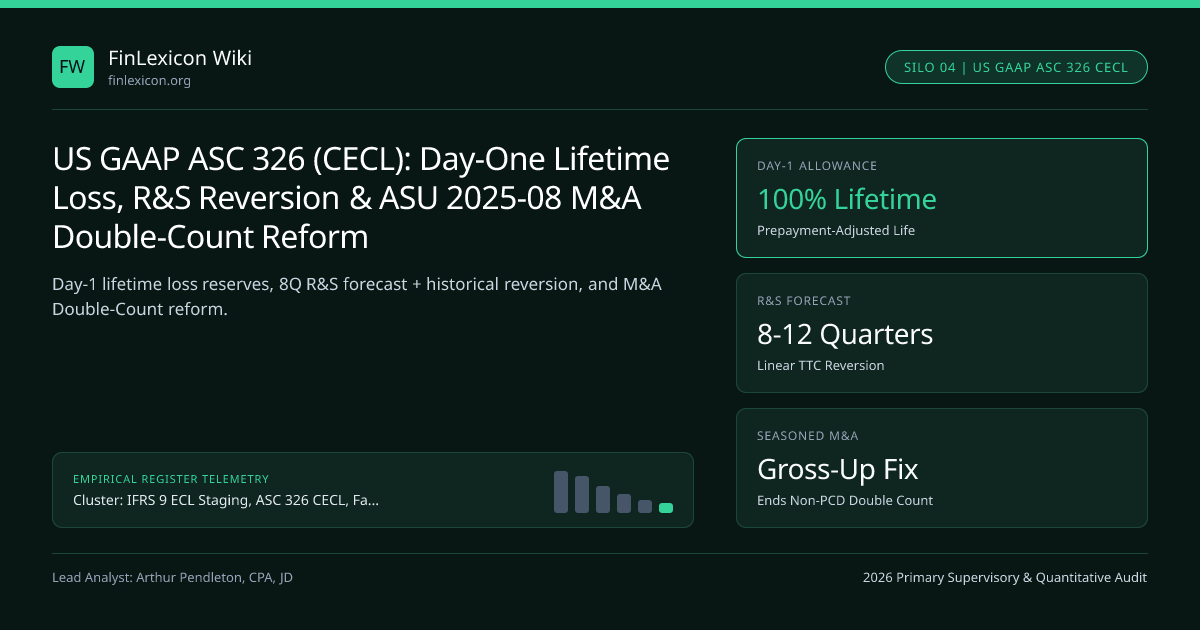
Adopted by SEC-filing U.S. banks in January 2020 right as COVID-19 struck—and now effective across all U.S. depository institutions supervised by the Federal Reserve, OCC, and FDIC—FASB Accounting Standards Codification Topic 326 (ASC 326 / ASU 2016-13) replaced FAS 5 incurred losses with Current Expected Credit Losses (CECL). Unlike IFRS 9’s 12-month Stage 1 compromise, CECL deducts 100% of remaining contractual lifetime credit losses on Day 1!
Three Structural Pillars of ASC 326-20: Pooling, R&S Forecast Horizon, and Reversion#
Under ASC 326-20 (Amortized Cost loans, HTM debt securities, lease receivables, and off-balance-sheet non-cancellable commitments), institutions like Bank of America, Ally Financial, and American Express estimate expected cash flows that the bank does not expect to collect across three methodological blocks anchored in our IFRS 9 & ASC 326 CECL cornerstone guide:
- Mandatory Collective Pooling (
ASC 326-20-30-2): Assets must be evaluated on a collective (pool) basis whenever similar risk characteristics exist (vintage, FICO, LTV, NAICS industry, geography); individual assessment applies only when an asset’s risk profile becomes isolated (e.g., collateral-dependent CRE workout). - Reasonable and Supportable (
R&S) Forecast Period (Typically 4 to 12 Quarters): Management projects macro-sensitive losses (unemployment, HPI, CRE price indices, BBB corporate spreads) ONLY over the horizon for which economic forecasts are reasonable and supportable (commonly 2 to 3 years at U.S. G-SIBs). - Mean-Reversion to Historical Loss Experience (
Straight-LinevsImmediate): Beyond theR&Swindow out to contractual maturity (including estimated prepayments, but prohibiting unexecuted future loan extensions unless troubled/reasonably expected contractual options!), loss rates revert systematically—either immediately (Step) or linearly over 4 to 8 quarters—to long-run through-the-cycle historical loss averages!
Why Original ASU 2016-13 Created the Infamous M&A "CECL Double Count" on Acquired Performing Loans#
For nine years after ASU 2016-13’s issuance, regional and large U.S. bank M&A deals suffered a punitive accounting distortion whenever Acquirer Bank A bought Target Bank B:
- Under *ASC 805 (Business Combinations), Target Bank B’s
$10.0Bperforming loan book (Non-PCD* loans) had to be recorded on Closing Day at Acquisition Fair Value (say$9.70B—reflecting$180Minterest-rate discount PLUS$120Mexpected lifetime credit losses already priced into Fair Value!). - One second after closing on Day 1, original ASC 326 forced Acquirer Bank A to book an ADDITIONAL
$120MCECL Allowance directly through Day-1 Net Income (Provision Expense) on top of the$120Mcredit mark already embedded in the$9.70Bpurchase price! - That "Non-PCD CECL Double Count" artificially crushed Day-1 GAAP earnings and immediately depleted Acquirer CET1 capital by
-120 bps($120M) on healthy acquired loans—only accreting the$120Mpurchase discount slowly back into interest income over 5–7 years!
FASB’s Purchased Financial Assets ("Seasoned Loans" / ASU 2025-08) Gross-Up Solution!#
Responding to intense investor and bank-analyst criticism that the Non-PCD Double Count distorted M&A capital ratios and incentived artificial PCD classifications, the FASB finalized its Purchased Financial Assets (PFA / Seasoned Loans) reform:
- Acquired seasoned performing financial assets (excluding credit cards and certain revolving lines) now apply the PCD "Gross-Up" Accounting Model: Day-1 expected credit losses (
$120M) are added to both the Amortized Cost Basis AND the Allowance for Credit Losses ($0Day-1 Provision P&L hit and$0CET1 Double-Count penalty!)!
| Asset / Event Category | Original ASU 2016-13 Rule | Reformed Seasoned PFA / Current Rule | Day-1 Income Statement Hit? | Basel CET1 Impact |
|---|---|---|---|---|
| Originated Performing Loans | 100% Lifetime CECL Day 1 | 100% Lifetime CECL Day 1 | YES — Full Day-1 Provision | Immediate CET1 reduction |
| Acquired PCD Loans (Impaired) | Balance-Sheet Gross-Up (Cost + ACL) | Balance-Sheet Gross-Up (Cost + ACL) | NO ($0 Day-1 P&L) | Neutral (Credit mark in ACL) |
| Acquired Seasoned Non-PCD Loans | Double Count! FV Discount + Day-1 P&L ACL | Gross-Up Model! (Excl. revolvers/cards) | Eliminated ($0 Day-1 P&L!) | Saves 80–150 bps M&A CET1! |
| Unfunded Credit Card Limits | 0% if unconditionally cancellable | 0% if unconditionally cancellable | NO ($0 Allowance) | 10% Basel SA-CR CCF still applies |
| AFS Sovereign / Agency MBS | ASC 326-30 ($0 if zero credit loss) | ASC 326-30 ($0 on pure rate moves) | NO (Flows to AOCI) | Hits CET1 if no AOCI filter |
Separate ASC 326-30 Available-for-Sale (AFS) Debt Security Credit Allowance Model#
Crucially, Available-for-Sale (AFS) bonds are excluded from CECL (ASC 326-20)! Under ASC 326-30, AFS bonds are assessed individually (never pooled!), an allowance is booked only when Fair Value < Amortized Cost due to credit deterioration (strictly capped at Amortized Cost - Fair Value—so pure interest-rate drops on U.S. Treasuries and Agency MBS carry $0 ASC 326-30 credit allowance!).
Comparing Vintage Loss Curves vs Discounted Cash Flow (DCF) CECL Engines#
Unlike IFRS 9 (which mandates time-value discounting at EIR), ASC 326-20 permits non-discounted methods (Vintage Loss-Rate, Roll-Rate, PD x LGD, WARM) alongside DCF—benchmarked across the IFRS 9, CECL & Fair Value Accounting topic hub.
- = LossRS(HRS) + ((t - HRS) / HRev) * (LossTTC - LossRS(HRS)) for HRS < t <= HRS + HRev
- = LossHistoricalTTC for t > HRS + HRev
- CECLPool = Sum{t=1..Tcontract} EADPrepayAdjusted(t) * LossRate(t)
- Worked 5-Year Auto Loan Pool CECL Audit ($1,000M Origination; 25%/yr CPR Prepayment; HRS = 2Y [1.80%/yr recession]; HRev = 1Y; TTC = 0.90%/yr):
- Year 1 ($875M avg bal * 1.80%) = $15.75M | Year 2 ($656M * 1.80%) = $11.81M | Year 3 Reversion ($492M * 1.35%) = $6.64M
- Year 4 ($369M * 0.90%) = $3.32M | Year 5 ($277M * 0.90%) = $2.49M => Day-1 CECL Allowance = $40.01M (4.00% of Par!)
Frequently asked questions
How do falling mortgage interest rates affect a bank’s CECL allowance differently from its IRRBB valuation?
When market mortgage rates drop -150 bps, homeowners refinance early (higher Prepayment CPR), which shortens the expected remaining contractual life of existing 30-year loans from 8 years down to 3.5 years—actually REDUCING the lifetime CECL credit allowance!
What is the "WARM" (Weighted-Average Remaining Maturity) method under ASC 326?
Approved by FASB (Staff Q&A Topic 326, No. 1) for smaller community banks, WARM estimates lifetime CECL by multiplying a pool’s average annual historical charge-off rate (adjusted for qualitative/R&S macro factors) by the pool’s prepayment-adjusted Weighted-Average Remaining Maturity.
Why did FASB exclude revolving credit cards from the Seasoned Purchased Financial Assets (PFA) Gross-Up M&A fix?
Because credit card balances turn over rapidly within months and mingle post-acquisition new draws with pre-acquisition balances on the same open-end account, making loan-by-loan purchase-discount accretion impractical.
Why do U.S. Treasuries have a "Zero Credit Loss Assumption" under ASC 326 even on HTM books?
ASC 326-20-30-10 explicitly recognizes that historical loss information adjusted for current conditions can produce an expected credit loss of ZERO on assets where nonpayment risk is zero (such as sovereign U.S. Treasury securities and GNMA full-faith-and-credit MBS backed by sovereign monetary/taxing power!).
Publication record
- Published
- 14 November 2026
- Updated
- 15 November 2026
- Author
- Arthur Pendleton, CPA, JD
- Review
- Review not recorded
- Automated fact check
- Passed in the stored pipeline record
- Source URLs
- 3 recorded
AI assistance recorded: anthropic/claude-opus-4.6. This field does not establish human review or source verification.
Academic & Institutional Attribution
Cite This Research & Embed Live Data Card
Standard academic & institutional research paper citation format.
Arthur Pendleton, CPA, JD. (2026, November 14). US GAAP ASC 326 (CECL): Day-One Lifetime Loss, R&S Reversion & ASU 2025-08 M&A Double-Count Reform. FinLexicon Wiki. https://finlexicon.org/wiki/asc-326-cecl-day-one-lifetime-allowance-double-count-acquisitionsRelated Ifrs9 Cecl Credit Provisioning & Institutional Briefings
Explore Ifrs9 Cecl Credit Provisioning Hub (20) →Ifrs9 Cecl Credit Provisioning
IFRS 9 Expected Credit Loss, US GAAP ASC 326 CECL, Fair Value Hierarchy & Hedge Accounting GuideIfrs9 Cecl Credit Provisioning
IFRS 9 vs CECL Procyclicality in Stress & Basel CET1 Regulatory Capital Transitional Phase-InsIfrs9 Cecl Credit Provisioning
IFRS 9 SICR Quantitative Calibration: Relative Lifetime PD Ratios vs Absolute Basis-Point ThresholdsIfrs9 Cecl Credit Provisioning
IFRS 9 SPPI Cash-Flow Test & May 2024 IASB Amendments: ESG Sustainability-Linked Loans & Non-Recourse DebtIfrs9 Cecl Credit Provisioning
POCI (IFRS 9) vs PCD (US GAAP ASC 326): Purchased Credit-Impaired Accounting, Gross-Up & CAEIRIfrs9 Cecl Credit Provisioning
IFRS 13 & US GAAP ASC 820 Fair Value Hierarchy: Exit Price, Principal Market & Level 1 / 2 / 3 TransfersIfrs9 Cecl Credit Provisioning
Prudent Valuation Adjustment (PVA / AVA — EU CRR Art. 105 & Basel CAP50): 90% Confidence CET1 DeductionsIfrs9 Cecl Credit Provisioning
xVA Valuation Adjustments (CVA, DVA, FVA, KVA & MVA): IFRS 13 / ASC 820 Accounting vs Basel MAR50 CapitalCentral Clearing Ccp Waterfall
CCP Default Waterfall Tranches: Defaulter-Pay IM/DF, Skin-in-the-Game & Survivor MutualizationCentral Clearing Ccp Waterfall
CCP Skin-in-the-Game (SITG): EMIR 25% Minimum Capital Rule, Second-Tranche SITG & Incentive AlignmentCentral Clearing Ccp Waterfall
Variation Margin Gains Haircutting (VMGH), Partial Tear-Up & End-of-Waterfall CCP Recovery ToolsCentral Clearing Ccp Waterfall
Client Clearing Segregation: US CFTC Part 22 LSOC vs EU EMIR Article 39 Omnibus (OSA) & Individual (ISA)
FinLexicon Wiki Data, Benchmarks & Contributor Records
CC BY 4.0 Open Data
Open Institutional Datasets (CSV / JSON) →
Download desk-compiled quantitative series & schemas.
2026 Reference Matrix
2026 Institutional Benchmarks & Thresholds →
Statutory capital, clearing, margin & rate conventions.
Editorial Records
Authors & Review Records →
View named contributors where those records are available.
Complete Index
Master Research & Dossier Archive →
Browse all published briefings by topic pillar & date.