
Ifrs9 Cecl Credit Provisioning
IFRS 9 Stage 1, Stage 2 & Stage 3 ECL Migration: 12-Month vs Lifetime PD, Net Interest & Cure Rules
IFRS 9 Section 5.5 routes debt instruments across three impairment stages—shifting both the Expected Credit Loss horizon (12-month vs Lifetime) and the basis on which Effective Interest Rate revenue is recognized.
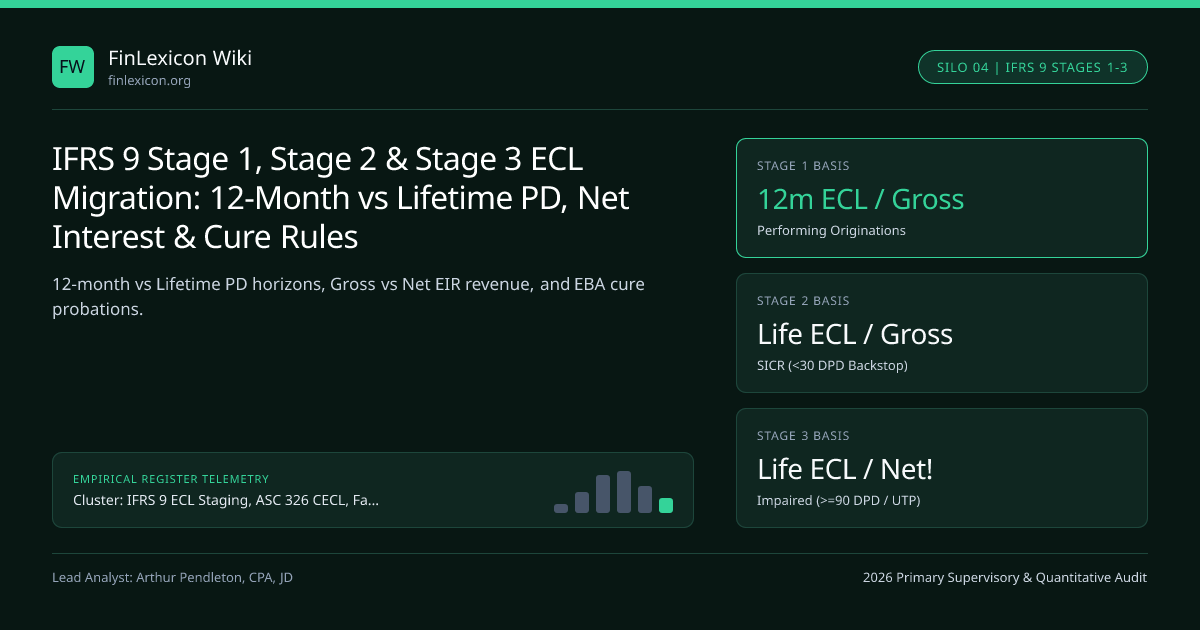
Unlike US GAAP CECL, IFRS 9 Section 5.5 links two fundamental financial-statement lines—credit impairment provisions AND net interest income (NII) recognition—to a dynamic Three-Stage Deterioration Ladder. Moving a EUR 10 billion corporate or mortgage book from Stage 1 into Stage 2 multiplies expected credit loss allowances 3x to 8x overnight; sliding into Stage 3 alters how interest revenue itself is calculated on the income statement!
Exact Mathematical Distinction: 12-Month ECL Is NOT "12 Months of Cash Shortfalls"!#
Clear up the #1 conceptual error seen on financial exams and junior audit files within our IFRS 9 & ASC 326 CECL cornerstone guide:
- What
12-Month ECL(Stage 1, IFRS 9 Appendix A) ACTUALLY Is: The ENTIRE lifetime cash shortfalls (Years 1 through 30!) that would occur if a default event happens within the next 12 months, weighted by the 12-month Probability of Default (PD_12m) (ECL_12m = PD_12m * LGD_lifetime * EAD_12m)! - What
12-Month ECLIs NOT: It is never "cash shortfalls expected over the next 12 months"! If a 20-year bullet bond defaults in Month 11, you lose60%of total principal (LGD), not merely one coupon! - What
Lifetime ECL(Stage 2 & Stage 3) Is: Present value of all lifetime cash shortfalls resulting from all possible default events across the entire remaining life (Months 1 through 240) of the financial instrument!
Gross vs Net Effective Interest Rate (EIR) Revenue Recognition Across Stages 1, 2, and 3#
Watch how IFRS 9.5.4.1 changes top-line Interest Revenue across the three stages at global IFRS reporters like BNP Paribas, Bank of Montreal, ANZ Bank, and Bank of Ireland:
- Stage 1 (
Performing — No SICR):12-Month ECLallowance; Interest Revenue =EIR * Gross_Carrying_Amount(full contractual balance before deducting ECL!). - Stage 2 (
Underperforming — SICR Occurred, Not Credit-Impaired):Lifetime ECLallowance; Interest Revenue STILL =EIR * Gross_Carrying_Amount! - Stage 3 (
Non-Performing / Credit-Impaired — Objective Evidence of Impairment):Lifetime ECL(PD = 100%, workout LGD scenarios); beginning in the next reporting period, Interest Revenue switches to the Net Basis ("Amortized Cost"):Interest_Revenue = EIR * ( Gross_Carrying_Amount - Loss_Allowance_Stage3 )! (Note: in U.S. banking practice under US GAAP / Call Reports, Stage-3-equivalent>=90 DPDloans typically go on Non-Accrual / Cash Basis* [$0interest accrued], whereas IFRS 9 continues unwinding the discountEIR * Net_Recoverable_PVas interest income!)*
Statutory Backstops (30 DPD & 90 DPD), the Low Credit Risk Exemption & Cure Probation#
Supervisors including the BCBS / BIS (BCBS d350), European Central Bank, EBA, and UK PRA strictly limit discretionary overrides:
- 30 Days Past Due (
30 DPD) Stage 2 Rebuttable Presumption (IFRS 9.5.5.11): Must serves as a last-resort backstop, NEVER the primary indicator! Forward-looking quantitative PD triggers must migrate weakening borrowers into Stage 2 well before they miss a payment by 30 days. - Low Credit Risk (
LCR) Practical Expedient (IFRS 9.5.5.10): Investment-grade debt securities (AAAtoBBB-external equivalent) may remain in Stage 1 without tracking relative origination PD jumps (BCBS d350 discourages banks from applying the Low Credit Risk expedient blindly to wholesale loan books where a drop fromAAtoBBB-triples risk!). - Symmetry & Supervisory Cure Probation (
EBA Guidelines on NPE/Forbearance): A Stage 3 or Stage 2 forborne borrower cannot bounce instantly back to Stage 1 on the day arrears are cleared! EBA rules enforce a minimum 3-month cure probation for non-forborne Stage 3 and a minimum 12-month Stage 3 + 24-month Stage 2 probation on forborne restructured loans!
| Attribute | Stage 1 (Performing) | Stage 2 (Underperforming / SICR) | Stage 3 (Credit-Impaired) | POCI (Purchased Impaired) |
|---|---|---|---|---|
| Entry Trigger | Initial recognition (non-POCI) | SICR since origination (<=30 DPD backstop) | Objective impairment / Basel UTP / >=90 DPD | Credit-impaired at Day-1 purchase |
| ECL Measurement Horizon | 12-Month ECL (PD_12m) | Lifetime ECL (PD_Lifetime) | Lifetime ECL (PD = 100%) | Cumulative Change in Lifetime ECL |
| Effective Interest Rate Used | Original contractual EIR | Original contractual EIR | Original contractual EIR | Credit-Adjusted EIR (CAEIR)! |
| Interest Income Calculation Base | Gross Carrying Amount | Gross Carrying Amount | Net Amortized Cost (Gross - ECL)! | Amortized Cost (CAEIR) |
| Cure Back to Stage 1 Allowed? | N/A | Yes (Once SICR reverses + probation) | Yes (To Stage 2 after 3m–12m probation) | NEVER exits POCI for life! |
Point-in-Time (PiT) IFRS 9 Parameters vs Through-the-Cycle (TTC) Basel IRB Parameters#
Risk quants never plug regulatory Basel IRB PDs and downturn LGDs straight into IFRS 9! Basel IRB uses conservative Through-the-Cycle (TTC) PDs and Downturn LGDs (plus 5 bps / 10% input floors), whereas IFRS 9 mandates unbiased, macro-conditioned Point-in-Time (PiT) term structures stripped of conservative regulatory floors!
Auditing Stage Migration Matrices Across the Silo#
Quarterly Gross Carrying Amount and Allowance roll-forward waterfalls (Stage 1 <-> Stage 2 <-> Stage 3) form the centerpiece of IFRS 7.35H & Pillar 3 credit risk disclosures across the IFRS 9, CECL & Fair Value Accounting topic hub.
- ECLStage1 = ( MarginalPD1 * LGD1 * EAD1 ) / ( 1 + EIR )^0.5
- ECLStage2 = Sum{t=1..T} ( MarginalPDt * LGDt * EAD_t ) / ( 1 + EIR )^(t - 0.5)
- NIIStage3 = EIRorig * ( GrossCarryingAmount - AllowanceStage_3 )
- Worked Stage 3 Net Interest "Unwinding of Discount" Audit ($100.0M Loan @ 6.00% EIR Enters Stage 3; Expected Collateral Sale = $61.91M in 2 Years):
- Present Value of Recovery @ 6.00% Original EIR = $61.91M / (1.06)^2 = $55.10M => Stage 3 ECL Allowance = $100.0M - $55.10M = $44.90M
- Year-1 Stage 3 Interest Income Recognized (IFRS 9.5.4.1(b)) = 6.00% * $55.10M Net Amortized Cost = $3.306M (vs $6.00M in Stage 1/2!)
Frequently asked questions
Why does IFRS 9 still recognize positive Interest Income on a defaulted Stage 3 loan when US GAAP puts the loan on $0 Non-Accrual?
Because Stage 3 ECL already discounted the future collateral recovery (say $61.9M received in Year 2) back to today ($55.1M) at the loan’s 6% Effective Interest Rate! As Year 1 passes and that $61.9M recovery draws one year closer, its present value rises by 6% * $55.1M = $3.31M—unwinding the time-value discount as net interest revenue!
What happens in Stage 3 if a bank still bills contractual 6% interest ($6.0M) on the $100M defaulted loan that the borrower never pays?
If unpaid contractual interest inflates the legal Gross Carrying Amount (+$6.0M), Stage 3 ECL increases simultaneously to offset the uncollectible portion so **Net Amortized Cost grows solely by EIR * Net_Amortized_Cost (+$3.31M)**—preventing phantom uncollectible interest from boosting net profit!
Can a bank rebut the 30 Days Past Due (30 DPD) Stage 2 presumption or 90 DPD Stage 3 presumption?
Only in rare, documented administrative exceptions (IFRS 9.B5.5.20)—for example, a sovereign ministry or AAA corporate whose wire failed for 32 days due to a verified clearing-system technical glitch with zero increase in credit default risk. Supervisors heavily challenge routine 30/90 DPD rebuttals!
When is a Stage 3 loan "written off" vs kept in Stage 3 with a 95% allowance?
Under IFRS 9.5.4.4, a bank must directly reduce (write off) the Gross Carrying Amount of a financial asset (in whole or in part) whenever the entity has no reasonable expectations of recovering that portion—even while legal enforcement proceedings continue!
Publication record
- Published
- 14 November 2026
- Updated
- 16 November 2026
- Author
- Arthur Pendleton, CPA, JD
- Review
- Review not recorded
- Automated fact check
- Passed in the stored pipeline record
- Source URLs
- 3 recorded
AI assistance recorded: anthropic/claude-opus-4.6. This field does not establish human review or source verification.
Academic & Institutional Attribution
Cite This Research & Embed Live Data Card
Standard academic & institutional research paper citation format.
Arthur Pendleton, CPA, JD. (2026, November 16). IFRS 9 Stage 1, Stage 2 & Stage 3 ECL Migration: 12-Month vs Lifetime PD, Net Interest & Cure Rules. FinLexicon Wiki. https://finlexicon.org/wiki/ifrs-9-stage-1-2-3-sicr-12-month-vs-lifetime-ecl-migrationRelated Ifrs9 Cecl Credit Provisioning & Institutional Briefings
Explore Ifrs9 Cecl Credit Provisioning Hub (20) →Ifrs9 Cecl Credit Provisioning
IFRS 9 Expected Credit Loss, US GAAP ASC 326 CECL, Fair Value Hierarchy & Hedge Accounting GuideIfrs9 Cecl Credit Provisioning
US GAAP ASC 326 (CECL): Day-One Lifetime Loss, R&S Reversion & ASU 2025-08 M&A Double-Count ReformIfrs9 Cecl Credit Provisioning
IFRS 9 vs CECL Procyclicality in Stress & Basel CET1 Regulatory Capital Transitional Phase-InsIfrs9 Cecl Credit Provisioning
IFRS 9 SICR Quantitative Calibration: Relative Lifetime PD Ratios vs Absolute Basis-Point ThresholdsIfrs9 Cecl Credit Provisioning
IFRS 9 SPPI Cash-Flow Test & May 2024 IASB Amendments: ESG Sustainability-Linked Loans & Non-Recourse DebtIfrs9 Cecl Credit Provisioning
POCI (IFRS 9) vs PCD (US GAAP ASC 326): Purchased Credit-Impaired Accounting, Gross-Up & CAEIRIfrs9 Cecl Credit Provisioning
IFRS 13 & US GAAP ASC 820 Fair Value Hierarchy: Exit Price, Principal Market & Level 1 / 2 / 3 TransfersIfrs9 Cecl Credit Provisioning
Prudent Valuation Adjustment (PVA / AVA — EU CRR Art. 105 & Basel CAP50): 90% Confidence CET1 DeductionsCentral Clearing Ccp Waterfall
CPMI-IOSCO PFMI Principles 4 & 7: Cover-2 Credit Default Fund vs Cover-1 / Cover-2 Liquidity SizingCentral Clearing Ccp Waterfall
CCP Default Waterfall Tranches: Defaulter-Pay IM/DF, Skin-in-the-Game & Survivor MutualizationCentral Clearing Ccp Waterfall
CCP Skin-in-the-Game (SITG): EMIR 25% Minimum Capital Rule, Second-Tranche SITG & Incentive AlignmentCentral Clearing Ccp Waterfall
Variation Margin Gains Haircutting (VMGH), Partial Tear-Up & End-of-Waterfall CCP Recovery Tools
FinLexicon Wiki Data, Benchmarks & Contributor Records
CC BY 4.0 Open Data
Open Institutional Datasets (CSV / JSON) →
Download desk-compiled quantitative series & schemas.
2026 Reference Matrix
2026 Institutional Benchmarks & Thresholds →
Statutory capital, clearing, margin & rate conventions.
Editorial Records
Authors & Review Records →
View named contributors where those records are available.
Complete Index
Master Research & Dossier Archive →
Browse all published briefings by topic pillar & date.