
Ifrs9 Cecl Credit Provisioning
IFRS 9 Expected Credit Loss, US GAAP ASC 326 CECL, Fair Value Hierarchy & Hedge Accounting Guide
Replacing backward-looking IAS 39 and FAS 5 incurred-loss provisioning after 2008, IFRS 9 Stage 1/2/3 Expected Credit Loss and US GAAP ASC 326 CECL link forward-looking credit allowances directly into bank CET1, fair-value hierarchies, and hedge accounting.
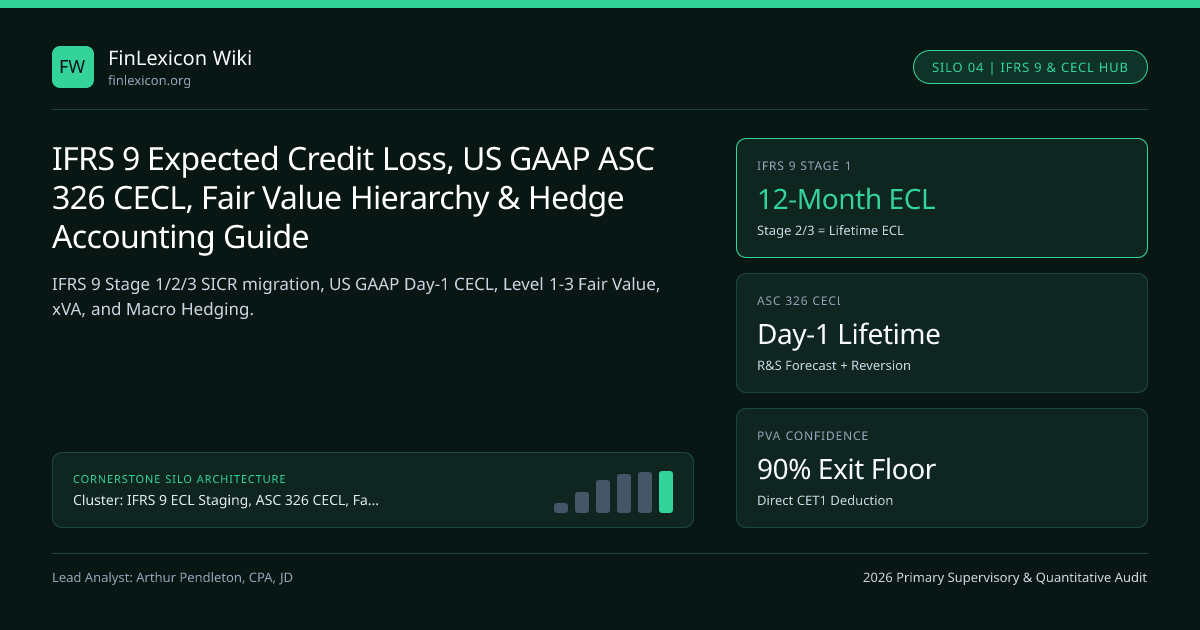
During the 2007–2008 financial crisis, legacy "incurred loss" accounting standards (IAS 39 and US GAAP FAS 5 / ASC 450) legally prohibited banks from booking credit loss allowances until an objective loss event had already occurred—delivering "too little, too late" reserves that collapsed Common Equity Tier 1 at the bottom of the cycle. At the request of G20 leaders and the BCBS / BIS, the IASB and FASB overhauled financial-instrument accounting—yet split into two distinct global architectures: *IFRS 9 (Financial Instruments, effective 2018)* across 140+ jurisdictions and *US GAAP ASU 2016-13 / ASC 326 (Current Expected Credit Losses — CECL, effective 2020)* in the United States.
Classification Gateways: Business Model & SPPI Testing vs HTM Tainting#
Before a loan or debt security ever enters an impairment engine, IFRS 9.4.1 classifies financial assets into Amortized Cost, Fair Value Through Other Comprehensive Income (FVOCI), or Fair Value Through Profit or Loss (FVTPL) via a two-step gate: the entity’s Business Model (Hold-to-Collect, Hold-to-Collect-and-Sell, or Other) and the contractual cash-flow Solely Payments of Principal and Interest (`SPPI`) test including 2024 ESG-linked loan amendments.
Under US GAAP (ASC 320 / ASC 310), debt securities split into Held-to-Maturity (HTM), Available-for-Sale (AFS), and Trading—policed by strict HTM sales tainting, IFRS 9 business-model reclassification, and AFS/FVOCI rules that determine whether rate-driven bond markdowns stay in footnotes or flow through AOCI into Basel III CET1 capital.
The Transatlantic Impairment Split: IFRS 9 Three-Stage SICR vs US GAAP Day-One Lifetime CECL#
Compare how BNP Paribas and Bank of Montreal (reporting under IFRS 9) vs Bank of America and Ally Financial (reporting under US GAAP ASC 326) provision identical performing corporate and retail loans:
- IFRS 9 Dual-Horizon Staging: Newly originated performing loans enter Stage 1 (
12-Month ECL)—recognizing only expected credit losses resulting from default events possible within the next 12 months. Only upon experiencing a Significant Increase in Credit Risk (SICR) via IFRS 9 Stage 1/2/3 migration mechanics and quantitative relative vs absolute PD triggers does an asset jump the "Stage 2 cliff" into Lifetime ECL (moving to Stage 3 upon credit impairment with net interest revenue dropping from gross carrying amount to net amortized cost!). - US GAAP ASC 326 CECL Single-Horizon Lifetime Loss: Eliminates staging cliffs completely by booking 100% Lifetime Expected Credit Losses on Day 1 of loan origination—creating the notorious CECL Day-One "Double Count" on non-PCD bank M&A acquisitions (recently reformed by FASB ASU 2025-08!) alongside specialized POCI vs PCD credit-adjusted effective interest rate accounting.
- Off-Balance-Sheet, Modifications & Macro Overlays: Both regimes extend provisioning to undrawn lines via CCF loan commitment and financial guarantee rules, police distressed restructurings under 10% present-value modification and derecognition tests, and weight non-linear recessions through multi-scenario macroeconomic overlays and post-model adjustments (`PMAs`).
Fair Value Hierarchy (IFRS 13 / ASC 820), Day-1 P&L Deferrals, Prudent Valuation & xVA#
For trading books, FVTPL loans, and OTC derivatives, IFRS 13 and ASC 820 converge on an exit-price definition stratified across Level 1, Level 2, and Level 3 Fair Value Hierarchy inputs. Whenever exotic derivatives rely on unobservable Level 3 correlations, IFRS 9.B5.1.2A Day-1 P&L deferral reserves lock inception margin off the income statement, while European/UK prudential supervisors (ECB, UK PRA) deduct extra 90%-confidence Prudent Valuation Adjustments (`PVA` / `AVA`) straight from CET1.
Simultaneously, derivative fair values incorporate CVA, DVA, FVA, KVA, and MVA (`xVA`) accounting vs Basel MAR50 capital divergences, while a bank’s own debt spread changes on fair-valued structured notes are isolated in OCI under IFRS 9.5.7.7 and ASC 825-10 Own Credit (`DVA`) rules.
| Accounting Dimension | IFRS 9 / IFRS 13 (IASB) | US GAAP ASC 326 / 815 / 820 (FASB) | Basel III Prudential Capital Link |
|---|---|---|---|
| Performing Loan Day-1 Allowance | 12-Month ECL (Stage 1) | Full Lifetime ECL (CECL Day-1 hit!) | Reduces Retained Earnings -> CET1 (3Y/5Y phase-in) |
| Deteriorated Loan Migration | Stage 2 Lifetime ECL upon SICR (>30 DPD backstop) | Already at Lifetime ECL (updates PD/LGD) | IRB shortfall (EL - Provisions) deducted 100% CET1 |
| Unfunded Loan Commitments | ECL over contractual / behavioral revolving period | Zero CECL if unconditionally cancellable! | Basel CCF (10%–100%) still charges RWA on lines! |
| Available-for-Sale / FVOCI Debt | FVOCI requires Stage 1/2/3 ECL model | ASC 326-30 AFS Allowance (capped at FV floor; no CECL pool) | Unrealized rate losses hit CET1 once AOCI filter ends |
| Portfolio Macro Rate Hedging | Retains IAS 39 EU Carve-Out pending IASB DRM | ASC 815 Portfolio Layer Method (2022 ASU) | Stabilizes GAAP/IFRS equity & IRRBB EVE |
Micro & Macro Hedge Accounting, CET1 Phase-Ins, Deferred Taxes, and Audit Governance#
To eliminate artificial accounting mismatches when hedging banking-book interest-rate and FX risks, banks deploy IFRS 9 micro hedge effectiveness, rebalancing, and Cost of Hedging OCI mechanics alongside the IAS 39 EU Macro Fair-Value Carve-Out, ASC 815 Last-of-Layer, and IASB Dynamic Risk Management (`DRM`).
Finally, ECL shocks ripple directly into regulatory solvency via IFRS 9 vs CECL procyclicality and Basel CET1 transitional phase-in filters, generate temporary tax timing differences governed by IAS 12 / ASC 740 Deferred Tax Asset (`DTA`) valuation allowances and 10%/15% CET1 caps, and undergo intense external audit verification under IFRS 7, Pillar 3 vintage disclosures, and ISA 540 / PCAOB AS 2501.

Navigating the FinLexicon Accounting & Provisioning Encyclopedia#
Cross-standard reconciliations across IASB, FASB, U.S. Federal Reserve, FDIC, and Basel frameworks are benchmarked across FinLexicon datasets, our methodology, and the IFRS 9, CECL & Fair Value Accounting topic hub.
- ECLLifetimeStg23 = Sum{s=1..K} ws * Sum{t=1..Tmat} [ MarginalPD{t,s} * LGD{t,s} * EAD_{t,s} / (1 + EIR)^t ]
- CECLASC326 = ECLLifetime( R&SForecastHorizon1to3Y -> HistoricalLossReversionto_Maturity )
- Worked Day-1 Origination CET1 Comparison ($1,000M 7-Year Corporate Loan Pool; EIR = 6.0%; Annual Marginal PD = 0.80%/yr; LGD = 40%):
- 1. IFRS 9 Stage 1 (Year-1 Default Events Only): 12m_ECL = 0.0080 * 0.40 * $1,000M / 1.06^0.5 = $3.11M (-31 bps Day-1 P&L)
- 2. US GAAP ASC 326 CECL (Discounted 7-Year Cumulative Lifetime): CECL = ~$18.40M (-184 bps Day-1 P&L = 5.9x IFRS 9 on 7Y loans!)
Frequently asked questions
Why did the IASB and FASB fail to converge on a single global Expected Credit Loss standard?
IASB board members argued that deducting 100% of lifetime losses on Day 1 when a bank originates a properly priced loan (whose future interest spread compensates for expected credit losses over time!) distorts economic faithful representation—preferring 12-month Stage 1 + Stage 2 SICR, whereas FASB prioritized a single Reserve Adequacy balance-sheet number without staging cliffs.
Why must IFRS 9 use probability-weighted multiple macroeconomic scenarios even if a bank’s "Baseline" GDP forecast equals the mean?
Because credit losses are convex (non-linear) in GDP and unemployment (IFRS 9.5.5.17(a)): losses in a severe recession (-4% GDP -> 6.0% loss) plus a boom (+4% GDP -> 0.2% loss) average 3.1%, which is strictly higher than evaluating the model once at the 0% baseline (1.2% loss — Jensen’s Inequality)!
How does US GAAP ASC 326 treat unconditionally cancellable credit card undrawn limits differently from IFRS 9?
Massive credit-card divergence: ASC 326-20-30-11 prohibits booking ANY CECL allowance on unconditionally cancellable undrawn credit card lines ($0 reserve on undrawn limits!), whereas IFRS 9.5.5.20 forces banks to book 12m/Lifetime ECL on expected future draws across behavioral revolving card lifetimes!
Does booking higher IFRS 9 / CECL accounting provisions always hurt an IRB bank’s CET1 ratio dollar-for-dollar?
Not on Internal Ratings-Based (IRB) portfolios that previously had an IRB Regulatory Expected Loss (EL) Shortfall! Under Basel CAP10.19, if Regulatory_EL > Accounting_Provisions, the shortfall was *already* deducted 100% from CET1—so raising accounting ECL absorbs the existing shortfall first (and excess provisions count as Tier 2 up to 0.6% of credit RWA)!
Publication record
- Published
- 15 November 2026
- Updated
- 15 November 2026
- Author
- Arthur Pendleton, CPA, JD
- Review
- Review not recorded
- Automated fact check
- Passed in the stored pipeline record
- Source URLs
- 4 recorded
AI assistance recorded: anthropic/claude-opus-4.6. This field does not establish human review or source verification.
Academic & Institutional Attribution
Cite This Research & Embed Live Data Card
Standard academic & institutional research paper citation format.
Arthur Pendleton, CPA, JD. (2026, November 14). IFRS 9 Expected Credit Loss, US GAAP ASC 326 CECL, Fair Value Hierarchy & Hedge Accounting Guide. FinLexicon Wiki. https://finlexicon.org/wiki/ifrs-9-ecl-asc-326-cecl-fair-value-hedge-accounting-guideRelated Ifrs9 Cecl Credit Provisioning & Institutional Briefings
Explore Ifrs9 Cecl Credit Provisioning Hub (20) →Ifrs9 Cecl Credit Provisioning
IFRS 9 Stage 1, Stage 2 & Stage 3 ECL Migration: 12-Month vs Lifetime PD, Net Interest & Cure RulesIfrs9 Cecl Credit Provisioning
US GAAP ASC 326 (CECL): Day-One Lifetime Loss, R&S Reversion & ASU 2025-08 M&A Double-Count ReformIfrs9 Cecl Credit Provisioning
IFRS 9 vs CECL Procyclicality in Stress & Basel CET1 Regulatory Capital Transitional Phase-InsIfrs9 Cecl Credit Provisioning
IFRS 9 SICR Quantitative Calibration: Relative Lifetime PD Ratios vs Absolute Basis-Point ThresholdsIfrs9 Cecl Credit Provisioning
IFRS 9 SPPI Cash-Flow Test & May 2024 IASB Amendments: ESG Sustainability-Linked Loans & Non-Recourse DebtIfrs9 Cecl Credit Provisioning
POCI (IFRS 9) vs PCD (US GAAP ASC 326): Purchased Credit-Impaired Accounting, Gross-Up & CAEIRIfrs9 Cecl Credit Provisioning
IFRS 13 & US GAAP ASC 820 Fair Value Hierarchy: Exit Price, Principal Market & Level 1 / 2 / 3 TransfersIfrs9 Cecl Credit Provisioning
Prudent Valuation Adjustment (PVA / AVA — EU CRR Art. 105 & Basel CAP50): 90% Confidence CET1 DeductionsCentral Clearing Ccp Waterfall
CCP Default Waterfalls, CPMI-IOSCO PFMI, VMGH, LSOC Segregation & Treasury Central Clearing GuideBasel Iii Endgame Capital Ratios
BCBS d424 72.5% Standardized RWA Output Floor: Phase-In Mechanics & Capital ImpactMarket Insights
Starch Derivatives Market Forecast to 2035, Driven by Clean-Label Demand and Bio-Based Industrial Shift - IndexBoxMarket Insights
Diesel (Derivatives) Analytics: Price Dynamics, Quarterly Returns, and Annual Price Changes in USD - CryptoRank
FinLexicon Wiki Data, Benchmarks & Contributor Records
CC BY 4.0 Open Data
Open Institutional Datasets (CSV / JSON) →
Download desk-compiled quantitative series & schemas.
2026 Reference Matrix
2026 Institutional Benchmarks & Thresholds →
Statutory capital, clearing, margin & rate conventions.
Editorial Records
Authors & Review Records →
View named contributors where those records are available.
Complete Index
Master Research & Dossier Archive →
Browse all published briefings by topic pillar & date.