
Ifrs9 Cecl Credit Provisioning
IFRS 13 & US GAAP ASC 820 Fair Value Hierarchy: Exit Price, Principal Market & Level 1 / 2 / 3 Transfers
Substantially converged across IFRS 13 and US GAAP ASC 820, Fair Value Accounting defines exit price in the Principal Market and classifies instruments by their lowest significant input across Level 1, Level 2, and Level 3.
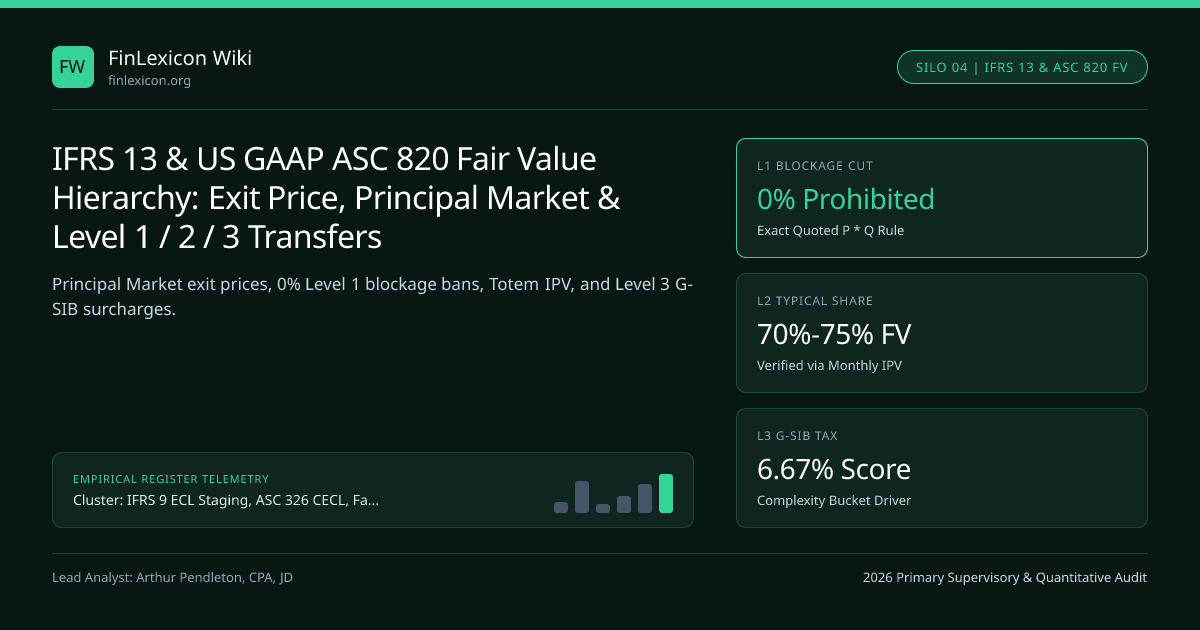
One of the crowning achievements of IASB–FASB convergence is word-for-word alignment between *IFRS 13 (Fair Value Measurement)* and US GAAP ASC Topic 820: Fair Value is NOT an entity-specific investment value or forced fire-sale liquidation price, but the price that would be received to sell an asset or paid to transfer a liability (Exit Price) in an orderly transaction between market participants at the measurement date!
Principal Market vs Most Advantageous Market & Prohibiting Blockage Discounts!#
In trading-book product control audits at Bank of America, BNP Paribas, and Bank of Montreal anchored to our IFRS 9, CECL & Fair Value cornerstone guide, three foundational exit-price rules govern valuation:
- Principal Market Takes Priority (
IFRS 13.16/ASC 820-10-35-5): Fair value is measured in the Principal Market (the market with the greatest volume and level of activity for the asset/liability to which the entity has access)—ignoring Transaction Costs! Only in the absence of a Principal Market do you use the Most Advantageous Market (where Transaction Costs ARE considered strictly to identify which market maximizes net proceeds, though Fair Value itself NEVER deducts transaction costs; transport costs are deducted for physical commodities!). - Strict Ban on
P x QBlockage Factors in Level 1 (IFRS 13.69/ASC 820-10-35-36B): Even if a bank holds15%of all outstanding shares of a listed company—a block that would drop the stock-8%if dumped in one afternoon—*IFRS 13 and ASC 820 strictly FORBID applying a blockage discount to a Level 1 price (`Fair Value = ExactQuotedPrice Quantity)**! *(Contrast this with [EU/UK Prudent ValuationAVA`](/wiki/prudent-valuation-adjustment-pva-ava-cet1-core-market-price), which does deduct Concentrated Position AVAs directly from CET1!)* - Portfolio Measurement Exception (
IFRS 13.48— Net Risk Exposure): Allows swap dealers managing market/credit risk on a net portfolio basis to apply bid-offer adjustments to the net open risk position (matching 2002 ISDA Close-Out Amount portfolio bid-ask rules!) rather than gross trade-by-trade bid-ask.
The Lowest-Significant-Input Rule: Separating Level 1, Level 2, and Level 3#
IFRS 13.73 classifies an entire financial instrument into Level 1, Level 2, or Level 3 based on the lowest level input that is significant to the entire measurement:
- Level 1 (
Unadjusted Quoted Prices in Active Markets for Identical Assets): Exchange-listed equities, on-the-run U.S. Treasuries/Bunds with deep executable screens, and CME/Eurex exchange-traded futures. Zero adjustments allowed! - Level 2 (
Directly or Indirectly Observable Inputs Other Than Level 1): Off-the-run sovereign/corporate bonds priced via evaluated matrix spreads, plain-vanilla SOFR/€STR interest-rate swaps, G10 FX forwards, and standard ATM swaptions where curves/vols are observable across full contract maturity. - Level 3 (
Unobservable Inputs Significant to Fair Value): Distressed private credit loans, equity/mezzanine CLO tranches, 30-year autocallable worst-of equity/FX correlation notes (unobservable cross-asset correlation!), long-dated >15Y corporate CDS/vol extrapolations, and swaps carrying material unobservable counterparty CVA/FVA!
How Product Control Tests "Significance" (10% PV / 5% Vol Thresholds): Valuation Control Groups shock each unobservable parameter across its plausible uncertainty range (90% confidence); if the resulting fair-value swing exceeds 5% to 10% of the instrument’s fair value (or benchmark notional band), the entire trade migrates into Level 3!
Level 2 <-> Level 3 Transfers, Roll-Forward Disclosures & G-SIB Complexity Penalties#
Why do CFOs and trading heads closely police Total Level 3 Assets before quarter-end? Two powerful supervisory gates enforced by the Federal Reserve, SEC, ECB, and UK PRA:
- Mandatory Level 3 Roll-Forward & Sensitivity Footnotes (
IFRS 13.93(e)-(h)): Every single dollar of Level 3 purchases, issuances, transfers in/out, unrealized P&L on still-held assets, and quantitative favorable/unfavorable P&L impact of shifting unobservable inputs must be published and audited! - Direct Basel G-SIB Complexity Surcharge Input (
SCO40): Level 3 Assets constitute one of the three core indicators inside the Complexity Category (1/3of Complexity =6.67%weight!) of BCBS Method 1 & Fed Method 2 G-SIB Surcharge scores!
| Hierarchy Level | Qualifying Input Standard | Representative Banking Instruments | Day-1 P&L Allowed (IFRS 9)? | Audit & Capital Scrutiny |
|---|---|---|---|---|
| Level 1 | Unadjusted quoted prices in active markets for identical items | Listed S&P/STOXX equities, on-the-run USTs/Gilts, CME futures | Yes (Immediate P&L) | Zero model risk; zero blockage cut |
| Level 2 | Observable market data (yield curves, FX, brokered spreads, Totem vols) | Plain-vanilla SOFR/€STR swaps, G10 FX forwards, IG corp bonds | Yes (Observable data) | Independent Price Verification (IPV) |
| Level 3 | >=1 Significant unobservable input (extrapolated vol, correlation, distressed LGD) | Worst-of autocallables, CLO equity, private credit, uncollat. 30Y CVA swaps | NO — Deferred (IFRS 9)! | Roll-forward + sensitivity + G-SIB score! |
| NAV Expedient (US GAAP Only) | Unlisted fund units valued at Manager NAV (ASC 820-10-35-59) | LP stakes in private equity / real-estate / hedge funds | Shown outside L1–3 columns | IFRS 13 slots into Level 2 or Level 3! |
Practical Expedient Difference: US GAAP Net Asset Value (NAV) Carve-Out vs IFRS 13#
Watch one rare ASC 820 vs IFRS 13 divergence: under US GAAP (ASU 2015-07 / ASC 820-10-35-54B), private-equity/hedge-fund investments measured using the NAV Practical Expedient are excluded completely from the Level 1/2/3 table (shown in a reconciling column!), whereas IFRS 13 has NO NAV practical expedient and slots unlisted fund units into Level 2 or Level 3!
Connecting Level 3 Classification to Day-1 P&L Deferral Reserves#
Booking any trade in Level 3 automatically triggers the IFRS 9.B5.1.2A Day-1 P&L deferral gate across the IFRS 9, CECL & Fair Value Accounting topic hub.
- UnobsImpactRatio = | V( thetaunobs + Delta90pct ) - V( thetaunobs ) | / max( |V| , MinMateriality_Floor )
- HierarchyLevel = 3 if UnobsImpact_Ratio >= 0.10 else 2 [ Valuation Control Significance Gate ]
- Worked Valuation Control Group (
VCG) Significance Audit ($50M 5-Year 3-Stock Worst-Of Autocallable Note; Fair Value MTM = $4.20M): - Observable Inputs: Spot Equity Prices (L1), 5Y SOFR Curve (L2), 2Y Listed Single-Stock Implied Vols (L2).
- Unobservable Input: 5-Year Equity-to-Equity Pairwise Correlation rho = 0.62 (Consensus Totem Dispersion +/- 0.12 -> 90% shock).
- Re-Pricing at rho = 0.74 vs 0.50 shifts Option Fair Value by +/- $0.68M => Impact Ratio = $0.68M / $4.20M = 16.2% >= 10.0%!
- Classification Decision: Entire $50M Autocallable Note MUST transfer from Level 2 into Level 3!
Frequently asked questions
How do Valuation Control Groups use "Totem" consensus data to prove whether a 20-year volatility input is Level 2 or Level 3?
Each month, dealers submit mid-market option and correlation marks to S&P Market Intelligence Totem: if enough independent contributing dealers (e.g., >= 5–8 contributors) price that exact tenor/strike within a tight standard-deviation dispersion band, the input passes observability (Level 2); thin contributor counts or wide dispersion fails into Level 3!
When must Level 2 <-> Level 3 transfers be dated — start of quarter, end of quarter, or event date?
IFRS 13.95 and ASC 820-10-50-2(c) permit an entity to adopt a consistent accounting policy recognizing transfers at the *actual date of the event*, *beginning of the reporting period*, or *end of the reporting period* (provided transfers In and transfers Out follow the exact same policy!).
Can an uncollateralized plain-vanilla SOFR swap become a Level 3 instrument purely because of Counterparty Credit Risk (CVA)?
Yes! Even if the underlying 15-year SOFR interest-rate curve is 100% Level 2 observable, if the counterparty is an illiquid unrated private company with no observable CDS curve—and the unobservable CVA reserve represents >10% of the swap’s MTM—the entire swap moves to Level 3!
How are U.S. Mortgage Servicing Rights (MSRs) classified in the Fair Value Hierarchy?
Almost universally in Level 3! Because MSR valuation depends heavily on unobservable long-run prepayment speed (CPR OAS models), delinquency servicing costs, and escrow float assumptions, U.S. banks like Bank of America report MSRs inside Level 3.
Publication record
- Published
- 13 November 2026
- Updated
- 15 November 2026
- Author
- Arthur Pendleton, CPA, JD
- Review
- Review not recorded
- Automated fact check
- Passed in the stored pipeline record
- Source URLs
- 3 recorded
AI assistance recorded: anthropic/claude-opus-4.6. This field does not establish human review or source verification.
Academic & Institutional Attribution
Cite This Research & Embed Live Data Card
Standard academic & institutional research paper citation format.
Arthur Pendleton, CPA, JD. (2026, November 14). IFRS 13 & US GAAP ASC 820 Fair Value Hierarchy: Exit Price, Principal Market & Level 1 / 2 / 3 Transfers. FinLexicon Wiki. https://finlexicon.org/wiki/ifrs-13-asc-820-fair-value-hierarchy-level-1-2-3-transfersRelated Ifrs9 Cecl Credit Provisioning & Institutional Briefings
Explore Ifrs9 Cecl Credit Provisioning Hub (20) →Ifrs9 Cecl Credit Provisioning
IFRS 9 Expected Credit Loss, US GAAP ASC 326 CECL, Fair Value Hierarchy & Hedge Accounting GuideIfrs9 Cecl Credit Provisioning
Prudent Valuation Adjustment (PVA / AVA — EU CRR Art. 105 & Basel CAP50): 90% Confidence CET1 DeductionsIfrs9 Cecl Credit Provisioning
xVA Valuation Adjustments (CVA, DVA, FVA, KVA & MVA): IFRS 13 / ASC 820 Accounting vs Basel MAR50 CapitalIfrs9 Cecl Credit Provisioning
Own-Credit Risk on Fair-Value Option Liabilities (IFRS 9.5.7.7 & ASC 825-10): OCI & Basel CET1 FiltersIfrs9 Cecl Credit Provisioning
IFRS 9 General Hedge Accounting vs US GAAP ASC 815: Rebalancing, Cost of Hedging OCI & Effectiveness RulesIfrs9 Cecl Credit Provisioning
Portfolio Macro Fair-Value Hedge Accounting: EU IAS 39 Carve-Out, US GAAP Portfolio Layer Method & IASB DRMIfrs9 Cecl Credit Provisioning
Off-Balance-Sheet Loan Commitments & Guarantees: IFRS 9 Behavioral CCF vs ASC 326 Cancellable RulesIfrs9 Cecl Credit Provisioning
Loan Modifications, Forbearance & 10% Derecognition Test (IFRS 9.5.4.3 vs US GAAP ASU 2022-02 TDR Repeal)Central Clearing Ccp Waterfall
FICC Sponsored Member Repo: Done-With vs Done-Away Execution, ASC 210-20 Netting & SLR ReliefCentral Clearing Ccp Waterfall
SEC Exchange Act Rule 15c3-3a Note H: Broker-Dealer Customer U.S. Treasury Margin On-Posting to FICCCentral Clearing Ccp Waterfall
FICC Capped Contingency Liquidity Facility (CCLF): Cover-1 Repo Liquidity Sizing & Bank LCR ImpactCentral Clearing Ccp Waterfall
CCP Margin Anti-Procyclicality (APC): EMIR RTS Article 28 25% Buffer, 10-Year Stress Weight & Margin Floors
FinLexicon Wiki Data, Benchmarks & Contributor Records
CC BY 4.0 Open Data
Open Institutional Datasets (CSV / JSON) →
Download desk-compiled quantitative series & schemas.
2026 Reference Matrix
2026 Institutional Benchmarks & Thresholds →
Statutory capital, clearing, margin & rate conventions.
Editorial Records
Authors & Review Records →
View named contributors where those records are available.
Complete Index
Master Research & Dossier Archive →
Browse all published briefings by topic pillar & date.