
Isda Csa Derivatives Collateral
UMR Eligible Collateral Schedules: Sovereign/Corporate Haircuts, Wrong-Way Risk Bans & the 8% FX Add-On
Under BCBS-IOSCO Uncleared Margin Rules, eligible non-cash collateral spans sovereign debt, IG corporates, gold, and main-index equities subject to 0.5%–15% maturity haircuts, an 8% FX mismatch add-on, and strict wrong-way bans.
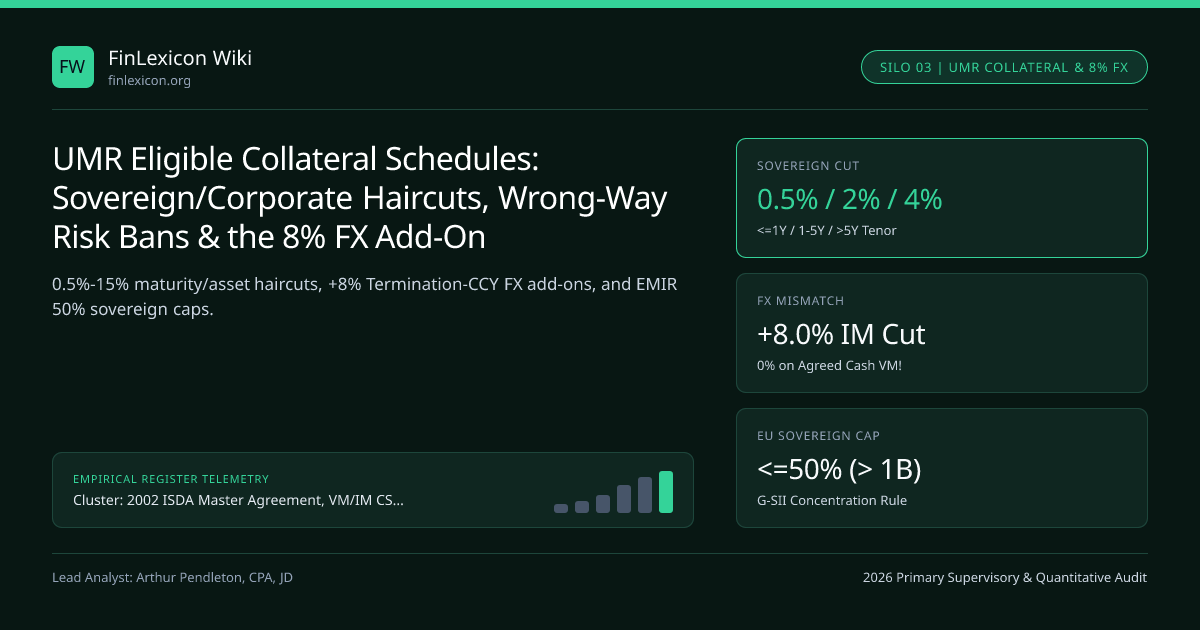
Posting cash into a segregated third-party custodian account for UMR Initial Margin carries severe custody credit risk and zero-yield drag—so over 85% of global Regulatory Initial Margin is posted in non-cash sovereign bonds, agency securities, corporate bonds, or money-market UCITS/40-Act funds. To protect Secured Parties across a 10-day close-out window without triggering fire-sales, BCBS-IOSCO Annex B prescribes a standardized 0.5% to 15.0% Valuation Haircut Schedule, an additive 8.0% FX Currency Mismatch Haircut, and strict Wrong-Way Risk and Concentration prohibitions.
Standardized BCBS-IOSCO Maturity & Credit Haircut Grid (0% Cash to 15% Equities/Gold)#
Codified across U.S. Prudential (12 CFR Part 237 Appendix B), CFTC (17 CFR 23.156), EU EMIR RTS Annex II, and UK PRA schedules inside our 2002 ISDA Master Agreement & UMR cornerstone guide, valuation percentages (100% - Haircut) step down by issuer credit quality and residual maturity:
- Eligible Cash in Same Currency: 0.0% Haircut (
100%Valuation Percentage) (Note: for UMR Initial Margin, cash held at a third-party custodian must quickly sweep into eligible government bonds or diversified MMFs in the EU to avoid custodian bank credit concentration!). - High-Grade Sovereign, Central Bank & MDB Debt (
<= 1Y/1–5Y/> 5Y): 0.5% / 2.0% / 4.0% haircut! Notice that unlike Basel LCR Level 1 HQLA (0% haircut across all tenors), a 30-year U.S. Treasury bond posted as UMR IM/VM takes a mandatory 4.0% duration haircut! - Investment-Grade Corporate Bonds, Covered Bonds & GSEs (
<= 1Y/1–5Y/> 5Y): 1.0% / 4.0% / 8.0% haircut (down to2% / 6% / 12%in lower EU CQS 2–3 tiers). - Main-Index Equities (
S&P 500,EURO STOXX 50,FTSE 100,Nikkei 225) & Physical Gold: 15.0% Haircut (85%Valuation Percentage;25%on wider stock indices in EU EMIR!). - Securitizations (ABS/MBS): Categorically ineligible in EU/UK EMIR unless meeting strict senior STS criteria; non-guaranteed private ABS excluded in U.S. UMR.
The Asymmetric 8.0% Additive FX Currency Mismatch Haircut (IM vs VM Nuance!)#
Watch the 8.0% FX Haircut trap carefully across global dealers like Bank of America, BNP Paribas, and Bank of Montreal—it operates differently on Initial Margin vs Variation Margin!
- On Regulatory Initial Margin (
IM): Each bilateral CSA designates a single "Termination Currency" per party (USD,EUR, orGBP). ANY Initial Margin collateral (including Cash OR Sovereign Bonds!) denominated in a currency DIFFERENT from the Secured Party’s designated Termination Currency suffers an immediate additive +8.0% FX Haircut! (Posting a 10-year German Bund [4.0%duration cut] against aUSDTermination Currency incurs4.0% + 8.0% =12.0% total haircut!) - On Variation Margin (
VM): Cash VM posted in any agreed major/eligible currency listed in the VM CSA takes 0.0% FX haircut! Only non-cash securities VM mismatched against agreed CSA/settlement currencies incurs the +8.0% FX haircut!
Strict Wrong-Way Risk Bans & EU EMIR 50% / 15% Concentration Limits#
To prevent collateral collapsing on the exact day a counterparty defaults:
- Absolute Wrong-Way Risk Ban: Counterparties are strictly forbidden from posting securities issued by themselves, their consolidated parent/affiliates, or (under EU/UK EMIR) financial-sector bank/insurer bonds where correlated systemic credit risk arises!
- EU / UK EMIR Sovereign & Issuer Concentration Limits (G-SIBs / O-SIIs): Unlike U.S. UMR, EU EMIR RTS Art. 8 prohibits G-SII/O-SII relationships collecting
> EUR 1.0 billionof IM from holding more than 50% of IM from a single sovereign issuer—forcing massive >EUR 1B European swap books to diversify across at least two sovereigns (e.g.,50% US Treasuries + 50% French OATs/German Bunds) while capping single corporate/equity issuers at15%(40%combined)!
| UMR Eligible Asset Class | Residual Maturity | Same-Currency Haircut | With +8% FX Mismatch (Val %) | Key Transatlantic Divergence |
|---|---|---|---|---|
| Cash in Agreed Currency | Overnight | 0.0% (100.0%) | 8.0% on IM! (0.0% on VM Cash!) | EU EMIR restricts un-reinvested custodian cash risk |
| High-Grade Sovereign / Central Bank | <= 1Y / 1–5Y / > 5Y | 0.5% / 2.0% / 4.0% | 8.5% / 10.0% / 12.0% (88%) | EU EMIR <=50% single-sovereign cap when IM >€1B! |
| IG Corporate & Covered Bonds | <= 1Y / 1–5Y / > 5Y | 1.0% / 4.0% / 8.0% | 9.0% / 12.0% / 16.0% (84%) | EU/UK exclude credit-institution bank bonds |
| Main-Index Equities & Gold | N/A | 15.0% (85.0%) | 23.0% (77.0% Valuation %) | U.S. Prudential bars dealers collecting equities from affiliates |
| Gov’t Money Market Funds (UCITS/2a-7) | Daily NAV | Look-through (~0.5%–2%) | +8.0% if fund CCY != Term CCY | Must hold pure sovereign/repo w/ zero SFT leverage |
ISDA Collateral Schedule Generator & Acadia Automated Eligibility Filters#
To reconcile intersecting U.S., EU, UK, Japanese, and Canadian haircut grids automatically, parties embed standardized ISDA Collateral Asset Definitions (ICAD) codes into Tri-Party Custodian ACA schedules at Euroclear, Clearstream, and BNY Mellon.
Optimizing Collateral Inventory Across LCR, NSFR, and UMR Haircuts#
Central collateral desks jointly optimize bond selection across LCR30 haircuts, 2016 Variation Margin CSA schedules, and UMR Annex B haircuts indexed in the ISDA-2002-CSA 2026 Benchmark Standard and the 2002 ISDA Master Agreement, CSA & SIMM topic hub.
- ValuationPercentagei = 1.00 - HaircutTotali
- MarketValueRequiredi = MarginCallUSD / ValuationPercentage_i
- Worked Cross-Border Pension Fund IM Posting Optimization (European Pension Fund owes $80.0M IM to U.S. Dealer [USD Termination Currency]):
- Option A (Post 15-Year EUR OATs Directly): Haircut = 4.0% (>5Y Sov) + 8.0% (EUR != USD) = 12.0% => Requires $80.0M / 0.88 = $90.91M EUR OATs!
- Option B (Upgrade EUR OATs into 2-Year USD Treasuries via 95d Collateral Swap): Haircut = 2.0% (1–5Y UST) + 0.0% FX = 2.0%
- Requires $80.0M / 0.98 = $81.63M USD USTs => Frees up $9.28M of unencumbered fund collateral!
Frequently asked questions
Why does UMR forbid posting cash as permanent un-invested Initial Margin at third-party bank custodians under EU EMIR?
Cash deposited on a custodian bank’s balance sheet becomes an unsecured deposit liability of that custodian bank! If the custodian failed, the cash IM would be exposed to bail-in/insolvency; thus EU EMIR requires custodial cash IM to be diversified or swept into bankruptcy-remote sovereign bonds / qualifying MMFs.
Can a Japanese insurer avoid the +8% FX haircut on JGBs when posting UMR Initial Margin to a U.S. dealer?
Only if the U.S. dealer agrees to designate JPY as the U.S. dealer’s Termination Currency in the ISDA Schedule/IM CSA! However, most U.S. G-SIBs insist on USD as their Termination Currency when acting as Secured Party (while the Japanese insurer designates JPY when *it* acts as Secured Party!).
Why does EU EMIR’s 50% single-sovereign concentration limit apply above EUR 1 billion?
If Bank A collected EUR 4 billion of IM from Bank B entirely in Italian BTPs or French OATs, a sovereign debt crisis coinciding with Bank B’s default would impair collateral liquidity; above EUR 1B between systemic institutions, EMIR mandates splitting across >=2 sovereigns (e.g., US Treasuries + Bunds).
Do U.S. SEC-registered 2a-7 Government Money Market Funds qualify as UMR Initial Margin on both sides of the Atlantic?
Watch the cross-border fund trap: U.S. UMR accepts 2a-7 Government MMFs and EU EMIR accepts qualifying UCITS MMFs (provided the fund does NOT engage in speculative securities lending/repo leverage!), so transatlantic pairs carefully vet exact CUSIP/ISIN MMF prospectuses before whitelisting!
Publication record
- Published
- 14 November 2026
- Updated
- 16 November 2026
- Author
- Arthur Pendleton, CPA, JD
- Review
- Review not recorded
- Automated fact check
- Passed in the stored pipeline record
- Source URLs
- 3 recorded
AI assistance recorded: anthropic/claude-opus-4.6. This field does not establish human review or source verification.
Academic & Institutional Attribution
Cite This Research & Embed Live Data Card
Standard academic & institutional research paper citation format.
Arthur Pendleton, CPA, JD. (2026, November 16). UMR Eligible Collateral Schedules: Sovereign/Corporate Haircuts, Wrong-Way Risk Bans & the 8% FX Add-On. FinLexicon Wiki. https://finlexicon.org/wiki/eligible-collateral-schedules-sovereign-corporate-fx-8pct-haircutRelated Isda Csa Derivatives Collateral & Institutional Briefings
Explore Isda Csa Derivatives Collateral Hub (20) →Isda Csa Derivatives Collateral
2002 ISDA Master Agreement, VM/IM CSA, ISDA SIMM v2.6, SA-CCR & Close-Out Netting ArchitectureIsda Csa Derivatives Collateral
Tri-Party & Third-Party Account Control Agreements (ACAs): Segregated UMR IM & Notice of Exclusive ControlIsda Csa Derivatives Collateral
ISDA Close-Out Netting Legal Opinions & Resolution Stay Protocols: EU BRRD, U.S. QFC & 48-Hour Bail-In StaysIsda Csa Derivatives Collateral
OTC Portfolio Reconciliation & Margin Dispute Aging: EMIR Art. 11, CFTC 23.502 & the EUR 15M / 5-Day ReportIsda Csa Derivatives Collateral
ISDA Additional Termination Events (ATEs — Sec. 5(b)(vi)): Hedge Fund NAV Decline & Credit Rating TriggersIsda Csa Derivatives Collateral
Multilateral Portfolio Compression & Margin Optimization (TriOptima / Quantile): SIMM, SA-CCR & eSLR ReliefIsda Csa Derivatives Collateral
Physically Settled FX Forwards & Swaps: U.S. Treasury Exemption, UMR IM Carve-Out, VM Nuances & SA-CCRIsda Csa Derivatives Collateral
2023 ISDA Digital Asset Derivatives Definitions: Fork Events, Oracle Disruptions & Basel SCO60 CapitalIfrs9 Cecl Credit Provisioning
Off-Balance-Sheet Loan Commitments & Guarantees: IFRS 9 Behavioral CCF vs ASC 326 Cancellable RulesIfrs9 Cecl Credit Provisioning
Loan Modifications, Forbearance & 10% Derecognition Test (IFRS 9.5.4.3 vs US GAAP ASU 2022-02 TDR Repeal)Ifrs9 Cecl Credit Provisioning
Day-1 P&L Deferral (IFRS 9.B5.1.2A vs US GAAP ASC 820): Level 3 Calibration Reserves & Release RulesIfrs9 Cecl Credit Provisioning
Multi-Scenario Macroeconomic Weighting & Post-Model Adjustments (PMAs / Overlays) in IFRS 9 & CECL
FinLexicon Wiki Data, Benchmarks & Contributor Records
CC BY 4.0 Open Data
Open Institutional Datasets (CSV / JSON) →
Download desk-compiled quantitative series & schemas.
2026 Reference Matrix
2026 Institutional Benchmarks & Thresholds →
Statutory capital, clearing, margin & rate conventions.
Editorial Records
Authors & Review Records →
View named contributors where those records are available.
Complete Index
Master Research & Dossier Archive →
Browse all published briefings by topic pillar & date.