
Ifrs9 Cecl Credit Provisioning
Own-Credit Risk on Fair-Value Option Liabilities (IFRS 9.5.7.7 & ASC 825-10): OCI & Basel CET1 Filters
Under legacy IAS 39 and FAS 159, banks booked paradoxical P&L windfalls whenever their own credit spreads widened; IFRS 9.5.7.7 and US GAAP ASC 825-10 isolate liability own-credit changes inside Other Comprehensive Income while Basel CAP30 strips 100% from CET1.
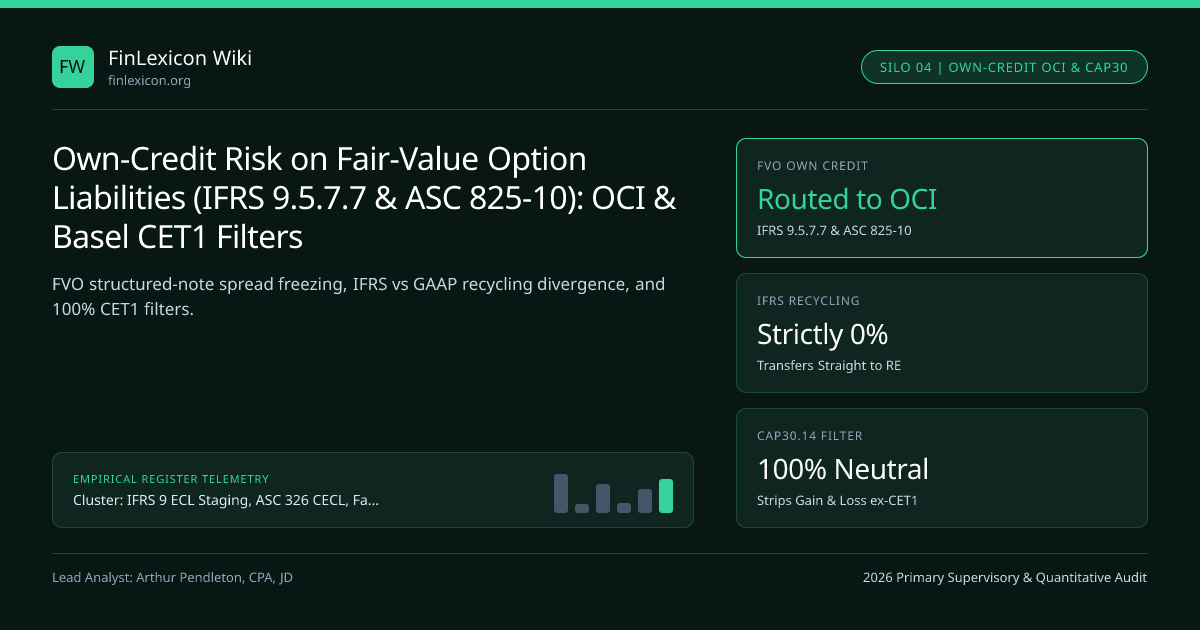
During the Q3 2008 and Q3 2011 banking stress episodes, global universal banks stunned equity analysts by reporting multi-billion-dollar quarterly net income gains solely because their own senior debt spreads widened by +150–300 bps, slashing the fair value of issued structured notes! Investors universally condemned this "own-credit anomaly"—leading both the IASB (IFRS 9 paragraph 5.7.7) and FASB (ASU 2016-01 / ASC 825-10-45-5) to quarantine Fair-Value Option (FVO) liability own-credit movements inside Other Comprehensive Income (OCI), even before the IASB or FASB finalized broader impairment reforms.
Why Banks Elect the Fair-Value Option (FVO) on Structured Notes in the First Place#
Major structured-note issuers like BNP Paribas, Bank of America, and Bank of Montreal issue billions in equity-linked autocallables, range accruals, and FX-linked notes. Under IFRS 9.4.3.3 and ASC 815-15, an issued debt host with a non-closely-related embedded derivative normally requires tedious embedded-derivative bifurcation—unless the bank elects the irrevocable Day-1 Fair-Value Option (FVO) on the entire hybrid liability, anchored in our IFRS 9, CECL & Fair Value cornerstone guide.
Once FVO is elected, the bank hedges the note’s interest-rate and equity risk with inter-dealer swaps marked at FVTPL. Routing the note’s market-risk fair-value changes through P&L cleanly matches those swap hedges—whereas routing the bank’s own credit spread (OCA / DVA) through P&L created artificial earnings swings.
Mechanics of IFRS 9.5.7.7 & ASC 825-10: Benchmark Curve Isolation vs Accounting Mismatch Override#
To separate Own-Credit Risk (OCI) from Market Risk (P&L), IFRS 9.B5.7.16–18 and ASC 825-10 prescribe the Default / Frozen Credit Spread Method:
- At initial issuance (
t = 0), solve for the note’s instrument-specific internal rate of return (IRR_0) minus the observable benchmark interest rate (SOFRorEURIBOR OIS_0) to lock in the initial non-benchmark spreads_init. - At each subsequent reporting date
t, compute what the liability’s fair value would be if discounted atOIS(t) + s_init(capturing pure benchmark rate and embedded option movements -> recognized in Profit or Loss). - Subtract that benchmark-adjusted value from the full current IFRS 13 / ASC 820 exit fair value: the residual equals the Change in Instrument-Specific Own Credit Risk, booked directly to Other Comprehensive Income (
OCI)!
Two Critical Statutory Rules:
- Accounting Mismatch Exception (
IFRS 9.5.7.8): In the rare case where routing own credit to OCI would create or enlarge a P&L mismatch (for example, a mortgage bank whose fair-valued mortgage liabilities contractually pass own-credit spreads directly through to linked fair-valued mortgage loans, such as Danish covered-bond pass-through structures), all fair-value changes stay in P&L. - Permanent Non-Recycling on Derecognition (
IFRS 9.B5.7.9): Under IFRS 9, even if the bank buys back or redeems the structured note early at88 cents on the dollar, the cumulativeOCIown-credit gain is NEVER recycled into Profit or Loss—it transfers directly fromAOCIinto Retained Earnings! (By contrast, US GAAP ASC 825-10-45-6 does recycle cumulativeAOCIown-credit gains/losses into Net Income upon actual early extinguishment or settlement!)
FVO Liability Own-Credit (OCI) vs Standalone Derivative DVA (P&L) & Basel CAP30.14–15#
Notice the sharp accounting boundary compared with bilateral OTC derivative `DVA`: IFRS 9.5.7.7 and ASC 825-10 apply ONLY to Financial Liabilities Designated at Fair Value (FVO)—they do NOT apply to standalone OTC derivatives (IRS, CDS, FX options), whose bilateral DVA continues to flow through Profit or Loss!
Regardless of whether own-credit sits in AOCI (FVO structured notes) or Retained Earnings via P&L (derivative DVA), Basel III chapter CAP30.14 and CAP30.15 enforced by the Federal Reserve, ECB, and UK PRA strip 100% of cumulative after-tax own-credit gains AND losses straight out of Common Equity Tier 1 (CET1)!
| Liability / Derivative Class | IFRS 9 Presentation of Own Credit | US GAAP (ASC 825 / ASC 815) Presentation | Recycling on Early Extinguishment? | Basel III CAP30.14–15 CET1 Rule |
|---|---|---|---|---|
FVO Structured Notes (Normal) | Other Comprehensive Income (OCI) | Other Comprehensive Income (OCI) | IFRS 9: NO (-> RE) / GAAP: YES (-> P&L) | 100% Stripped from CET1 |
| FVO Debt w/ Pass-Through Asset Match | Profit or Loss (IFRS 9.5.7.8 exception) | OCI (narrow mismatch rules) | N/A (already in P&L) | 100% Stripped from CET1 |
Standalone OTC Derivatives (DVA) | Profit or Loss (FVTPL) | Profit or Loss (FVTPL) | Realized in P&L on tear-up | 100% Stripped from CET1 (CAP30.15) |
| Amortized Cost Senior / TLAC Bonds | Not marked to market (0 FV move) | Not marked to market (0 FV move) | Extinguishment gain/loss in P&L! | Realized buyback gain stays in CET1! |
Interaction With Bail-In TLAC Debt Issuance & Structured-Note Funding Desks#
When a G-SIB’s TLAC / MREL senior non-preferred debt spread tightens by -45 bps during a bull market, its AOCI own-credit reserve turns negative (-$600M GAAP equity drag), yet Basel CAP30.14 adds that +$600M straight back into CET1—preventing credit-spread tightening from penalizing bank regulatory capital across the IFRS 9, CECL & Fair Value Accounting topic hub!
Audit Verification of Issuance-Spread Freeze vs Senior Unsecured CDS Proxies#
External auditors verify under ISA 540 / PCAOB AS 2501 that treasury valuation teams do not contaminate the OCI own-credit bucket with unhedged equity-volatility or funding-liquidity spread errors.
- FVBenchmarkOnlyt = PV( CashFlowst ; DiscountCurve = rBenchmarkOIS(t) + sInitInstrument )
- DeltaPandLt = FVBenchmarkOnlyt - FVBenchmarkOnly{t-1}
- DeltaOCIOwnCredt = ( FVFullExitt - FVFullExit{t-1} ) - DeltaPandL_t
- Worked Early Redemption Divergence ($100.0M Par FVO Note; Bank Spread Widens -> Full FV = $91.0M; Benchmark FV = $97.0M; Cumul. Tax-Adj OCI = +$4.5M):
- Bank repurchases note in secondary market for $91.0M cash:
- IFRS 9.B5.7.9: +$4.5M AOCI transfers directly to Retained Earnings (ZERO P&L Extinguishment Gain!).
- US GAAP ASC 825-10-45-6: +$4.5M AOCI recycles into Net Income as Realized Debt Extinguishment Gain! (And NOW enters CET1!)
Frequently asked questions
Why does an actual cash buyback of discounted debt boost Basel CET1, whereas unrealized own-credit FV gains do not?
Unrealized own-credit gains vanish if the bank stays solvent and repays $100 par at maturity—so counting unrealized gains in going-concern CET1 is illusory. By contrast, if the bank retires $100M par of debt permanently for $91M cash (subject to supervisory TLAC call approval!), the $9M liability is legally extinguished forever, creating genuine going-concern equity!
Does senior funding liquidity spread ("issuance spread above CDS") count inside Own-Credit Risk in OCI?
Yes! Under IFRS 9.B5.7.13–18, "credit risk" of a financial liability is distinguished from *asset-specific performance risk*, and the default frozen-spread method captures the entire instrument-specific funding/credit spread over the OIS/LIBOR benchmark curve inside OCI unless a more faithful decomposition is proven.
Why don’t IFRS 9.5.7.7 and ASC 825-10 route standalone OTC Derivative DVA into OCI too?
Because OTC derivative portfolios (IRS, FX swaps) constantly flip between net asset (CVA) and net liability (DVA) positions as market rates move, and are dynamically risk-managed alongside FVA in a single integrated book—splitting derivative DVA into OCI proved operationally unworkable.
When is the IFRS 9.5.7.8 "Accounting Mismatch" P&L override actually triggered in practice?
Primarily in Danish mortgage-credit institutes (Realkredit), where statutory balance-principle laws link fair-valued mortgage loans 1-for-1 to the exact market price (including credit spread!) of the underlying issued covered bonds—putting bond own-credit in OCI while loan fair value sits in P&L would create a fake mismatch!
Publication record
- Published
- 13 November 2026
- Updated
- 15 November 2026
- Author
- Arthur Pendleton, CPA, JD
- Review
- Review not recorded
- Automated fact check
- Passed in the stored pipeline record
- Source URLs
- 3 recorded
AI assistance recorded: anthropic/claude-opus-4.6. This field does not establish human review or source verification.
Academic & Institutional Attribution
Cite This Research & Embed Live Data Card
Standard academic & institutional research paper citation format.
Arthur Pendleton, CPA, JD. (2026, November 14). Own-Credit Risk on Fair-Value Option Liabilities (IFRS 9.5.7.7 & ASC 825-10): OCI & Basel CET1 Filters. FinLexicon Wiki. https://finlexicon.org/wiki/own-credit-risk-dva-oci-presentation-ifrs-9-asc-825-liabilitiesRelated Ifrs9 Cecl Credit Provisioning & Institutional Briefings
Explore Ifrs9 Cecl Credit Provisioning Hub (20) →Ifrs9 Cecl Credit Provisioning
IFRS 9 Expected Credit Loss, US GAAP ASC 326 CECL, Fair Value Hierarchy & Hedge Accounting GuideIfrs9 Cecl Credit Provisioning
IFRS 9 General Hedge Accounting vs US GAAP ASC 815: Rebalancing, Cost of Hedging OCI & Effectiveness RulesIfrs9 Cecl Credit Provisioning
Portfolio Macro Fair-Value Hedge Accounting: EU IAS 39 Carve-Out, US GAAP Portfolio Layer Method & IASB DRMIfrs9 Cecl Credit Provisioning
Off-Balance-Sheet Loan Commitments & Guarantees: IFRS 9 Behavioral CCF vs ASC 326 Cancellable RulesIfrs9 Cecl Credit Provisioning
Loan Modifications, Forbearance & 10% Derecognition Test (IFRS 9.5.4.3 vs US GAAP ASU 2022-02 TDR Repeal)Ifrs9 Cecl Credit Provisioning
Day-1 P&L Deferral (IFRS 9.B5.1.2A vs US GAAP ASC 820): Level 3 Calibration Reserves & Release RulesIfrs9 Cecl Credit Provisioning
Multi-Scenario Macroeconomic Weighting & Post-Model Adjustments (PMAs / Overlays) in IFRS 9 & CECLIfrs9 Cecl Credit Provisioning
IFRS 7, ASC 326 Vintage Charge-Off Tables & ISA 540 / PCAOB AS 2501 External Audit of Credit Loss EstimatesCentral Clearing Ccp Waterfall
CCP Margin Anti-Procyclicality (APC): EMIR RTS Article 28 25% Buffer, 10-Year Stress Weight & Margin FloorsCentral Clearing Ccp Waterfall
CCP Default Management Groups (DMG), Macro Hedging, Auction Juniorization & 2018 Nasdaq LessonsCentral Clearing Ccp Waterfall
Basel III CRE54 Qualifying CCP (QCCP) Capital: 2% vs 4% Client Trade Exposure Risk Weights & K_CCPCentral Clearing Ccp Waterfall
CCP Intraday Variation & Ad-Hoc Margin Calls: Dash-for-Cash Liquidity Spirals & One-Way Pass-Through
FinLexicon Wiki Data, Benchmarks & Contributor Records
CC BY 4.0 Open Data
Open Institutional Datasets (CSV / JSON) →
Download desk-compiled quantitative series & schemas.
2026 Reference Matrix
2026 Institutional Benchmarks & Thresholds →
Statutory capital, clearing, margin & rate conventions.
Editorial Records
Authors & Review Records →
View named contributors where those records are available.
Complete Index
Master Research & Dossier Archive →
Browse all published briefings by topic pillar & date.