
Basel Iii Endgame Capital Ratios
Enhanced Supplementary Leverage Ratio (eSLR) & Total Leverage Exposure (LEV20–LEV30)
Calibrated at 3.0% Tier 1 globally plus G-SIB buffers (5.0% BHC / 6.0% IDI under U.S. eSLR), the leverage ratio constrains low-risk Treasury repo balance sheets via Total Leverage Exposure.
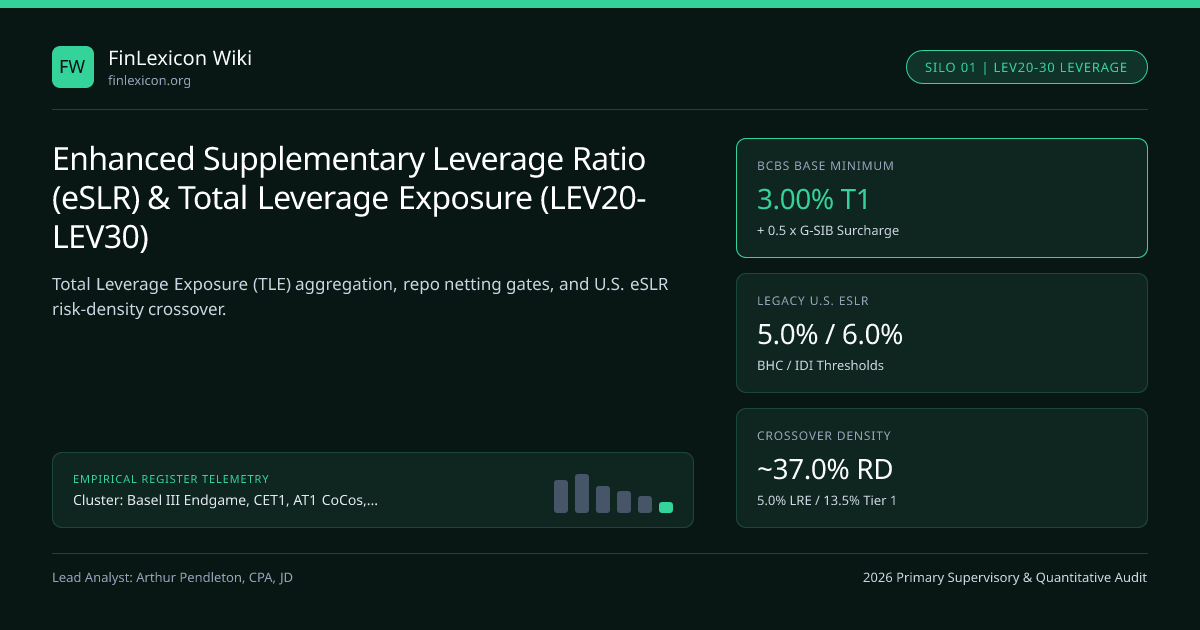
Designed under Basel Framework chapters LEV20–LEV30 as a non-risk-based backstop against excessive balance sheet leverage and risk-weight model error, the Basel III Leverage Ratio divides Tier 1 capital by Total Leverage Exposure (TLE) with a 3.0% Pillar 1 minimum plus a G-SIB buffer equal to 50% of the Method 1 G-SIB surcharge. In the United States, 12 CFR 217.10–217.11 historically imposed a stiffer uniform 5.0% holding-company / 6.0% insured-depository-institution Enhanced Supplementary Leverage Ratio (eSLR), tracked in the SLR-LEVERAGE 2026 Benchmark Standard.
Four Pillars of the Total Leverage Exposure (TLE) Denominator (LEV30)#
Because GAAP and IFRS balance sheets differ starkly on derivative netting—U.S. GAAP ASC 210-20 permits master-netting balance sheet offset whereas IFRS IAS 32 reports gross derivative fair values—Basel LEV30 constructs an accounting-neutral four-part Total Leverage Exposure denominator:
- On-Balance-Sheet Exposures: All non-derivative, non-SFT assets at accounting carrying value (including central bank reserves and cash U.S. Treasuries unless exempted by national rule), less Tier 1 regulatory deductions.
- Derivative Exposures:
1.4 * (Replacement Cost + Potential Future Exposure)under modified SA-CCR leverage rules, where collateral received generally cannot reduce PFE multipliers below 1.0 and cash variation margin offsets RC only when strict daily currency-matched settlement conditions hold. - Securities Financing Transactions (SFTs): Gross SFT cash receivables (netted across bilateral repo/reverse-repo legs ONLY with the same counterparty, same final settlement date, and legally enforceable set-off) plus a counterparty credit risk exposure add-on
E*. - Off-Balance-Sheet Commitments: Undrawn loan commitments, letters of credit, and guarantees multiplied by standardized Credit Conversion Factors (CCFs) ranging from 10% (unconditionally cancellable credit card lines) through 20%, 40%, 50%, to 100% (direct credit substitutes), as integrated into our Basel III Endgame & CET1 cornerstone guide.
Why U.S. eSLR (5.0% BHC / 6.0% IDI) Constrained Treasury Market Intermediation#
Under international BCBS LEV20.7, a Bucket 1 G-SIB (1.0% CET1 surcharge) faces a 3.0% + 0.5% = 3.5% Tier 1 leverage minimum, and a Bucket 3 G-SIB (2.0% surcharge) faces 3.0% + 1.0% = 4.0%. By contrast, the 2014 U.S. eSLR rule imposed a flat 2.0% leverage buffer (5.0% BHC total) on all eight U.S. G-SIBs regardless of systemic bucket, and a 6.0% "well-capitalized" Prompt Corrective Action threshold at insured bank subsidiaries overseen by the OCC and FDIC!
Whenever Federal Reserve quantitative easing flooded banks like Bank of America with zero-risk-weight reserve balances and primary-dealer Treasury inventory surged, eSLR flipped from a backstop into the primary binding constraint—discouraging low-spread Treasury repo intermediation during March 2020 and prompting U.S. supervisory reforms to align the eSLR buffer to 0.5 * GSIB_Method1 (3.5%–4.25% BHC range) and recalibrate IDI thresholds.
Central Bank Reserve Exemptions: UK PRA Exclude-and-Recalibrate vs U.S. Custody Rule#
Jurisdictions diverge sharply on whether central bank reserves belong inside TLE:
- United Kingdom (Bank of England / UK PRA): Permanently excludes omnibus claims on the Bank of England matched by sterling liabilities while recalibrating the minimum UK leverage ratio upward from 3.0% to 3.25% so central bank monetary expansion never crowds out private repo intermediation.
- United States Custody Bank Carve-Out (EGRRCPA Section 402): Permanently excludes central bank deposits ONLY for custodial G-SIBs predominantly engaged in custody, safekeeping, and asset servicing (up to the value of fiduciary deposit liabilities), while leaving universal dealer G-SIBs fully exposed unless narrow dealer-inventory or reserve reforms apply.
| Jurisdiction & Regime | Base Tier 1 Floor | G-SIB Leverage Add-On | Central Bank Reserve Treatment | Critical Risk Density Crossover |
|---|---|---|---|---|
| INTL (BCBS / BIS LEV20) | 3.00% Tier 1 | 50% of Method 1 G-SIB (0.5%–1.75%) | Temporary exceptional exemption option | ~30.8% (at 4.0% LRE / 13.0% T1) |
| U.S. Legacy eSLR (Fed / FDIC) | 3.00% SLR (Cat I–III) | +2.0% BHC (5.0%) / +3.0% IDI (6.0%) | Included (except custody banks Sec. 402) | 37.0% BHC (and >45% at IDI level) |
| U.S. Recalibrated eSLR Framework | 3.00% SLR | 50% of Method 1 G-SIB (0.5%–1.25%) | Evaluated w/ Treasury dealer carve-out | ~28.5%–31.5% (restores backstop role) |
| United Kingdom (UK PRA) | 3.25% Tier 1 | 35% of G-SIB + 35% of UK CCyB | Permanently excluded (GBP matched) | ~29.0% on non-reserve assets |
| Eurozone SSM (ECB CRR III) | 3.00% Tier 1 | 50% of G-SII buffer + P2R-LR | Included post-2022 COVID expiry | ~30.0% across Eurozone G-SIIs |
Cleared Client Derivatives Treatment After the 2019 BCBS Revision#
Originally, futures commission merchants (FCMs) acting as clearing brokers had to count client-posted initial margin inside their own TLE, driving rapid consolidation in OTC clearing. In June 2019, BCBS revised LEV30.26 to permit clearing members to offset cash and non-cash initial margin received from clients on centrally cleared derivatives provided those client funds are segregated under regimes like CFTC LSOC or EMIR segregation.
Critical Risk Density Crossover Ratio (Tier1_Target / Leverage_Target)#
Algebraically, a bank transitions from being RWA-constrained to leverage-constrained whenever its average Risk Density (RWA / TLE) drops below Leverage_Ratio_Requirement / Risk_Based_Tier1_Requirement. For a U.S. G-SIB requiring 13.5% risk-based Tier 1 (incorporating its G-SIB Method 2 surcharge and FSB TLAC leverage buffers) against 5.0% eSLR, the crossover sits at 5.0% / 13.5% = 37.0% risk density (or 6.0% / 8.0% = 75.0% at an IDI!), explaining why FICC-cleared repo netting under FICC Sponsored Member Repo became indispensable across the Basel III Endgame & Capital Ratios topic hub.
- CriticalRiskDensity = LeverageMinPct / RiskBasedTier1TargetPct
- Worked Primary Dealer Treasury Repo Example ($50B Cash Reverse Repo vs $50B Cash Repo):
- Case A (Bilateral Non-Matched Dates: Overnight Repo funding 30-Day Reverse Repo):
- Accounting/LEV30 Netting = $0 => Incremental TLE = +$50.0B (Incremental RWA ~ $0–$1.0B)
- At 5.0% eSLR, Tier 1 Capital Required = 0.05 * $50.0B = $2.50B (At 12% ROE => +60 bps repo spread hurdle!)
- Case B (Centrally Cleared via FICC GSD w/ Matched Settlement Dates):
- Receivable & Payable Netted under LEV30.37 => Incremental TLE = $0 + minor E* haircut add-on!
Frequently asked questions
Why cannot collateral received on OTC derivatives reduce Potential Future Exposure (PFE) in the leverage ratio?
Under Basel LEV30.16, the SA-CCR PFE multiplier is fixed at 1.0 for leverage exposure purposes (ignoring initial margin overcollateralization), because recognizing collateral haircuts inside PFE would reintroduce risk-sensitivity into a non-risk-based backstop.
When does cash variation margin reduce derivative Replacement Cost (RC) in Total Leverage Exposure?
LEV30.21 treats cash variation margin as a form of pre-settlement payment (reducing RC) only if it is settled daily in cash, denominated in the currency of settlement specified in the contract/CSA, not segregated, and governed by a single master netting agreement.
How does central clearing at FICC reduce U.S. Treasury repo Total Leverage Exposure?
Once novated to FICC Government Securities Division, all repo and reverse-repo legs face a single counterparty (FICC), enabling dealers to net offsetting cash payables and receivables sharing the same settlement date (including open/overnight rolls) to zero on-balance-sheet TLE.
What minimum Credit Conversion Factor applies to unconditionally cancellable credit card lines in LEV30?
Basel LEV30.54 applies a 10% Credit Conversion Factor floor to unconditionally cancellable retail and corporate commitments—eliminating the 0% CCF allowed under legacy Basel II standardized rules.
Publication record
- Published
- 14 November 2026
- Updated
- 15 November 2026
- Author
- Arthur Pendleton, CPA, JD
- Review
- Review not recorded
- Automated fact check
- Passed in the stored pipeline record
- Source URLs
- 4 recorded
AI assistance recorded: anthropic/claude-opus-4.6. This field does not establish human review or source verification.
Academic & Institutional Attribution
Cite This Research & Embed Live Data Card
Standard academic & institutional research paper citation format.
Arthur Pendleton, CPA, JD. (2026, November 14). Enhanced Supplementary Leverage Ratio (eSLR) & Total Leverage Exposure (LEV20–LEV30). FinLexicon Wiki. https://finlexicon.org/wiki/eslr-supplementary-leverage-ratio-total-leverage-exposureFurther Institutional Analysis & Briefings
Basel Iii Endgame Capital Ratios
Basel III Standardized Credit Risk (CRE20): LTV Mortgage Buckets & ADC Real Estate WeightsBasel Iii Endgame Capital Ratios
Foundation IRB (F-IRB) Migration & A-IRB PD/LGD Input Floors (CRE30–CRE32)Market Insights
SGX Group’s Derivatives Volume Hits Six-Month High - Markets MediaRegulatory Compliance
Statement on Proposing Release for Executive Compensation Disclosure ReformBasel Iii Endgame Capital Ratios
Operational Risk Standardized Measurement Approach (SMA): BIC Buckets & ILM=1 DiscretionRegulatory and Market Glossary
Bitcoin ETFs shed $2.35B in 2 weeks, BlackRock’s losing streak hits 11Corporate Governance
Analysis: Companies love a ‘rockstar’ CEO. Until they depend on oneBasel Iii Endgame Capital Ratios
FRTB Market Risk (MAR21/MAR30): Sensitivities-Based Method (SbM), PLA Test & NMRF CapitalBasel Iii Endgame Capital Ratios
Maximum Distributable Amount (MDA): CET1 Buffer Quartiles & AT1 Coupon RestrictionsRegulatory Compliance
SEC Proposes Executive and Director Compensation Disclosure ReformsBasel Iii Endgame Capital Ratios
Standardized Credit Risk Assessment (SCRA): Grade A, B & C Interbank Risk Weights (CRE20)Basel Iii Endgame Capital Ratios
U.S. Stress Capital Buffer (SCB): CCAR Nine-Quarter PPNR & Peak CET1 Drawdown Mechanics
FinLexicon Wiki Data, Benchmarks & Contributor Records
CC BY 4.0 Open Data
Open Institutional Datasets (CSV / JSON) →
Download desk-compiled quantitative series & schemas.
2026 Reference Matrix
2026 Institutional Benchmarks & Thresholds →
Statutory capital, clearing, margin & rate conventions.
Editorial Records
Authors & Review Records →
View named contributors where those records are available.
Complete Index
Master Research & Dossier Archive →
Browse all published briefings by topic pillar & date.