
Ifrs9 Cecl Credit Provisioning
IFRS 9 General Hedge Accounting vs US GAAP ASC 815: Rebalancing, Cost of Hedging OCI & Effectiveness Rules
Legacy IAS 39 disqualified genuine economic hedges whenever retrospective offset drifted to 79% or 126%; IFRS 9 Chapter 6 and US GAAP ASU 2017-12 modernized Fair Value, Cash Flow, and Net Investment hedges via economic-relationship tests and Cost of Hedging deferrals.
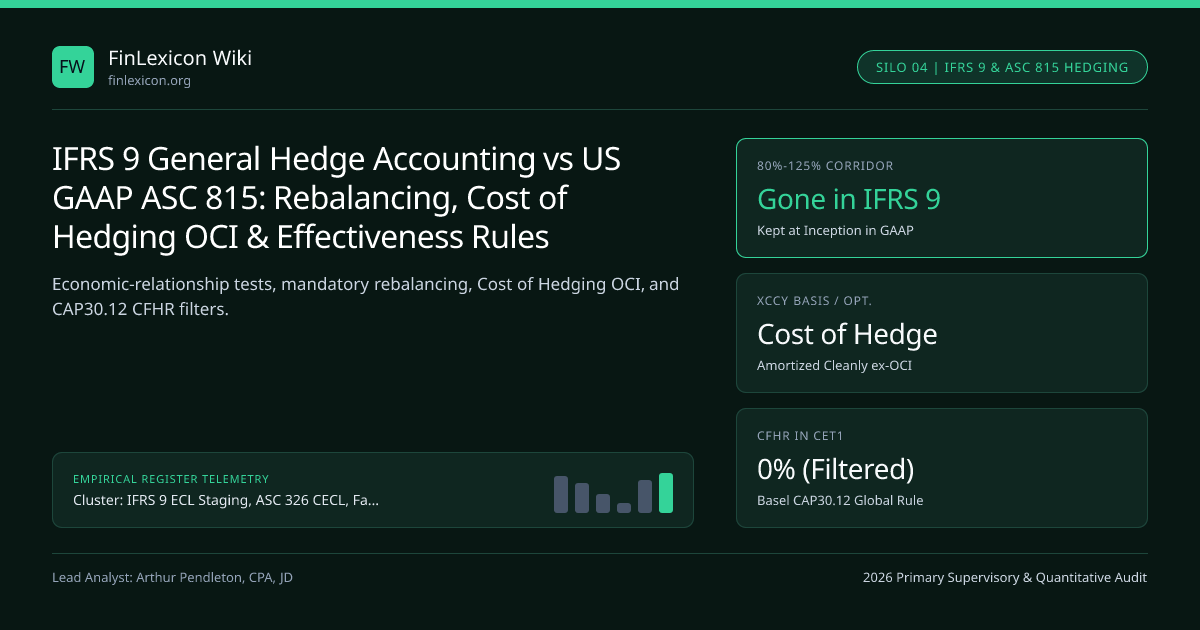
Under legacy IAS 39, corporate and bank treasurers lived in terror of the infamous 80%–125% bright-line retrospective effectiveness corridor: if cross-currency basis spreads moved slightly during a quarter so that a perfectly sensible 10-year swap offset 79.4% (or 125.6%) of the hedged bond’s fair-value move, hedge accounting failed completely—dumping the entire derivative MTM straight into quarterly Profit or Loss! Both IFRS 9 Chapter 6 and US GAAP ASU 2017-12 (ASC 815) overhauled micro hedge accounting to align financial reporting with actual treasury risk management.
The Three Canonical Hedge Relationships: Fair Value (FVH), Cash Flow (CFH), and Net Investment (NIH)#
Across Bank of America, BNP Paribas, and ANZ Bank, treasury desks deploy three distinct micro hedge-accounting models anchored in our IFRS 9, CECL & Fair Value cornerstone guide:
- Fair Value Hedge (
FVH): Hedges exposure to changes in the fair value of a recognized fixed-rate asset or liability (e.g., swapping an issued$2B5.00% fixed-rate bond to floating SOFR). Both the swap MTM and the hedged risk adjustment (Basis Adjustment) on the fixed-rate bond flow into P&L simultaneously—with zero impact on AOCI! - Cash Flow Hedge (
CFH): Hedges variability in cash flows of a floating-rate asset/liability or highly probable forecast transaction (e.g., receiving fixed SOFR against floating-rate commercial loans). The effective portion of swap MTM ("lower of" cumulative derivative vs hypothetical-derivative change) parks in Cash Flow Hedge Reserve (OCI) and recycles to Net Interest Income as floating coupons reset! BaselCAP30.12strips 100% ofCFHRout of CET1 because the hedged future floating loans are not fair-valued on balance sheet! - Net Investment Hedge (
NIH): Hedges FX translation risk on foreign subsidiaries (USDparent hedgingEURorJPYsubsidiary equity via cross-currency swaps or FX debt), parking effective FX gains/losses in the Cumulative Translation Adjustment (CTA/FCTR) inside OCI.
IFRS 9 Chapter 6 Overhaul: Goodbye 80%–125%, Mandatory Rebalancing & Prohibition of Voluntary De-Designation#
IFRS 9.6.4.1 abolished IAS 39’s 80%–125% retrospective bright line completely, replacing it with three prospective principles:
- Economic Relationship: Hedging instrument and hedged item must move in opposite directions from the same risk (provable qualitatively when critical terms match, or quantitatively via regression/dollar-offset).
- Credit Risk Does Not Dominate: Neither counterparty CVA nor own DVA dominates value changes.
- Designated Hedge Ratio Matches Actual Risk Management (
Mandatory Rebalancing): If proxy basis shifts the optimal hedge ratio from1.00xto0.92x, treasury updates (rebalances) the designated notional without terminating the hedge! Conversely, IFRS 9.6.5.6 STRICTLY FORBIDS voluntary de-designation so long as the risk-management objective remains unchanged!
Compare US GAAP (ASC 815 post-ASU 2017-12): US GAAP kept the 80%–125% quantitative threshold at initial designation (unless qualifying for the Shortcut or Critical Terms Match qualitative paths), allowed subsequent qualitative effectiveness assessments, still permits voluntary de-designation at any time, and spares effective-versus-ineffective P&L measurement splits on Cash Flow and Net Investment hedges (recording 100% of qualified CFH/NIH derivative changes in OCI!).
Game-Changer for FX & Options Desks: "Cost of Hedging" OCI (Time Value, Forward Points, XCCY Basis)#
Under IAS 39, buying an interest-rate cap/swaption or executing a Cross-Currency Swap (XCCY) caused brutal P&L volatility because option time-value decay and USD/EUR cross-currency basis spreads (-15 to -45 bps) were treated as "ineffectiveness" in P&L! IFRS 9.6.5.15–16 introduced Cost of Hedging OCI (matched by ASC 815’s Excluded Component Amortization Approach):
- Option Time Value, FX Forward Points, and Foreign Currency Basis Spreads can be separated from intrinsic/spot risk, parked temporarily in a Cost of Hedging OCI reserve, and amortized smoothly into P&L (or capitalized into transaction-related hedged items)!
| Hedge Accounting Feature | Legacy IAS 39 | IFRS 9 Chapter 6 (General) | US GAAP ASC 815 (Post-ASU 2017-12) |
|---|---|---|---|
Quantitative 80%–125% Test | Mandatory prospective & retrospective! | Abolished (Economic Relationship test) | Required at inception (unless qualitative); optional after |
| Hedge Ratio Rebalancing | Forced de-designation & re-designation | Mandatory rebalancing without discontinuation | Elective adjustment / de-designation |
| Voluntary De-Designation | Permitted anytime | Strictly Prohibited if objective unchanged! | Permitted anytime prospectively |
| CFH Ineffectiveness P&L Split | Lower-of test; excess to P&L | Lower-of test; over-hedges hit P&L! | 100% to OCI if highly effective (no P&L dribble!) |
| XCCY Basis & Option Time Value | Forced into P&L volatility | Cost of Hedging OCI reserve | Excluded Component systematic amortization |
Basel CAP30.12 Cash Flow Hedge Reserve (CFHR) Prudential Neutralization#
Why do Federal Reserve, ECB, and APRA rules strip 100% of the Cash Flow Hedge Reserve (CFHR) out of CET1 even at Advanced Approaches banks whose AFS bond AOCI does hit CET1? Because a Cash Flow Hedge marks only the swap to fair value in AOCI while leaving the hedged floating-rate loans at $100 par—creating a one-sided accounting equity swing across the IFRS 9, CECL & Fair Value Accounting topic hub!
Bridging Micro General Hedge Accounting to Open-Portfolio Macro Hedging#
General hedge accounting (IFRS 9 Ch. 6) works only on closed items or identified groups—forcing banks hedging open core deposits into EU IAS 39 Carve-Out or US GAAP Portfolio Layer Macro Hedging.
- IFRS9CFHIneffectPnL = DeltaSwapTotalt - IFRS9CFHRDeltaOCIt
- BaselCET1Adjusted = ShareholdersEquityGAAPIFRS - AOCICashFlowHedgeReservePostTax [CAP30.12]
- Worked IFRS 9 vs US GAAP "Under-Hedge vs Over-Hedge" Asymmetry on Cash Flow Hedge:
- Under-Hedge (Swap moves +$95M; Hypothetical Hedged Item moves -$100M -> 95% offset):
- BOTH IFRS 9 and US GAAP book +$95M to OCI and $0M to P&L!
- Over-Hedge (Swap moves +$104M; Hypothetical Hedged Item moves -$100M -> 104% offset):
- IFRS 9 caps OCI at +$100M ("lower of") -> +$4M hits P&L! | US GAAP (ASU 2017-12) books ALL +$104M to OCI ($0M P&L)!
Frequently asked questions
Why did the Federal Reserve keep the AOCI filter on Cash Flow Hedges (CFHR) for U.S. G-SIBs while removing the AOCI filter on AFS bonds?
Because an AFS bond is carried at Fair Value on the asset side of the balance sheet (economic loss is real), whereas a Cash Flow Hedge marks *only* the receive-fixed swap to Fair Value while leaving the hedged $50B of floating-rate C&I loans at $100 amortized cost—counting CFHR in CET1 would distort solvency with half of an economic pair!
Why does IFRS 9 prohibit voluntary de-designation of a hedge relationship when US GAAP allows it?
The IASB wanted to stop earnings management (e.g., terminating a Fair Value Hedge selectively to freeze a basis adjustment or crystallize swap P&L timing); under IFRS 9.6.5.6, hedge accounting ceases *only* if the risk-management objective changes (e.g., selling the bond) or the economic relationship fails.
What happens to a Fair Value Hedge "Basis Adjustment" on a fixed-rate bond when a bank terminates the swap early?
Under both IFRS 9.6.5.10 and ASC 815-25-35-9, the cumulative fair-value basis adjustment stamped onto the bond’s carrying amount is amortized into Net Interest Income over the bond’s remaining life using a recalculated Effective Interest Rate (EIR)—never recognized immediately in P&L unless the bond itself is sold!
Can a non-financial corporate hedge an isolated risk component (like Brent Crude inside Jet Fuel contracts) under IFRS 9 and ASC 815?
IFRS 9.6.3.7 allows hedging *any separately identifiable and reliably measurable* non-financial risk component (even if not contractually specified, like crude oil inside physical jet-fuel purchases!), whereas US GAAP ASC 815 restricts non-financial component hedging strictly to contractually specified components!
Publication record
- Published
- 13 November 2026
- Updated
- 15 November 2026
- Author
- Arthur Pendleton, CPA, JD
- Review
- Review not recorded
- Automated fact check
- Passed in the stored pipeline record
- Source URLs
- 3 recorded
AI assistance recorded: anthropic/claude-opus-4.6. This field does not establish human review or source verification.
Academic & Institutional Attribution
Cite This Research & Embed Live Data Card
Standard academic & institutional research paper citation format.
Arthur Pendleton, CPA, JD. (2026, November 14). IFRS 9 General Hedge Accounting vs US GAAP ASC 815: Rebalancing, Cost of Hedging OCI & Effectiveness Rules. FinLexicon Wiki. https://finlexicon.org/wiki/ifrs-9-hedge-accounting-effectiveness-rebalancing-cost-of-hedgingRelated Ifrs9 Cecl Credit Provisioning & Institutional Briefings
Explore Ifrs9 Cecl Credit Provisioning Hub (20) →Ifrs9 Cecl Credit Provisioning
IFRS 9 Expected Credit Loss, US GAAP ASC 326 CECL, Fair Value Hierarchy & Hedge Accounting GuideIfrs9 Cecl Credit Provisioning
Portfolio Macro Fair-Value Hedge Accounting: EU IAS 39 Carve-Out, US GAAP Portfolio Layer Method & IASB DRMIfrs9 Cecl Credit Provisioning
Off-Balance-Sheet Loan Commitments & Guarantees: IFRS 9 Behavioral CCF vs ASC 326 Cancellable RulesIfrs9 Cecl Credit Provisioning
Loan Modifications, Forbearance & 10% Derecognition Test (IFRS 9.5.4.3 vs US GAAP ASU 2022-02 TDR Repeal)Ifrs9 Cecl Credit Provisioning
Day-1 P&L Deferral (IFRS 9.B5.1.2A vs US GAAP ASC 820): Level 3 Calibration Reserves & Release RulesIfrs9 Cecl Credit Provisioning
Multi-Scenario Macroeconomic Weighting & Post-Model Adjustments (PMAs / Overlays) in IFRS 9 & CECLIfrs9 Cecl Credit Provisioning
IFRS 7, ASC 326 Vintage Charge-Off Tables & ISA 540 / PCAOB AS 2501 External Audit of Credit Loss EstimatesIfrs9 Cecl Credit Provisioning
Deferred Tax Assets (IAS 12 & ASC 740 Valuation Allowances) vs Basel III CAP30 10% / 17.65% CET1 DeductionsCentral Clearing Ccp Waterfall
CCP Default Management Groups (DMG), Macro Hedging, Auction Juniorization & 2018 Nasdaq LessonsCentral Clearing Ccp Waterfall
Basel III CRE54 Qualifying CCP (QCCP) Capital: 2% vs 4% Client Trade Exposure Risk Weights & K_CCPCentral Clearing Ccp Waterfall
CCP Intraday Variation & Ad-Hoc Margin Calls: Dash-for-Cash Liquidity Spirals & One-Way Pass-ThroughCentral Clearing Ccp Waterfall
Cross-Margining Across Futures & Cleared Fixed Income: CME-FICC Treasury Offsets & Dual BD/FCMs
FinLexicon Wiki Data, Benchmarks & Contributor Records
CC BY 4.0 Open Data
Open Institutional Datasets (CSV / JSON) →
Download desk-compiled quantitative series & schemas.
2026 Reference Matrix
2026 Institutional Benchmarks & Thresholds →
Statutory capital, clearing, margin & rate conventions.
Editorial Records
Authors & Review Records →
View named contributors where those records are available.
Complete Index
Master Research & Dossier Archive →
Browse all published briefings by topic pillar & date.