
Isda Csa Derivatives Collateral
ISDA Section 2(a)(iii) Condition Precedent: Payment Suspension, Lomas & 2014 Sunset Amendment
Section 2(a)(iii) of the ISDA Master Agreement allows a non-defaulting party to suspend swap payments while an Event of Default persists—sparking transatlantic court clashes between Lomas v Firth Rixson and Metavante.
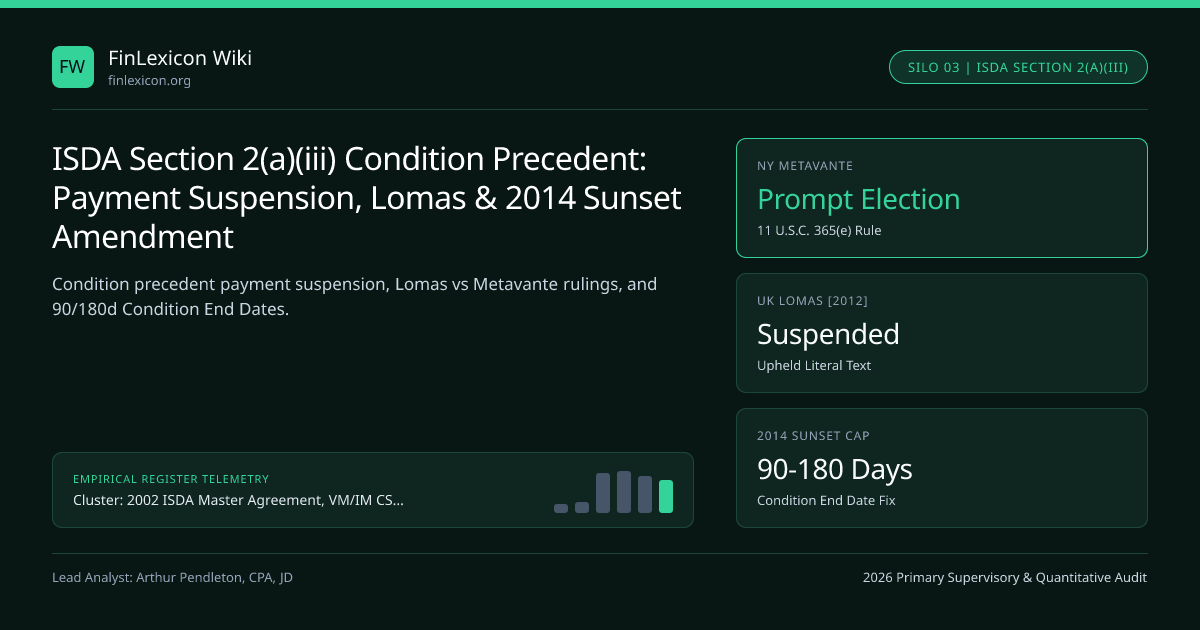
Buried inside sixty words of Section 2(a)(iii) of the 1992 and 2002 ISDA Master Agreements sits one of the most fiercely litigated clauses in financial history. Designed to prevent a solvent counterparty from wiring cash into a black-hole bankruptcy estate ("throwing good money after bad"), Section 2(a)(iii) makes every scheduled swap payment and delivery subject to the condition precedent that no Event of Default or Potential Event of Default with respect to the other party has occurred and is continuing.
How Unamended Section 2(a)(iii) Created "Perpetual Limbo" After Lehman’s 2008 Bankruptcy#
When Lehman Brothers Holdings Inc. and Lehman Brothers International (Europe) filed for insolvency in September 2008, hundreds of out-of-the-money counterparties—corporates, municipalities, and funds that owed net millions to Lehman on interest-rate swaps—made a startling tactical discovery inside the 2002 ISDA Master Agreement architecture:
- Under Section 6(a), electing Early Termination upon an Event of Default is a right, not an obligation, of the Non-Defaulting Party (unless Automatic Early Termination [AET] was switched on in the Schedule!).
- Had those out-of-the-money counterparties designated an Early Termination Date, Section 6(e) two-way close-out netting ("Full Two-Way Payment") would have forced them to pay Lehman’s estate the full positive Close-Out Amount immediately!
- Instead, they refused to terminate and invoked Section 2(a)(iii)—withholding every quarterly fixed-rate swap payment indefinitely while Lehman remained in permanent bankruptcy!
Transatlantic Judicial Split: U.S. Metavante Ruling vs English Court of Appeal Lomas v Firth Rixson#
Lehman’s U.S. Chapter 11 debtors and UK PwC administrators sued in New York and London, producing diametrically opposite precedents across the two governing laws of global OTC swaps:
- *United States (In re Lehman Brothers Holdings Inc. / Metavante, Bankr. S.D.N.Y. 2009): Judge James Peck ruled that under the U.S. Bankruptcy Code (11 U.S.C. §§ 365(e)(1) & 560), although swap safe harbors protect prompt liquidation/termination* of swaps, sitting on an un-terminated swap indefinitely while refusing to pay violates the automatic stay and ipso facto prohibition! Metavante was given a brief "reasonable window" to terminate and pay—or else perform its ongoing swap payments with statutory default interest!
- *England & Wales (Lomas v JFB Firth Rixson Inc., [2012] EWCA Civ 419): The English Court of Appeal enforced the literal freedom-of-contract wording of Section 2(a)(iii)! It held that (a) payment obligations are suspended* (not extinguished once-and-for-all), (b) no implied term forces a Non-Defaulting Party to designate Early Termination within a "reasonable time," and (c) suspended obligations simply fall away if still unpayable at final trade maturity!
Regulatory Backlash & the June 2014 ISDA Section 2(a)(iii) Time-Limit Amendment#
Prudential supervisors—including the UK Prudential Regulation Authority, UK HM Treasury, and BCBS / BIS—warned that indefinite Section 2(a)(iii) payment suspension trapped billions of liquid value away from failing G-SIB estates like Bank of America or BNP Paribas and undermined orderly resolution, threatening to deny regulatory close-out netting capital relief on unamended contracts.
In June 2014, ISDA published the Amendment to the ISDA Master Agreement in respect of Section 2(a)(iii) introducing a contractual "Condition End Date": the defaulting party (or its insolvency administrator) may serve formal notice triggering a negotiated sunset window (typically 90 or 180 calendar days)—by the end of which the Non-Defaulting Party MUST either designate an Early Termination Date or resume paying suspended amounts (with accrued interest)!
| Legal Regime / Contract Version | Can Out-of-Money Party Suspend Indefinitely? | Are Suspended Amounts Extinguished or Deferred? | Trigger to End Limbo | Basel Netting Capital Status |
|---|---|---|---|---|
| 1992 ISDA ("First Method" Walkaway) | Walkaway extinguished full net liability! | Permanently zeroed on close-out | Abolished globally in 2002 ISDA | BANNED under Basel CRE52.20(3)! |
| Unamended 1992/2002 ISDA (NY Law) | NO (Metavante, Bankr. S.D.N.Y. 2009) | Accrues default interest if un-terminated | Automatic stay enforces prompt election | Enforceable via U.S. safe harbors |
| Unamended 1992/2002 ISDA (English Law) | YES (Lomas v Firth Rixson [2012]) | Suspended until default cured or maturity | Only cure of default or final trade expiry | Regulatory capital/resolution risk! |
| 2014 ISDA Sec. 2(a)(iii) Amendment | NO — Capped at Condition End Date | Payable with interest if not closed out | Defaulting party serves Sunset Notice (90/180d) | Full Basel & PRA netting compliance |
Interaction With Credit Support Annexes and Resolution Stay Protocols#
Notice too that under Paragraph 4(a) of the 1995 English Law CSA and Paragraph 4(a) of the 1994 NY Law CSA, delivery of collateral is also subject to conditions precedent! Modern 2016 Variation Margin CSAs and BRRD / U.S. QFC Resolution Stay Protocols tightly bound suspension windows to 24–48 hours during resolution bail-ins.
Drafting Best Practices in Institutional Schedule Negotiations#
Legal and credit teams benchmark Condition End Date elections (90 days dealer-to-dealer vs 180 days institutional buy-side) across the ISDA-2002-CSA Standard and the 2002 ISDA Master Agreement, CSA & SIMM topic hub.
- ConditionEndDate = DateofDefaultingPartyNotice + SunsetDays [ Standard Election: SunsetDays in {90, 180} ]
- Worked Estate Valuation Audit (5Y Pay-Fixed 4.50% Swap on $200M Notional; SOFR falls to 2.00%; Defaulting Bank MTM = +$22.4M):
- Quarterly Net Coupon Owed by Solvent Client to Defaulting Bank = $200M * (4.50% - 2.00%) * 0.25 = $1.25M / quarter
- Without 2014 Amendment (English Law): Client invokes Sec 2(a)(iii) for 20 quarters -> Estate loses $22.4M PV ($25.0M undiscounted)!
- With 90-Day Condition End Date: Administrator serves notice on Day 15 -> By Day 105 Client MUST close out under Sec 6(e) & pay $22.4M!
Frequently asked questions
What is the difference between a prohibited "Walkaway Clause" ("First Method") and Section 2(a)(iii)?
Under the obsolete 1992 ISDA First Method (Walkaway), even *after* terminating the agreement under Section 6, a solvent party owing net money paid $0; under Second Method / 2002 Full Two-Way Payment, once terminated you *must* pay 100% of net owes, which is why holdouts avoided terminating and hid behind Section 2(a)(iii) instead!
Does Section 2(a)(iii) also apply to a Potential Event of Default before a grace period expires?
Yes! That is its essential daily protective purpose: if Counterparty B misses a payment on Monday (starting a 1-Local-Business-Day grace period before becoming an Event of Default), Section 2(a)(iii) lets Counterparty A lawfully pause wiring cash on Monday afternoon during the grace window.
If a non-defaulting party suspends payments under English law and later closes out, do suspended back-coupons enter Section 6(e)?
Yes! *Lomas v Firth Rixson* confirmed that Section 2(a)(iii) merely suspends the payment obligation rather than wiping out the underlying debt; if an Early Termination Date is designated prior to trade maturity, all unpaid past-due coupons enter "Unpaid Amounts" in Section 6(e) with interest!
Why do dealers avoid switching on Automatic Early Termination (AET) in the U.S. and UK if it prevents Section 2(a)(iii) holdouts?
Because AET terminates the entire swap book blindly at the exact microsecond an insolvency petition is filed (often before the solvent bank even knows, leaving the desk unhedged in volatile markets!). AET is switched on only for jurisdictions like Switzerland or Germany where local insolvency law requires automatic termination for netting.
Publication record
- Published
- 14 November 2026
- Updated
- 15 November 2026
- Author
- Arthur Pendleton, CPA, JD
- Review
- Review not recorded
- Automated fact check
- Passed in the stored pipeline record
- Source URLs
- 3 recorded
AI assistance recorded: anthropic/claude-opus-4.6. This field does not establish human review or source verification.
Academic & Institutional Attribution
Cite This Research & Embed Live Data Card
Standard academic & institutional research paper citation format.
Arthur Pendleton, CPA, JD. (2026, November 14). ISDA Section 2(a)(iii) Condition Precedent: Payment Suspension, Lomas & 2014 Sunset Amendment. FinLexicon Wiki. https://finlexicon.org/wiki/isda-section-2a-iii-condition-precedent-payment-suspensionRelated Isda Csa Derivatives Collateral & Institutional Briefings
Explore Isda Csa Derivatives Collateral Hub (20) →Isda Csa Derivatives Collateral
2002 ISDA Master Agreement, VM/IM CSA, ISDA SIMM v2.6, SA-CCR & Close-Out Netting ArchitectureIsda Csa Derivatives Collateral
1992 ISDA Market Quotation & Loss vs 2002 Close-Out Amount: Section 6(e) Early Termination ValuationIsda Csa Derivatives Collateral
ISDA Section 5(a) Events of Default vs Section 5(b) Termination Events: Cross-Default & Threshold AmountsIsda Csa Derivatives Collateral
2016 ISDA Variation Margin CSA: New York Security Interest Pledge vs English Law Title TransferIsda Csa Derivatives Collateral
Uncleared Margin Rules (UMR Phases 1–6): $8B/€8B AANA Calculation & the $50M/€50M IM ThresholdIsda Csa Derivatives Collateral
ISDA SIMM v2.6 / v2.7 Methodology: Delta, Vega, Curvature Risk Weights, Concentration Thresholds & Add-OnsIsda Csa Derivatives Collateral
Regulatory Grid Schedule Initial Margin vs ISDA SIMM: Notional Percentages & the 0.4 + 0.6*NGR FormulaIsda Csa Derivatives Collateral
CSA Minimum Transfer Amounts (MTA <= $500k/€500k), Rounding & Independent Amounts (IA vs Reg IM)Ifrs9 Cecl Credit Provisioning
US GAAP ASC 326 (CECL): Day-One Lifetime Loss, R&S Reversion & ASU 2025-08 M&A Double-Count ReformIfrs9 Cecl Credit Provisioning
IFRS 9 vs CECL Procyclicality in Stress & Basel CET1 Regulatory Capital Transitional Phase-InsIfrs9 Cecl Credit Provisioning
IFRS 9 SICR Quantitative Calibration: Relative Lifetime PD Ratios vs Absolute Basis-Point ThresholdsIfrs9 Cecl Credit Provisioning
IFRS 9 SPPI Cash-Flow Test & May 2024 IASB Amendments: ESG Sustainability-Linked Loans & Non-Recourse Debt
FinLexicon Wiki Data, Benchmarks & Contributor Records
CC BY 4.0 Open Data
Open Institutional Datasets (CSV / JSON) →
Download desk-compiled quantitative series & schemas.
2026 Reference Matrix
2026 Institutional Benchmarks & Thresholds →
Statutory capital, clearing, margin & rate conventions.
Editorial Records
Authors & Review Records →
View named contributors where those records are available.
Complete Index
Master Research & Dossier Archive →
Browse all published briefings by topic pillar & date.