
Ifrs9 Cecl Credit Provisioning
Deferred Tax Assets (IAS 12 & ASC 740 Valuation Allowances) vs Basel III CAP30 10% / 17.65% CET1 Deductions
Huge IFRS 9 / CECL credit provisions and AFS bond losses generate billions in Deferred Tax Assets (DTAs)—yet IAS 12 / ASC 740 valuation allowances can wipe them out in a crisis, explaining why Basel CAP30 deducts NOL DTAs 100% and caps temporary-difference DTAs at 10%/15% of CET1.
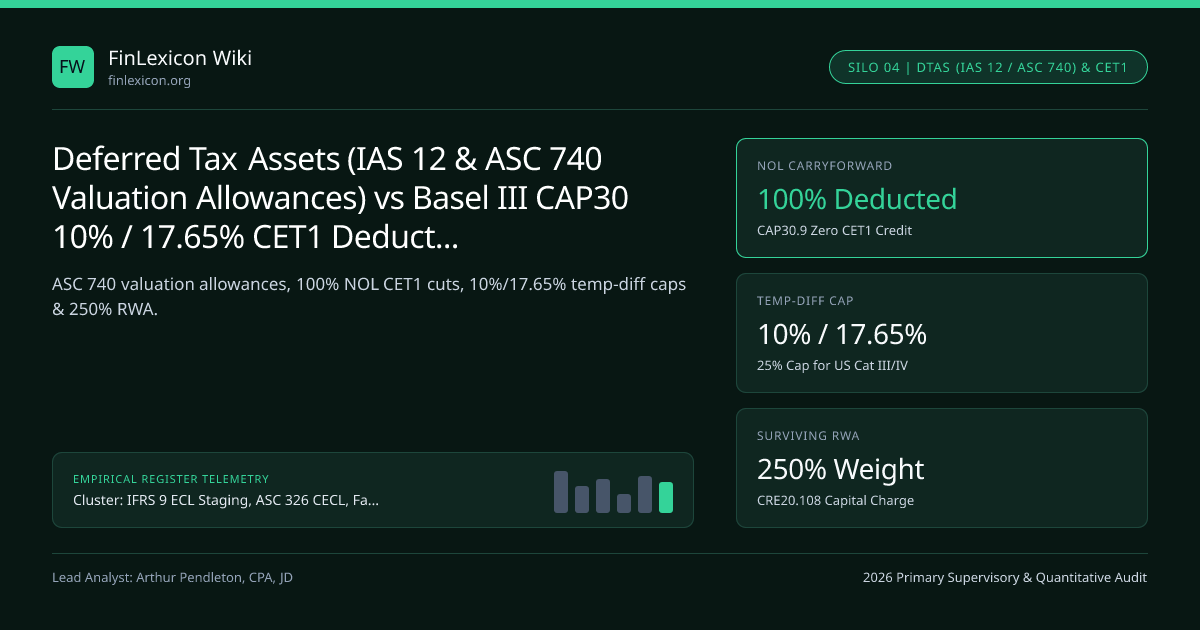
In Q3 2008 and again at Credit Suisse in Q4 2022 (which suffered a CHF 3.7 billion Deferred Tax Asset write-off!), investors learned a brutal solvency lesson: a Deferred Tax Asset (DTA) is only worth anything if the bank survives and earns billions in future taxable profits! The moment a bank enters sustained losses, accounting rules (IAS 12 and US GAAP ASC 740) force an abrupt DTA write-down / Valuation Allowance, vaporizing accounting equity right in the middle of a crisis—which is why Basel III chapter CAP30 imposes strict 100% NOL deductions and 10% / 17.65% threshold caps on bank DTAs!
Accounting Recognition: IAS 12 Net Approach vs US GAAP ASC 740 Gross DTA + Valuation Allowance (>50% Test)#
Bank DTAs arise from two fundamentally different tax sources across Bank of America, BNP Paribas, and Ally Financial, anchored in our IFRS 9, CECL & Fair Value cornerstone guide:
- Unused Tax Loss / Tax Credit Carryforwards (
NOLs): Past cumulative tax losses waiting for future taxable profits. - Deductible Temporary Differences (
Timing DTAs): Expenses already booked in GAAP/IFRS financial statements that tax authorities only allow as deductions later—above all IFRS 9 / CECL Loan Loss Allowances (only deductible upon actual charge-off in the U.S./UK!) and unrealized AFS/FVOCI bond losses!
Although IAS 12.24 (recognize net DTA only to the extent "probable") and US GAAP ASC 740-10-30-5 (recognize 100% Gross DTA, then book a contra-asset Valuation Allowance if "more likely than not" [>50%] some portion won’t be realized) arrive at identical net numbers, ASC 740-10-30-21’s "Three-Year Cumulative Loss" Negative Evidence Rule is lethal: once a U.S. bank enters a 3-year cumulative pre-tax loss, positive management profit forecasts are almost completely discounted—forcing a sudden multi-billion-dollar Valuation Allowance charge!
Basel III CAP30.9 vs CAP30.32–34: The Three Prudential Tiers of Bank DTAs#
Supervised by the Federal Reserve, ECB, and APRA, Basel III CAP30 splits DTAs (after netting jurisdiction-matched Deferred Tax Liabilities DTLs, excluding DTLs already netted against goodwill/intangibles!) into three sharply different capital treatments:
- NOL / Unused Tax Credit Carryforward DTAs (
CAP30.9— 100% Deducted From CET1!): Zero threshold relief! Every dollar of net NOL DTA is deducted 1-for-1 straight out of Common Equity Tier 1. - Government-Guaranteed / Refundable Tax Credit DTAs (
Southern European "Law-Converted" DTAs—100%Risk Weight, No Deduction!): In Italy, Spain, and Greece, statutory laws converted certain loan-loss DTAs into sovereign-payable tax credits even in liquidation or tax loss (non-profitability-dependent) -> risk-weighted at100%RWA (or stricter ECB CRR phase-out rules for post-2014 originations). - Temporary-Difference DTAs Relying on Future Profitability (
CAP30.32–34—10%Individual &15%/17.65%Basket Threshold!):
- Tested alongside Mortgage Servicing Rights (
MSRs) and Significant (>10%) Financial Institution CET1 Investments! - Individual Cap: Deduct excess above
10%of pre-threshold adjusted CET1. - Combined
15%(17.65%Operational) Basket Cap: Combined survivingTemp-Diff DTAs + MSRs + Sig. FI Equitycannot exceed15%of final CET1 (mathematically17.65%=15 / 85of pre-basket CET1!). - Punitive RWA on Surviving Threshold Slice (
CRE20.108): Whatever survives inside the10% / 17.65%cap is risk-weighted at250%RWA!
The U.S. 2019 Capital Simplification Rule (25% Cap for Category III & IV Regional Banks!)#
Watch a critical U.S. regulatory divergence: while U.S. Category I & II G-SIBs (Bank of America) remain subject to the strict Basel 10% / 15% (17.65%) threshold (250% RWA), the Federal Reserve/OCC/FDIC 2019 Capital Simplification Rule gave Non-Advanced Category III & IV U.S. banks (e.g., Ally Financial) a generous 25% individual CET1 threshold for Temporary-Difference DTAs (250% RWA below 25%)!
Deferred Tax Asset (DTA) Category | Primary Originating Accounting Driver | IAS 12 / ASC 740 Fragility | Basel CAP30 G-SIB CET1 Rule | Surviving CRE20 RWA |
|---|---|---|---|---|
| NOL & Tax Credit Carryforwards | Prior fiscal-year taxable losses | Extreme (Credit Suisse CHF 3.7B write-off!) | 100% Immediate CET1 Deduction | N/A (0 Surviving) |
Temp-Diff DTAs (Loan Loss ECL) | IFRS 9 / CECL allowances pre-charge-off | Moderate (reverses as loans default/pay) | 10% Ind. / 17.65% Basket Cap | 250% RWA |
Temp-Diff DTAs (AFS / FVOCI Bonds) | Unrealized rate markdowns in AOCI | Low if held to par (ASC 740 tax-strategy) | 10% Ind. / 17.65% Basket Cap! | 250% RWA |
| Refundable Sovereign-Payable DTAs | Statutory Law-Converted DTAs (IT/ES) | Backed by sovereign fiscal claim | 0% Deduction (Not profit-reliant) | 100% RWA |
The 2022–2023 Rate-Hike Trap: How AFS Unrealized Bond Losses Bloated Temporary-Difference DTAs Past 10%!#
When +500 bps rate hikes created -$100B+ pre-tax unrealized AFS bond losses at U.S. banks in 2022–2023, they simultaneously booked +$25B+ in Temporary-Difference AFS DTAs—pushing several banks straight over their 10% CET1 DTA cap and multiplying the CET1 capital hit (double penalty!) across the IFRS 9, CECL & Fair Value Accounting topic hub!
Prohibiting Double-Counting of DTL Netting Across Goodwill & Threshold DTAs (CAP30.10)#
Under Basel CAP30.10, if a bank nets $800M of intangible DTLs to reduce its Goodwill/Intangible CET1 deduction, those $800M DTLs cannot be netted a second time against Temporary-Difference DTAs—and any DTA netting must match the exact same national tax authority and distribute pro-rata between NOL DTAs and Temporary-Difference DTAs!
- DTATempDiffNet = DTATempDiffGross - DTLEligible * [ DTATempDiffGross / ( DTANOLGross + DTATempDiff_Gross ) ]
- CET1PreThresh = CET1Gross - GoodwillIntang - DTANOLNet - OtherCAP30FullDeductions
- Ind10pctCut = max( 0 , DTATempDiffNet - 0.10 * CET1PreThresh ) + max( 0 , MSR - 0.10 * CET1PreThresh ) + max( 0 , SigFI - 0.10 * CET1_PreThresh )
- Basket1765Cut = max( 0 , Surviving3Items - (15 / 85) * ( CET1PreThresh - Ind10pct_Cut ) )
Frequently asked questions
Where does the strange "17.65%" number come from in Basel III’s 15% Combined Threshold Deduction?
Basel CAP30.33 caps the sum of surviving Temp-Diff DTAs + MSRs + Sig. FI CET1 at 15% of FINAL post-deduction CET1 (after deducting the basket excess itself!). Algebraically, if those 3 items equal 15% of total CET1, all *other* clean CET1 equals 85%—and 15 / 85 = 17.647% (~17.65%) of pre-basket CET1!
When a corporate tax rate is CUT (like the U.S. 2017 TCJA cutting corporate tax from 35% to 21%), does that help or hurt bank CET1?
It immediately HURTS bank accounting earnings and CET1 on Day 1! Under IAS 12.47 and ASC 740-10-35-4, DTAs are measured at enacted future tax rates: cutting the corporate tax rate from 35% to 21% slashed the value of existing bank DTAs by -40% (14 / 35) overnight (Citigroup alone booked a -$22B one-day TCJA DTA write-down in Q4 2017!).
Do unrealized AFS bond losses require an ASC 740 Valuation Allowance on the resulting DTA when a bank has no taxable operating profit?
Usually NO, provided the bank has the intent and liquidity ability to hold the AFS bonds to par maturity! Because a fixed-rate U.S. Treasury par redemption mathematically pulls the unrealized mark-to-market loss back to $0 (zero realized tax deduction needed at maturity!), ASC 740 / SEC staff guidance lets banks avoid an AFS DTA Valuation Allowance—though Basel CAP30 still subjects that AFS DTA to the 10% CET1 cap!
Why did Southern European banks convert billions of loan-loss DTAs into "Tax Credits" (DTAs not relying on future profitability)?
Italian (Law 214/2011), Spanish (RDL 14/2013), and Greek laws statutorily guaranteed that if a bank posted an accounting loss or entered liquidation, loan-loss DTAs automatically converted into cash-refundable sovereign tax credits—escaping the 10% CET1 deduction under CAP30 (weighted at 100% RWA), though EU State-Aid compromises later charged annual guarantee fees to the state.
Publication record
- Published
- 13 November 2026
- Updated
- 15 November 2026
- Author
- Arthur Pendleton, CPA, JD
- Review
- Review not recorded
- Automated fact check
- Passed in the stored pipeline record
- Source URLs
- 3 recorded
AI assistance recorded: anthropic/claude-opus-4.6. This field does not establish human review or source verification.
Academic & Institutional Attribution
Cite This Research & Embed Live Data Card
Standard academic & institutional research paper citation format.
Arthur Pendleton, CPA, JD. (2026, November 14). Deferred Tax Assets (IAS 12 & ASC 740 Valuation Allowances) vs Basel III CAP30 10% / 17.65% CET1 Deductions. FinLexicon Wiki. https://finlexicon.org/wiki/deferred-tax-assets-ias-12-asc-740-valuation-allowance-cet1Related Ifrs9 Cecl Credit Provisioning & Institutional Briefings
Explore Ifrs9 Cecl Credit Provisioning Hub (20) →Ifrs9 Cecl Credit Provisioning
IFRS 9 Expected Credit Loss, US GAAP ASC 326 CECL, Fair Value Hierarchy & Hedge Accounting GuideIfrs9 Cecl Credit Provisioning
Held-to-Maturity (HTM) Tainting (ASC 320), IFRS 9.4.4.1 Reclassification & AFS/FVOCI Bond Loss RulesIfrs9 Cecl Credit Provisioning
IFRS 9 Stage 1, Stage 2 & Stage 3 ECL Migration: 12-Month vs Lifetime PD, Net Interest & Cure RulesIfrs9 Cecl Credit Provisioning
US GAAP ASC 326 (CECL): Day-One Lifetime Loss, R&S Reversion & ASU 2025-08 M&A Double-Count ReformIfrs9 Cecl Credit Provisioning
IFRS 9 vs CECL Procyclicality in Stress & Basel CET1 Regulatory Capital Transitional Phase-InsIfrs9 Cecl Credit Provisioning
IFRS 9 SICR Quantitative Calibration: Relative Lifetime PD Ratios vs Absolute Basis-Point ThresholdsIfrs9 Cecl Credit Provisioning
IFRS 9 SPPI Cash-Flow Test & May 2024 IASB Amendments: ESG Sustainability-Linked Loans & Non-Recourse DebtIfrs9 Cecl Credit Provisioning
POCI (IFRS 9) vs PCD (US GAAP ASC 326): Purchased Credit-Impaired Accounting, Gross-Up & CAEIRCentral Clearing Ccp Waterfall
CCP Initial Margin Models (Expected Shortfall vs SPAN 2): 5-Day House vs 7-Day Client MPOR & PortingMonetary Policy
Japan's current account surplus and corporate adjustmentMonetary Policy
One policy, many realities - why differences matter for monetary policyCryptocurrency News
Tether Gold Gets Clean KPMG Audit Confirming $2.2B in Physical Gold Backing
FinLexicon Wiki Data, Benchmarks & Contributor Records
CC BY 4.0 Open Data
Open Institutional Datasets (CSV / JSON) →
Download desk-compiled quantitative series & schemas.
2026 Reference Matrix
2026 Institutional Benchmarks & Thresholds →
Statutory capital, clearing, margin & rate conventions.
Editorial Records
Authors & Review Records →
View named contributors where those records are available.
Complete Index
Master Research & Dossier Archive →
Browse all published briefings by topic pillar & date.