
Ifrs9 Cecl Credit Provisioning
Held-to-Maturity (HTM) Tainting (ASC 320), IFRS 9.4.4.1 Reclassification & AFS/FVOCI Bond Loss Rules
Transferring $100B+ of Treasury and MBS books from Available-for-Sale (AFS) to Held-to-Maturity (HTM) shielded GAAP equity in 2022—until ASC 320 HTM sales tainting locked Silicon Valley Bank out of selling underwater bonds without tainting its whole balance sheet!
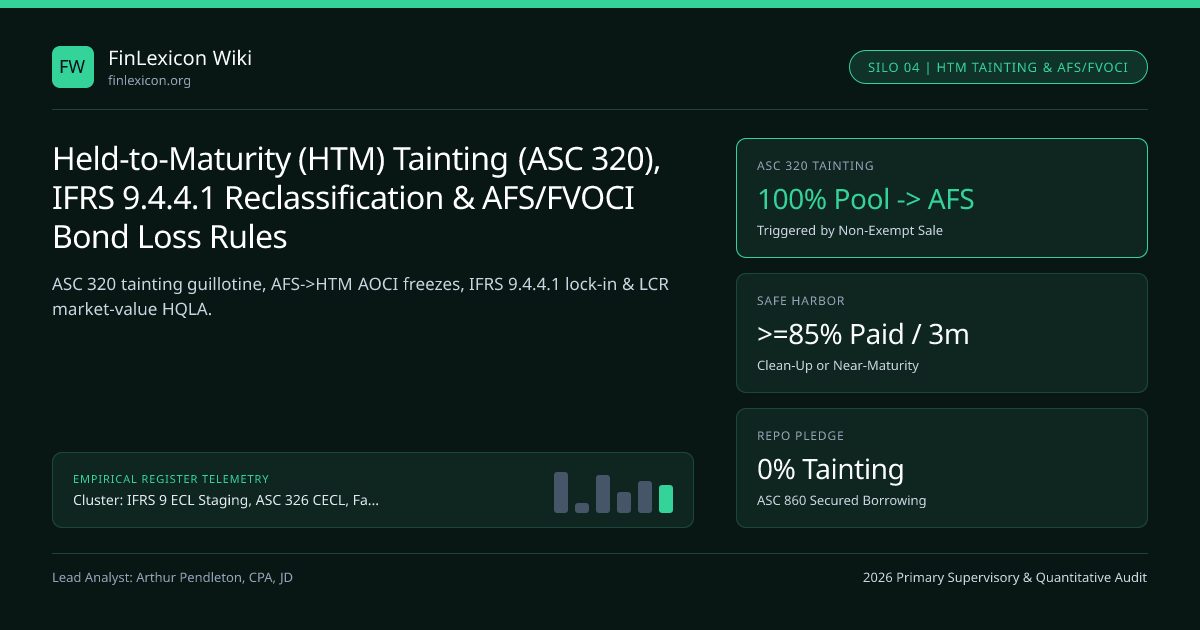
Nothing illustrates the life-or-death link between accounting classification and bank liquidity runs more vividly than March 2023: Silicon Valley Bank held $91.3 billion of long-duration agency MBS inside Held-to-Maturity (HTM under US GAAP ASC 320) carrying -$15.1 billion in unrecognized fair-value losses (exceeding its entire $12B tangible common equity!). Selling even $5 billion of that $91.3B HTM book to raise cash would have triggered ASC 320 HTM Tainting—legally forcing the bank to reclassify the remaining $86.3 billion into AFS overnight and crystallizing -$15.1B of equity destruction on the spot!
US GAAP ASC 320 (HTM vs AFS) vs IFRS 9.4.1 (Amortized Cost vs FVOCI): Where Tainting Lives Today#
Compare how US GAAP (ASC 320) and IFRS 9 (Section 4.1 & 4.4) police bond portfolios across Bank of America, BNP Paribas, and Bank of Montreal, anchored in our IFRS 9, CECL & Fair Value cornerstone guide:
- US GAAP
ASC 320-10-25(Strict Intent + Ability + Tainting Penalty):
- Classifying a debt security as Held-to-Maturity (
HTM) requires both positive intent AND financial ability to hold until maturity. - The HTM Tainting Guillotine (
ASC 320-10-35-8..9): Selling or transferring any HTM security before maturity—unless inside narrow statutory safe harbors (within 3 months of maturity,after >=85% principal paydown cleanup,isolated severe issuer credit deterioration, orstatutory regulatory capital rule change)—taints the ENTIRE remaining HTM portfolio, forcing immediate reclassification toAFS(marking 100% to AOCI!) and typically barring new HTM designations for 2 years!
- IFRS 9 (
Abolished IAS 39 HTM Tainting — Replaced With Rare Business-Model Gate!):
- IFRS 9 abolished IAS 39’s bright-line 2-year HTM tainting rule! Instead, Amortized Cost (
Hold-to-Collect) permits sales due to credit deterioration freely, and tolerates infrequent or insignificant liquidity sales (IFRS 9.B4.1.3B). - However,
IFRS 9.4.4.1makes Reclassification nearly impossible: while US GAAP lets banks transferAFS -> HTMwhenever management’s intent changes on individual bonds, IFRS 9 allows reclassification ONLY when an entity shuts down or acquires a major line of business (prospectively from the first day of the next reporting period—occurring once a decade!).
The Great 2021–2022 AFS -> HTM Transfer Illusion (ASC 320-10-35-10(c))#
In 2021–2022, U.S. banks transferred over $500 billion of agency MBS and Treasuries from AFS into HTM as yields rose. Watch the ASC 320-10-35-10(c) double-entry trap that fools novice analysts:
- Suppose an
AFSbond (Par = $100,FV = $90,Pre-Tax AOCI = -$10) is transferred toHTMtoday. - On transfer day, the bond enters
HTMat$90Fair Value (creating a -$10 carrying discount), while the-$10unrealized loss stays frozen insideAOCI! - Over the remaining 8 years, the
$90HTM carrying amount accretes up to$100(+$1.25/yrinterest yield boost), AND the-$10frozenAOCIamortizes out (+$1.25/yrinterest yield drag)—canceling out 1-for-1 ($0net yield boost!), while merely shielding FUTURE post-transfer rate drops ($90 -> $80) fromAOCI!
Impairment of Underwater AFS / FVOCI Bonds: ASC 326-30 Intent-to-Sell Floor vs IFRS 9 Stage 1/2/3#
What if an underwater AFS (US GAAP) or FVOCI (IFRS 9) bond suffers credit risk or forced sale?
- US GAAP
ASC 326-30(AFS Debt Securities — Excluded From Pooled CECL!):
- Intent to Sell / More-Likely-Than-Not Forced to Sell Before Recovery (
ASC 326-30-35-10): Immediate 100% write-down of the ENTIRE fair-value loss (including interest-rate markdown!) straight into Profit or Loss (zero allowance—permanent cost-basis cut!)! - No Intent/Forced Sale, But Credit Loss Exists (
PV of cash flows < Amortized Cost): Book an AFS Credit Allowance in P&L, capped at the fair-value floor (Amortized Cost minus Fair Value)!
- IFRS 9 (
FVOCIDebt): Applies the exact same Stage 1 / Stage 2 / Stage 3 ECL model as Amortized Cost loans—recording the ECL charge in P&L with the offsetting credit entry insideOCI(leaving the balance-sheet bond carrying amount at exact Fair Value!).
| Portfolio Dimension | US GAAP HTM (ASC 320 + ASC 326-20) | US GAAP AFS (ASC 320 + ASC 326-30) | IFRS 9 Amortized Cost (HTC) | IFRS 9 FVOCI (HTCS) |
|---|---|---|---|---|
| Balance-Sheet Carrying Value | Amortized Cost (Net of CECL) | Fair Value (Unrealized in AOCI) | Amortized Cost (Net of Stage 1/2/3) | Fair Value (Unrealized in OCI) |
| Basel CET1 Rate-Loss Impact | 0% (Shielded unless sold/tainted!) | 100% in CET1 (EU/UK/CA + US Cat I–II; Endgame: >$100B!) | 0% (Shielded unless sold) | 100% in CET1 (Post-2018 AOCI Rule) |
| Credit Impairment Engine | Pooled ASC 326-20 CECL (0% on US Treasuries!) | Security-level ASC 326-30 (FV Floor; Intent-to-Sell = 100% P&L!) | Stage 1 (12m) / Stage 2–3 (Lifetime) | Stage 1/2/3 ECL (P&L vs OCI offset) |
| Sales Tainting / Reclassification | 1 Non-Exempt Sale Taints Entire Pool! | Transferable to HTM (freezes prior AOCI) | No bright-line taint; reclassification nearly banned | Free sales; reclassification nearly banned |
Prudential Liquidity (LCR HQLA) vs Capital (Basel III Endgame AOCI Filter Removal)#
Crucial prudential paradox supervised by the Federal Reserve and FDIC: HTM U.S. Treasuries still count in LCR Level 1 HQLA ONLY at current Market Value ($80, NOT $100 HTM book value!)—and must be monetized via repo (FICC / Fed Standing Repo Facility) rather than outright cash sale (to avoid ASC 320 tainting!) across the IFRS 9, CECL & Fair Value Accounting topic hub! Meanwhile, U.S. Basel III Endgame proposals extend mandatory AFS AOCI inclusion in CET1 down from Category I/II (>$700B) to all Category III & IV banks (>$100B assets) (while HTM stays un-marked in CET1!).
Footnote Fair-Value Transparency (IFRS 7.25 & ASC 825-10-50-10)#
Even though HTM / Amortized Cost bonds sit at historical cost on the balance sheet, both IFRS 7.25 and ASC 825-10-50-10 require quarterly footnote disclosure of their exact Level 1/2/3 Fair Value—allowing markets to compute Marked-to-Market Tangible Common Equity alongside Portfolio Layer macro hedges and AFS Deferred Tax Asset CET1 caps!
- HTMCarrying(t=0) = $90 (Discount = -$10 accretes +EIRDisc(t) to NII) AND FrozenAOCI(t=0) = -$10 (amortizes -EIRDisc(t) from AOCI to NII)
- NetNIIYieldImpact(t) = +AccretionHTMDiscount(t) - AmortizationFrozen_AOCI(t) = $0.00 (Pure Future-AOCI Volatility Shield!)
- US GAAP ASC 326-30 AFS Impairment Decision:
- If IntentToSell OR Prob(ForcedSaleBeforeRecovery) > 50% => PnLWriteDown = AmortizedCost - FairValue (100% Rate + Credit Loss!)
- Else If PVCreditCashFlows < AmortizedCost => AFSCECLAllowance = min( AmortizedCost - PVCF , AmortizedCost - Fair_Value )
Frequently asked questions
Does pledging Held-to-Maturity (HTM) Treasuries in a bilateral/FICC Repo or at the Fed Standing Repo Facility trigger ASC 320 tainting?
NO! So long as a standard repurchase agreement (Repo) or central-bank collateral pledge is accounted for as a secured borrowing (ASC 860) rather than a true sale (because the bank retains obligation/right to repurchase substantially the same security), repo monetization does NOT taint an HTM portfolio!
Why do U.S. Treasury bonds in an HTM portfolio have $0.00 CECL allowance under US GAAP ASC 326-20?
ASC 326-20-30-10 ("Zero-Loss Expectation" guidance) recognizes that for sovereign securities backed by the full faith and credit of the U.S. Treasury (with a multi-century zero-default history and sovereign currency-issuance power), historical + current + R&S credit loss expectation equals $0.00!
Why couldn’t European IFRS banks copy U.S. banks’ 2022 trick of shifting EUR 500B of FVOCI bonds into Amortized Cost?
Because IFRS 9.4.4.1 & B4.4.3 explicitly state that a change in management intention (even amidst rising interest rates or market turmoil) is NOT a reclassification event—an IFRS bank can reclassify FVOCI -> Amortized Cost *only* upon a verifiable restructuring of external business operations demonstrable to external parties!
What happens under US GAAP ASC 326-30 when deposit outflows make it >50% likely a bank must sell underwater AFS bonds next quarter?
Even *before* a single bond is sold, crossing the >50% more-likely-than-not forced-sale threshold (ASC 326-30-35-10) forces the bank to dump 100% of the unrealized interest-rate loss out of AOCI straight into quarterly Net Income (crystallizing an immediate CET1 hit even for smaller AOCI-opt-out banks!)!
Publication record
- Published
- 13 November 2026
- Updated
- 15 November 2026
- Author
- Arthur Pendleton, CPA, JD
- Review
- Review not recorded
- Automated fact check
- Passed in the stored pipeline record
- Source URLs
- 4 recorded
AI assistance recorded: anthropic/claude-opus-4.6. This field does not establish human review or source verification.
Academic & Institutional Attribution
Cite This Research & Embed Live Data Card
Standard academic & institutional research paper citation format.
Arthur Pendleton, CPA, JD. (2026, November 14). Held-to-Maturity (HTM) Tainting (ASC 320), IFRS 9.4.4.1 Reclassification & AFS/FVOCI Bond Loss Rules. FinLexicon Wiki. https://finlexicon.org/wiki/htm-tainting-reclassification-afs-fvoci-amortized-cost-rulesRelated Ifrs9 Cecl Credit Provisioning & Institutional Briefings
Explore Ifrs9 Cecl Credit Provisioning Hub (20) →Ifrs9 Cecl Credit Provisioning
IFRS 9 Expected Credit Loss, US GAAP ASC 326 CECL, Fair Value Hierarchy & Hedge Accounting GuideIfrs9 Cecl Credit Provisioning
IFRS 9 Stage 1, Stage 2 & Stage 3 ECL Migration: 12-Month vs Lifetime PD, Net Interest & Cure RulesIfrs9 Cecl Credit Provisioning
US GAAP ASC 326 (CECL): Day-One Lifetime Loss, R&S Reversion & ASU 2025-08 M&A Double-Count ReformIfrs9 Cecl Credit Provisioning
IFRS 9 vs CECL Procyclicality in Stress & Basel CET1 Regulatory Capital Transitional Phase-InsIfrs9 Cecl Credit Provisioning
IFRS 9 SICR Quantitative Calibration: Relative Lifetime PD Ratios vs Absolute Basis-Point ThresholdsIfrs9 Cecl Credit Provisioning
IFRS 9 SPPI Cash-Flow Test & May 2024 IASB Amendments: ESG Sustainability-Linked Loans & Non-Recourse DebtIfrs9 Cecl Credit Provisioning
POCI (IFRS 9) vs PCD (US GAAP ASC 326): Purchased Credit-Impaired Accounting, Gross-Up & CAEIRIfrs9 Cecl Credit Provisioning
IFRS 13 & US GAAP ASC 820 Fair Value Hierarchy: Exit Price, Principal Market & Level 1 / 2 / 3 TransfersMonetary Policy
Japan's current account surplus and corporate adjustmentMonetary Policy
One policy, many realities - why differences matter for monetary policyCryptocurrency News
Tether Gold Gets Clean KPMG Audit Confirming $2.2B in Physical Gold BackingRegulatory and Market Glossary
Are Alt-L1s over? Security, costs drive smaller chains to Ethereum
FinLexicon Wiki Data, Benchmarks & Contributor Records
CC BY 4.0 Open Data
Open Institutional Datasets (CSV / JSON) →
Download desk-compiled quantitative series & schemas.
2026 Reference Matrix
2026 Institutional Benchmarks & Thresholds →
Statutory capital, clearing, margin & rate conventions.
Editorial Records
Authors & Review Records →
View named contributors where those records are available.
Complete Index
Master Research & Dossier Archive →
Browse all published briefings by topic pillar & date.