
Basel Iii Endgame Capital Ratios
BCBS d424 72.5% Standardized RWA Output Floor: Phase-In Mechanics & Capital Impact
Under Basel RBC20.11, internal-model banks must floor aggregate risk-weighted assets at 72.5% of standardized RWA, curbing IRB capital relief on low-default mortgages and unrated corporates across prudential banking.
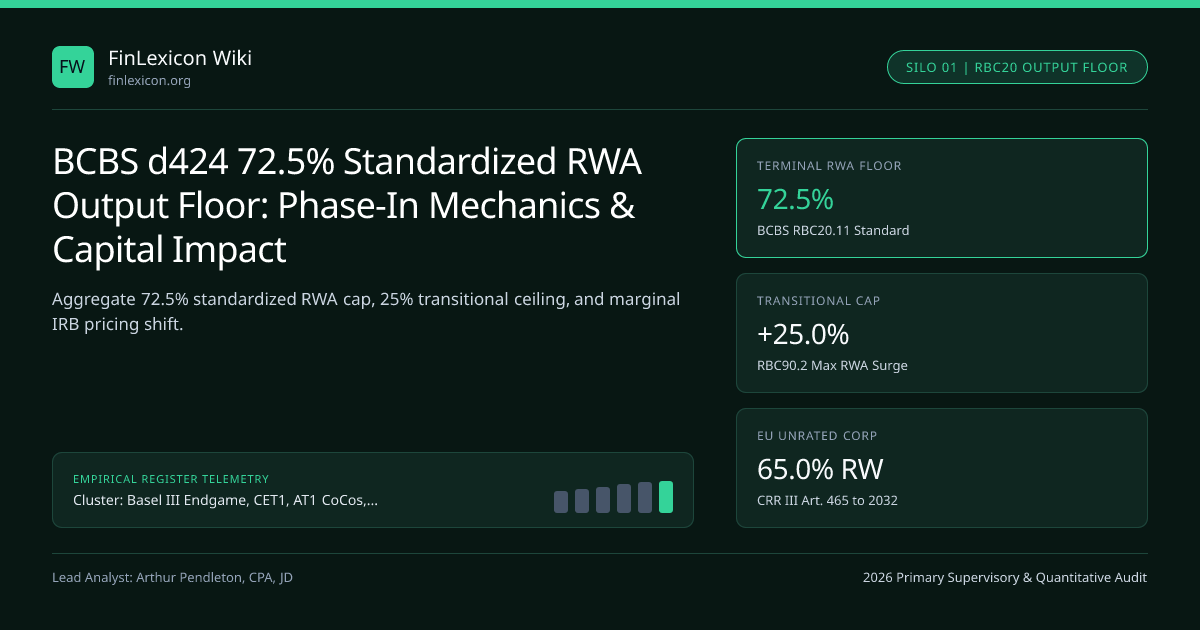
Codified in Basel Framework paragraph RBC20.11 (originating in BCBS d424), the aggregate output floor prevents internal-model risk-weighted assets from dropping below 72.5% of the capital denominator calculated strictly under standardized credit, counterparty, market, and operational risk rules. Monitored across the Basel III 72.5% RWA Output Floor benchmark and its 2026 institutional benchmark standard, the rule eliminates single-asset-class model arbitrage while preserving a maximum 27.5% aggregate RWA discount relative to non-modeled standardized banks.
Why BCBS Replaced the Legacy Basel II 80% Transitional Floor#
Under Basel II paragraph 45, supervisors originally imposed an 80% capital floor anchored to the 1988 Basel I accord. Over time, divergent national waivers—including complete expiration in several European jurisdictions versus permanent statutory codification in the United States under Section 171 of the Dodd-Frank Act (the Collins Amendment)—shattered cross-border comparability. As documented in the Basel III Endgame & CET1 cornerstone guide, BIS Hypothetical Portfolio Exercises demonstrated that two G-SIBs holding identical investment-grade corporate revolving loans could report modeled risk weights ranging from 14% to 52%.
RBC20.11 resolves this discrepancy by benchmarking modeled capital denominators against the modernized Basel III Standardized Approach rather than obsolete Basel I buckets. Because the floor applies at the consolidated group aggregate level (though EU CRR III initially debated sub-consolidated application), standardized excesses in one portfolio can partially offset deep internal-model discounts in another.
Five-Year Phase-In Trajectory and the 25% Transitional RWA Inflation Cap#
BCBS d424 designed a six-step linear ramp starting at 50% and stepping through 55%, 60%, 65%, and 70% before reaching the permanent 72.5% steady state. During the transition window, paragraph RBC90.2 grants national authorities discretion to cap incremental RWA expansion attributable solely to the output floor at 25% of a bank’s pre-floor RWA.
Put concretely, if a mortgage-heavy lender supervised by De Nederlandsche Bank or Oesterreichische Nationalbank reports EUR 100 billion of modeled RWA against EUR 190 billion of standardized RWA, a raw 72.5% floor would jump RWA to EUR 137.75 billion (+37.75%); during transition, the supervisory cap limits the floored RWA to EUR 125 billion (+25%) until terminal implementation.
Cross-Asset Aggregation Across Credit, SA-CCR, CVA, FRTB, and SMA#
Calculating the standardized comparator requires running parallel risk engines across six regulatory pillars: Standardized Credit Risk (CRE20 LTV residential and commercial real estate rules), Standardized Counterparty Credit Risk (SA-CCR), Securitization External Ratings or Standardized Approach (SEC-ERBA/SEC-SA), Credit Valuation Adjustment (BA-CVA/SA-CVA), FRTB Standardized Sensitivities-Based Method (MAR21), and SMA operational risk.
Crucially, IRB expected loss (EL) provisions interact asymmetrically with the floor. Under modeled IRB, accounting credit provisions exceeding regulatory expected loss can be added back to Tier 2 capital up to 0.6% of credit RWA, whereas standardized RWA allows general credit risk adjustments in Tier 2 up to 1.25% of standardized credit RWA—requiring careful reconciliation when the floor becomes the binding denominator.
| Banking Cohort / Institution Profile | Typical Modeled IRB Density | Full Standardized Density | 72.5% Floored Density | Primary Binding Regime |
|---|---|---|---|---|
| Benelux / Nordic Prime Mortgage Lender (ASN Bank) | 11.5% RWA / Exposure | 26.0% RWA / Exposure | 18.85% (+63.9% RWA jump) | 72.5% Output Floor Binds Hard |
| Eurozone Universal Bank (BNP Paribas) | 28.4% RWA / Exposure | 46.0% RWA / Exposure | 33.35% (+17.4% RWA jump) | CRR III Output Floor Binds |
| U.S. Category I G-SIB (Bank of America) | 39.2% Advanced RWA | 44.5% Collins SA RWA | 44.50% (100% Collins SA) | U.S. Collins / ERBA 100% Floor |
| APAC Regional Commercial Bank (ANZ Bank) | 34.0% APRA IRB Floor | 45.0% Standardized RWA | 34.00% (above 32.63% floor) | APRA Narrowed IRB Scalars |
Portfolio Divergence: European Low-LGD Mortgage Books vs U.S. Collins Floor Banks#
Output floor bite varies dramatically by business model and regional credit structure. For U.S. Category I and II institutions supervised under 12 CFR Part 217 and the U.S. ERBA dual-requirement regime, the Dodd-Frank Collins Amendment already enforces a 100% standardized RWA floor on minimum capital ratios, meaning a 72.5% international floor is less restrictive than existing domestic law.
By contrast, European universal banks such as BNP Paribas and Irish or UK retail lenders like Bank of Ireland and Bank of Scotland historically held prime residential mortgages at 8%–12% A-IRB risk weights and large unrated corporate loans at 25%–35% modeled weights. Under CRR III, unrated corporates without external credit ratings jump to a 100% standardized weight (subject to a temporary 65% transitional concession through 2032 where IRB PD does not exceed 0.50%).
Synthetic Risk Transfer (SRT) Optimization and Portfolio Repricing Dynamics#
Once the 72.5% floor binds, marginal RWA on any newly originated loan equals 72.5% of its standardized risk weight rather than 100% of its internal-model weight. Consequently, low-margin prime mortgages and investment-grade unrated corporate revolvers lose return-on-RWA attractiveness relative to higher-yielding SME or rated bond exposures. Treasury capital desks covered in the Basel III Endgame & Capital Ratios hub increasingly execute funded credit-linked note SRT transactions under SEC-SA to trim standardized RWA denominators alongside modeled RWA.
- MarginalRWAi = 0.725 * RWSAi (whenever 0.725 * RWASA > RWAModeled)
- Worked Portfolio Example (EUR 250B Prime Mortgage & Corporate Bank, Steady State phi = 0.725):
- RWAModeled = EUR 62.0B | RWASA = EUR 108.0B
- Floored Target = 0.725 * EUR 108.0B = EUR 78.30B
- Output Floor RWA Add-On = EUR 78.30B - EUR 62.0B = +EUR 16.30B (+26.29% RWA Inflation)
- At a 11.0% CET1 target, incremental equity required = 0.11 * EUR 16.30B = EUR 1.793B
Frequently asked questions
Does the 72.5% output floor apply asset-class by asset-class or at the total bank level?
Under BCBS RBC20.11, the 72.5% floor is evaluated across aggregate bank-wide RWA—combining credit, counterparty, CVA, securitization, market, and operational risk—not separately per individual asset class or desk.
Why are European mortgage and corporate banks hit harder by the 72.5% floor than U.S. G-SIBs?
U.S. banks retain agency securitization channels (Fannie Mae/Freddie Mac) off balance sheet and already face a 100% standardized floor under the Dodd-Frank Collins Amendment, whereas European banks retain low-default mortgages on balance sheet at ~10% IRB weights and lend heavily to unrated corporates.
How does EU CRR III treat unrated investment-grade corporates in the output floor denominator?
Article 465 of CRR III grants a transitional arrangement through December 31, 2032 allowing IRB banks to assign a 65% standardized risk weight (instead of 100%) to unrated corporate entities whose internal one-year PD is less than or equal to 0.50%.
Can operational risk or CVA internal models reduce RWA below the 72.5% floor?
No. BCBS d424 abolished internal operational risk (AMA) and internal CVA models altogether; both SMA operational risk and BA-CVA/SA-CVA enter both the modeled and standardized totals identically, concentrating floor sensitivity in credit and FRTB market risk.
Publication record
- Published
- 15 November 2026
- Updated
- 15 November 2026
- Author
- Arthur Pendleton, CPA, JD
- Review
- Review not recorded
- Automated fact check
- Passed in the stored pipeline record
- Source URLs
- 4 recorded
AI assistance recorded: anthropic/claude-opus-4.6. This field does not establish human review or source verification.
Academic & Institutional Attribution
Cite This Research & Embed Live Data Card
Standard academic & institutional research paper citation format.
Arthur Pendleton, CPA, JD. (2026, November 15). BCBS d424 72.5% Standardized RWA Output Floor: Phase-In Mechanics & Capital Impact. FinLexicon Wiki. https://finlexicon.org/wiki/bcbs-d424-72-5-percent-standardized-rwa-output-floorRelated Basel Iii Endgame Capital Ratios & Institutional Briefings
Explore Basel Iii Endgame Capital Ratios Hub (20) →Basel Iii Endgame Capital Ratios
Basel III Endgame (BCBS d424), CET1 Capital Adequacy, 72.5% Output Floor & TLAC ArchitectureBasel Iii Endgame Capital Ratios
CET1 Regulatory Deductions (CAP30): Goodwill, DTAs, MSRs & the 10%/15% Threshold RuleBasel Iii Endgame Capital Ratios
AT1 Contingent Convertibles (CoCos): 5.125% vs 7.0% Triggers, Write-Down & PONV HierarchyBasel Iii Endgame Capital Ratios
U.S. Expanded Risk-Based Approach (ERBA) & AOCI Unrealized Securities Filter RemovalBasel Iii Endgame Capital Ratios
Countercyclical Capital Buffer (CCyB): Weighted-Average Reciprocity & Positive Neutral RatesBasel Iii Endgame Capital Ratios
G-SIB Systemic Surcharge: BCBS Method 1 Five-Category Score vs Fed Method 2 STWF ScalarBasel Iii Endgame Capital Ratios
FSB TLAC Term Sheet: 18% RWA / 6.75% Leverage Minimums & Clean Holding Company RulesBasel Iii Endgame Capital Ratios
EU BRRD II MREL Calibration: SPE vs MPE Resolution & Senior Non-Preferred Debt HierarchyMarket Insights
Diesel (Derivatives) Analytics: Price Dynamics, Quarterly Returns, and Annual Price Changes in USD - CryptoRankbiotechnology
Dairy Milk Derivatives Emerge as Sustainable Substitutes for Fetal Bovine Serum - Bioengineer.orgMonetary Policy
A rapid interest rate rise seems inevitable – and households are expected to pick up the tabMonetary Policy
Interest rate rises likely in coming months, Bank of England’s chief economist says
FinLexicon Wiki Data, Benchmarks & Contributor Records
CC BY 4.0 Open Data
Open Institutional Datasets (CSV / JSON) →
Download desk-compiled quantitative series & schemas.
2026 Reference Matrix
2026 Institutional Benchmarks & Thresholds →
Statutory capital, clearing, margin & rate conventions.
Editorial Records
Authors & Review Records →
View named contributors where those records are available.
Complete Index
Master Research & Dossier Archive →
Browse all published briefings by topic pillar & date.