
Basel Iii Endgame Capital Ratios
Basel III Standardized Credit Risk (CRE20): LTV Mortgage Buckets & ADC Real Estate Weights
Basel CRE20 replaces flat 35% residential and 100% commercial mortgage risk weights with Loan-to-Value (LTV) bands from 20% to 110% and a 150% land acquisition, development, and construction bucket.
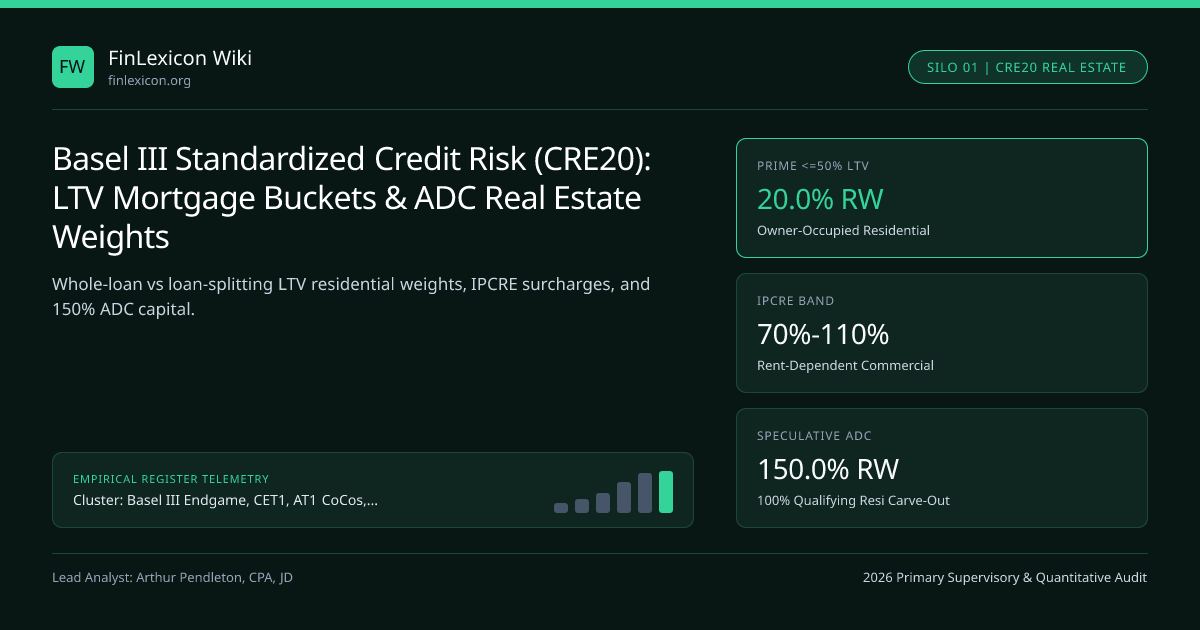
Replacing the blunt flat 35% residential mortgage and 100% commercial real estate weights of Basel II, Basel Framework chapter CRE20.69–CRE20.91 introduces a granular Loan-to-Value (LTV) and cash-flow-dependency matrix across all real estate exposures. Because standardized credit RWA anchors both non-modeled community banks and the Basel III 72.5% RWA Output Floor, CRE20’s mortgage schedules directly govern marginal home-loan and property-finance pricing globally.
Six Operational Prerequisites for Preferential Real Estate Risk Weighting#
Before a property loan qualifies for LTV-tiered weights rather than a punitive 100%–150% unsecured fallback, CRE20.71 enforces six strict underwriting gates: (1) construction of the underlying property must be fully finished (otherwise it falls into ADC), (2) the first-lien mortgage must be legally enforceable in all relevant jurisdictions within a reasonable foreclosure timeframe, (3) the lender must hold a first-ranking security claim (or adjust LTV to include all senior/pari passu liens), (4) the borrower must demonstrate verified repayment ability under prudently underwritten debt-service-to-income metrics, (5) property value must be appraised conservatively independently of borrower creditworthiness, and (6) all documentation and insurance must be maintained.
Critically, CRE20.74 freezes the property value denominator in the LTV ratio at origination appraisal value unless a national supervisor explicitly mandates downward revaluation during housing downturns or a permanent physical modification improves the asset—preventing housing-bubble price appreciation from artificially lowering RWA!
Whole-Loan vs Loan-Splitting Approaches for Regulatory Residential Real Estate#
For non-income-producing owner-occupied residential mortgages, CRE20 offers national supervisors two alternative calculation methodologies illustrated in our Basel III Endgame & CET1 cornerstone guide:
- Whole-Loan Approach (Adopted by U.S. ERBA, UK PRA, APRA, MAS): Assigns a single risk weight to the entire loan balance based on total LTV: 20% (
LTV <= 50%), 25% (50%–60%), 30% (60%–80%), 40% (80%–90%), 50% (90%–100%), and 70% (LTV > 100%). - Loan-Splitting Approach (Adopted by EU CRR III Art. 125): Splits any residential mortgage into two tranches—assigning a flat 20% risk weight to the loan slice up to 55% of property value (capped at 55% in CRR III transitional/adjusted bands) and assigning the borrower’s unsecured counterparty weight (75% for regulatory retail, 100% for individuals outside retail) to the excess loan slice above 55% LTV!
Materially Dependent on Cash Flows Caused by the Property (IPRE / Buy-to-Let)#
Whenever repayment of a residential or commercial mortgage depends materially (>50% of debt service or refinance proceeds) on rent or sale cash flows generated by the collateralized property itself—covering buy-to-let investor apartments and multi-tenant office/retail centers—CRE20 imposes substantially steeper schedules.
Income-producing residential real estate (IPRRE) jumps from 20%–30% owner-occupied bands up to 30% (LTV <= 50%), 35% (50%–60%), 45% (60%–80%), 60% (80%–90%), 75% (90%–100%), and 105% (LTV > 100%). Income-producing commercial real estate (IPCRE) starts at 70% (LTV <= 60%), steps to 90% (60%–80%), and hits 110% (LTV > 80%), directly impacting commercial property lenders from Bank of Ireland to ANZ Bank.
| Origination LTV Bucket | Owner-Occupied RRE (Whole-Loan) | Income-Producing RRE (Buy-to-Let) | Non-IP Commercial RE (Own-Use) | Income-Producing CRE (IPCRE) |
|---|---|---|---|---|
| LTV <= 50% | 20% risk weight | 30% risk weight | min(60%, Counterparty RW) | 70% risk weight |
| 50% < LTV <= 60% | 25% risk weight | 35% risk weight | min(60%, Counterparty RW) | 70% risk weight |
| 60% < LTV <= 80% | 30% risk weight | 45% risk weight | Counterparty RW (75%–100%) | 90% risk weight |
| 80% < LTV <= 90% | 40% risk weight | 60% risk weight | Counterparty RW (75%–100%) | 110% risk weight |
| 90% < LTV <= 100% / >100% | 50% / 70% risk weight | 75% / 105% risk weight | Counterparty RW (75%–100%) | 110% risk weight |
Land Acquisition, Development, and Construction (ADC): 150% Baseline vs 100% Residential Carve-Out#
Speculative property development carries acute completion and market-absorption risk. CRE20.90 assigns a 150% risk weight to all Land Acquisition, Development, and Construction (ADC) loans—harmonizing international standards with the U.S. High-Volatility Commercial Real Estate (HVCRE) regime supervised by the OCC and FDIC. Only residential ADC projects meeting strict pre-sale/pre-lease deposit thresholds or substantial borrower cash equity qualify for a reduced 100% weight.
Interactions With Private Mortgage Insurance (PMI) and Output Floor Binding#
Under the initial 2023 U.S. ERBA standardized proposal, bank-originated >80% LTV loans carrying private mortgage insurance could not reduce LTV unless the insurer met stringent rated-guarantor criteria under CRE22 credit risk mitigation rules—a focal point recalibrated to preserve LMI mortgage access across the Basel III Endgame & Capital Ratios topic hub.
- RWLoanSplitRetail = [ min(Loan, 0.55 * PropVal) * 0.20 + max(0, Loan - 0.55 * PropVal) * 0.75 ] / Loan
- Worked EUR 380,000 Owner-Occupied Mortgage on EUR 400,000 Home (Origination LTV = 95.0%):
- 1. BCBS Whole-Loan Approach (90% < LTV <= 100% bucket): RW = 50.0% => RWA = EUR 190,000
- 2. EU Loan-Splitting Approach (75% Retail Counterparty Weight):
- Secured Tranche (55% * EUR 400k = EUR 220,000) * 20% = EUR 44,000 RWA
- Unsecured Slice (EUR 380k - EUR 220k = EUR 160,000) * 75% = EUR 120,000 RWA
- Total Loan-Split RWA = EUR 164,000 => Effective RW = 43.16% (-684 bps lower than Whole-Loan!)
Frequently asked questions
Can a bank lower a mortgage’s LTV bucket when neighborhood home prices appreciate by 30%?
Under BCBS CRE20.74, no—property value must be maintained at no higher than the value measured at loan origination, except where physical renovations demonstrably increase the property’s intrinsic value or upon a genuine new refinancing origination.
What happens if property prices crash 25% below origination value in a recession?
While upward revaluations above origination are barred, CRE20.74 empowers national supervisors (and EU CRR III valuation monitoring) to require downward adjustments to property value whenever broad market declines erode collateral coverage.
When does a multi-property investor portfolio avoid the higher Income-Producing Real Estate (IPRRE) table?
Some jurisdictions set a unit-count exemption (for instance, up to four residential units owned by an individual whose primary salary covers total debt service), whereas commercial landlords relying >50% on rental cash flows always fall into IPRRE.
How are corporate headquarters buildings occupied by the borrower weighted under CRE20?
Non-income-producing commercial real estate (general corporate own-use) with LTV <= 60% receives min(60%, Counterparty_RW) under Whole-Loan rules—so an unrated 100%-weighted SME owning its factory at 55% LTV drops from 100% to a 60% risk weight.
Publication record
- Published
- 14 November 2026
- Updated
- 15 November 2026
- Author
- Arthur Pendleton, CPA, JD
- Review
- Review not recorded
- Automated fact check
- Passed in the stored pipeline record
- Source URLs
- 3 recorded
AI assistance recorded: anthropic/claude-opus-4.6. This field does not establish human review or source verification.
Academic & Institutional Attribution
Cite This Research & Embed Live Data Card
Standard academic & institutional research paper citation format.
Arthur Pendleton, CPA, JD. (2026, November 14). Basel III Standardized Credit Risk (CRE20): LTV Mortgage Buckets & ADC Real Estate Weights. FinLexicon Wiki. https://finlexicon.org/wiki/sa-cr-standardized-credit-risk-ltv-residential-commercial-reRelated Basel Iii Endgame Capital Ratios & Institutional Briefings
Explore Basel Iii Endgame Capital Ratios Hub (20) →Basel Iii Endgame Capital Ratios
Basel III Endgame (BCBS d424), CET1 Capital Adequacy, 72.5% Output Floor & TLAC ArchitectureBasel Iii Endgame Capital Ratios
Foundation IRB (F-IRB) Migration & A-IRB PD/LGD Input Floors (CRE30–CRE32)Basel Iii Endgame Capital Ratios
Operational Risk Standardized Measurement Approach (SMA): BIC Buckets & ILM=1 DiscretionBasel Iii Endgame Capital Ratios
FRTB Market Risk (MAR21/MAR30): Sensitivities-Based Method (SbM), PLA Test & NMRF CapitalBasel Iii Endgame Capital Ratios
Maximum Distributable Amount (MDA): CET1 Buffer Quartiles & AT1 Coupon RestrictionsBasel Iii Endgame Capital Ratios
Standardized Credit Risk Assessment (SCRA): Grade A, B & C Interbank Risk Weights (CRE20)Basel Iii Endgame Capital Ratios
U.S. Stress Capital Buffer (SCB): CCAR Nine-Quarter PPNR & Peak CET1 Drawdown MechanicsBasel Iii Endgame Capital Ratios
ECB SREP Pillar 2 Requirement (P2R) vs Pillar 2 Guidance (P2G) & UK PRA Pillar 2A/2BLiquidity Coverage Nsfr Prudential
Non-Maturity Deposits (NMD) Behavioral Modeling: Deposit Betas, Core Caps & SRP31 Duration CeilingsLiquidity Coverage Nsfr Prudential
U.S. Regulation WW (12 CFR Part 249): Peak-Day Maturity Mismatch Add-On & Tailoring Categories I–IVLiquidity Coverage Nsfr Prudential
Supervisory ILAAP, Internal Liquidity Stress Testing (Reg YY) & Reverse Stress Survival HorizonsLiquidity Coverage Nsfr Prudential
Central Bank Liquidity Facilities: Fed Standing Repo (SRF), Discount Window, BoE ILTR & HQLA Monetization
FinLexicon Wiki Data, Benchmarks & Contributor Records
CC BY 4.0 Open Data
Open Institutional Datasets (CSV / JSON) →
Download desk-compiled quantitative series & schemas.
2026 Reference Matrix
2026 Institutional Benchmarks & Thresholds →
Statutory capital, clearing, margin & rate conventions.
Editorial Records
Authors & Review Records →
View named contributors where those records are available.
Complete Index
Master Research & Dossier Archive →
Browse all published briefings by topic pillar & date.