
Basel Iii Endgame Capital Ratios
Countercyclical Capital Buffer (CCyB): Weighted-Average Reciprocity & Positive Neutral Rates
Under Basel RBC30, internationally active banks compute an exposure-weighted Countercyclical Capital Buffer (CCyB) with mandatory supervisory reciprocity up to 2.5% CET1 across credit jurisdictions.
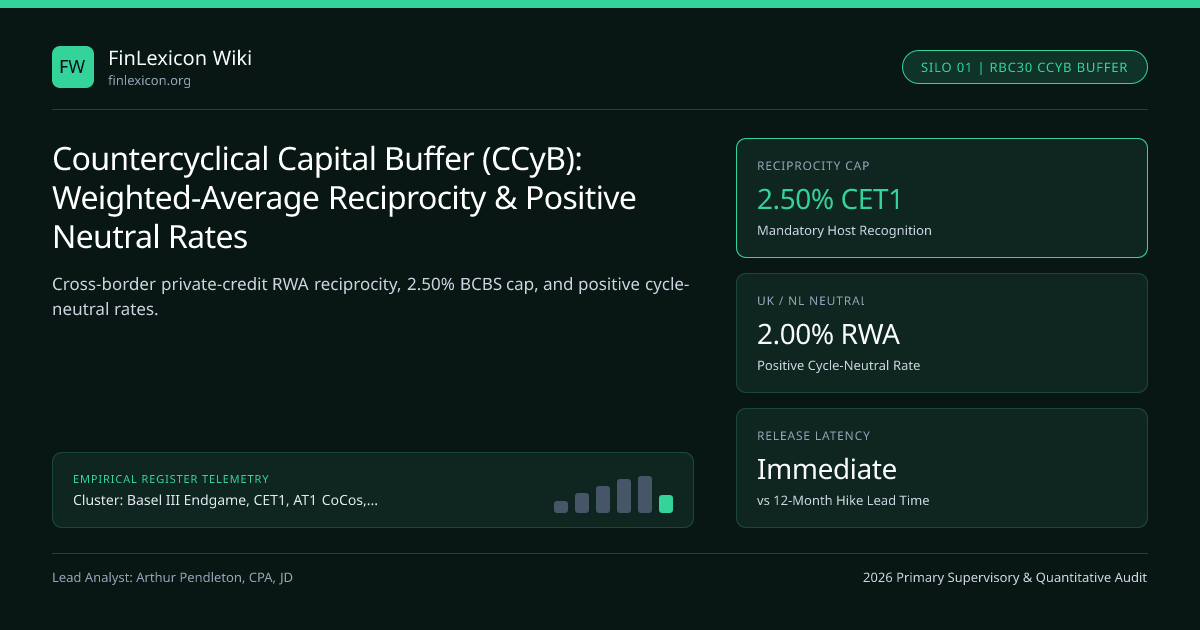
Designed under Basel Framework chapter RBC30 to build releasable Common Equity Tier 1 buffers during credit booms and prevent procyclical deleveraging in downturns, a bank’s institution-specific Countercyclical Capital Buffer (CCyB) equals the credit-RWA-weighted average of national CCyB rates across every jurisdiction where its private-sector credit exposures reside. Enforced via mandatory international reciprocity up to 2.50% of RWA under BCBS / BIS rules, CCyB directly expands the Basel III CET1 Capital Adequacy Standard Combined Buffer Requirement.
From the Hodrick-Prescott Credit-to-GDP Gap to Positive Cycle-Neutral CCyB Regimes#
When the Basel Committee first published its 2010 CCyB guidance, calibration relied heavily on the standardized Credit-to-GDP gap—measuring deviations of private non-financial credit-to-GDP from its one-sided Hodrick-Prescott trend (lambda = 400,000), mapping a +2 percentage point gap to a >0% buffer and a +10 percentage point gap to the full 2.50% ceiling.
Following the COVID-19 shock—when jurisdictions starting at a 0.00% CCyB lacked releasable macroprudential headroom—central banks led by the Bank of England Financial Policy Committee (2.00% UK neutral rate), De Nederlandsche Bank (2.00% NL neutral rate), the Central Bank of Ireland ecosystem (1.50%), and the Reserve Bank of Australia / APRA (1.00% default rate) pivoted to a Positive Cycle-Neutral CCyB maintained above zero even in normal risk environments, whereas the U.S. Federal Reserve System has historically held the domestic U.S. CCyB at 0.00%.
Jurisdictional Reciprocity Mechanics and Ultimate-Risk Geographic Allocation#
Without cross-border reciprocity, foreign bank branches could undercut domestic lenders whenever a host authority raised its national CCyB. Under RBC30.7, home supervisors must reciprocate host-country CCyB rates up to 2.50% unconditionally; if a host sets a CCyB above 2.50%, reciprocity for the excess above 2.50% is voluntary unless agreed bilaterally (or within the EU ESRB up to higher thresholds).
Geographic allocation follows the ultimate risk principle rather than booking-hub location. If BNP Paribas books a GBP 500 million loan in Paris to a London borrower guaranteed unconditionally by a parent corporation domiciled in Amsterdam, the credit RWA shifts from the UK 2.00% bucket to the Netherlands bucket for weighted-average CCyB computation, as integrated into our Basel III Endgame & CET1 cornerstone guide.
Which Exposures Enter the Weighted-Average CCyB Formula?#
Crucially, sovereign exposures, central bank reserves, Supranational/MDB claims (such as Asian Development Bank), and interbank exposures to regulated credit institutions are excluded from the geographic weighting weights w_j—only non-bank private-sector credit exposures (banking-book credit RWA, trading-book specific risk / FRTB default risk charge, and securitization RWA) determine the weighted-average CCyB percentage.
However, once that weighted-average CCyB rate (e.g., 0.86%) is calculated from private-sector credit RWA, the resulting percentage applies across the bank’s entire consolidated Total RWA (including operational risk, sovereign RWA, interbank SCRA bank exposures, and FX market risk)!
| Jurisdiction & Macroprudential Authority | Policy Framework Type | Representative CCyB Rate | ActivationLead / Release Rule | Primary Domestic Cohort |
|---|---|---|---|---|
| United Kingdom (Bank of England FPC) | Positive Cycle-Neutral | 2.00% standard neutral | 12m hike notice / T+0 cut | Bank of Scotland & UK ring-fenced |
| Netherlands (De Nederlandsche Bank) | Positive Cycle-Neutral | 2.00% neutral target | 12m hike notice / T+0 cut | ASN Bank & Dutch IRB lenders |
| Australia (APRA) | Default Positive Neutral | 1.00% baseline (0%–3.5% range) | 12m phase-in / immediate release | ANZ Bank & Bank of Queensland |
| France (Bank of France HCSF) | Active Cyclical Buffer | 1.00% credit-cycle setting | 12m hike notice under ESRB | BNP Paribas & French groups |
| United States (Federal Reserve) | Stress-Regime Activation | 0.00% baseline (SCB preferred) | 12m hike notice (12 CFR 217.11) | Bank of America (foreign reciprocity applies) |
Announcement Lead Times vs Immediate Downward Buffer Release#
RBC30.13 enforces asymmetric timing to avoid sudden credit crunches: decisions to increase a national CCyB generally carry a mandatory 12-month pre-announcement window so banks can accumulate retained earnings organically without shrinking loan supply. Conversely, decisions to cut or zero out the CCyB take effect immediately upon publication, instantly lowering the Maximum Distributable Amount (MDA) CET1 trigger so banks can absorb credit losses and continue lending.
De Minimis Foreign Materiality Thresholds Under EU CRR and UK PRA Rules#
To reduce reporting burdens on immaterial cross-border footprints, EBA RTS (Commission Delegated Regulation (EU) No 1152/2014) and UK PRA rulebooks establish a 2% materiality threshold: if an institution’s aggregate foreign private-sector credit exposures represent less than 2% of its total private-sector risk-weighted exposures, those foreign exposures may be allocated directly to the institution’s home jurisdiction rather than tracked country-by-country across the Basel III Endgame & Capital Ratios topic hub.
- CCyBDollar = CCyBInstPct * RWATotal_Consolidated
- Worked Cross-Border Calculation:
- Private-Sector Credit RWA: US = $135B (0.0%), UK = $75B (2.0%), FR = $30B (1.0%), NL = $30B (2.0%), AU = $30B (1.0%)
- Total Private Credit RWA = $300.0B | Non-Private RWA (Sovereigns, Banks, SMA Ops) = $120.0B => Total RWA = $420.0B
- CCyBInstPct = (135/300)0% + (75/300)2.0% + (30/300)1.0% + (30/300)2.0% + (30/300)*1.0% = 0.900%
- Required CET1 CCyB Dollar Buffer = 0.0090 * $420.0B = $3.780B
Frequently asked questions
Why does a U.S. G-SIB still report a non-zero CCyB when the Federal Reserve sets the U.S. rate at 0%?
Under 12 CFR 217.11(b), Category I–III U.S. banking organizations must reciprocate foreign host-country CCyB rates across their international corporate and retail credit books, typically producing a 10–35 bps consolidated CCyB from UK, European, and APAC lending.
Why are interbank and sovereign exposures excluded from CCyB geographic weights?
CCyB specifically targets excessive non-financial private-sector credit growth; including central bank reserves or sovereign HQLA bonds would distort geographic weights toward reserve-currency hubs and penalize liquidity buffers.
How does the ultimate-risk rule change CCyB weighting on guaranteed corporate loans?
Where an eligible credit risk mitigation guarantee or credit derivative transfers credit risk to a guarantor in another country, the exposure shifts from the immediate borrower’s jurisdiction to the guarantor’s jurisdiction for CCyB weighting.
What happens if a host authority sets a national CCyB above 2.50%, such as 3.00%?
Mandatory Basel reciprocity caps at 2.50%; foreign home supervisors must apply at least 2.50% to exposures in that host jurisdiction and may voluntarily recognize the extra 0.50% (within the EU, ESRB recommendations coordinate higher voluntary reciprocity).
Publication record
- Published
- 14 November 2026
- Updated
- 15 November 2026
- Author
- Arthur Pendleton, CPA, JD
- Review
- Review not recorded
- Automated fact check
- Passed in the stored pipeline record
- Source URLs
- 3 recorded
AI assistance recorded: anthropic/claude-opus-4.6. This field does not establish human review or source verification.
Academic & Institutional Attribution
Cite This Research & Embed Live Data Card
Standard academic & institutional research paper citation format.
Arthur Pendleton, CPA, JD. (2026, November 14). Countercyclical Capital Buffer (CCyB): Weighted-Average Reciprocity & Positive Neutral Rates. FinLexicon Wiki. https://finlexicon.org/wiki/countercyclical-capital-buffer-ccyb-jurisdictional-reciprocityRelated Basel Iii Endgame Capital Ratios & Institutional Briefings
Explore Basel Iii Endgame Capital Ratios Hub (20) →Basel Iii Endgame Capital Ratios
Basel III Endgame (BCBS d424), CET1 Capital Adequacy, 72.5% Output Floor & TLAC ArchitectureBasel Iii Endgame Capital Ratios
G-SIB Systemic Surcharge: BCBS Method 1 Five-Category Score vs Fed Method 2 STWF ScalarBasel Iii Endgame Capital Ratios
FSB TLAC Term Sheet: 18% RWA / 6.75% Leverage Minimums & Clean Holding Company RulesBasel Iii Endgame Capital Ratios
EU BRRD II MREL Calibration: SPE vs MPE Resolution & Senior Non-Preferred Debt HierarchyBasel Iii Endgame Capital Ratios
Enhanced Supplementary Leverage Ratio (eSLR) & Total Leverage Exposure (LEV20–LEV30)Basel Iii Endgame Capital Ratios
Basel III Standardized Credit Risk (CRE20): LTV Mortgage Buckets & ADC Real Estate WeightsBasel Iii Endgame Capital Ratios
Foundation IRB (F-IRB) Migration & A-IRB PD/LGD Input Floors (CRE30–CRE32)Basel Iii Endgame Capital Ratios
Operational Risk Standardized Measurement Approach (SMA): BIC Buckets & ILM=1 DiscretionLiquidity Coverage Nsfr Prudential
HQLA Level 1, 2A & 2B Haircuts: 40%/15% Composition Caps & Secured Funding Unwind (LCR30)Liquidity Coverage Nsfr Prudential
LCR 30-Day Deposit Run-Off Rates (LCR40): Stable Retail (3%/5%), Operational (25%) & Financial (100%)Liquidity Coverage Nsfr Prudential
LCR 75% Aggregate Cash Inflow Cap: Performing Loan Rollovers, SFTs & the 25% HQLA FloorLiquidity Coverage Nsfr Prudential
LCR Derivatives Collateral Outflows: 24-Month Historical Look-Back Approach (HLBA) & Rating Triggers
FinLexicon Wiki Data, Benchmarks & Contributor Records
CC BY 4.0 Open Data
Open Institutional Datasets (CSV / JSON) →
Download desk-compiled quantitative series & schemas.
2026 Reference Matrix
2026 Institutional Benchmarks & Thresholds →
Statutory capital, clearing, margin & rate conventions.
Editorial Records
Authors & Review Records →
View named contributors where those records are available.
Complete Index
Master Research & Dossier Archive →
Browse all published briefings by topic pillar & date.