
Basel Iii Endgame Capital Ratios
CET1 Regulatory Deductions (CAP30): Goodwill, DTAs, MSRs & the 10%/15% Threshold Rule
Basel CAP30 prudential banking rules strip goodwill, intangibles, and loss-carryforward DTAs from accounting equity while capping temporary-difference DTAs, MSRs, and financial stakes under the 10%/15% CET1 threshold basket.
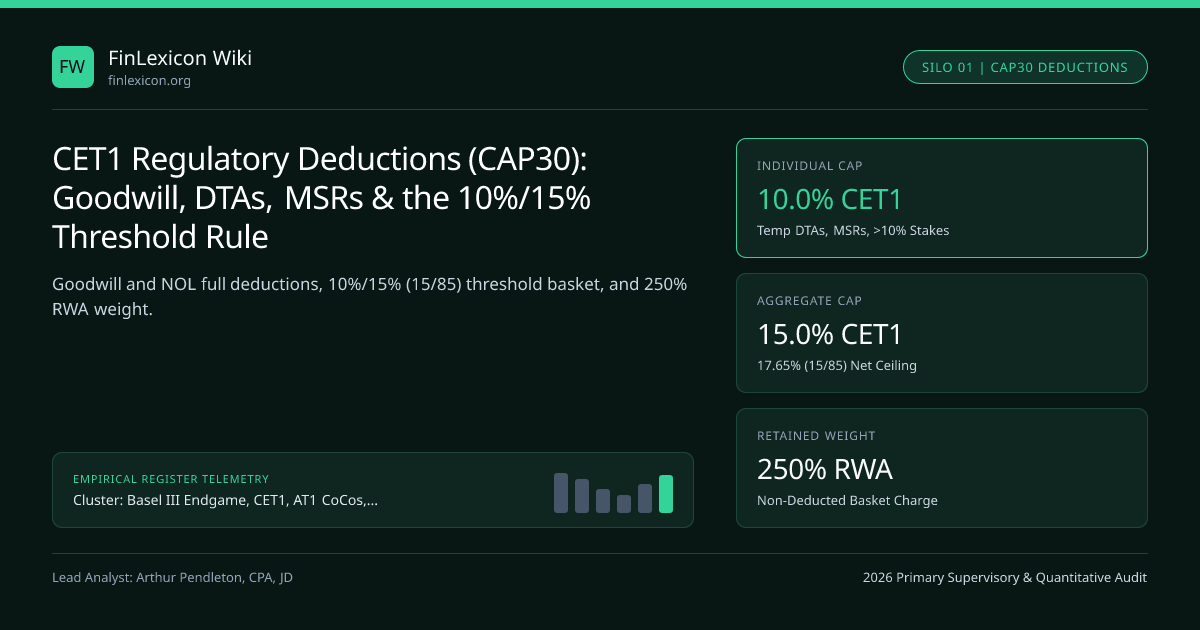
Accounting shareholders’ equity reported under IFRS or U.S. GAAP routinely overstates loss-absorbing capacity during bank liquidation because intangible assets and tax carryforwards evaporate precisely when earnings turn negative. Under Basel Framework chapter CAP30 (and 12 CFR 217.22 in the United States), supervisors reconcile GAAP equity to the Basel III CET1 Capital Adequacy Standard through mandatory dollar-for-dollar deductions and a two-stage 10% individual / 15% aggregate threshold basket weighted at 250% RWA.
Full Dollar-for-Dollar CET1 Deductions Under Basel CAP30#
Before testing threshold baskets, CAP30.7 through CAP30.18 require complete 100% subtraction of assets lacking standalone liquidation value. Goodwill and other intangibles (excluding mortgage servicing rights, net of associated deferred tax liabilities) are deducted immediately. Similarly, deferred tax assets (DTAs) that rely on future profitability—specifically net operating loss (NOL) and tax credit carryforwards—are stripped in full from CET1 without threshold relief.
Additional full deductions encompass defined-benefit pension fund net assets (unless the institution holds unfettered legal access to surplus cash), cash-flow hedge reserves tied to items not fair-valued on the balance sheet, treasury stock repurchases, and any shortfall of accounting credit provisions below IRB expected losses, as cross-referenced in our Basel III Endgame & CET1 cornerstone guide.
Prudential Valuation Filters: Own Credit DVA and Unrealized AOCI Securities#
CAP30.14 enforces a strict prudential filter removing cumulative gains and losses resulting from changes in an institution’s own credit risk on fair-valued derivative liabilities (DVA) and structured notes—preventing a deteriorating bank from manufacturing CET1 capital as its credit spread widens. Equally consequential is Accumulated Other Comprehensive Income (AOCI) on Available-for-Sale (AFS) debt portfolios, examined in detail under U.S. ERBA and AOCI filter removal.
Following the 2023 regional banking turmoil supervised by the FDIC and Federal Reserve, removing the legacy Category III/IV AOCI opt-out forces unrealized rate-driven bond losses at lenders such as Ally Financial and American Express directly into regulatory CET1.
Mechanics of the 10% Individual and 15% Aggregate Threshold Deduction Basket#
Three asset classes receive partial recognition under CAP30.32–CAP30.34 rather than immediate full deduction: (1) DTAs arising from temporary timing differences (such as deferred tax assets on credit provisioning), (2) Mortgage Servicing Rights (MSRs), and (3) significant investments (>10% ownership) in the common shares of unconsolidated financial institutions.
Each of these three items is first capped individually at 10% of adjusted CET1 (calculated after all full CAP30 deductions). Second, the combined remaining sum of the three items cannot exceed 15% of post-deduction CET1; mathematically, in final net CET1 terms, the aggregate basket is capped at 17.65% (15 / 85) of net CET1. Any dollar exceeding either the 10% individual or 15% aggregate ceiling is deducted 1-for-1 from CET1, while retained amounts below the thresholds carry a punitive 250% risk weight!
| Balance Sheet Item | Basel CAP30 G-SIB Rule | U.S. Simplification (Cat III/IV Pre-ERBA) | EU CRR III Treatment | Retained RWA Weight |
|---|---|---|---|---|
| Goodwill & Non-MSR Intangibles | 100% CET1 deduction (net of DTL) | 100% CET1 deduction | 100% deduct (limited software relief) | 0% (already deducted) |
| NOL & Tax Credit Carryforward DTAs | 100% CET1 deduction (net of DTL) | 100% CET1 deduction | 100% CET1 deduction (Art. 36 CRR) | 0% (already deducted) |
| Temporary-Difference DTAs | 10% individual / 15% aggregate cap | 25% individual CET1 cap | 10% / 15% cap (Art. 48 CRR) | 250% risk weight |
| Mortgage Servicing Rights (MSRs) | 10% individual / 15% aggregate cap | 25% individual CET1 cap | Deducted as intangible / 10%-15% | 250% risk weight |
| Significant (>10%) Fin. Common Stakes | 10% individual / 15% aggregate cap | 25% individual CET1 cap | 10% / 15% cap (FICO exemptions) | 250% risk weight |
U.S. Non-Advanced Simplification Rule (25% Cap) vs International G-SIB Strictness#
In 2019, U.S. banking agencies enacted the Capital Simplifications Rule for non-Category I/II banks, replacing the complex 10%/15% dual-threshold calculation with a single 25% individual CET1 deduction threshold per item alongside a 250% RWA weight. However, U.S. G-SIBs such as Bank of America and Category II institutions—and under the Expanded Risk-Based Approach standard, banks above USD 100B—remain subject to the stricter Basel 10%/15% CAP30 discipline alongside the BCBS d424 72.5% RWA output floor, monitored across the Basel III Endgame & Capital Ratios topic hub.
Reciprocal Cross-Holdings and Non-Significant Financial Investments#
To prevent double-gearing of equity across interconnected banking groups, CAP30.22 deducts reciprocal cross-holdings designed to inflate capital ratios artificially. Non-significant investments (<=10% of issued common share capital) in unconsolidated banks, insurers, and broker-dealers are aggregated across long cash and synthetic derivative positions; only the net aggregate excess above 10% of adjusted CET1 is deducted via the corresponding deduction approach across CET1, AT1, and Tier 2.
- DedIndiv = max(0, DTATemp - 0.10CET1_Adj) + max(0, MSR - 0.10CET1Adj) + max(0, FinSig - 0.10*CET1Adj)
- BasketRem = min(DTATemp, 0.10CET1_Adj) + min(MSR, 0.10CET1Adj) + min(FinSig, 0.10*CET1Adj)
- CET1Prelim = CET1Adj - Ded_Indiv
- BasketAllowed = min( BasketRem , (15 / 85) * (CET1Prelim - BasketRem) )
- Worked Audit ($50.0B Adjusted CET1; $6.2B Temp DTAs, $4.5B MSRs, $3.0B Fin Stakes):
- 10% Individual Cap = $5.00B => DTA Excess Deducted = $1.20B (MSR & Fin Stakes = $0 excess)
- BasketRem = $5.00B + $4.50B + $3.00B = $12.50B | CET1Prelim = $50.0B - $1.20B = $48.80B
- Max Allowed Basket = (15/85) * ($48.80B - $12.50B) = 0.17647 * $36.30B = $6.406B
- 15% Aggregate Deduction = $12.50B - $6.406B = $6.094B => Final Net CET1 = $42.706B
- 250% RWA Add-On on Allowed Basket = 2.50 * $6.406B = $16.015B RWA
Frequently asked questions
Why does Basel CAP30 treat NOL carryforward DTAs differently from temporary-difference DTAs?
NOL carryforwards require future taxable profits across the entire entity to monetize, whereas temporary-difference DTAs (such as credit loss reserves) reverse as specific underlying loan portfolios mature or charge off, justifying partial 10%/15% recognition.
Why is the 15% aggregate threshold algebraically implemented as 17.65% (15/85)?
CAP30.33 stipulates that the retained basket cannot exceed 15% of final CET1 *after* all deductions. If retained basket assets equal 15% of final CET1, non-basket CET1 equals 85% of final CET1, making the maximum basket equal to 15/85 (17.647%) of non-basket CET1.
Can deferred tax liabilities (DTLs) be netted against goodwill and DTA deductions?
Yes, under CAP30.10, associated DTLs that would be extinguished if the intangible asset became impaired or derecognized may be netted prior to deducting goodwill, and remaining DTLs can offset DTAs within the same taxing jurisdiction where tax netting is legally enforceable.
How do EU CRR financial conglomerate (FICO) rules modify deductions of insurance subsidiaries?
Under Article 49 of CRR (the Danish Compromise, made permanent with tightened risk weights in CRR III), qualifying European bancassurance groups overseen by the ECB may risk-weight significant holdings in insurance subsidiaries rather than deducting them from CET1.
Publication record
- Published
- 15 November 2026
- Updated
- 15 November 2026
- Author
- Arthur Pendleton, CPA, JD
- Review
- Review not recorded
- Automated fact check
- Passed in the stored pipeline record
- Source URLs
- 3 recorded
AI assistance recorded: anthropic/claude-opus-4.6. This field does not establish human review or source verification.
Academic & Institutional Attribution
Cite This Research & Embed Live Data Card
Standard academic & institutional research paper citation format.
Arthur Pendleton, CPA, JD. (2026, November 14). CET1 Regulatory Deductions (CAP30): Goodwill, DTAs, MSRs & the 10%/15% Threshold Rule. FinLexicon Wiki. https://finlexicon.org/wiki/cet1-regulatory-deductions-dta-msr-threshold-10-15-ruleRelated Basel Iii Endgame Capital Ratios & Institutional Briefings
Explore Basel Iii Endgame Capital Ratios Hub (20) →Basel Iii Endgame Capital Ratios
Basel III Endgame (BCBS d424), CET1 Capital Adequacy, 72.5% Output Floor & TLAC ArchitectureBasel Iii Endgame Capital Ratios
AT1 Contingent Convertibles (CoCos): 5.125% vs 7.0% Triggers, Write-Down & PONV HierarchyBasel Iii Endgame Capital Ratios
U.S. Expanded Risk-Based Approach (ERBA) & AOCI Unrealized Securities Filter RemovalBasel Iii Endgame Capital Ratios
Countercyclical Capital Buffer (CCyB): Weighted-Average Reciprocity & Positive Neutral RatesBasel Iii Endgame Capital Ratios
G-SIB Systemic Surcharge: BCBS Method 1 Five-Category Score vs Fed Method 2 STWF ScalarBasel Iii Endgame Capital Ratios
FSB TLAC Term Sheet: 18% RWA / 6.75% Leverage Minimums & Clean Holding Company RulesBasel Iii Endgame Capital Ratios
EU BRRD II MREL Calibration: SPE vs MPE Resolution & Senior Non-Preferred Debt HierarchyBasel Iii Endgame Capital Ratios
Enhanced Supplementary Leverage Ratio (eSLR) & Total Leverage Exposure (LEV20–LEV30)Monetary Policy
Interest rate rises likely in coming months, Bank of England’s chief economist saysMarket Insights
SGX Group’s Derivatives Volume Hits Six-Month High - Markets MediaRegulatory Compliance
Statement on Proposing Release for Executive Compensation Disclosure ReformRegulatory and Market Glossary
Bitcoin ETFs shed $2.35B in 2 weeks, BlackRock’s losing streak hits 11
FinLexicon Wiki Data, Benchmarks & Contributor Records
CC BY 4.0 Open Data
Open Institutional Datasets (CSV / JSON) →
Download desk-compiled quantitative series & schemas.
2026 Reference Matrix
2026 Institutional Benchmarks & Thresholds →
Statutory capital, clearing, margin & rate conventions.
Editorial Records
Authors & Review Records →
View named contributors where those records are available.
Complete Index
Master Research & Dossier Archive →
Browse all published briefings by topic pillar & date.