
Basel Iii Endgame Capital Ratios
EU BRRD II MREL Calibration: SPE vs MPE Resolution & Senior Non-Preferred Debt Hierarchy
Under EU BRRD II and SRMR II prudential banking rules, Single Resolution Board MREL combines Loss Absorption and Recapitalization Amounts with 8% TLOF Senior Non-Preferred subordination.
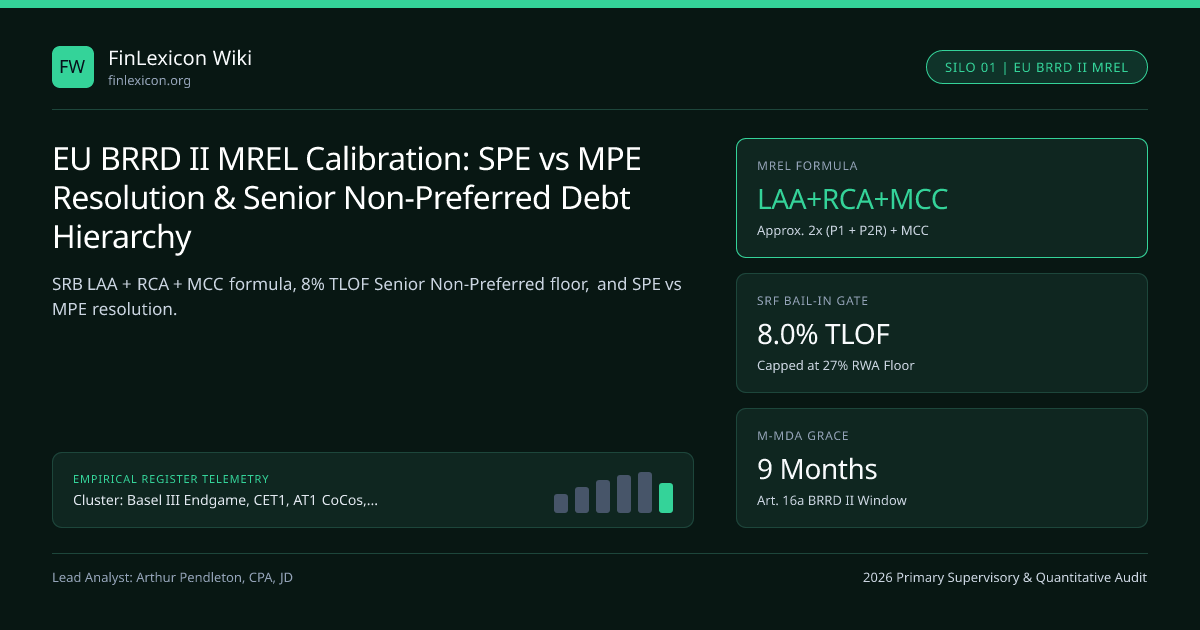
Across the European Union and Banking Union, Directive (EU) 2019/879 (BRRD II) and Regulation (EU) 2019/877 (SRMR II) extend bail-in debt mandates far beyond G-SIBs through the Minimum Requirement for Own Funds and Eligible Liabilities (MREL). Calibrated bank-by-bank by the Single Resolution Board (SRB) alongside the European Central Bank and national resolution authorities like Banco de Portugal and National Bank of Belgium, MREL tailors the TLAC & MREL Bail-In Debt Standard across Single-Point-of-Entry (SPE) and Multiple-Point-of-Entry (MPE) banking groups.
The SRB MREL Formula: LAA + RCA + Market Confidence Charge (MCC)#
Unlike the fixed 18% RWA Pillar 1 TLAC floor applicable solely to G-SIIs, Pillar 2 institution-specific MREL under Article 45c of BRRD II sums two risk-based components (mirrored on a Total Exposure Measure leverage basis):
- Loss Absorption Amount (LAA): Equal to
Pillar 1 Total Capital (8.0%) + Pillar 2 Requirement (P2R), designed to absorb losses that wipe out pre-resolution regulatory capital. - Recapitalization Amount (RCA): Equal to
post-resolution Pillar 1 (8.0%) + post-resolution P2R(adjusted downward if the resolution plan scales down balance sheet RWA via asset divestitures), plus a Market Confidence Charge (MCC) equal toCombined Buffer Requirement (CBR) minus 125 bps(typicallyCBR - CCyBorCBR - 1.25%under SRB policy) so the newly recapitalized bank immediately commands wholesale funding market trust on Monday morning, as detailed in our Basel III Endgame & CET1 cornerstone guide.
8% TLOF Subordination Rule: Top-Tier Banks (>EUR 100B) and Fishing-Net Entities#
Not all MREL must be subordinated—Senior Preferred (SP) unsecured notes lacking complex derivatives can satisfy non-subordinated MREL. However, because Article 44(5) of BRRD prohibits tapping the Single Resolution Fund until shareholders and creditors have absorbed losses equal to 8% of Total Liabilities and Own Funds (TLOF), BRRD II mandates a subordinated MREL floor for G-SIIs, Top-Tier Banks (resolution groups with consolidated assets exceeding EUR 100 billion, such as BNP Paribas or Allied Irish Banks / Bank of Ireland peers where designated), and "Fished" banks below EUR 100B judged likely to pose systemic NCWO risk.
Subordinated MREL equals max(18% RWA + CBR for G-SIIs; 13.5% RWA + CBR for Top-Tier; 8% TLOF — subject to a 27% RWA cap scenario) and must be met exclusively with own funds and Senior Non-Preferred (SNP) debt created under Directive (EU) 2017/2399 (Article 108(2) BRRD).
Single-Point-of-Entry (SPE) vs Multiple-Point-of-Entry (MPE) Resolution Architectures#
European banking groups choose between two fundamentally distinct resolution topologies reflecting legal and funding autonomy:
- Single-Point-of-Entry (SPE): One parent resolution entity (e.g., in Paris, Amsterdam, or Dublin) issues 100% of External MREL to capital markets and subscribes to Internal MREL issued by domestic and cross-border subsidiaries. Losses anywhere in the group flow upward to the parent.
- Multiple-Point-of-Entry (MPE): Characteristic of decentralized cross-border retail franchises (such as Spanish and Austrian banking groups overseen alongside Banco de Espana and Oesterreichische Nationalbank), each autonomous regional sub-group acts as its own independent resolution entity, raises its own local External MREL in local currency, and can be resolved locally without contaminating sister sub-groups—subject to CRR Article 72e adjustments preventing parent capital double-counting.
| EU Bank Resolution Category | Risk-Based External MREL | Leverage MREL (TEM) | Subordinated MREL Floor | Primary Debt Instrument Mix |
|---|---|---|---|---|
| EU G-SII (BNP Paribas) | max(18% + CBR, LAA + RCA + MCC + CBR) | max(6.75% TEM, LAAL + RCAL) | max(18% + CBR, 8% TLOF capped 27% RWA) | Own Funds + Senior Non-Preferred + SP |
| Top-Tier Bank (>EUR 100B Assets) | LAA + RCA + MCC (+ CBR on top) | LAAL + RCAL (typically ~6% TEM) | max(13.5% + CBR, 8% TLOF capped 27% RWA) | Own Funds + SNP / HoldCo Senior + SP |
| Fished Systemic Bank (<EUR 100B) | LAA + RCA + MCC (+ CBR on top) | LAAL + RCAL | Supervisory 8% TLOF / NCWO calibration | Own Funds + Targeted SNP + SP |
| Transfer / Sale-of-Business Bank | LAA + Partial Scaled RCA | Scaled TEM requirement | No mandatory SNP floor unless NCWO risk | Own Funds + Senior Preferred Notes |
| Liquidation Entity (Normal Insolvency) | LAA only (= 8% + P2R; RCA = 0%) | 3.0% Leverage Ratio only | None (resolved under national law) | Regulatory Capital only (Zero MREL add-on) |
EU "Daisy Chain" Amendments (Regulation 2022/2036 & Directive 2024/1174)#
In multi-tiered SPE groups where a parent resolution entity owns an intermediate bank that in turn owns downstream operating subsidiaries ("Daisy Chains"), an uncalibrated 1-for-1 deduction of internal MREL holdings at the intermediate parent could exhaust the intermediate entity’s own MREL capacity. Recent EU Daisy Chain acts allow resolution authorities to set consolidated internal MREL at intermediate parents or exempt purely technical pass-through layers.
MREL-MDA (M-MDA) vs Capital MDA: The 9-Month Supervisory Grace Evaluation#
Whereas dipping below capital buffers triggers automatic immediate Maximum Distributable Amount (MDA) coupon and dividend limits (distinct from the FSB TLAC 18% RWA clean holding company framework), breaching the CBR stack on top of MREL triggers M-MDA under Article 16a BRRD II: resolution authorities evaluate market access monthly and generally impose mandatory distribution restrictions after nine months if the MREL shortfall persists unless caused by systemic market-wide bond closure across the Basel III Endgame & Capital Ratios topic hub.
- MMDATrigger = MRELTREA + CBR (CET1 in CBR cannot double-count inside MRELTREA)
- SubMRELTopTier = max( 0.135 * RWA + CBR , min( 0.08 * TLOF , 0.27 * RWA ) )
- Worked Top-Tier Eurozone Bank Audit (EUR 300B TLOF, EUR 99B RWA [33% density], P2R = 2.0%, CBR = 4.0%, 0% Depletion):
- LAA = 8.0% + 2.0% = 10.00% | RCA = 10.00% | MCC = 4.00% - 1.25% = 2.75%
- Binding MREL_TREA = 22.75% (EUR 22.52B) | M-MDA Stack = 22.75% + 4.00% = 26.75% (EUR 26.48B)
- 8% TLOF Subordinated Check: 0.08 * EUR 300B = EUR 24.00B (= 24.24% of RWA, below 27% RWA cap)
- 13.5% + CBR Check: 17.50% * EUR 99B = EUR 17.33B => 8% TLOF Binds Subordinated Stack at EUR 24.00B!
Frequently asked questions
Why did the EU create Senior Non-Preferred (SNP) bonds instead of requiring UK/U.S.-style holding companies?
Major continental European universal banks (such as BNP Paribas, Societe Generale, Santander, and BBVA) raise deposits, trade derivatives, and list shares directly out of their top operating bank; reorganizing into non-operating holding companies would have triggered prohibitive tax and novation costs, so Article 108(2) BRRD created statutory-contractual SNP subordination.
What does the 8% TLOF rule mean for accessing the Single Resolution Fund (SRF)?
Under Article 44(5) of BRRD, the Single Resolution Fund can contribute up to 5% of TLOF toward resolution stabilization ONLY after shareholders and bailed-in creditors have already absorbed losses equal to at least 8% of Total Liabilities and Own Funds.
When does a small European bank receive an RCA of zero in its MREL decision?
If the SRB or national resolution authority determines that a small bank’s failure would not harm financial stability or critical functions and can be wound down via normal national insolvency rather than bail-in open-bank resolution, its Recapitalization Amount (RCA) is set to zero.
Can structured notes with embedded equity or commodity options count as Senior Preferred MREL?
Only under tight Article 72a(2) CRR / Article 45b BRRD conditions: the principal amount repayable at maturity must be fixed and known in advance, with only the coupon return linked to the derivative index, so bail-in valuation in resolution remains instantaneous.
Publication record
- Published
- 14 November 2026
- Updated
- 15 November 2026
- Author
- Arthur Pendleton, CPA, JD
- Review
- Review not recorded
- Automated fact check
- Passed in the stored pipeline record
- Source URLs
- 3 recorded
AI assistance recorded: anthropic/claude-opus-4.6. This field does not establish human review or source verification.
Academic & Institutional Attribution
Cite This Research & Embed Live Data Card
Standard academic & institutional research paper citation format.
Arthur Pendleton, CPA, JD. (2026, November 14). EU BRRD II MREL Calibration: SPE vs MPE Resolution & Senior Non-Preferred Debt Hierarchy. FinLexicon Wiki. https://finlexicon.org/wiki/eu-brrd-mrel-internal-vs-external-spe-mpe-bail-in-hierarchyRelated Basel Iii Endgame Capital Ratios & Institutional Briefings
Explore Basel Iii Endgame Capital Ratios Hub (20) →Basel Iii Endgame Capital Ratios
Basel III Endgame (BCBS d424), CET1 Capital Adequacy, 72.5% Output Floor & TLAC ArchitectureBasel Iii Endgame Capital Ratios
Enhanced Supplementary Leverage Ratio (eSLR) & Total Leverage Exposure (LEV20–LEV30)Basel Iii Endgame Capital Ratios
Basel III Standardized Credit Risk (CRE20): LTV Mortgage Buckets & ADC Real Estate WeightsBasel Iii Endgame Capital Ratios
Foundation IRB (F-IRB) Migration & A-IRB PD/LGD Input Floors (CRE30–CRE32)Basel Iii Endgame Capital Ratios
Operational Risk Standardized Measurement Approach (SMA): BIC Buckets & ILM=1 DiscretionBasel Iii Endgame Capital Ratios
FRTB Market Risk (MAR21/MAR30): Sensitivities-Based Method (SbM), PLA Test & NMRF CapitalBasel Iii Endgame Capital Ratios
Maximum Distributable Amount (MDA): CET1 Buffer Quartiles & AT1 Coupon RestrictionsBasel Iii Endgame Capital Ratios
Standardized Credit Risk Assessment (SCRA): Grade A, B & C Interbank Risk Weights (CRE20)Liquidity Coverage Nsfr Prudential
LCR Derivatives Collateral Outflows: 24-Month Historical Look-Back Approach (HLBA) & Rating TriggersLiquidity Coverage Nsfr Prudential
Undrawn Credit vs Liquidity Facilities in LCR40: Corporate (10%/30%), Bank (40%) & SPV (100%)Liquidity Coverage Nsfr Prudential
NSFR Available Stable Funding (ASF) Factors (NSF30): Tier 1/2 Capital, Retail & Sub-1Y CliffsLiquidity Coverage Nsfr Prudential
NSFR Required Stable Funding (RSF) Weights (NSF30): Asset Encumbrance, 65% Mortgages & NPLs
FinLexicon Wiki Data, Benchmarks & Contributor Records
CC BY 4.0 Open Data
Open Institutional Datasets (CSV / JSON) →
Download desk-compiled quantitative series & schemas.
2026 Reference Matrix
2026 Institutional Benchmarks & Thresholds →
Statutory capital, clearing, margin & rate conventions.
Editorial Records
Authors & Review Records →
View named contributors where those records are available.
Complete Index
Master Research & Dossier Archive →
Browse all published briefings by topic pillar & date.